On the morning of January 22, 1879, Lieutenant John Chard of the Royal Engineers peered through his telescope from the camp at Isandlwana. Zulu warriors were massing behind the mountain, and Chard feared they were heading straight for the pontoon bridges he was building at Rorke’s Drift. He raced back to warn his superior officer—but the man in charge that day was not Chard. It was Major Henry Spalding. And Spalding was about to ride away, leaving Chard in command of a mission station that would become one of the most legendary defensive stands in military history.
But this is not the story you think you know. This is the story of the commander who wasn’t there.
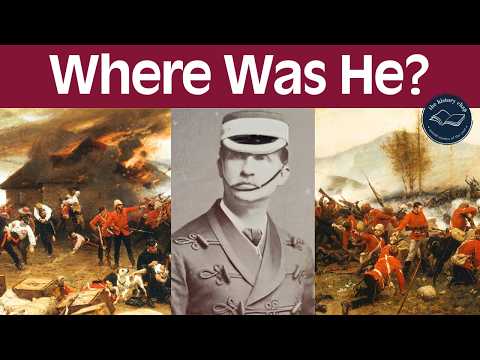
When Chard spotted the Zulu on the heights above Isandlwana, he mounted his horse and returned to Rorke’s Drift, expecting an imminent attack. But none came. What Chard didn’t realize was that the Zulu weren’t heading for the drift—they were turning to assault the camp itself. By the end of that afternoon, over 1,500 British and colonial soldiers would be dead.
Earlier that day, Chard had crossed the river to find Spalding, the senior officer at the mission station. If you’re wondering where Spalding is in the film *Zulu*, the answer is simple: he isn’t. And here’s why.
Spalding was the central column’s deputy assistant adjutant and quartermaster general—in other words, he was in charge of supplies for the column advancing into Zululand. That’s why he was at Rorke’s Drift, where the mission station served as a supply depot and hospital. Food, equipment, and ammunition were stored there for the advance. It was also why Chard was there: he had been ordered to supervise the construction of pontoon bridges across the river into Zululand.
The bridges were to be built by a company of the 1st Battalion, 24th Foot, which had not yet advanced despite orders from Helpmekaar, about 10 miles down the road in British Natal. Spalding shared Chard’s concern that the Zulu might attack the drift, cutting off supplies to the column. At the time, the mission station was protected by another company of the 24th—B Company, 2nd Battalion, under Lieutenant Gonville Bromhead. Spalding had already taken a sergeant and six men to guard the crossing, but he agreed with Chard that this small force could not repel a determined attack.
So Major Henry Spalding decided to ride his horse 10 miles to Helpmekaar to urge the relief column to advance. It was 2 p.m. Before he left, Spalding asked Chard who was senior between the engineer and Lieutenant Bromhead. Chard had no idea, so Spalding consulted the army list and announced: “I see you are senior, so you will be in charge.” Before completing his immortal sentence, “Although I won’t do anything of course, and I’ll be back again this evening, early.” Then he rode off.
Some argue this was either a dereliction of duty or an act of cowardice. Why, for instance, didn’t Chard—since the engineer couldn’t build the pontoon bridges without the company 10 miles away—go himself? On the other hand, Spalding was responsible for supplies. The bridges were part of that supply line, and the missing company was disrupting the operation, especially with Lord Chelmsford about to engage the Zulu. He needed as much of his supply train at the front as possible. Since the company they were waiting for was commanded by a captain, perhaps Spalding felt his rank as major was needed to get them moving.
And it wasn’t as if the men left at Rorke’s Drift watched him disappear in absolute terror. Apart from Chard, who was watching Zulu maneuvers north at Isandlwana, no one saw anything on his ride back to camp. Despite the sound of artillery in the distance, no one seemed particularly worried. In fact, to reinforce the calm at the mission station, Lieutenant Bromhead sat down to a quiet lunch with Assistant Commissary James Dalton, while Chard returned to his tent by the river to write some letters.
But as Spalding approached Helpmekaar, everything changed. It was about 3:30 p.m., and he was still far from his destination when he was delighted to meet not one but two companies of the 1st Battalion, 24th Foot, finally on the move. His joy was short-lived. These two companies were responding to shocking news that had reached Helpmekaar: the British camp at Isandlwana had fallen. They were marching to reinforce Rorke’s Drift. Spalding joined them, turning back toward the station.
At almost the same time, at the pontoon bridges, Lieutenant Chard had finished his letter and saw two men on horseback on the Zulu side of the river. They told him the camp at Isandlwana had fallen. By the time Chard reached the mission station, Lieutenant Bromhead and Dalton had already begun building barricades. Meanwhile, Spalding was riding ahead of the two marching companies to support Rorke’s Drift.
With a man named Dickson from the local Buffalo Border Guard, he encountered a group of fugitives—African civilians at first—who all told him two things: Isandlwana had fallen, and Rorke’s Drift had fallen too. Now, while the civilians’ accounts were alarming, what truly panicked him was the appearance of mounted troops among the fugitives, telling him the exact same thing.
In one account, Spalding claimed he ordered some fleeing soldiers to rally behind the two companies of the 24th returning toward the enemy. He also claimed in a later report that all these men obeyed the order except two. As darkness fell, Spalding and Dickson saw flames in the sky above Rorke’s Drift. It was the hospital burning, but Spalding took it as confirmation that the mission station had indeed fallen.
Then, in the last light of day, he met the Zulu. They were spread along the road leading to the mission station, about two miles from Rorke’s Drift. Behind them, Spalding saw the Donga, a dry riverbed he believed might contain more enemy lurking. Then the Zulu began to spread out, forming their famous “buffalo horns” attack formation. The two men were about a mile ahead of the infantry companies. As the Zulu moved to surround Spalding and Dickson, they spurred their horses and rode back down the road.
When they reached the companies, they climbed to high ground to assess the situation. The Zulu seemed to have disappeared, but on the horizon, flames were rising above Rorke’s Drift.
Let’s pause for a moment. With news spreading of the British defeat at Isandlwana, the fall of Rorke’s Drift, and having faced the Zulu yourself, with night falling—what would you do?
Spalding decided the best course of action was to retreat to Helpmekaar and try to save at least the supplies there. The exhausted and tense column marched back to the supply depot around 9 p.m., where they helped build a defensive fortification under the command of a colonel of the Royal Engineers.
Meanwhile, at Rorke’s Drift, the 139 defenders were fighting for their lives against 4,000 Zulu warriors.
Some of the survivors later claimed they had actually glimpsed British soldiers from the possible relief column in the distance, but the figures vanished suddenly. If true, it must have been a crushing psychological blow for the defenders. Curiously, though, Chard never mentioned them in his later report.
On the morning of January 23, Spalding and the garrison at Helpmekaar found themselves wrapped in a thick fog. The men strained their eyes and ears for any sight or sound of the enemy, who had to be somewhere out there. Then, suddenly, the sound of galloping hooves broke through the gloom, and a European rider cut his way through the darkness.
He carried a message from Lieutenant Chard: the mission station was still standing.
Spalding mounted his horse at once and rode off with a small escort of cavalry toward Rorke’s Drift. Along the way, they met another rider—a man named Flynn from Lord Chelmsford’s column. He brought them news that only half the column had survived. Spalding’s forces at Isandlwana had been annihilated. Chelmsford, with the remnants of his troops, was retreating back to Natal, and they had just relieved the garrison at Rorke’s Drift.
Spalding now rode on to Rorke’s Drift—a place far removed from the mission station he had left the day before—and presented his report to Lord Chelmsford.
The Battle of Rorke’s Drift is regarded as one of the great David-and-Goliath engagements. One hundred thirty-nine British soldiers defended their ground against 4,000 Zulu warriors for roughly twelve hours through the night. The battle was immortalized in the film Zulu, and eleven of the defenders received the Victoria Cross. Had Spalding stayed, he might well have been among those honored.
But he didn’t stay. And he wasn’t.
It was a somewhat awkward end to a long military career. Henry Spalding was born on September 27, 1840, the second son of Eliza and Thomas Spalding. Thomas managed the family firm of Spalding and Hodge, one of London’s oldest and largest paper and stationery suppliers at the time.
Henry joined the army as an ensign—the lowest officer rank—in early 1858, when he was seventeen, and he soon saw combat during the Indian Mutiny. He was present with the army that crossed the Ganges during the final advance to capture Lucknow, and he was part of the garrison in the captured city of Sultanpur. His first posting appears to have been with the 53rd Regiment of Foot, which later became the Shropshire Regiment. That is certainly the regiment whose name appears on the Indian Mutiny Medal he received. But he soon transferred to the 104th Regiment of Foot.
This was an interesting regiment, formed in 1858 when the European regiments of the East India Company—specifically the 2nd Bengal European Fusiliers—were transferred to the regular British Army. I’ve told the story of that transfer, and how some of the men mutinied, in an earlier episode. The 104th later became the Royal Munster Fusiliers, which was in turn disbanded when the Irish Free State was formed in 1922.
Spalding remained with the 104th for the rest of his military career. He was promoted to captain and graduated from the Staff College in December 1869. He was seen as a promising officer. At some point in the 1870s, he was posted to the British Embassy in St. Petersburg. There, perhaps unsurprisingly, he learned Russian to a very high standard.
In 1874, he published a book titled Khiva and Turkestan, and he became a fellow of the Royal Geographical Society. The book—written by a Russian-speaking British officer within a year of Russia’s conquest of those ancient khanates—suggests that Henry Spalding was not merely a military attaché but was deeply interested in the Great Game being played between the two empires in Central Asia.
In January 1879, he returned to the field, joining Lord Chelmsford’s central column with the honorary rank of major during the invasion of Zululand. As deputy assistant adjutant and quartermaster general, he was responsible for the column’s supply chain, keeping lines of communication open, and ensuring supplies reached the main force in enemy territory.
Most importantly, as a member of Chelmsford’s headquarters staff—despite being the senior officer present at Rorke’s Drift on January 22—he was not officially the commander of the mission station.
To this day, the reason for his departure to the supply depot at that moment, and why he did not advance with the two companies of the 24th when they saw the smoke rising from Rorke’s Drift, remains a matter of debate. What is certain is that Spalding submitted an official report explaining his actions on January 22, and while some might see it as a justification of his position, senior officers were expected to write reports of their actions.
His name was mentioned in official reports later in the war, and he served as a commander at the funeral of the Imperial Prince. So his absence from the Battle of Rorke’s Drift does not appear to have been a great stain on his career. But it was certainly a tremendous missed opportunity. Had he stayed, he would have—like Chard—received the Victoria Cross as the senior officer present at the battle.
He retired at the end of the following year after twenty-two years of service, at the age of forty, with the honorary rank of lieutenant colonel. He then revived his interest in the Russian language. In 1881, he published the first English translation of Pushkin’s novel Eugene Onegin. It is said that the greatest living Russian writer of the time, Ivan Turgenev, described it as remarkably faithful, and it remained the only complete English translation for the next fifty years.
Henry Spalding died in 1907 in London from a tumor. He was sixty-six years old. His body was cremated, and his ashes were buried in his wife’s grave in Brookwood Cemetery in Surrey.
Rorke’s Drift—the battle he wasn’t there for—was the moment with destiny that passed him by.
Now, would you like to know more about the Anglo-Zulu War? You know—why it broke out, the battles, what happened in the end, and what happened afterward? Well, I intend to put together a short course covering the war from beginning to end, all in one place. So if you’re interested, click the link in the description below, and I’ll let you know when it’s released. Thank you for joining me today. Stay well, and I’ll see you soon.
So there it is. Henry Spalding rode into history’s blind spot—not as a coward, but as a quartermaster doing his job. He missed the Victoria Cross by ten miles and a few hours. Instead, he gave the world Pushkin in English and a textbook lesson in how duty and destiny rarely align.
Chard got the film. Bromhead got the glory. Spalding got a footnote and a Russian translation that Turgenev himself praised.
Maybe that’s the real story: history remembers the men who stayed—but it’s built by the ones who rode away to do something else.
So, what do you think? Was Spalding a scapegoat, a pragmatist, or just a man in the wrong place at the right time? Drop your verdict in the comments below.
Report this article
Select a reason for reporting:






