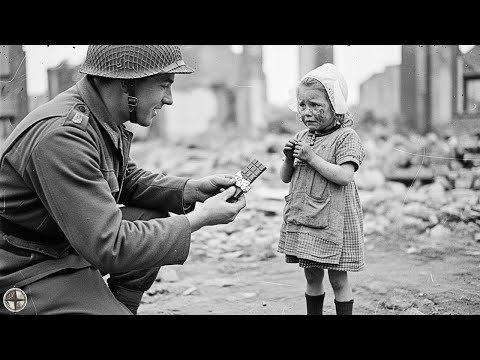
The morning of May 5, 1945, was eerily quiet in the small Dutch town of Wageningen. American trucks rolled slowly down broken streets, their engines growling through the cold air. The soldiers expected cheers, waving flags, smiling faces. Instead, they found silence—and thin children standing in wooden shoes, too weak to move.
One soldier stepped down, opened a box, and pulled out a chocolate bar. He handed it to a little girl. She didn’t eat it. She just stared at it, then began to cry. That moment said everything: the war was over, but hunger was not.
The soldier knelt, offering the chocolate with both hands. The girl took it gently, as if it might break. Then her shoulders shook, and the sound of her crying filled the quiet street. Behind her, more children appeared—pale, hollow-eyed, silent. A mother whispered, “We thought we were forgotten.”
One soldier later wrote, “I had seen death in battle, but I never saw pain like hunger.” Before that day, they had fought to defeat an enemy. Now they were fighting a different battle—against starvation, against despair. And this fight needed no guns, only food and compassion.
That first piece of chocolate started something larger. Soldiers opened more boxes, sharing rations—soup, crackers, powdered milk. The Dutch, too weak to thank them properly, simply cried or held their hands. Victory, they realized, could come through kindness.
As the Americans moved deeper into the Dutch towns, they began to understand the full scope of the tragedy. Streets were quiet, houses dark, animals gone. “It was like walking into a ghost village,” one soldier wrote. Families had not eaten a real meal in months. Children’s bellies were swollen from hunger; some could not lift their heads.
Inside homes, the smells were of sickness and smoke. Tables were bare except for cups of water or tiny pieces of dried potato. Many had burned their furniture to keep warm. The soldiers gave away everything they had—cans of beans, army biscuits. Children lined up in silence, too weak to fight or rush. One American noticed how carefully they chewed each bite, as if afraid it might disappear.
Doctors later counted more than 20,000 dead from hunger during the Dutch Hunger Winter. In Amsterdam, the average person had survived on only 4,500 calories a day—less than a small sandwich. Some boiled tulip bulbs; others mixed weeds into soup. And still, the Dutch said thank you. “They hadn’t eaten properly in weeks, but they still said thank you,” a soldier recalled.
That night, a few soldiers built a small kitchen near the town square. They boiled water and cooked soup in metal pots. The smell spread through the streets—warm, rich, full of life. People followed the scent like a promise. For the first time in months, they would eat a real meal. Parents helped their children sip the soup. Some smiled through tears. “This is the taste of peace,” one woman whispered.
But the soldiers still wondered: How could a country full of farms and canals end up starving? The answer lay not in this town, but in what had happened months before, when the war had trapped the Netherlands in a cruel blockade that turned bread into a weapon.
To understand the hunger, we must go back to the autumn of 1944. The Allies had freed southern Holland after Operation Market Garden, but the North—including Amsterdam, Rotterdam, and The Hague—remained under German control. The people believed freedom was close. Then the Dutch railway workers went on strike to help the Allies, stopping trains so German troops couldn’t move supplies. The Germans answered with revenge: they blocked all food, fuel, and medicine from entering the western Netherlands. Barges were stopped, trains locked, trucks banned. It was the start of the Hunger Winter.
At first, people survived on thinner slices of bread, shared potatoes, dried peas. But as weeks passed, nothing was left. The cold came early; by December, the canals froze solid. Cities were trapped—no food in, no escape out. German soldiers took most of the crops. Farmers had almost nothing left. People ate tulip bulbs, sugar beets, animal feed, even wallpaper paste. Some boiled grass or made soup from flower petals. In Amsterdam, they broke apart fences and furniture for warmth. “The sound of chopping wood is everywhere,” one man wrote in his diary. “We burn our memories to survive.”
By January 1945, the average adult weighed only 95 pounds. The daily ration had dropped to 400 calories—about one small chocolate bar. Children fainted in school. Hospitals ran out of medicine. Still, the people tried to stay strong. Teachers kept schools open; churches shared whatever food they found. The Dutch spirit—calm, polite, proud—refused to break. But hunger does not care about courage. Every week, more died quietly at home.
The Allies knew what was happening but could not reach the starving cities. “We could see the people starving through our binoculars, but we could not get to them,” one British officer said. The hunger was no accident. It was a weapon, a cruel punishment by the German occupiers for Dutch resistance. It was meant to break their spirit. But it did not.
By March, at least 20,000 had died from starvation and cold. Doctors believed the true number was higher. Hospitals became places of quiet suffering. Nurses wrapped starving children in blankets, trying to keep them warm. One doctor wrote, “Their bodies were so small the bones showed through the skin.” And yet people still shared what they had. Mothers took turns cooking one pot of thin soup for ten families. Strangers gave away their last piece of bread to a child.
In April, some German soldiers began to realize the Dutch were dying. Even a few felt shame. One officer secretly allowed farmers to bring food into towns, breaking orders. It was small, but it saved lives. Then rumors spread: The Allies are coming. People were too weak to celebrate, but hope returned.
The Allies faced a terrible choice: move fast to end the war or stop to help the starving civilians first. And so they made a decision never tried before—to drop food from the sky over enemy territory. The mission had one goal: feed the Netherlands before it was too late.
At the end of April 1945, the Dutch heard a strange sound: the deep hum of airplane engines. For months, that sound had meant danger. But this time, children ran outside pointing at the sky. Huge silver planes flew low—American and British bombers with white stars on their sides. Instead of bombs, brown sacks and metal containers fell gently by parachute. When they hit the ground, people rushed toward them. The sacks burst open, spilling flour, sugar, and tins of food. Food was falling from the sky.
This was Operation Manna and Operation Chowhound. Between April 29 and May 8, 1945, more than 11,000 tons of food were dropped by British and American planes. The Germans agreed to a temporary truce, promising not to fire. Even some German soldiers stood and watched quietly as the bombers flew low and steady. One Dutch farmer said, “We waved at them with white sheets. The sky looked like heaven itself.”
Pilots aimed for open fields, racetracks, and canals so people could collect the packages safely. Inside were tins of meat, powdered milk, chocolate, biscuits, and flour. Each drop could feed thousands. One pilot later said, “We flew so low we could see people waving flags below.” For the Dutch, it was a miracle. They laughed and cried at the same time. Children danced around sacks of flour. Mothers hugged soldiers they had never met. The smell of bread began to return to kitchens after months of emptiness. In one village, a woman baked small loaves from the dropped flour and gave each child a piece: “This is freedom bread.”
For many, that first meal was more than food. It was a sign that they had survived. The war was almost over. Hope was back. In total, the food drops saved tens of thousands of lives. Historians still call it one of the greatest humanitarian missions of the war. But for the soldiers on the ground, the work was not finished. They were about to enter the towns they had helped from the sky, and there they would see the true face of hunger up close. The battlefields were quiet now, but the battle for life had only just begun.
May 5, 1945. The guns finally went silent. In towns across the western Netherlands, German soldiers laid down their weapons. The war in Europe was ending. But for the Dutch people, liberation did not begin with fireworks or loud cheers. It began with silence—the silence of exhaustion, hunger, and disbelief.
When the American and Canadian troops entered the cities, they expected celebrations, waving flags, smiling faces, maybe even music. Instead, they found streets filled with thin, pale figures. People moved slowly, their steps weak. Some were too tired to stand. Children leaned on parents who were barely stronger than they were.
Staff Sergeant William Cooper from the 101st Airborne remembered stopping his jeep near a small Dutch town. A little girl stood by the road, her dress too big for her thin body, her eyes large and hollow. Cooper knelt down and handed her a small piece of chocolate—a simple thing for a soldier, but to her it was everything. She clutched it tightly and whispered, “Thank you.” Then she began to cry. Behind her, more children came forward—dozens of them, silent, watching. The soldiers realized what starvation really looked like. “We broke open every ration box we had,” one soldier wrote. “It was all we could do.”
Soon the quiet streets turned into scenes of emotion. American soldiers gave away their rations—canned meat, biscuits, chocolate, and milk powder. Mothers fell to their knees, crying and thanking them. Some kissed the soldiers’ hands. Even the toughest men in uniform could not hold back their own tears. “We had seen combat,” said one veteran, “but nothing broke us like seeing hungry children eat again.”
Hospitals and aid centers were quickly set up. Army cooks worked day and night making soup and porridge. Doctors treated people too weak to digest normal food. Some patients were so starved that they could only take spoonfuls of broth at a time. Every meal was a slow step toward life again. In one village, a soldier wrote in his diary, “The children follow us everywhere. They smile again.” One little boy gave him a flower. “He said it was the only thing he had to give.”
For many soldiers, that small act of kindness meant more than medals or victory parades. The Dutch people slowly began to rebuild. They opened windows to let in the spring air. They cleaned streets that had been empty for months. Flags appeared again—bright orange, red, white, and blue. But this time, celebration came not from excitement, but from relief. They had survived the darkest winter of their lives.
For the Americans, it was a different kind of victory. They had come to fight an enemy, but they discovered that the greatest victory was saving lives. The bond formed between the Dutch and their liberators was not built on politics or power, but on compassion. The soldiers had brought food, but more importantly, they brought back faith—faith that kindness could still exist after so much cruelty.
And yet, as the Dutch began to eat again, and children played in the streets, a question remained: what would come next? Now that the guns were quiet, the world had to start over. The war was finally over. But peace did not come quickly. The Dutch people had survived the hunger, yet their bodies and hearts were still weak. Children who had been close to death needed months of careful care. They couldn’t eat normal food right away. Their stomachs had forgotten how.
American and Canadian doctors set up special feeding centers. Nurses gave small meals every few hours—warm milk, thin soup, soft bread. Slowly, the children began to gain weight. Their pale faces started to glow again. A doctor in Rotterdam wrote, “Some of the children smiled for the first time in months. That was when I knew they would live.”
The recovery was not only physical. The war had hurt people’s minds, too. Children had nightmares about hunger. Parents couldn’t stop worrying that food might disappear again. To help, Allied soldiers and Dutch teachers opened schools and started games for the children. Soldiers played baseball with Dutch boys in the fields. Girls sang songs they had learned from the Americans. For the first time in years, the sound of laughter returned to the towns. One Dutch woman said, “The soldiers didn’t just bring food. They brought life back to our children.”
As the months passed, something beautiful happened. The Dutch began to rebuild their cities. Bridges were repaired, farms planted again, shops reopened. But the memory of that terrible winter never left them. Families kept diaries, drawings, and letters from those months as reminders of what they had endured and who had helped them survive.
The Americans, too, carried the memories home. Many wrote to their families about what they had seen. One young soldier wrote, “We fought a war to end evil. But the day I gave a starving child a piece of chocolate, that was the day I truly understood why we fought.” The bond between the Netherlands and the United States grew stronger because of those moments. To this day, the Dutch people still honor the Allied soldiers who saved them. Each year, during memorial events, children place flowers on the graves of the men who brought them hope.
The Hunger Winter became more than just a story of suffering. It became a lesson in compassion. It showed what happens when ordinary people choose kindness over cruelty, when soldiers choose mercy over orders. For the Dutch children who survived, that kindness changed everything. They grew up in peace, had families of their own, and told their children about the strangers who came with food from the sky.
And for the Americans who helped them, it was a reminder that true victory is not just about winning wars. It’s about saving lives. They had come as soldiers, but they left as heroes in the hearts of the Dutch people. In the end, America’s greatest weapon wasn’t its bombs or guns. It was its humanity. Because when the world was starving, they fed it. When hope was gone, they gave it back. And in doing so, they proved that mercy could defeat even the darkest hunger.
Decades later, in a quiet Dutch classroom, an old woman holds up a faded chocolate wrapper. “This saved my life,” she tells the children. “Not the chocolate—the hand that gave it.”
The children lean forward, eyes wide. Outside, the same fields where flour once drifted from the sky are green again. The planes are gone, the soldiers too. But the story remains.
One girl raises her hand. “Did they ever come back?” The old woman smiles. “Every spring,” she says. “In the flowers we leave on their graves.”
And so the lesson passes on—that mercy, once given, never truly ends.
What small act of kindness from your own life still echoes in someone else’s memory today?
Report this article
Select a reason for reporting:






