Seventeen rabbits. That’s what Queen Anne kept in her bedchamber—or so The Favourite would have you believe. In the film’s opening scene, the frail monarch asks her confidante, Lady Sarah, to say hello to her beloved bunnies, a bizarre menagerie that stands in for the 17 children she lost. It’s a haunting image, one that sets the tone for a story of grief, power, and betrayal. But did the real Queen Anne really share her palace with a hutch of hopping stand-ins for her dead children? The answer, like so much in this Oscar-winning drama, is a blend of fact and fiction.
The film’s historical consultant, Hannah Greig, has admitted that the rabbit scene is pure invention. “Pet rabbits would never have been found lolloping around a royal bedchamber,” she stated. In the 18th century, rabbits were food and pests, not pampered pets. Yet the emotional truth remains: Anne did tragically lose all 17 of her children. Twelve died through miscarriage or stillbirth, four perished before their second birthday, and her only surviving son, Prince William, died at age 11 in 1711. The rabbits may be fictional, but the heartbreak they represent is devastatingly real.
From the bedchamber, the film moves to a grand gesture: Queen Anne gifts Lady Sarah and her husband, John Churchill, a palace. This, too, is rooted in history. Blenheim Palace was indeed a reward for Churchill’s military victories during the War of the Spanish Succession. The land was a gift from the Crown, and the Queen offered financial support for its construction. But the film also captures the later fallout: Anne eventually rescinded the funding, just as Lady Sarah and her husband voluntarily exiled themselves from Britain. And yes, that last name is significant—Winston Churchill was born at Blenheim, and Lady Sarah is an ancestor of Princess Diana.
But the film’s most dramatic license comes with the arrival of Abigail Hill, played by Emma Stone. In reality, Abigail was Lady Sarah’s cousin, her family bankrupted by her father’s gambling. Sarah helped her secure a position in the Queen’s service, likely out of embarrassment rather than kindness. The lewd carriage scene? Entirely fictional, designed to set up the film’s cynical view of men. “Have you come to seduce me or rape me?” Abigail asks Samuel Masham later in the film, to which he replies, “I’m a gentleman.” “So raped, then,” she shoots back. Such dialogue is pure invention, a modern lens on 18th-century gender dynamics.
Lady Sarah, in reality, was a force of nature. As Mistress of the Robes, Keeper of the Privy Purse, and Groom of the Stole, she controlled Anne’s finances, her circle of friends, and much of her life. The film accurately portrays her brutal honesty and the Queen’s dependence on her. Anne, shy and uneducated, found spontaneous conversation a challenge; Sarah was intelligent and outspoken. Yet Sarah largely used the friendship for personal gain, once remarking that she’d rather be in a dungeon than in a conversation with the tedious Queen.
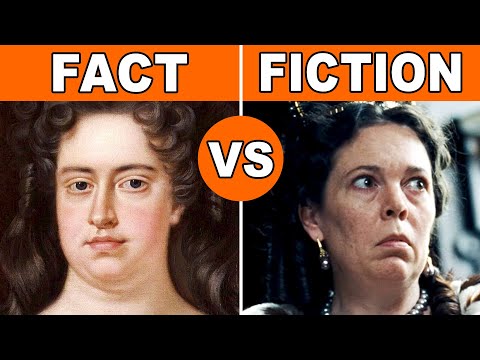
What the film captures brilliantly is Anne’s battle with gout—a painful form of arthritis that can make even the weight of a sheet unbearable. The real Anne was also much heavier than Olivia Colman’s portrayal and suffered from an eye condition that caused excessive watering. These details are omitted, but the essence of her physical suffering remains. The costumes? Another departure. Designer Sandy Powell’s vivid African-inspired prints and recycled denim are hardly period-accurate, but they serve the film’s modern sensibility.
The political rift between Anne and Sarah is grounded in truth. Sarah was a Whig, advocating for the war and supporting her husband’s military campaigns. Anne leaned Tory, backing the Anglican Church and the landed gentry. This clash, combined with Sarah’s frequent absences from court, strained their bond. Enter Abigail, whose flattering demeanor contrasted sharply with Sarah’s bluntness. Sarah saw Abigail’s kindness as manipulation, and she wasn’t entirely wrong—Abigail did encourage the Queen’s Tory sympathies, threatening the Whig agenda.
But the film’s central question—did a love triangle exist?—is where history and Hollywood diverge most dramatically. Most historians reject the idea that Anne had sexual relationships with either Sarah or Abigail. The film’s premise is likely fiction, heightened by scenes of men as chauvinistic pigs and the omission of Anne’s husband, Prince George, who was alive for years after Abigail’s arrival. Anne was devoted to George, shared his bed, and bore 17 pregnancies—hardly the profile of a woman carrying on extramarital affairs.
The rumored lesbian relationship between Anne and Abigail originated from a scurrilous poem circulated by Sarah and Whig propagandist Arthur Mainwaring. It suggested “a dirty chambermaid” had pierced the royal heart, hoping to force Anne to cut ties with Abigail. When that failed, Sarah threatened to expose Anne’s letters, which included lines like “I hope I shall get a moment or two to be with my dear… I can’t go to bed without seeing you.” Today, such words might seem romantic, but in the early 1700s, deeply affectionate language between female friends—so-called “romantic friendships”—was common. The film invents a line about longing for “the heat of your naked body on mine,” which appears nowhere in the historical record.
So what became of them? Sarah and her husband left England after the Queen dismissed him on trumped-up charges. Abigail replaced Sarah as Keeper of the Privy Purse, and funding for Blenheim was halted. Sarah mourned her lost position but returned to England on the very afternoon of Anne’s death in 1714. Under King George, she found favor again—until her fiery disposition caused another falling out. Abigail, meanwhile, lost her court position, retired to a country manor with Samuel, and lived there until her death in 1734.
The Favourite is a masterpiece of emotional truth, but its historical accuracy is selective. The rabbits are fake, the love triangle is likely imagined, and the costumes are anachronistic. Yet the grief, the power struggles, and the betrayals—those are as real as the gout that crippled a queen.
But the story doesn’t end with Anne’s death—and neither does the fascination with her court. What the film glosses over, and what historians still debate, is the sheer political machinery that hummed beneath the personal drama. Abigail Masham wasn’t merely a chambermaid who caught the Queen’s eye; she became a conduit for Tory power, a quiet operator who understood that intimacy with the monarch translated directly into influence over the state.
Consider the mechanics of it. Anne, increasingly isolated by her health and her grief, relied on a shrinking circle of women for everything from financial decisions to political gossip. Whoever controlled access to the Queen effectively controlled the levers of government—and both Sarah and Abigail knew it. Sarah’s mistake wasn’t that she was cruel; it was that she forgot to be kind. Abigail’s genius was that she never forgot, even when she didn’t mean a word of it.
Robert Harley, the Tory politician played with such oily menace by Nicholas Hoult, understood this dynamic perfectly. The real Harley was a morose, middle-aged operator—not the sneering young schemer of the film—but his strategy was the same: cultivate Abigail, cultivate the Queen, and let the Whigs choke on their own arrogance. Abigail was Harley’s eyes and ears in the bedchamber, and she delivered.
Yet here’s the twist the film never quite explores: Abigail’s political usefulness didn’t make her happy. Biographers describe her later years as quiet, almost withdrawn. She had won the game—title, wealth, a husband, a manor house—but the court that had made her had also hollowed her out. When Anne died and the Whigs swept back into power, Abigail didn’t fight. She simply vanished into the countryside, a footnote in a story that had moved on without her.
Sarah, by contrast, never stopped fighting. Even in exile, even after the falling out with Queen Caroline, she remained ferociously herself—proud, sharp-tongued, and utterly unrepentant. She outlived Anne by thirty years, writing memoirs and letters that carefully curated her own legend. She wanted history to remember her as the wronged friend, the honest counselor cast aside for a flatterer. And to a remarkable degree, she succeeded.
The film’s final image—Abigail kneeling beside the Queen, the rabbits hopping softly in the background—is a fiction, but it captures something true. Power in Anne’s court was never about armies or parliaments. It was about who could sit closest to a grieving woman and make her feel, for a moment, less alone. Sarah forgot that. Abigail never did. And that, more than any love triangle, is the real story of The Favourite.
So where does that leave us with the film’s most provocative claim? The love triangle, as presented, is almost certainly a fiction—a dramatic device stitched together from a scurrilous poem, a few affectionate letters, and a modern appetite for scandal. But the emotions that fueled it were real: jealousy, ambition, grief, and the desperate need to be needed. Anne didn’t need lovers; she needed someone who would stay.
And that’s the quiet tragedy the film circles without ever quite landing. Sarah stayed for decades but couldn’t hide her contempt. Abigail stayed for advantage and never pretended otherwise. Neither woman loved Anne the way Anne loved them—or at least, not in any way history can prove. What we’re left with is a queen who lost seventeen children, a friend who wielded honesty like a blade, and a chambermaid who turned flattery into a career.
The rabbits were never real. The costumes were never accurate. The love triangle was never documented. But the loneliness? That was as real as the gout that twisted Anne’s joints and the crown that sat heavy on her head. History doesn’t give us a neat ending, and neither does The Favourite—just three women, a palace full of whispers, and a question that will never be fully answered.
So here’s what I want to know: if you were in Anne’s bedchamber, would you be the friend who tells the truth, the maid who tells her what she wants to hear, or the queen who just wants someone to stay? Drop your answer in the comments—I read every single one.
Report this article
Select a reason for reporting:






