In the frozen predawn of December 16, 1944, the Ardennes Forest erupted. A deafening artillery barrage shattered the silence, and Lieutenant Lyle Bouck, just 20 years old, knew this was no ordinary attack. “This isn’t just some spoiling fire,” he thought. “This is something much bigger.” His small platoon of 22 men—the Intelligence and Reconnaissance Platoon of the 394th Infantry Regiment—was about to face the spearhead of Hitler’s last great gamble: Operation Wacht am Rhein.
Bouck’s men were handpicked: intelligent, observant, deadly with a rifle. But they were also cold, exhausted, and vastly outnumbered. Their mission was simple: hold the crossroads above the village of Lanzerath at all costs. That road was the key to the German advance—a fast route west for armor and vehicles. If it fell, the enemy could drive deep into Allied lines.
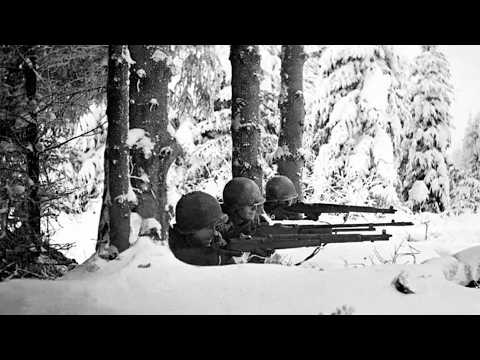
As the shelling lifted, the first Germans appeared. A company of Fallschirmjäger—elite paratroopers—advanced in a skirmish line. The Americans held their fire until the enemy reached the barbed wire fence. Then, all hell broke loose. “We just fired on them,” Bouck recalled. “It was kind of like a manslaughter.” For eight minutes, the platoon poured rifle and machine-gun fire into the attackers. Dozens fell; the survivors retreated.
But the Germans came again. And again. Each time, the Iron Men cut them down. The jeep-mounted .50 caliber machine gun tore through the advancing ranks. Private Milosevic, a crack shot, picked off a medic who was suspiciously talking into a radio. The snow was stained red with enemy blood, but the platoon’s ammunition was running low, and their communications were gone.
By late afternoon, Bouck had lost several men wounded, including Private Khalil, whose face was lacerated by a rifle grenade that failed to explode. With over 1,000 enemy infantry massing for another assault, Bouck resolved to hold out until dusk, then retreat. He sent two men for withdrawal orders. Neither made it back.
As the sun set, a sudden attack burst from their exposed flank. Germans swarmed the foxholes. Bouck fired until a gun barrel appeared at his hole. He pushed Private Sakanikis aside, but the bullet struck Sak in the face. Moments later, the firing stopped. Bouck was a prisoner. “I thought about my Aunt Mildred,” he later said. “She told me if I lived to be 21, I’d have a long life. I had a few hours to go.”
The platoon had held for over 12 hours, inflicting some 130 casualties and delaying the German timetable. But the story of their stand was largely forgotten—until decades later. In 1981, they received the Presidential Unit Citation, making them the most highly decorated American platoon of World War II.
Yet the battle was not over. The delay at Lanzerath would have far-reaching consequences for Kampfgruppe Peiper, the ruthless Panzer commander racing toward the Meuse. And for the 22 men who survived, a long, brutal journey into captivity was just beginning.
Obersturmbannführer Joachim Peiper received the news with cold fury. His armored column—the spearhead of the 6th SS Panzer Army—had been idling for hours, engines rumbling, fuel burning, while a handful of Americans on a wooded ridge refused to break. “A platoon? You were stopped by a platoon?” he reportedly snapped at the infantry commanders. The timetable that Hitler himself had insisted upon was already bleeding precious hours.
Peiper’s tanks—massive King Tigers and Panther mediums—could not simply bypass Lanzerath. The crossroads to the north was the only road wide enough to carry his armored weight, and the Americans had made it a killing ground. Every minute of delay tightened the noose around the offensive, for Allied reinforcements were already beginning to stir in the west.
When the remnants of the I&R platoon were marched into the village that evening, they passed the towering silhouettes of German armor waiting in the darkness. Private Sakanikis, his face bloodied and bandaged, stumbled alongside Lieutenant Bouck. The young lieutenant caught the eye of a German officer who stared at the battered prisoners with disbelief. “Where are the rest of your men?” the officer asked through an interpreter. “This is all of us,” Bouck replied. The German shook his head—he had been certain he was facing a full battalion.
That moment of disbelief would echo through the entire Ardennes campaign. The delay at Lanzerath forced Peiper to reroute his armor through narrow, muddy forest tracks. Fuel ran low. Bridges were blown before his tanks could reach them. The race to the Meuse—the very heart of Hitler’s plan—began to unravel, one hour at a time.
For the men of the I&R Platoon, however, the war was over. They were herded into trucks and driven east, deeper into Germany. The journey would take them through freezing rail cars, crowded prison camps, and brutal interrogations. Bouck, still just twenty years old, kept his men close, whispering words of encouragement when the guards were not listening. “We held the line,” he told them. “No matter what happens now, remember that.”
Back on the ridge above Lanzerath, the snow continued to fall, slowly covering the foxholes and the bodies left behind. The barbed wire fence that had marked the high tide of the German assault stood silent in the darkness. And somewhere to the west, the first American reinforcements were moving toward the sound of the guns—thanks, in part, to twenty-two men who had refused to break.
The trucks carrying the prisoners eastward rattled through the frozen night, and Bouck counted the men in his care by the sound of their breathing. Fourteen wounded, one dead, and the rest of the platoon scattered across the German rear. He had no idea whether the two runners he’d sent for withdrawal orders were alive or dead, only that they had vanished into the chaos of the Ardennes.
The journey to the rear was a blur of cold and confusion. German military police herded the prisoners past columns of tanks and half-tracks, all pointed west, all burning precious fuel as they waited for the roads ahead to clear. Bouck watched them pass and felt a grim satisfaction. Every hour they sit here is an hour the Allies gain.
At a makeshift collection point near the town of Prüm, the platoon was separated. Officers were pulled aside for interrogation, while the enlisted men were packed into a barn already crowded with American prisoners. Private Khalil, his face swollen and bandaged, slumped against a wall. Sakanikis sat beside him, one eye covered, the other staring at nothing.
It was there that Bouck learned the full measure of what they had done. A captured American officer from another unit, a major who had been taken two days earlier, listened to the young lieutenant’s account of the fight on the ridge. When Bouck finished, the major was silent for a long moment. “You held a crossroads against a regiment for twelve hours with twenty-two men?” he asked. “You know what that means, don’t you?”
Bouck shook his head. He was twenty years old, exhausted, and still had a few hours to go before his twenty-first birthday. The major leaned closer. “It means Peiper is behind schedule. It means the whole German timetable is coming apart. You may have just saved the entire damn front.”
The words did not feel real. Bouck thought of the snow on the ridge, the bodies at the fence, the faces of his men as they were led away. He thought of Billy Queen, who would never go home. “We were just doing our job,” he said quietly. “We didn’t know we were saving anything. We just knew we couldn’t run.”
Outside the barn, the German guards were growing nervous. Word was spreading that American reinforcements were massing to the west, that the great offensive was already slowing. The guards barked at the prisoners to move, and the men of the I&R Platoon were herded back onto trucks for the long journey deeper into the Reich. But as the trucks pulled away, Bouck looked back at the road behind them, and for the first time since the guns had opened, he allowed himself to believe that the sacrifice had meant something.
The weeks that followed blurred into a haze of hunger, cold, and uncertainty. Bouck and his men were shuttled between camps, their names logged and their futures suspended. Yet even in captivity, the platoon’s spirit held. “We kept each other alive,” one survivor later recalled. “That’s what the I&R did. We looked after our own.”
News of the war filtered through in fragments—rumors of a German collapse, of American armies surging back across the Rhine. Bouck listened and said little. He had done his part on a snowy ridge in Belgium, and now survival was its own kind of battle.
When liberation finally came in the spring of 1945, the men of the 394th I&R Platoon emerged from the camps gaunt and weary, but alive. They returned to families who had feared them dead, to towns that had moved on without them. Most never spoke of Lanzerath. The war was over, and the future demanded their attention.
Decades passed. The young lieutenant became an older man, and the ridge above Lanzerath grew over with trees and time. It was not until historians began to sift through the records of that desperate December that the full story emerged. The platoon had held for over twelve hours against overwhelming odds, inflicting casualties and—most crucially—delaying the German timetable.
In 1981, the recognition finally came. The Presidential Unit Citation. The Distinguished Service Cross for Bouck and three others. Silver Stars and Bronze Stars for the rest. The most highly decorated American platoon for a single action in all of World War II.
Bouck accepted the honors with characteristic humility. “We were just soldiers doing our duty,” he said. “The real heroes are the ones who didn’t come home.” Among them, Private Billy Queen, who fell at his foxhole on the ridge and never saw the victory he helped make possible.
The snows of the Ardennes have long since melted, and the foxholes have faded into the earth. But the story of twenty-two men who refused to break—who held a crossroads against an army and bought precious hours for the Allies—remains a testament to courage in its purest form.
What would you have done, facing a thousand enemies with only a handful of comrades and a few rounds left? Would you have held the line—or would you have run?
Report this article
Select a reason for reporting:






