Imagine a world where a fermented fish sauce so pungent it could clear a room was the ultimate status symbol. Where dinner wasn’t just a meal—it was a political battlefield. In ancient Rome, the dining table was where alliances were forged, reputations made, and fortunes lost. And at the center of it all? A bowl of garum, the infamous fish sauce that flavored everything from humble porridge to extravagant feasts.
But this isn’t just a story about food. It’s about power, ambition, and the lengths one man would go to climb the social ladder. Meet Marcus Gavius Apicius, a notorious gourmand whose name became synonymous with excess. His cookbook, a collection of recipes and dubious tricks, is our window into a world where culinary ingenuity and social climbing went hand in hand.
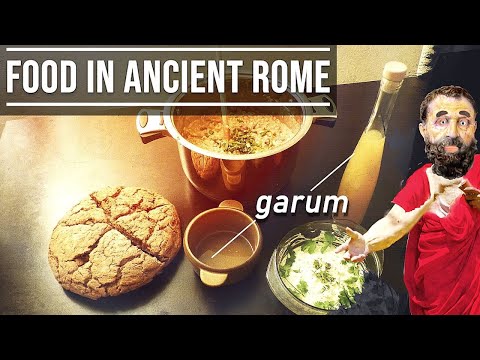
Apicius was a man who understood one thing: in Rome, you are what you eat. And if you wanted to impress, you couldn’t just serve any old porridge. You needed flair. You needed exotic ingredients. You needed to deviate from the Mediterranean triad of grains, olives, and grapes—the staples that graced every table, from slave to senator.
So he turned to fish. Not just any fish, but the lowly, oily ones that most would discard. Fermented with salt and herbs, left to rot for weeks, they transformed into garum—a sauce so potent it was used in almost every recipe. “It is the ketchup of the ancient world,” classicists say, but its production was anything but mundane. Fish remains, blood, even testes went into the mix, creating a condiment that was both a flavor bomb and a test of endurance.
But garum was just the beginning. Apicius knew that to truly impress, he had to offer something more. Something that spoke of wealth and connections. And so, he would have served puls—the ancient Roman porridge—but not as the common folk ate it. No, his version would be enriched with chopped vegetables, bits of meat, herbs, and cheese, a dish that modern aficionados compare to risotto. “Puls was considered the aboriginal food of the Romans,” involved in religious rites and a staple throughout history.
Then there was the bread—emmer bread with its nutty flavor, refined with olives and figs. And moretum, a spread of sheep cheese, garlic, and herbs, pounded into a paste that would have been slathered on fresh bread. The aromas alone would have been enough to make a guest’s mouth water.
But the pièce de résistance? The wine. Not the watered-down posca that the lower classes drank, but strong, undiluted wine, sometimes spiced with honey or herbs. The Romans even had recipes to turn red wine white—a process that involved egg whites and a good shake, though as we’ll see, it didn’t always work as planned.
Yet for all his culinary showmanship, Apicius’s motives were far from pure. Dining was a social function, a way to see and be seen. “Many scholars considered the ancient Romans a face-to-face society,” where politics and social mobility were negotiated over dinner. And Apicius, with his notorious reputation as a wastrel, used his table to lure others into collaborations, to prove his worth, to climb higher.
But would it be enough? In a world where appearances were everything, one misstep could ruin a man. And Apicius, with his dubious tricks—like mixing bad honey with good and selling it—was always skating on thin ice. His story is a reminder that in ancient Rome, the dinner table was a stage, and every course was a performance. But the curtain was about to rise on a feast that would test even his limits.
The guest that evening was none other than a young senator named Lucius, a man whose vote on a grain tariff could make or break Apicius’s fortunes. Lucius arrived late—fashionably so—and eyed the dining room with the cold appraisal of a man who had seen every luxury Rome could offer.
Apicius had prepared carefully. The first course, the gustatio, was a triumph of illusion: dormice fattened on walnuts and glazed in honey, arranged to look as though they were sleeping in a bed of rose petals. Lucius raised an eyebrow, which Apicius took as a good sign.
But the senator barely touched his food. He spoke instead of the provinces, of shipments delayed, of men who promised more than they could deliver. Apicius felt the cold weight of judgment settle over the table. The garum, so carefully fermented, suddenly seemed too sharp, too common.
Then came the moment Apicius had gambled everything on. A whole roasted boar was carried in, its hide split open to release a flock of live thrushes that fluttered up toward the ceiling. The guests gasped. Lucius, for the first time, smiled.
“You are a man of spectacle, Apicius,” he said, wiping his fingers on the linen. “But spectacle fades. What endures is substance.”
Apicius leaned forward, his voice low. He spoke not of recipes but of snow cellars—of ice carried down from the mountains, of wine chilled in the heat of summer, of a network of suppliers who could keep such luxuries flowing year-round. “Substance, Lucius, is knowing where the ice comes from before the summer does.”
The senator’s expression shifted. He set down his cup. For a long moment, the only sound was the crackle of the oil lamps and the distant flutter of the thrushes settling on the rafters.
Apicius pressed his advantage. He described the mustard trick—pork packed in a paste of salt, vinegar, and honey, preserved for months. He spoke of the Akkadian tablets, of King Zimri-Lim ordering his ice house built by the Euphrates nearly two thousand years before. “The great ones have always understood,” he said, “that the man who controls the cold controls the table.”
Lucius was silent. Then he laughed—a short, sharp sound. “You would sell me ice, then? Or a seat at your table?”
Apicius smiled and refilled the senator’s cup with wine dark as blood. “I would sell you the certainty that when the summer comes, your guests will remember who kept them cool.”
Lucius turned the cup slowly in his hand, watching the lamplight fracture across the surface. He did not drink. “Certainty,” he repeated, as though tasting the word for the first time. “You offer me certainty, Apicius, and yet I am told your honey is half clay and your reputation is half rumor.”
The insult landed like a slap. Apicius did not flinch. He had been called worse by better men, and he had outlived most of them. Instead he reached beneath the table and drew out a small clay jar, its lid sealed with wax.
“Then let us speak of proof, not reputation.” He broke the seal and set the jar before the senator. Inside, packed tight in a golden crust of mustard, salt, and honey, lay a cut of pork that had been buried there for the better part of a season.
Lucius leaned closer despite himself. The smell that rose was sharp and clean—vinegar, honey, the faint bite of mustard seed. Apicius carved a thin slice with his own knife and ate it first, deliberately, so the senator could see him swallow.
Lucius hesitated. Then he took a slice of his own. He chewed slowly, his expression unreadable, and Apicius watched the man’s jaw work as though reading a scroll in a foreign tongue.
“It is not spoiled,” Lucius said at last, and there was something almost grudging in his voice. “It is not even unpleasant.”
“It is not spoiled because the mustard keeps it so,” Apicius replied. “Salt, vinegar, honey—three humble things, and yet they hold back time itself. Imagine a legion that does not starve when the roads flood. Imagine a province that eats well in winter. That is what I am selling, Lucius. Not ice. Not pork. Time.”
The senator set down his knife. For the first time that evening, he looked at Apicius not as a wastrel to be indulged, but as a man to be reckoned with.
“And what do you want in return?”
Apicius allowed himself the smallest of smiles. “Your vote on the grain tariff. And your presence at my table when the envoys from Parthia arrive next month. They say the Parthians have never tasted garum. I intend to correct that.”
Lucius laughed again, but this time it was warmer, and he drained his cup at last. “You are either the greatest fool in Rome or its cleverest man. I have not yet decided which.”
“Decide after the boar,” Apicius said, and signaled to the slaves.
But as the dishes were cleared and the second course brought in, a slave girl slipped to Apicius’s side and whispered in his ear. His smile did not falter—years of performance had taught him that much—but his hand tightened around his cup until the knuckles went pale.
The message was brief. His chief supplier of snow, the man who kept the ice cellars deep beneath the Palatine, had been found dead that afternoon. Drowned, they said, in his own melting stores.
Apicius set the cup down with the care of a man who feared it might shatter. “Forgive me, Lucius. A matter of the cellar requires my attention.” He did not explain further, and the senator, sensing that some doors were better left unopened, merely nodded.
Behind the kitchen, in the narrow passage where the smoke and the slaves’ whispers mingled, Apicius found the man who had brought the news trembling. “Drowned, you say. In his own melting stores.” The words tasted of something far worse than garum. Ice did not simply kill a man. Ice was the one luxury Apicius could not conjure from a jar or a trick. It was his true currency, and now the source was gone.
He thought of the honey trick, the mustard, the wax-sealed pork. All of it was cleverness—but cleverness could not freeze water in summer. He would need a new supplier before the Parthians arrived, or the feast he had promised Lucius would melt into humiliation.
When he returned to the table, his face was a mask of calm. “A small crisis,” he said lightly. “Nothing that cannot be preserved.” And he raised his cup, and the guests drank, and the boar was carved, and no one but Apicius knew that the ice was gone.
But as the lamps burned low, he caught Lucius watching him—not with suspicion, but with something closer to respect. The senator had seen the flicker. He knew a man on thin ice when he saw one.
What happened next is lost to history. Perhaps Apicius found new cellars. Perhaps he did not. But the lesson of his table endures: in Rome, the difference between a feast and a farce was often a single, melting block of ice. And what, dear reader, would you have done—sell the senator the certainty, or admit the ice had run out?
Report this article
Select a reason for reporting:






