The heat pressed down like a heavy hand smelling of dust, sweat, and strong army coffee. Twenty-three-year-old German nurse Liselotte Weber stepped off the truck at Seagoville Internment Camp, Texas, on August 3rd, 1945, certain she was walking into hell. Chains, straw on the floor, shouts in a language she barely knew—that was what Nazi propaganda had promised her about American captivity.
When an American sergeant asked, “Any medical problems?” she whispered the truth she had carried for two years: “I haven’t slept in a bed in 2 years.” She braced herself for laughter or cruelty. Instead, he opened a door, and cool air with the clean smell of soap and fresh sheets flowed out over rows of neatly made steel beds. Liselotte saw the white pillow waiting for her and suddenly began to cry—because nothing in her Nazi training had prepared her for kindness from an enemy.
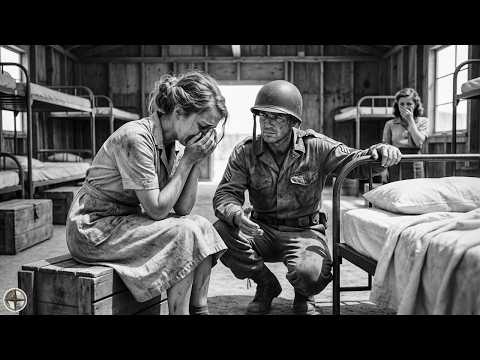
What happened to her in that room would change how she saw America, Germany, and the whole war. But to understand why a bed could shatter a lifetime of belief, we must go back to the night her world first fell apart.
March 3rd, 1943, Cologne, Germany. The sirens began just after midnight, a rising metal scream that pushed through brick walls and thin blankets. Twenty-one-year-old nurse trainee Liselotte Weber sat up on her narrow bed, feet touching the cold wooden floor, and already knew this alarm was different. The air smelled thick, like coal smoke and fear, as her father shouted from the hallway, “Keller, schnell! To the cellar, now!”
They ran down the stairs with the rest of the tenants, past framed pictures that rattled against the wall. In the basement, sixty people packed into a space built for twenty. The air was wet and close. Someone’s cheap cologne mixed with sweat and the chalky smell of brick dust. Above them, the first bombs fell with a flat distant thump, then a closer one. Light bulbs swung, dust sifted down, a baby cried so hard it had no sound left.
Later, she would write in a letter, “You could feel the building shiver like a living thing.” Cologne had already known war from the sky. By 1943, Allied forces had bombed the city more than 120 times. That year alone, British and American planes dropped thousands of tons of explosives on its streets and churches. By the end of the war, nearly 95% of the old city center would lie in ruins.
But on this night, Liselotte could not think in numbers. She thought only of her small room on the third floor, her white-painted bed with its wool blanket folded just so by habit.
The final wave hit close. There was a tearing roar, a rush of hot air through the cellar, then darkness as the power failed. People screamed. Someone’s hand clamped down on her wrist so hard it hurt. Dust filled her mouth. For a moment, she could taste brick and plaster and something else, like burned cloth.
When the all-clear finally sounded and the doors were forced open, the stairway was half blocked by rubble. Outside, the street looked wrong, like a picture that had been torn and badly put back together. Her building was a broken shell. The third floor was gone. Where her room had been, there was only open air and smoke.
She stood in the street in borrowed wooden clogs looking up at the empty space. In a later interview, she said quietly, “I remember thinking very clearly, my bed is gone. I will never sleep there again.” It was a small loss in a city of thousands of dead, but it marked her. From that night on, she never slept in a real bed in Germany again.
Her family was split by the bombing. Her father was sent to repair railway lines. Her mother was evacuated to the countryside with younger relatives. Liselotte stayed. The regime needed nurses. Posters said, “The German woman cares for the wounded front fighter.” She believed them. At 19, she had joined the nursing school with pride, wearing the white apron and the small swastika badge on her collar.
There was a paradox at the center of her days. She was trained to save lives inside a system that was destroying whole cities. She watched wounded soldiers brought in from the front, legs missing, lungs burned by smoke, and thought, “If I work harder, we will win and this will stop.” She did not yet see that more work only fed the machine.
By late 1944, the field hospital where she served had moved twice, each time farther east, following the shrinking front. It ended up in a village near the Rhine, inside a school building that smelled of chalk, cabbage soup, and carbolic disinfectant. The beds here were not really beds, either. They were iron frames without real mattresses, covered with thin straw sacks that went damp in the cold. When space ran out, stretchers lined the hallway, cold canvas over metal.
She slept where she could, on a folded blanket on the floor between wards, on a stair landing, sometimes sitting up in a chair with a coat over her knees. “You learn to sleep like a thief,” she later wrote. “You steal 10 minutes here, 20 there. Always in your clothes, always ready to run.”
By early 1945, the war had turned into a flood running backwards across Germany. In the west, more than 3.6 million homes had been destroyed by bombing. Refugees clogged the roads. The Rhine, once a proud frontier, became a last barrier. In March, American guns began to speak from the far bank. Their shells had a different sound from German ones, a heavier crack, a pause, then the thud of impact that shook dust from the schoolhouse beams.
The wards smelled of ether, sweat, and fear. At night, through broken windows, she could see the western sky flash with artillery. The order to retreat never came. Instead, one morning there were shouts in the street, the harsh clatter of tank tracks on cobblestones, and the strange sound of English shouted through amplifiers. “Come out with your hands up! Hospital staff, stay with your patients!”
Liselotte stood by a window and watched olive drab uniforms move past the gate. For years, party meetings and radio voices had told her these men were monsters who would burn and torture German women. Her hands shook so hard she could not tie a bandage. Yet the first American she saw through the doorframe was a medic carrying a red cross bag, not a weapon.
“I felt my world turn upside down,” she recalled. “The enemy we had been taught to hate looked at our wounded the same way I did.” That day, she put down her scissors, raised her hands, and became a prisoner of war, together with the doctors, orderlies, and the broken men in her care. Outside, trucks waited to take them to collection camps and later to the ports. She still had not slept in a real bed since that night in Cologne. The first one waiting for her would be on another continent, behind a fence in Texas.
The trucks came at dawn, engines coughing in the cold. Liselotte and the other nurses were loaded in with the wounded they could move, standing room only between stretchers. The canvas cover flapped, letting in strips of gray light and the smell of wet earth and exhaust. No one told them where they were going. Orders were simple. “You are prisoners now. You go where we take you.”
First came a holding area in a nearby town, a wired-off field that had once held cows. Now it held people. For three days, they slept on the ground in their uniforms, wrapped in thin blankets. The nights were damp. The grass pressed cold and wet through the cloth. The Americans gave them metal cans of coffee in the morning and thick soup at night. It was more than many German civilians were getting, but fear still sat heavy in her stomach. “I waited for the cruelty they had promised us,” she later said, “but it did not come.”
From there, trains took them west. The wagons were crowded, but they were not cattle cars. Each man and woman had a place to sit on wooden benches. Guards walked the corridor with rifles, but they did not shout or hit. When someone fainted, an American medic knelt down at once. Outside, through slats, Liselotte saw the broken back of her country, bridges in the river, houses with no roofs, black craters where stations had been.
At the French port Le Havre, the air smelled of tar, salt, and rotting fish. Long lines of German prisoners moved toward the docks, thousands of them like columns of ants. By mid-1945, more than 370,000 German POWs would be shipped to camps in the United States, spread across about 500 main and branch camps. She was one small body in that mass.
The ship waiting for them was a gray Liberty ship built to carry 10,000 tons of cargo. Now its cargo was men and women. Inside, the holds were fitted with rough wooden bunks stacked three high. The air below decks was thick, diesel fumes, sweat, damp wood, and the sharp tang of disinfectant. When the hatches closed, the dark felt solid.
The voyage took twelve days. Each morning they queued for food, white bread softer than anything she had seen in years, watery stew with real pieces of meat, black coffee that tasted of metal cups. An American officer read from a list. Rations were counted, about 3,000 calories a day, more than most civilians in Cologne ever saw after 1943. It was a strange thing to fill your stomach in chains.
At night the ship’s engine beat like a slow heart through the metal walls. She lay on her plank bunk, straw tick under her back, and thought of torpedoes and sharks. Some prisoners whispered that they would be thrown into labor camps and worked to death. Others claimed they had heard on the front that Americans treated their prisoners well, even too well. No one knew what to believe. “I did not trust the food. I did not trust the smiles,” she admitted in her memoir. “I waited for the trick.”
The first sight of America was a wide low line of green and roofs through hot mist. The ship entered the mouth of the Mississippi and slid up toward New Orleans. The air changed. It was warmer, heavy with river mud and spices, a smell she could not name. On the banks she saw houses with whole walls, cars on roads without bomb craters, children riding bicycles. It felt like stepping into another world that had refused the war.
Trains again, this time with open windows and padded seats. Guards handed out sandwiches wrapped in wax paper. Fields rolled past, wide and flat with fat cows and neat fences. In Germany, more than 3.6 million homes had been destroyed by bombing. Here, farmhouses stood clean and painted, clothes flapping on lines in the sun.
Her destination was Seagoville, an internment camp near Dallas, Texas. The compound covered more than 150 acres of scrubby land and low buildings ringed with a double fence and guard towers. It had been built first as a prison, then used to hold enemy aliens, German, Italian, and Japanese civilians, many of them women. Now it would also hold captured German nurses like her.
Processing began in a long low hall that smelled of ink, sweat, and floor polish. Fluorescent lights hummed. An American sergeant with a clipboard sat behind a table. Beside him was an interpreter, a German-American in a neat khaki uniform. “Name?” “Lieselotte Weber.” “Age?” “Three and twenty.” “Occupation?” “Krankenschwester.” “Nurse.”
The pencil scratched, pages turned. Then came the question that had surprised her in the field hospital, too. “Any medical conditions we should know about?” the sergeant asked. The interpreter repeated it in German. She started to say no. Then something in her loosened. She said, “I have not slept in a bed for two years.”
The interpreter’s eyebrows rose slightly as he translated. The sergeant stopped writing and looked at her for the first time, not at the paper. His eyes moved over her thin face, the lines of fatigue, the nurse’s badge still pinned crookedly to her collar. “Two years?” he repeated. She nodded, suddenly ashamed as if it were her fault. “Cellars, floors, stretchers,” she added in broken English.
The sergeant did not make a joke. He simply put down the pencil. After a moment he said, “Well, ma’am, you’ll sleep in a bed tonight.” His voice was flat, but not unkind.
An hour later, a woman guard in a crisp uniform led her and a small group of German nurses toward a low barracks building. The Texas heat hit like a wall, thick, buzzing with insects. Inside, though, the air was cooler. The smell changed to soap, bleach, and something else, starch. Rows of steel beds stood in two lines, each made up with a thin mattress, white cotton sheets, a gray army blanket folded at the foot, and one plump pillow. Sunlight fell in rectangles on the clean floor.
Lieselotte stopped in the doorway. The sight of so many empty beds made ready as if for guests went through her like a knife. “I could not move,” she said later. “My legs stopped. Then I began to cry.” The other women moved past her, touching the sheets with uncertain fingers, feeling the spring of the mattresses. Some laughed, high and nervous. One sat down and buried her face in the pillow, breathing in the dry, clean smell.
The guard watched them with a tired, almost puzzled expression. This was not propaganda. This was reality. The so-called enemy had given her what her own country had not managed for two years, a real bed, a place to rest. What she found in that bed in the days that followed would change more than her body. It would change what she believed about friends and enemies and about what kind of power wins a war.
The first night in the Texas barracks, Lieselotte did not sleep much, even with the bed under her. The mattress felt too soft after wood and stone. Every time a truck passed outside, the thin walls shook and she started awake, thinking of bombs. But by the third night, her body began to trust the springs. “It was like learning to breathe again,” she said later.
Life in Seagoville fell into a clear pattern. A bell rang at six. Breakfast was oatmeal, white bread, jam, and bitter coffee—about 3,000 calories a day, close to what American soldiers ate. “They fed us like their own men,” she wrote. “How could such an enemy be real?”
As a trained nurse, she was assigned to the camp infirmary. There, a guard named Private John Miller practiced German words with her each afternoon. “The same country that dropped bombs on us was now teaching me how to say good morning.”
In October 1946, she sailed home to a Cologne of rubble. Her parents were gone—her father killed in another raid, her mother listed only as verschollen, missing. Where her house had stood, weeds grew in the cracks. As a free German she had no bed at all.
Yet her Seagoville papers, stamped with an American eagle, won her work in a British-supported hospital. There she met Karl, a bitter former soldier. “Some gave me coffee and a bed,” she told him. In 1952, she married him.
Years later she wrote her memoir, My Bed in Texas. “The bed in Texas told me more about America than any speech,” she said. “It said: you are our enemy, but you are still a human being.”
Bombs can win space—but only dignity wins hearts. So tell me: what small act of kindness have you seen change someone’s deepest beliefs?
Report this article
Select a reason for reporting:






