The desert sun blazed overhead, casting harsh shadows across the rocky terrain. Inside the cramped turret of a Matilda II, the crew sweated and prayed as enemy shells ricocheted off the armor. “Hold steady, lads,” the commander whispered, his voice barely audible over the roar of battle. Outside, Italian tanks were firing frantically, but their shots glanced off the Matilda’s thick hide like pebbles. The tank rumbled forward, relentless, a steel beast that seemed to mock the very idea of destruction.
This was the scene that earned the Matilda II its legendary nickname: the Queen of the Desert. In the wide-open expanses of North Africa, where speed often meant survival, the Matilda defied convention. It was slow, yes—painfully so at times—but it was also nearly indestructible. “She’s a fortress on tracks,” one crewman recalled. “You could hit her with everything you’ve got, and she’d just keep coming.” And that’s exactly what she did, time and again, breaking enemy lines and shattering morale.
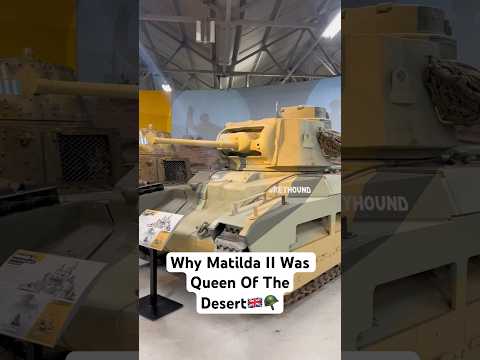
The Italians learned to fear the Matilda. Their light tanks and anti-tank guns were virtually useless against its 78mm of frontal armor. “We might as well be throwing stones,” an Italian officer reportedly said after watching his shells bounce harmlessly off the British tank. The Matilda’s 2-pounder gun, while not the most powerful, was more than enough to punch through the thin skins of Italian armor. The desert became a graveyard for Axis vehicles, and the Matilda’s reputation grew with every skirmish.
But the Germans were different. They were methodical, calculating, and they had a weapon that could finally crack the Matilda’s shell: the 88mm anti-aircraft gun. “The 88 is the only thing that can stop the Matilda,” German commanders noted with grudging respect. It was a testament to the tank’s toughness that such a powerful gun had to be redeployed from its intended role to counter a single type of British armor.
For the Allied crews, the Matilda was more than just a machine—it was a lifeline. “Knowing you’re in a Matilda gives you a certain peace of mind,” one driver said. “You feel like you can take on the world.” That confidence was crucial in the see-saw battles of the desert campaign, where morale could break as easily as a tank’s track. The Matilda’s ability to absorb punishment and keep fighting became a symbol of British resilience.
Yet, the Matilda was not without its flaws. Its speed was often a liability, and its mechanical reliability left something to be desired. But in the harsh desert environment, where dust clogged engines and heat tested men and machines alike, the Matilda’s ruggedness shone through. “She’s not fast, but she’s tough as nails,” a mechanic remarked. “And out here, tough is what matters.”
As the war in North Africa wore on, the Matilda’s dominance began to wane. The Germans brought in heavier tanks and more powerful guns, and the Queen of the Desert found herself increasingly outmatched. But her legacy was already sealed. She had proven that armor and determination could overcome speed and agility, and she had earned the respect of friend and foe alike.
The story of the Matilda II is not just one of a tank, but of the men who crewed her. Their courage and skill turned a slow, heavily armored vehicle into a weapon of terror. And as the sun set over the desert, casting long shadows across the battlefield, the Matilda II stood as a testament to a simple truth: in war, sometimes the most unlikely hero is the one that refuses to die.
But the story of the Matilda II does not end with the desert. As the tide of war shifted, the Queen of the Desert was called upon to serve in new and unfamiliar theaters. In the jungles of the Pacific and the mud of Burma, her thick armor and slow, deliberate advance proved invaluable against a different kind of enemy. “The Matilda was never meant for jungle warfare,” one historian noted, “yet she adapted, just as her crews did.” The tank that had once ruled the open sands now pushed through dense foliage, her steel hide deflecting ambushes and her presence alone enough to break the will of defenders.
In the hands of Australian and British forces, the Matilda became a rolling fortress in environments where every step could hide an ambush. “If you heard the Matilda coming, you knew the game was up,” a Japanese officer recalled after the war. Her 2-pounder gun, though outdated by European standards, was more than sufficient against lightly armored opponents, and her armor shrugged off anti-tank fire that would have destroyed lighter vehicles.
Yet even as she proved her worth in new battlegrounds, the Matilda’s limitations grew harder to ignore. The same armor that made her nearly invincible in 1940 was becoming a liability by 1943, as newer German tanks and anti-tank guns could punch through her plating with alarming ease. “She was a queen, but the throne was crumbling,” one veteran admitted. The Matilda’s crews knew it too—they loved her, but they also knew her time was passing.
Still, the Matilda II refused to go quietly. She was adapted for specialized roles—flamethrower variants, mine-clearing versions, and even bridge-laying models—proving that her rugged chassis could serve far beyond the front lines. “She was a workhorse disguised as a queen,” a Royal Engineer remarked. “And workhorses don’t retire easily.”
As the war entered its final years, the Matilda II faded from the headlines, replaced by faster, more heavily armed designs. But in the memories of those who served in her, she remained something special. “You never forget your first tank,” one gunner said softly. “And for me, that was the Matilda. She brought me home.” The Queen of the Desert had earned her crown, not through speed or grace, but through sheer, stubborn survival.
But the desert campaigns were not the only chapters written in her story. Before the sand ever clung to her tracks, the Matilda II had already seen her baptism of fire in a very different place: the damp, rolling fields of France. During the disastrous 1940 campaign, the Matilda IIs of the 7th Royal Tank Regiment charged into battle against the German blitzkrieg. “We were outnumbered and outmaneuvered, but the Matildas held the line,” one survivor recalled. “The Germans simply couldn’t believe their shells were bouncing off.” At Arras, a counterattack led by these slow, thick-skinned tanks nearly broke through the German flank, a moment of shock that lingered in enemy reports for months.
That early shock planted a seed of fear in the German high command. They had expected a swift, clean victory, but the Matilda forced them to pause, to think, and to improvise. “The Matilda is a nasty surprise,” a captured German officer admitted. “We have nothing in our arsenal that can reliably kill it.” It was a foretaste of what would happen in the desert—the slow, creeping dread that came with seeing that slab-sided silhouette cresting a ridge.
Back in Britain, the factories that built the Matilda were working around the clock. Women who had never touched a rivet gun found themselves assembling armor plates and mounting turrets. “We knew the boys out there were counting on us,” one factory worker said. “Every tank that rolled off the line was a promise we kept.” The Matilda became more than a weapon—she was a bond between the home front and the fighting front, a shared symbol of defiance.
And yet, for all her fame, the Matilda was never produced in the vast numbers of the American Shermans or the Soviet T-34s. She was a specialist, a tool built for a specific kind of war, and when that war changed, her production lines slowed. “She was too good at one thing,” a British planner later reflected. “And the battlefield never stays the same for long.” That singularity made her crews feel like an elite, a brotherhood bound by the knowledge that they drove something unique.
In the desert, that brotherhood was tested daily. Water was rationed, sand got into everything, and the heat inside the tank could reach unbearable levels. But the Matilda’s crews learned to live with discomfort, even to laugh at it. “We named her ‘Old Faithful’ because she never let us down,” one commander remembered. “She was slow, she was hot, but she was ours.” The bond between man and machine grew into something almost superstitious—crews would pat her hull before battle, whisper to her as if she could hear.
That affection was not misplaced. Time and again, the Matilda brought her crew home when other tanks would have been torn apart. “I saw a shell hit the turret of a Matilda and just bounce off,” a wounded soldier recalled from a field hospital. “The crew inside didn’t even flinch. They just kept firing.” Such stories spread through the ranks, reinforcing the legend and giving hope to men who faced long odds.
Decades later, in the quiet of a museum hall, a restored Matilda II sits beneath a skylight, its desert camouflage faded but its silhouette unmistakable. “My grandfather drove one of these,” a visitor whispers to his son, pointing at the slab-sided turret. “He said it was the safest place he ever knew.” The boy touches the cold steel, and for a moment, the rumble of engines seems to echo through the silence.
Historians still debate her legacy. Some call her obsolete by 1942, a relic of a slower war. Others argue she was exactly what Britain needed when it needed it most—a shield against the storm. “The Matilda wasn’t designed to win the war,” one curator explains. “She was designed to survive it. And she did—along with thousands of men who owed her their lives.”
Her crews are nearly gone now, but their words remain. “She was slow, she was stubborn, and she never gave up,” one veteran wrote in his memoirs. “Just like the men who fought beside her.” The Queen of the Desert has no throne, no crown—only a place in memory, where steel and courage become one.
So the next time you see a photograph of that angular, thick-skinned tank rolling through the dust, remember what she stood for: the idea that survival is its own kind of victory. Would you have trusted your life to the Matilda II?
Report this article
Select a reason for reporting:






