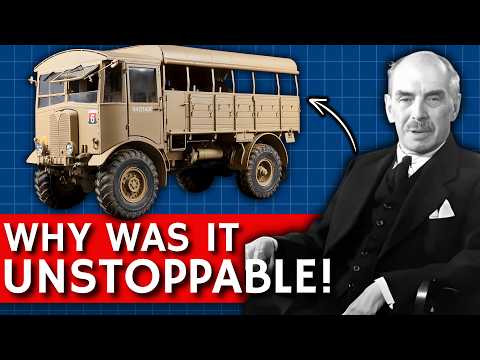
Imagine the most feared artillery in the British Army rolling through the Libyan desert at 36 mph. Guns that could loft a 100-lb shell across 10 miles of sand. Guns that shattered panzer formations, silenced enemy batteries, and punched holes in the sky above terrified infantry. Guns that could make the ground shake like a living thing. Now, imagine that the machine hauling every one of those guns was, at its very heart, built in a bus factory in the suburbs of West London.
That is not an exaggeration. That is the story of the AEC Matador. It is one of the strangest, most quietly consequential journeys in the history of military engineering.
This is a story about a company that never set out to arm a nation and ended up doing exactly that. It is a story about the invisible infrastructure of war. The machines that do not fire, do not fly, and do not make the headlines, but without which nothing else moves. It is a story about what happens when an industrial discipline, quietly accumulated over decades of civilian production, meets a moment of national emergency that demands everything at once.
A company whose entire identity was wrapped around civilian public transport—the double-decker buses of London, the coaches that moved workers through fog-draped streets, the lorries that carried goods across the English countryside—quietly became the backbone of British artillery mobility for the Second World War. And it happened not because of military genius or government foresight. It happened because one factory in Southall, Middlesex, had already solved the problem of building heavy, reliable vehicles at volume. The Army simply had no one better to ask.
To understand why this matters, you have to understand what moving a gun means in war. A gun that cannot move is a target. Artillery in the modern era is not about planting a weapon in a fixed position and firing until the barrels melt. It is about mobility. A gun crew that fires from the same spot twice is inviting destruction. You shoot, you move, you survive. You shoot again from somewhere unexpected. The whole philosophy of 20th century artillery warfare depended on rapid displacement. The ability to drag a multi-ton gun, its crew, and its ammunition across roads, fields, mud, rock, and sand faster than the enemy could respond. The tractor pulling that gun was not a support element. It was a tactical weapon.
In the late 1930s, the British Army was staring at a problem it had been quietly ignoring for years. It had modern guns, but aging inadequate transport. The Morris Quad was fine for the 25-pounder field gun. The Scammell Pioneer was reserved for the heaviest howitzers. But in the middle of the spectrum, the medium artillery, guns like the 5.5-in field gun and the 3.7-in anti-aircraft weapon, there was nothing capable enough. A 5.5-in gun weighed roughly 6 tons. It demanded a tractor with genuine pulling power, four-wheel drive, a low-ratio gearbox, and a winch capable of dragging the entire rig out of deep mud. The War Office issued specifications. They needed something new, and they needed it quickly.
The Associated Equipment Company, known simply as AEC, was not an obvious choice for this work. The firm had been built out of the operational needs of London’s bus network. Its origins stretched back to 1912, when the London General Omnibus Company separated its manufacturing arm into a dedicated concern. The goal was straightforward. Build bus chassis at scale, reliably, without variation. That became AEC’s fundamental discipline. Not glamour, not innovation for its own sake. Precision production engineering day after day, year after year, turning out vehicles that had to work in all weathers across demanding urban routes.
The factory moved from its original home in Walthamstow to a vast new site in Southall in 1927, eventually spanning 63 acres beside the Great Western Railway. What AEC had quietly accumulated alongside the buses was something even more valuable for military purposes. They had mastered diesel engines. Through the early 1930s, AEC developed and refined their own compression ignition six-cylinder power plants. Diesel was not fashionable in military circles at the time. Petrol engines were simpler, faster to start in cold weather, and familiar to most mechanics. But diesel offered something that petrol could not match in prolonged operations: fuel efficiency. A diesel engine stretching its fuel across a 360-mile range on 40 gallons was a completely different logistical proposition from a petrol engine burning through its supply at half the range. And AEC’s diesels were proving themselves in London’s buses every single day, through city traffic in rain and ice, with no toleration for mechanical failure. Reliability was built into the product by necessity.
In 1936, AEC began exploring four-wheel drive architecture. They absorbed Hardy Motors, a firm that had worked on rugged multi-axle truck designs with the American company FWD. That acquisition gave AEC the foundation for what would become the Matador’s chassis. By 1937, a prototype was ready. The War Office examined it and responded with an order for 200 vehicles, but with one firm condition. They wanted diesel, not petrol. AEC redesigned the engine installation. On the 9th of January 1939, the first production prototype was delivered. By November of that same year, the production version, designated internally as the 0853 Wayne, was rolling off the line.
The vehicle that emerged was not beautiful. It was not elegant. It had a flat-fronted cab with a gently curved roof, thick steel sides on the passenger compartment, and large balloon tires that made it look somehow both purposeful and ungainly at the same time. But every one of its design choices had been made with function in mind. The flat-fronted cab maximized interior space for the driver and his co-driver, while keeping the overall length manageable. The rear body, constructed largely of wood with steel reinforcements, could seat a gun crew of up to 10 men on two long bench seats. The floor was fitted with rollers so that ammunition could be moved quickly from storage to the loading position without having to lift it repeatedly. A tarpaulin stretched over a steel frame brought the overall height to just over 10 ft, which was enough to shelter the crew from rain without making the vehicle unmanageable on narrow roads.
The heart of the machine was the A187, a six-cylinder AEC diesel engine displacing 7.6 L, developing 95 horsepower at 1,780 revolutions per minute. That figure sounds modest by later standards, but in 1939, it was entirely appropriate for the task. The engine drove through a four-speed gearbox with a two-speed transfer case, giving the crew eight forward ratios in total. In low ratio mode, the Matador became a different animal. The same engine that could push the vehicle to 36 mph on a tarmac road could, in its lowest gear, drag a dead weight with a tenacity that surprised everyone who witnessed it in the field. Fully loaded, the Matador weighed 10.8 tons. In tow configuration, with a 5.5-in gun hitched behind it, and a full crew and ammunition load on board, it still handled the terrain it was asked to cross.
That winch deserves a moment of attention. Mounted at the front of the chassis, it was rated to a 7-ton pulling capacity, fitted with 250 ft of steel cable. Every artillery tractor of the period carried a winch, but the Matador’s was particularly well regarded because the vehicle’s engine power and gearing let the crew use it aggressively. A Matador could self-recover from a deep rut. It could winch a sibling vehicle out of mud while itself remaining on firmer ground. It could haul a gun into a firing position across terrain where the wheels alone would have spun uselessly. In the North African desert where sand could swallow a vehicle up to its axles without warning, and in the Italian hills where clay mud turned paths into traps, that winch saved guns, saved vehicles, and saved the lives of the men who depended on both.
The Matador entered combat in 1940. Its baptism was not promising. The campaigns in France and Norway that year collapsed in military disasters. British forces were evacuated at Dunkirk and from the Norwegian coast. And in the chaos of retreat, vehicles of all kinds were abandoned. The first Matadors to see action were left behind on the beaches and the roads of France. Some of them captured by German forces who, in the way that professional armies do, examined the equipment of the enemy they had just beaten and drew conclusions. German logistics officers reportedly found the Matador impressive. Not spectacular, not revolutionary, just honest, capable, and well-built. Which was exactly the kind of vehicle a retreating army most hated to surrender.
In Britain, the production lines in Southall barely paused. Civilian bus production at AEC ceased entirely by 1941, and the factory was completely redirected toward the war effort. Lorries, artillery tractors, and military variants in several configurations began moving out of Southall in a continuous stream. AEC would ultimately produce over 9,000 Matadors by the end of the war. A figure that reflects not just the vehicle’s utility, but the factory’s capacity for sustained, disciplined volume production. It was the bus-building muscle of AEC that made this possible. The company did not have to learn how to make thousands of units to tight specifications. It had been doing exactly that for 30 years.
North Africa became the theater where the Matador found its purpose and its reputation. The war in the desert between 1940 and 1943 was a war of movement and supply. The distances were vast. The terrain was unforgiving. Sand invaded everything—engines, bearings, fuel systems, the eyes and lungs of the men who maintained the machines. The Matador thrived. Its diesel engine was less vulnerable to the fine desert sand than petrol carburetors, which choked on contaminated fuel. Its wide-section balloon tires, running at reduced pressure, spread the vehicle’s weight across the surface instead of cutting into it.
Gun crews with Matadors could occupy a firing position, engage a target, and move again with a speed that genuinely unnerved any observers. A British medium artillery regiment equipped with Matadors and 5.5-in guns could displace entirely in a matter of minutes. Gun limbered, crew mounted, vehicle rolling, and vanish from the position before counter-battery fire arrived.
But the most celebrated aspect of the Matador’s North African career was not the guns it pulled—it was the machines it rescued. In a desert campaign, the breakdown of a vehicle was not merely inconvenient. It could mean death. The Matador became, by reputation and by practice, the recovery vehicle of choice. A Matador reportedly tow-started a Sherman tank on a steep incline when the tank’s own systems had failed. In another incident, a single Matador, already carrying a Jeep on its deck and towing a 3-ton truck it had recovered, came across a second broken-down 6×6 truck attempting to recover yet another vehicle. The Matador crew assessed the situation, hitched both disabled trucks behind them, and drove the entire convoy 50 miles to safety.
The Germans noticed. Captured Matadors were pressed into Axis service without hesitation. German Africa Korps logisticians gave them the informal designation Mammoth. Large, ponderous, indestructible, and immensely capable. Several captured Matadors served German units throughout the North African campaign.
And then there was the variant that took the Matador’s story into entirely different territory. In 1941, senior commanders needed to move their headquarters—not simply relocate, but genuinely operate from the field, maintaining continuous radio contact while staying mobile enough to avoid becoming a fixed target. The solution was the armored command vehicle built on the Matador chassis. Britain was the only country in the Second World War that developed and deployed purpose-built armored command vehicles in significant numbers. The troops who rode in it did not call it the armored command vehicle. They called it the Dorchester after the most luxurious hotel in London.
Field Marshal Bernard Montgomery conducted much of the planning for the battles that ultimately ended the desert war from the interior of these vehicles. The combination of armor protection, radio capacity, and genuine off-road mobility gave senior headquarters a freedom of movement they had never previously enjoyed.
Early in the campaign, however, three of these Dorchesters were captured. In April 1941, during a period of rapid German advance, reconnaissance elements of the Africa Corps reached the region of Mechili. In the chaos of the retreat, they captured two British generals, Lieutenant General Philip Neame and Lieutenant General Richard O’Connor, along with three of the armored command vehicles that had served their headquarters. General Erwin Rommel’s officers named two of the captured vehicles Max and Moritz after the mischievous boy characters in a popular German children’s story. The name Max was given to the former vehicle of O’Connor, which Rommel himself used as a personal command platform. He was photographed on multiple occasions riding on the roof of Max as it crossed the desert. Rommel reportedly remarked that the British had built something he wished he had designed.
There was an additional irony to the Max and Moritz episode. A British Army camouflage officer, Major Jasper Maskelyne—who in civilian life had been a celebrated stage magician—was tasked with making the Dorchesters less conspicuous after the losses at Mechili. His solution was characteristically theatrical. He disguised the armored command vehicles to resemble ordinary Matador gun tractors. The bus factory’s product was so ubiquitous that it had become the perfect disguise.
The Matador’s operational presence spread as the war expanded. In the Italian campaign from 1943 onward, it operated in completely different terrain—the narrow mountain roads, steep ravines, and glutinous mud of the Apennines. The bocage of Normandy after D-Day presented yet another environment. An IWM photograph dated the 1st of July, 1944, shows a Matador named Gazala, named after a battle in Libya where its crew had likely served, pulling a 5.5-inch gun through a Norman village. A chain of causally related events connecting the bus factory in Southall to the liberation of France.
By the time the war in Europe ended, the Matador had accumulated a combat record that spanned three continents and half a decade. Canada had used it. Australia had used it. Lend-Lease allocations had sent a proportion of production to the Soviet Union, where Matadors served in conditions more extreme than any the designers in Southall had imagined.
The post-war years did not put the Matador in a museum. They put it back to work. As they were retired from military service, they were sold on to civilian buyers who recognized the same qualities the Army had valued. Recovery truck operators bought them. Showmen who traveled the fairground circuit bought them and used them to haul heavy rides and generators across the country. Matadors went into forestry work across Britain, in some cases continuing to operate well into the 1970s, three decades after the first prototype was delivered to the army.
The AEC Matador was built over 9,600 times. Each one began life in the same factory that built London’s red double-deckers, assembled by the same workforce using the same diesel engines refined for the same requirements of durability and economy. The engineering disciplines of bus production were precisely the disciplines that produced a machine capable of hauling guns across North Africa.
There is a Matador today at the Imperial War Museum in Duxford. Its olive drab paintwork unchanged. Its flat-fronted cab staring impassively at the people who walk past it. Most visitors linger longer at the tanks and the aircraft. The Matador sits there in the manner of all workhorses that outlasted the races they were entered in. Quietly patient, unspectacular, and irreplaceable.
The gun it towed won battles. The commanders it carried decided campaigns. But without the vehicle that moved through every theater in every season, on every surface, the entire apparatus of British medium artillery would have been stranded. There was no single design genius behind the Matador. No visionary engineer whose name belongs in the same breath as Rolls or Mitchell or Johnson. The Matador was the product of an institution—a company that had spent 30 years learning to build reliable heavy vehicles at volume, meeting a moment in history that demanded exactly that.
The buses of London went to war, and somewhere in the Western Desert, a gunner owes his life to a bus engineer’s workbench. Britain could not have fired a shot without them.
So the next time you see a red double-decker rolling through London traffic, spare a thought for the flat-fronted workhorse that carried the guns—and ask yourself: how many of history’s decisive weapons were actually built by people who never intended to make one?
Report this article
Select a reason for reporting:






