Imagine standing on the crumbling walls of a city that hasn’t slept in two months. The air is thick with sulfur, with rot, with the stench of bodies that nobody has the strength left to bury. Below you, stretching to the horizon in every direction, are the tents of the largest army the Ottoman Empire has assembled in over a century. There are so many campfires burning at night that it looks like a second city has grown outside the walls, one that dwarfs the capital it is trying to swallow.
Inside the city, the garrison is down to fewer than 4,000 men still able to hold a weapon. The walls are shattered. The powder is almost gone. The food ran out days ago, and the Ottoman sappers, the miners tunneling beneath your feet, are so close now that defenders can hear them scraping through the earth, planting charges that will blow the last standing bastions into rubble. It is September of 1683, and Vienna, the seat of the Holy Roman Empire, the beating heart of Christian Europe, is about to fall. If it does, there is nothing between the Ottoman armies and the rest of the continent. Germany, France, Italy, everything west of the Danube would be exposed. The balance of power that has shaped civilization for a millennium is about to be rewritten in a single afternoon.
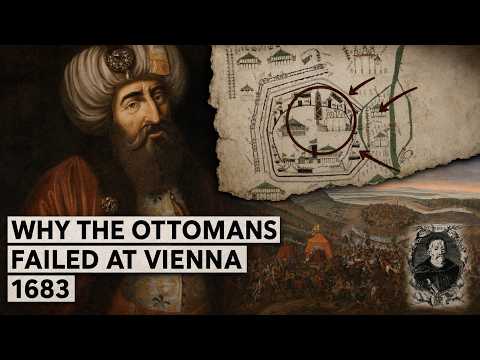
But Vienna did not fall, and the reason it didn’t, the real reason, is far more complicated and far more dramatic than most people realize. It wasn’t just a battle. It was a collision of empires, egos, secret alliances, religious fervor, and one catastrophic miscalculation by the most powerful man in the Ottoman government.
This is a story about how close Europe came to a completely different future, and the chain of decisions, betrayals, and desperate gambles that prevented it.
To understand why an Ottoman army of roughly 150,000 soldiers was camped outside Vienna in the summer of 1683, you have to understand what the Ottoman Empire actually was at this point in history. Because the Ottoman Empire of the late 17th century was not the declining relic that it would eventually become. It was still one of the most formidable military and political machines on the planet.
Its territory stretched from the gates of Morocco in the west to the borders of Persia in the east, from the steppes of Ukraine in the north to the coasts of Yemen in the south. It controlled the most strategic waterways in the known world, the Bosphorus, the Dardanelles, the eastern Mediterranean, the Red Sea. It sat on top of the old Silk Road trade routes and collected revenue from three continents. Its capital, Istanbul, the city that had been Constantinople before the Ottomans took it in 1453, was the largest and richest city in Europe. And its military, particularly its elite Janissary Corps, was considered the most disciplined and lethal fighting force west of China.
But empires are never as strong as they appear from the outside, and by the 1680s, the Ottoman Empire was showing cracks that its leaders were desperate to seal. The 17th century had been turbulent for the Ottomans. There had been a string of weak sultans, palace coups, Janissary revolts, and periods of stagnation where the empire seemed to be running on institutional momentum rather than genuine strength. There was a growing sense among the Ottoman ruling class that the empire needed a spectacular military victory to reassert its dominance, to remind Europe and the world that the Ottomans were not fading, that they were still the force that had toppled Constantinople, conquered the Balkans, and terrorized Christendom for over two centuries.
And the man who believed he could deliver that victory was Kara Mustafa Pasha.
Now, Kara Mustafa is one of the most fascinating and ultimately tragic figures in Ottoman history. He was born around 1634 in a village near Merzifon in Anatolia. His origins are disputed. Some sources say he was the son of a soldier. Others say his father was a simple fruit peddler. What is not disputed is that he was adopted into the powerful Köprülü family, one of the most influential political dynasties in the Ottoman Empire. The Köprülüs had essentially been running the empire for decades through a series of grand viziers, the equivalent of prime ministers who wielded enormous executive power while the sultans increasingly retreated into palace life, preferring hunting and leisure to governance.
Kara Mustafa married into the Köprülü family, and when his brother-in-law, Köprülü Fazıl Ahmed Pasha, died in 1676, Kara Mustafa inherited the position of Grand Vizier. He was now, for all practical purposes, the most powerful man in the Ottoman Empire. Sultan Mehmed IV, often called Mehmed the Hunter because of his obsession with the sport, had effectively handed over the day-to-day running of the empire to his Grand Vizier. Mehmed preferred the forests to the council chamber. And so, Kara Mustafa had almost unlimited authority to pursue his ambitions. And those ambitions were enormous.
You see, Kara Mustafa was not simply looking to win a border skirmish or secure a minor territorial gain. He wanted to do what even Suleiman the Magnificent, the greatest of all Ottoman sultans, had failed to do. He wanted to conquer Vienna. Suleiman had besieged the city in 1529 and been forced to withdraw. That failure was one of the few dark spots on Suleiman’s otherwise extraordinary military record. And Kara Mustafa believed that by succeeding where Suleiman had failed, he would not only secure his own legacy, but also establish himself as the most important figure in Ottoman history since the conquest of Constantinople.
But here is the critical detail that most people miss. Kara Mustafa did not tell the sultan that Vienna was his true objective. When he was assembling his massive army and requesting the sultan’s blessing for a military campaign, the officially declared targets were the frontier fortresses of Győr and Komárom in Hungary. These were strategically important but relatively modest objectives that the sultan and the Ottoman court would have considered achievable and worthwhile. Vienna was never part of the approved plan.
Kara Mustafa concealed his true ambition because he knew the Ottoman court would recoil from an assault on the Habsburg capital. The Grand Mufti had balked even at a limited Hungarian campaign. “A full-scale attack on Vienna would have been called reckless, even suicidal,” one court faction warned. But the Grand Vizier did not care. He was a man of avarice, pride, and boundless self-belief, and he believed he could take the city where Suleiman had failed.
And the political stars seemed to align. Emperor Leopold I had alienated his Hungarian subjects by forcing Catholicism upon them, driving nobles under Imre Thököly into open revolt — and Thököly invited Ottoman suzerainty. Meanwhile, Louis XIV of France, the most powerful Christian monarch in Europe, quietly encouraged Ottoman aggression against the Habsburgs, because every Austrian soldier fighting Turks in the east was one who could not fight France in the west.
By spring 1683, Kara Mustafa had assembled roughly 150,000 troops — the largest Ottoman army of the century — and in late March it began its slow, inexorable march from Edirne. When word reached Vienna, panic spread. On July 7, Emperor Leopold fled to Passau, leaving the defense to Count Ernst Rüdiger von Starhemberg.
When Kara Mustafa demanded surrender, Starhemberg’s reply became legend: “Let them come. I will fight to the last drop of blood.”
On July 14, the encirclement was complete. The siege had begun.
What do you think would have happened to Europe if Vienna had fallen that September? Let me know in the comments below.
Report this article
Select a reason for reporting:






