Imagine a German bomber limping back across the English Channel in the summer of 1940. Its fuselage is riddled with bullet holes, yet the engines hum steadily. The crew is alive. This should have been impossible. Because the Royal Air Force had just thrown everything it had at it: eight machine guns, firing 320 rounds in two seconds—a wall of lead built by the most feared air force in the world. And still, the bomber flew on.
This scene repeated itself again and again during the Battle of Britain. And it never should have happened. Because the RAF went to war with fighters that fired the same rifle cartridge as the infantry’s rifles from the previous war. Why?
The easy answer—the one everyone reaches for first—is that the RAF was cheap, backward, or broke after the Depression. That’s the story that makes sense. The Germans were bolting cannons onto their fighters. The Americans were moving toward heavy .50-caliber guns. And here was Britain, flying the beautiful, advanced Spitfire, armed with eight small guns firing a bullet designed in the 1880s. It looks wrong. It looks like the embarrassing detail no one wants to explain.
It isn’t wrong. That’s the whole problem.
Because the men who chose those eight guns had already looked at heavier weapons. They had tested them. They had argued about them in rooms that reached the highest levels of the Air Ministry. And they had rejected them deliberately, for reasons that were perfectly sound in 1934.
To understand why the RAF entered 1940 with those guns, you have to go back to a problem no one had faced before—and to a calculation partly performed by a thirteen-year-old girl.
Go back to 1933. Fighters were getting faster. Everyone could see it. The old biplanes with two machine guns mounted in front of the pilot, firing through the propeller—that world was ending. The new monoplanes would be faster, sleeker, and would close on each other at speeds that made the old rules meaningless.
This created a problem that seems simple until you actually do the math. The problem is time.
When two fast aircraft approach each other, the moment one can actually aim at the other is tiny. Seconds, maybe two. In those two seconds, the pilot must put enough rounds into the enemy to physically destroy it—to break a spar, kill the crew, or ignite the fuel. If you miss that window, the other aircraft is a mile away before you can turn around.
Let’s put a number on it. Two aircraft approaching head-on, each at 300 miles per hour, close the distance at 600 miles per hour—about 900 feet per second. The range at which your guns are truly lethal is a few hundred yards, and the opportunity lasts a fraction of a second. That was the frame in which Hill was working. Not how to damage the enemy, but how to destroy it in less time than it takes to say the word.
So how much firepower do you need to bring down an aircraft in two seconds?
The man who answered that was Captain Frederick William Hill, known as “Gunner Hill,” working on the technical side of the Air Ministry. He took firing-trial data and calculated how many hits were needed to bring down a modern aircraft, and how many guns you needed to deliver those hits in that impossible time window. The calculations were grueling, and the story goes that his thirteen-year-old daughter, Hazel, helped him work them out on the kitchen table. Whether you like that detail or not—and it is well documented—the result is what matters.
Two guns were not enough. Four were not enough. You needed eight. Eight guns firing together could put about 320 rounds into that two-second gap.
That was the number. That was the whole idea. Not eight guns because eight looks impressive. Eight guns because the physics of speed had quietly rewritten what sufficient firepower meant, and no one had noticed until Hill put it on paper.
To feel how big that leap was, look at what the RAF was actually flying when Hill did his calculations. The front-line fighter in the early 1930s was a biplane with two machine guns, sometimes mounted right in front of the pilot and timed to fire through the spinning propeller. Two guns. The last generation of biplanes had reached four. Hill was asking the Air Ministry to double that number, and to bury the guns inside the wings where the propeller couldn’t get in the way.
It sounded excessive. The opposite was true.
But this only tells you the number of guns. It doesn’t tell you why they fired that particular bullet. Here the boring, unglamorous reasons show up as the real ones.
The .303 was the cartridge the entire British Army already depended on. It was used in rifles. It was used in ground machine guns. Factories were producing it by the tens of millions. The supply chain stretched across the Empire, and every armorer knew it inside out. When you are rearming in a hurry against a Germany that is rebuilding its strength faster than anyone expected, the thing you already make by the millions and know how to keep working is not a small advantage. It might be the whole game.
Then there was the gun itself. The RAF took an American design, the Browning, and rebuilt it to fire the British cartridge. They adopted it in 1937, and most of it was made by the Birmingham Small Arms Company. It was belt-fed, so you weren’t stuck with a small ammunition drum. It was reliable. It kept firing even in the bitter cold and thin air screaming past at high altitude. Reliability sounds boring until your gun jams at 20,000 feet with an enemy in front of you—then reliability is the only thing in the world that matters.
So the logic was clear. Fast fighters give you only two seconds. Two seconds means you need eight guns. Eight guns means a huge amount of ammunition and machinery crammed into a thin wing, which means each gun must be light, compact, and utterly reliable. And the light, compact, reliable option that could be mass-produced was the .303.
Every piece followed from the one before. But someone had to force that decision, because a decision that size doesn’t just happen.
That job fell to a squadron leader in the Operational Requirements branch named Ralph Sorley. Operational Requirements is exactly what it sounds like. They are the people who decide what the air force actually needs from its future aircraft. Sorley took Hill’s calculations and turned them into a fight. He pushed to change the specifications for the new fighters—the documents that would become the Spitfire and the Hurricane—from the old two-gun idea to a battery of eight.
It was not an easy argument to win. Eight guns meant more weight, more complexity, redesigned wings, and a leap of faith that the math was right. One of the armament experts involved, Claude Hilton Keith, later described how hard that fight was. He said the case was taken to very high levels before anyone approved it. And then he added something that lands harder once you know what came next.
If they had settled for half-measures, things would have gone very badly for us in the late summer of 1940.
Read that again. The men who chose the guns understood at the time that getting this wrong could mean losing the war. They were not careless. They were careful. And the careful answer in 1934 was eight .303-caliber guns.
Nor was Sorley a bureaucrat shuffling papers he didn’t understand. The man who forced the eight-gun fighter went on to run Britain’s aircraft and armament testing establishment, then rose to become one of the senior commanders of the Air Staff. He knew what the weapon had to do in the air, and he staked his credibility on the number eight that plenty of senior officials thought was more than necessary. If he had lost that argument, or accepted six guns, the fighters that met the German Air Force would have thrown a third less firepower into that two-second window. Keith’s grim line about our fate was not just hindsight. It was a real fork in the road that the RAF nearly took.
And so the decision took physical shape. When R.J. Mitchell’s Type 300—the Spitfire—was redesigned, the armament became eight Browning machine guns buried in those thin elliptical wings. The prototype flew in March 1936. The Hurricane followed the same path. Its wing was built to carry the same eight guns. Two very different fighters—one designed around a thin, high-performance wing, the other around a sturdier, easier-to-manufacture airframe—and both carried the same answer to Hill’s question.
The Spitfire’s wing was so thin that the guns barely fit. Production aircraft ended up with small bumps on the underside of the wing to make room for the gun mechanisms. That tells you how tight the margins were. The most elegant fighter of its generation had lumps on its beautiful wing because eight guns is a lot of hardware to hide inside something that slender.
On paper, it was done. The RAF had the most heavily armed fighters of their kind in the world. And when the eight-gun Hurricane first appeared, it genuinely outgunned the early Messerschmitt 109s, which were still flying with a lighter mix of rifle-caliber guns.
It is worth pausing on the German choice, because it is a mirror image of the British one. Those early 109s were lightly armed, but the German direction was toward cannon—a slow-firing 20mm weapon throwing explosive shells, with rifle-caliber guns beside it for aiming. Fewer hits, but each hit capable of blowing a gap in a wing. That was the other answer to Hill’s question. Don’t flood the target with bullets. Hit it with something that explodes. Two air arms, the same problem, opposite philosophies: weight of fire versus explosive power.
The argument that had played out inside RAF headquarters was becoming real in the sky over France.
And this is the moment you expect the story to end happily. The math was right, the guns were reliable, the fighters were fast. Except the question Hill had answered in 1933 was quietly going out of date, and the men who chose the .303 knew it before almost anyone else.
Here is the part that ends that simple story forever.
The myth says the RAF went to war with rifle-caliber guns because it failed to see the future, and was caught flat-footed while shrewder air forces moved to cannon. It is a satisfying story. It fits the image of a tired, underfunded Britain between the wars. But it is also wrong, and the dates prove it—because the RAF had already realized the .303 would not stay sufficient. They could see the same trend everyone else could. Aircraft were getting faster, but they were also gaining stronger metal structures, then armor plate, then fuel tanks that could seal themselves after a bullet punched through. Against a target like that, a rifle bullet starts to look like what it is: small.
So they went looking for something bigger, and when they looked, they deliberately passed over the weapon you might expect them to choose—the heavy .50-caliber machine gun that the Americans would build their whole fighting strength around. The RAF’s assessment was blunt. The .50 was neither useful nor harmful: heavier and slower-firing than the .303, yet lacking the one thing that would truly change the equation—an explosive shell. Why carry a medium-weight gun with worse rate of fire than the .303 and still be unable to blow a hole in an aircraft’s structure? What they wanted was a cannon. A 20mm weapon that fired shells to burst inside the enemy rather than merely punch neat holes through it.
In 1936, RAF officers watched a demonstration in Paris of a French weapon, the Hispano-Suiza HS.404, and from that moment, that was the plan. The .303 battery was never meant to be the final answer. It was the bridge—the thing you fight with until the real weapon is ready.
There is a revealing phrase in the official thinking of the time. The pursuit of the cannon was, in the words of one document, a partial precaution against the Germans armoring the rear of their engines—protecting the one place where a rifle bullet from behind might reach something vital. Read that and the whole mentality becomes clear. They were not guessing that aircraft would get tougher. They were already planning for the specific ways the enemy would harden the targets they so badly wanted to destroy.
So the real question is not why they used the .303. It is why they were still using it in 1940, years after they had realized it was not enough.
The answer is that the real weapon did not work.
The Hispano cannon was a magnificent weapon. But it simply did not take to life inside a Spitfire. To understand why, you have to know how it was born.
The Hispano was designed to be mounted on an engine—literally built into the block of a massive French V12, nestled in the valley between the cylinder banks, firing its shells straight through the hollow propeller shaft. Bolted to that huge mass of metal, the gun was rock-solid. It was designed around the assumption that it would never move.
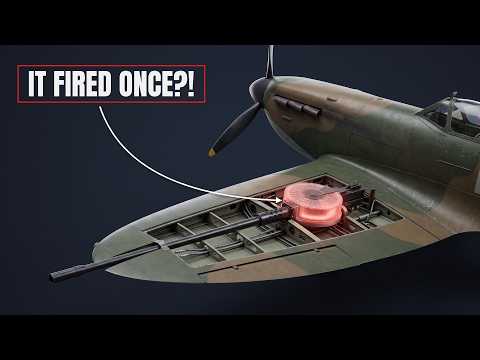
Now take that gun and move it to a fighter’s wing. The wing is not solid. It flexes. It bends and twists under the stresses of hard maneuvering, especially in a thin, elegant wing like the Spitfire’s. The RAF tried mounting the Hispano in the Spitfire’s wing and found in 1939 tests that under negative g-forces, the wing flexed enough to jam the gun and stop it dead.
There was a second problem piled on the first. The cannon’s ammunition came in a large circular drum, and there was no neat way to fit that drum inside a thin wing. So they mounted the entire weapon on its side to make it fit. The Hispano hated being on its side as much as it hated bending.
They sent it to war anyway, because time had run out.
On January 13, 1940, a cannon-armed Spitfire engaged a German bomber. The pilot squeezed the trigger. The right cannon fired exactly one round and stopped. The left ran for about thirty rounds and stopped too. One round from one gun, thirty from the other, and then a fast, expensive fighter had nothing to shoot with.
It got worse. In the summer of 1940, as the Battle of Britain raged, No. 19 Squadron was equipped with cannon-armed Spitfires. The guns jammed so often in actual combat—often after a single shot—that the squadron did something almost unheard of. They asked for their old planes back. Give us back the eight Brownings.
The obsolete guns worked. The modern ones did not.
Think about what that means. In the months when Britain was fighting for its life, the weapon they had been trying to reach since 1936 was so unreliable that front-line pilots were begging to return to the rifle-caliber battery everyone loves to call a mistake.
So the bridge held. Not because it was ideal, but because it was the only thing that worked.
And there was one more reason the bridge held at all. There were enough of these guns to go around. The .303 Brownings were pouring out of British factories, most of them from one massive plant, in numbers no cannon factory could dream of. Every Hurricane needed eight. Every Spitfire needed eight. Multiply that by a fighter force being rebuilt in desperate haste, and you need tens of thousands of guns, plus spares, plus replacements for everything damaged or shot down. A weapon can be brilliant in a test field and useless to a nation if you cannot build it fast enough.
The .303 you could build fast enough.
The eight-gun .303 fighter fought the Battle of Britain because the alternative wasn’t ready and the enemy wouldn’t wait. And the pilots who flew it knew its weaknesses intimately, so they did everything they could to sharpen its strength.
If the bullet was small, make every bullet do more. Here the ammunition enters the story, and it is a better tale than the guns themselves. The RAF didn’t just load plain ball rounds. They mixed the belts. Some rounds were standard, some armor-piercing to punch through protection, some incendiary to start fires.
The grand prize was a new incendiary round that came from a strange, tangled development process. A Belgian inventor named de Wilde brought an incendiary design to Britain before the war. His original rounds didn’t work very well, and had to be radically redesigned by a British officer, Major Dixon. But the result, which kept the name “de Wilde,” was worth the trouble.
It did two things. First, it was nearly twice as good as the old incendiary at igniting enemy fuel tanks, with a one-in-five chance of ignition in tests compared to one-in-ten for the old type. Second—and this is the part pilots loved—it flashed on impact. For the first time, a pilot could see his hits striking the enemy in real time and correct his aim within that two-second window.
It was first issued in June 1940 and blooded over the beaches of Dunkirk. It was so scarce at first that only two guns per fighter could carry it.
The .303 was never going to get bigger, so they made it smarter and they made it burn.
Against the right target, the bullet worked exactly as designed. When a Spitfire or Hurricane caught a German fighter or bomber at its weak points, eight guns throwing 300 rounds in a two-second pass could tear an aircraft apart. Hill’s math was not wrong. The weight of fire was real. The reliability was real. And against lightly armored targets, the effect was savage and swift.
The problem was that the target had changed.
The German bombers over England in 1940 were not the fragile objects Hill had pictured in 1933. They carried armor plate behind the crew. Their fuel tanks were lined and protected, so that if a bullet pierced them, the rubber sealed the hole and the fuel didn’t pour out and ignite. So a fighter might find a perfect position, pour its full two-second burst into a Heinkel or a Dornier, watch the rounds strike home, and still the bomber flew on.
Rifle bullets were puncturing the aircraft neatly, and the aircraft was absorbing them and limping back across the Channel with a wounded crew and a machine that could be patched and readied again.
The pilots said it plainly. They watched their fire pour into a bomber and saw it keep flying. Reports confirmed that enemy aircraft were taking dozens of hits and returning to base. This was not a rare complaint. It was the ordinary experience of trying to shoot down an armored, self-sealing bomber with rifle-caliber guns, and it reached the top as damning evidence that the stopgap had reached the end of its usefulness.
Every bomber that limped home was a written argument, in bullet holes, for the cannon that still didn’t work.
You could see the pilots trying to solve the problem themselves. RAF fighters had their guns adjusted so the eight streams converged at a set distance, concentrating fire into one lethal point. At first, this convergence distance was set at about 400 yards. During the battle, they shortened it to 250 yards to increase the density of fire and put more rounds into the same small patch of enemy aircraft.
It helped. But it was still eight rifle bullets against armor and self-sealing rubber.
The strength and the weakness were the same fact. The .303 gave you weight of fire, which is what the short two-second window demanded. But a hail of small bullets is still small bullets, and the war had quietly armored the very thing they had to destroy.
This is the honest heart of the whole story, and it is why the title question is such a good one. The RAF did not use the .303 because it was the best weapon. They used it because it was the weapon that combined two things that actually win wars in the short run: enough firepower to make a difference, delivered by a weapon reliable enough and available enough to arm every fighter in the force now, this year, before the fighting starts.
The cannon was better in theory, but useless in practice in 1940. The .50 was a compromise that solved nothing. The .303 was, for a decisive stretch of history, the only answer that actually worked when you pulled the trigger.
This is the trade-off at the heart of it all. The perfect weapon you cannot rely on loses to the imperfect weapon you can. The men who chose the eight .303s did not choose the best possible weapon. They chose the best weapon that would be ready in numbers, and would fire every time. In the summer of 1940, that was worth more than explosive shells that jammed after one round.
And afterward, once the crisis had passed, the real solution arrived. The cannon’s problem was solvable, but it took time no one had during the battle itself. The feed was modified to use a belt instead of the troublesome drum. The mounting was sorted out. In November 1940, as the Battle of Britain faded, a squadron of Spitfires received a new fit: two cannon and four .303 machine guns. Per aircraft. The cannon for the knockout blow, the machine guns for volume and aiming.
It worked. That mix became the standard pattern, and from 1941 onward, the cannon gradually took over. Later came a universal wing that could carry cannon or machine guns in almost any combination, and eventually the heavy .50 found its place too. The .303 machine gun faded slowly from front-line fighters, exactly as the men who chose it had expected from the start.
But here is the correction the whole story needs. It is tempting now to swing to the other extreme and say the cannon won the Battle of Britain. It did not. No single weapon did. Britain survived 1940 because of an integrated system, not a single gun. Radar spotted the raids coming. A chain of observers, the Dowding system, steered fighters to the right place at the right altitude instead of wasting them on patrols in empty sky. Damaged aircraft fell over friendly ground where pilots could be recovered and machines repaired, while German aircrew who bailed out were lost. British factories produced replacement fighters at a speed no one thought possible. The .303 was good enough to let all of that work. It was not, by itself, the reason any of it succeeded. It was one correct decision among hundreds of others.
So let us return to that bomber, the one we mentioned at the start, limping back across the Channel with holes across its fuselage and its crew still alive. For years, that image was used to make the RAF look foolish, as proof that Britain went to war with a weak weapon. But you know the real story now, and the picture changes completely. That bomber came home not because the men who armed the Spitfires were careless, but because they were forced to fight a 1940 war with a weapon chosen to win a 1934 war, while the better weapon they had chased for years sat in the workshop jamming after a single round. They knew the .303 was small. They had known it for years. They had rejected the .50, reached for the cannon, and watched it fail them at the worst possible moment. So they went to war with the weapon that worked, sharpened its bullets, tightened their aim, and held on long enough for everything else—the radar, the factories, the cannon that finally matured—to catch up.
The eight little guns were not a mistake. They were the right answer to a question the world had already stopped asking. And that gap between the war they prepared for and the war that actually came is why a rifle bullet from the last war decided the battles of the next.
So here is the question for you: if you were the one choosing Britain’s fighter guns in 1934, knowing the cannon was better but not yet working, would you have gambled on the future—or bet your pilots’ lives on the weapon that fired every time?
Report this article
Select a reason for reporting:






