In the annals of aviation history, the F-15 Eagle stands as an undisputed champion—a fighter that has dominated the skies for decades without a single combat loss. But behind its legendary service record lies a forgotten chapter: a radical experiment that pushed the boundaries of what a fighter jet could do. This is the story of the F-15 that never entered combat but forever changed the future of aerial warfare.
It began in the 1970s, when the U.S. Air Force sought to unlock the secrets of super maneuverability. While most designers focused on beyond-visual-range combat, a few visionaries believed that dogfighting agility would still reign supreme. The F-15, with its promising airframe, became the perfect canvas for their bold ideas.
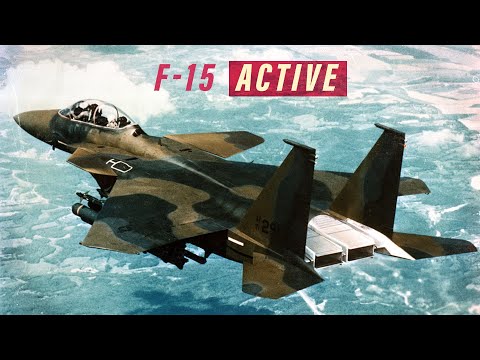
At Langley Research Center, engineers embarked on a daring quest: to equip the F-15 with thrust vectoring—a technology borrowed from rockets that could redirect engine exhaust to maneuver the aircraft in ways conventional control surfaces never could. By 1977, they had fitted an F-15B with square-shaped nozzles capable of deflecting thrust up to 20 degrees up or down. This two-dimensional vectoring was just the beginning.
The success caught the attention of McDonnell Douglas, which in 1984 won a contract to develop the F-15 STOL/MTD—a variant designed for short takeoff and landing and improved maneuverability. Integrating the Langley advances and adding forward canards, the demonstrator shattered expectations. It could land on just over 1,600 feet of runway—a quarter of the standard F-15’s requirement—and take off at speeds as low as 42 mph. In 1991, tests showed it could even reverse thrust in midair, decelerating rapidly and landing on a mere 500-foot runway.
With such promise, the aircraft was reborn in 1993 as the F-15 ACTIVE, handed over to NASA for further research. Initially, its agility was left untouched while engineers used it to test cockpit technology for the F-15E Strike Eagle. But soon, NASA would push the envelope even further.
The most dramatic upgrade came with the engines: a pair of Pratt & Whitney pitch/yaw balance beam nozzles, designated F100-PW-229, replaced the two-dimensional nozzles. Now thrust could be redirected in a full 360-degree arc—three-dimensional vectoring. NASA’s flight research report declared that the F-15 ACTIVE’s flying qualities were ‘significantly improved over production F-15 aircraft,’ with crisp, heavily damped response throughout the envelope. In supersonic flight, the canards improved stability by over 100%.
The ACTIVE program ended in 1999, but the aircraft’s journey was far from over. It went on to serve in Quiet Spike research and later became the F-15 IFCS—a test bed for a neural network system designed to identify and correct critical failures in flight. This remarkable airframe, the sixth F-15 off the production line, finally retired in 2009 as the oldest F-15 still flying.
Though never intended as a test bed for F-15 upgrades, this forgotten prototype provided invaluable insights into thrust vectoring and super maneuverability. Its legacy lives on in modern fighters like the F-22, the Su-30MKI, and the Su-57. It may be that American, Russian, and Chinese designers alike have this humble F-15 to thank for breakthroughs that define today’s aerial combat.
But how exactly did this program influence the next generation of fighters? And what other secrets does this remarkable aircraft hold? The answers lie in the details of its groundbreaking research—and the daring pilots who flew it.
The story of the F-15 ACTIVE is not just one of hardware, but of the people who strapped into it. Test pilots who flew the modified Eagle described an experience unlike any other fighter in the inventory. With three-dimensional thrust vectoring at their fingertips, they could command the nose to pivot in ways that defied conventional aerodynamics.
One pilot recalled that at high angles of attack, where a standard F-15 would begin to buffet and lose control authority, the ACTIVE simply kept pointing where he wanted it to go. The nozzles would gimbal, the canards would bite, and the aircraft would respond as if it were reading his mind. It was, in his words, like flying a fighter from a generation ahead of its time.
But the ACTIVE program was never about building a combat-ready super-fighter. Its true purpose was research—gathering data that would feed into future designs. Every flight generated reams of telemetry: thrust vector angles, control surface deflections, structural loads, and handling qualities at the edges of the envelope. Engineers at NASA’s Dryden Flight Research Center (now Armstrong) pored over this data, translating raw numbers into design principles.
The neural network system tested under the IFCS program was perhaps the most forward-looking of these experiments. The idea was to give the aircraft a kind of artificial intuition—a system that could detect a failing component or an unstable flight condition and automatically correct it before the pilot even knew something was wrong. In a sense, the F-15 IFCS was teaching a fighter jet to heal itself.
That research paved the way for fly-by-wire systems with integrated fault tolerance, now standard on every modern fighter. The lessons learned from the ACTIVE’s canards and vectoring nozzles also fed directly into the design of the F-22 Raptor, whose two-dimensional thrust vectoring nozzles owe a clear debt to the Langley and McDonnell Douglas work.
Yet the F-15 ACTIVE’s influence extends beyond American shores. When Russian engineers developed the Su-30MKI’s two-dimensional vectoring and later the Su-57’s three-dimensional system, they were building on a body of knowledge that the F-15 program had helped make public. Technical papers from the ACTIVE research were studied worldwide, and the aircraft itself became a reference point for anyone pursuing super maneuverability.
By the time the aircraft retired in 2009, it had flown for over three decades—longer than many operational fighters. It had never fired a shot in anger, never deployed to a combat zone. But its contribution to aviation was immeasurable. The sixth F-15 off the line had become a flying laboratory, and in doing so, it had shaped the future of air combat.
Today, the aircraft sits in storage, its engines silent, its nozzles still. But the data it produced lives on in every fighter that vectors thrust, every jet that lands on a short strip, every pilot who pulls a high-alpha maneuver and feels the aircraft respond with uncanny precision.
The F-15 Eagle may be the undefeated champion of the skies, but its forgotten cousin—the one with the funny nozzles and canards—is the reason the champions of tomorrow fly the way they do.
To understand the full weight of that legacy, one must look beyond the test reports and telemetry. The F-15 ACTIVE was flown by men and women who had to unlearn decades of instinct. In a conventional fighter, a pilot avoids extreme angles of attack the way a sailor avoids a reef—it is where control authority bleeds away and the aircraft begins to bite back. But in the ACTIVE, the reef had been dredged.
Test pilots described a maneuver they called ‘the pirouette’—pulling the nose past ninety degrees of alpha while the vectoring nozzles kept the aircraft flying, not falling. The jet would hang in the air, seemingly suspended, then pivot toward a new heading as if mounted on a gimbal. No operational F-15 could dream of such a thing. The data from those flights filled technical papers that circulated through design bureaus in St. Louis, Fort Worth, Moscow, and Chengdu.
What the ACTIVE proved was not merely that thrust vectoring worked—rockets had shown that for years—but that it could be integrated into a fighter without destroying its handling qualities. The canards and nozzles had to talk to the flight control computers in a language the pilot could trust. That integration was the real breakthrough.
When engineers later designed the F-22’s control laws, they leaned on the ACTIVE’s flight data to solve a thorny problem: how to blend aerodynamic surfaces and vectored thrust so seamlessly that the pilot never felt the handoff. The Raptor’s legendary agility at low speed is, in a direct line, a descendant of the sixth F-15’s experiments.
But there was a cost to all this knowledge. The ACTIVE was a one-off, a hand-built curiosity never meant for the production line. Its components were bespoke, its maintenance a nightmare of custom fittings and obsolete parts. As the 1990s wore on and budgets tightened, keeping the aircraft flying became an act of institutional will.
That will was supplied, in part, by the pilots themselves. Several of them had flown the aircraft through its STOL/MTD days and refused to let the program die quietly. They argued that the research was not finished—that the neural network work under IFCS could save lives in an era of increasingly complex cockpits.
Their persistence paid off in a way few expected: the fault-tolerant control system tested on the ACTIVE became a direct ancestor of the automated recovery systems now standard on unmanned aircraft. When a modern drone loses a sensor or an actuator, the software that keeps it flying owes something to the neural network that first learned to diagnose a failing F-15 in midair.
By the time the aircraft was finally retired, it had become something of a legend among test pilots—a jet that looked like a production fighter but flew like a glimpse of the future. Its canards gave it a shark-like profile, and its vectoring nozzles, even at rest, seemed to promise motion.
Yet the aircraft’s story does not end in a museum. The lessons of the ACTIVE continue to surface in unexpected places. When engineers began designing the next generation of air superiority concepts—the so-called sixth-generation fighters—they returned to the ACTIVE’s flight reports for guidance on how much maneuverability is worth the cost and complexity.
The answer, as the sixth F-15 had shown, was that maneuverability is not merely about turning tighter. It is about controlling the fight—dictating the terms of engagement, refusing to be cornered, and surviving the moments when technology and tactics fail.
That hard-won wisdom shaped the sixth-generation debate in ways few outside the design labs understood. Engineers pored over the ACTIVE’s flight reports not for nostalgia, but for hard numbers: how much thrust vectoring actually bought in a dogfight, how much complexity it added to maintenance, and where the trade-offs began to bite.
The verdict, repeated in briefing rooms from Wright-Patterson to Farnborough, was that vectoring was a scalpel, not a sledgehammer—devastating in the hands of a skilled pilot, wasteful in the hands of a careless one. That insight pushed designers toward adaptive cycle engines and stealthier airframes, reserving thrust vectoring for the moments that mattered most.
And so the aircraft’s final legacy was not a single design, but a philosophy: that agility must serve the mission, never the other way around. The sixth F-15 never fired a shot, yet its fingerprints are on every fighter that pivots its nose with a gimballed nozzle.
Its engines are silent now, its canards still. But somewhere, a young pilot pulls past ninety degrees of alpha, feels the jet hang and pivot, and never knows whose ghost is riding along.
What do you think—was the F-15 ACTIVE the most influential fighter that never fought, or just an expensive curiosity? Share your take in the comments below.
Report this article
Select a reason for reporting:






