In the black jungle of Muschu Island, 1945, a single Australian commando made a decision that defied every rule of military survival. His patrol was gone—seven men dead or captured—and a Japanese garrison of roughly 1,000 soldiers was hunting him through the undergrowth with orders to bring back a body or at least a head. Every trained instinct screamed: hide, stay still, wait for extraction. Corporal Mick Dennis heard all of it. And then he picked up his silent Sten, stepped deeper into the jungle, and went looking for trouble.
What happened next was not a story of desperation. It was something far more calculated and far more brutal. To understand why one man could paralyze an entire Japanese garrison, you first need to understand what Z Special Unit actually was—because the name alone tells you almost nothing.
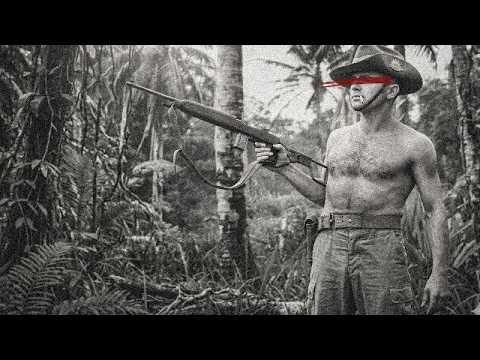
Formed in 1942 under the Directorate of the Allied Intelligence Bureau, Z Special Unit was Australia’s most secretive and most dangerous special operations force of the entire Pacific War. It was not a conventional military unit in any recognizable sense. Its operatives were handpicked from across the Australian Army, Navy, and civilian population—men who could parachute into enemy territory, live off hostile jungle for weeks, speak local languages, and conduct sabotage operations deep behind Japanese lines without any realistic prospect of reinforcement. Their missions were the kind that never made the newspapers while the war was still being fought, because acknowledging their existence would have compromised every active operation still in progress.
By April 1945, Z Special had already conducted dozens of raids across the Pacific theater—from Borneo to Timor to the islands of the Bismarck Sea. But Operation Copper, the mission to Muschu Island, was about to become one of the most extraordinary episodes in the unit’s entire history. For all the wrong reasons—and then, improbably, for all the right ones.
The strategic context behind Operation Copper was brutally straightforward. Australian command was preparing to land the 6th Division on the New Guinea mainland, and the landing beaches were directly within range of Muschu Island—a narrow volcanic strip of land sitting roughly 12 kilometers off the coast near Wewak. Intelligence reports suggested the Japanese had positioned heavy naval guns on the island. Possibly 120mm coastal artillery pieces capable of tearing apart troop transports packed with hundreds of soldiers before a single boot touched the sand. Before the invasion could proceed, someone had to get eyes on those guns, confirm their location, and bring that information back to the bombers waiting on the airstrips further south.
The mission sounded clean on paper. It was anything but clean on the ground.
On the night of April 11, 1945, a patrol of eight Z Special operators launched from the mainland by rubber dinghy toward Muschu Island under conditions of near-total darkness. The team was led by Lieutenant Arthur Jones, and Mick Dennis, at the rank of corporal, was one of his most experienced operators. The insertion plan called for a specific landing point on the island’s southern coastline—a stretch of beach screened from the main Japanese positions by dense secondary jungle. What the plan did not account for was the local current patterns around Muschu, which were treacherous, irregular, and entirely capable of dragging an unpowered rubber dinghy kilometers off course in less than an hour.
That is precisely what happened. The eight men paddled hard against a current that refused to cooperate, and by the time they reached the shore, they were nowhere near their intended landing zone. They had come ashore in the wrong place at the wrong time, leaving traces in the sand that a Japanese dawn patrol would find within hours. The clock had already started ticking before the first shot was fired.
By morning, the island was alive with activity. Japanese soldiers had found the tracks, identified the landing site, and mobilized a search operation involving multiple company-strength patrols fanning out through the jungle. One thousand men on an island roughly 12 kilometers long and 3 kilometers wide is not a comfortable ratio when you are the eight people being searched for. The contacts came fast, they came hard, and they did not go in Australia’s favor.
In a series of violent close-range engagements over the following hours, the patrol was systematically destroyed. Seven of the eight operators were either killed in action or captured. And for those captured by Japanese forces in the Pacific theater in 1945, the distinction between those two outcomes was in practice almost meaningless. When the chaos finally settled, one man was still moving through the jungle under his own power. Corporal Mick Dennis was alone, unwounded by any miracle of geometry and timing, and he was carrying a weapon that most soldiers in the Pacific had never seen and would never use.
But the fact that Dennis was still breathing was only the beginning of the question. What he chose to do with that breathing was the part that would go down in the records of the Australian War Memorial and stay there.
The Sten Mk II S was not a glamorous weapon by any standard. The Sten in its standard configuration was already regarded by most Allied soldiers as one of the ugliest, cheapest, and most mechanically unreliable submachine guns of the entire war—a stamped-metal instrument of desperation produced in British factories at a cost of roughly £2 and 10 shillings per unit, at a time when the Wehrmacht were carrying finely machined MP 40s. The Sten was the weapon you issued to resistance fighters and paratroopers when you had nothing better available, and it had a notorious habit of discharging accidentally if dropped on a hard surface. It was not a weapon that inspired confidence.
The Mk II S, however, was a different animal entirely. The S stood for silenced, and this particular variant had been developed specifically for special operations use, with an integrated suppressor machined directly into the barrel assembly. It reduced the report of the 9mm cartridge from a sharp crack to something closer to a muffled mechanical click—audible at close range if you were listening for it, but completely unidentifiable as a gunshot from more than 20 or 30 meters away, and entirely indistinguishable from the constant background noise of a working tropical jungle. Dennis had been issued this weapon for precisely the kind of close-quarters clandestine work that Z Special operations demanded. On Muschu Island, surrounded by a thousand enemy soldiers, it was about to become the single most important piece of equipment in the entire Pacific theater.
The conventional military logic in Dennis’s situation pointed in one direction only: evasion. Find a hide site, go to ground, move only at night, conserve food and water, and attempt to signal for extraction when the search intensity decreased. This was the trained response. This was the doctrine. This was what a sensible man would do when facing odds of 1,000 to 1 on a piece of jungle-covered rock in the Bismarck Sea.
Dennis appears to have considered this option and rejected it—not out of bravado or panic, but out of a clear-eyed tactical assessment. The island was too small. The Japanese search was too thorough. Staying still meant being found within days, possibly within hours. Moving meant risking contact—but contact on his terms, at distances and timings of his own choosing, with a weapon that left no acoustic signature. The mathematics, if you were Mick Dennis, were surprisingly straightforward.
And so he began to move.
The specific details of the engagements that followed over the next several days are fragmentary, pieced together from Dennis’s subsequent debriefing and from Japanese garrison records recovered after the war. What is clear is that Dennis began operating as a one-man ambush force, using the Sten’s suppressor to eliminate Japanese patrol elements at close range before the soldiers around them had registered that anything had happened. A Japanese soldier would enter a section of jungle, reach a particular point along a trail, and simply stop moving. No sound, no muzzle flash, no warning to his comrades. From the perspective of the soldiers around him, the man had simply collapsed. By the time they understood what was happening, Dennis was already repositioning through the undergrowth to a new firing point.
The effect on Japanese morale was, by every available account, profound and rapid. But this was only the first layer of what Dennis was doing to the garrison’s ability to function.
The seizure of the Japanese light machine gun was the moment Operation Copper transformed from a survival story into something that military historians would spend decades trying to adequately categorize. At some point during his solo campaign through the Muschu jungle, Dennis encountered and neutralized a Japanese machine gun position, killing the crew and taking possession of their weapon—a Type 96 light machine gun firing the 6.5mm Arisaka cartridge, fed from a distinctive top-mounted box magazine. This was not a light weapon. It weighed roughly 9 kilograms unloaded and required a trained crew of at least two men for efficient operation in a sustained firefight. Dennis was one man who had already been moving and fighting for multiple days on jungle rations and whatever water he could find.
And yet, he picked it up, added its weight to his already considerable load, and began using it. The reason was tactical rather than sentimental. A silenced 9mm submachine gun was superb for quiet, close-range elimination. A Japanese light machine gun firing in sustained bursts produced a sound signature entirely consistent with a substantial Allied raiding force operating in coordinated fashion across multiple positions.
The Japanese garrison commander on Muschu was now dealing with a situation that made no operational sense. His patrols were encountering fire from positions that moved without pattern, using both suppressed individual weapons and crew-served automatic weapons simultaneously—a combination that implied a minimum of eight to twelve trained operators moving in tactical bounds across the island’s interior. The logical conclusion, and the one the garrison appears to have reached, was that the initial eight-man patrol had been a diversionary element and that a larger Allied commando force had subsequently landed and was now conducting an offensive sweep operation across the island.
Entire companies were redirected from their original patrol routes to reinforce positions that did not need reinforcing. Reserve elements were committed to the search. The garrison’s defensive coherence—its ability to man the coastal artillery positions and respond to an amphibious landing—was being systematically degraded. Not by a platoon of commandos or a company of raiders, but by a single corporal from Queensland who had decided that hiding was not a viable strategy.
The psychological dimension of what Dennis was doing to the Japanese garrison deserves more attention than it typically receives in the standard accounts of Operation Copper. Military units exposed to what is known in modern terminology as a ghost force—an enemy element that cannot be located, cannot be fixed in place, and continues to inflict casualties despite all search efforts—experience a specific form of collective anxiety that is qualitatively different from ordinary combat stress. The knowledge that death can arrive from any direction at any time, with no warning and no acoustic confirmation, does not produce a proportionate tactical response. It produces a disproportionate one.
Patrols slow down. Soldiers bunch together for mutual reassurance, which actually makes them easier targets. Commanders commit resources to threats that cannot be confirmed because the psychological cost of not committing those resources is greater than the practical cost of depleting the reserve. Dennis, whether consciously or through an instinct refined by months of Z Special training, was exploiting exactly this dynamic. He was not just eliminating individual soldiers. He was editing the garrison’s collective decision-making capacity.
But even a man operating at the absolute outer edge of human physical and psychological endurance has a finite supply of ammunition, water, and time. After several days of continuous movement, contact, and improvised guerrilla action against a force roughly a thousand times his own numerical strength, Mick Dennis reached the coastline of Muschu Island with one problem that no amount of tactical ingenuity could solve. He was on the wrong side of a shark-infested, Japanese-patrolled stretch of water with no boat, no radio contact with the mainland, and no obvious means of crossing the roughly twelve kilometers of the Bismarck Sea that separated him from Allied lines.
The Pimm Channel was not a benign obstacle. Unpredictable currents, whitetip reef sharks, and Japanese motor launches out of Wewak Harbor made it a potential death sentence for a man in full kit, exhausted and dehydrated. Dennis’s solution was characteristically pragmatic and, by any rational assessment, borderline insane.
He found a piece of timber along the shoreline, lashed his weapons and remaining equipment to it, and entered the water under cover of darkness. He swam for more than ten hours—navigating by the stars, managing his own buoyancy and the weight of his gear, while every hour further depleted reserves already severely compromised.
He reached the New Guinea mainland. He found Allied positions. He delivered his intelligence report. The 120mm gun batteries on Muschu were struck by air attack before the 6th Division’s landing craft ever moved toward the beach. The guns were rubble. The soldiers packed into those boats never knew how close the alternative had been.
Mick Dennis received a Military Medal. The citation noted gallantry and devotion to duty in the face of overwhelming enemy opposition. It did not attempt to convey the eleven days of jungle warfare, the captured machine gun turned against its owners, or the ten-hour crossing in the dark.
A man left, a man came back. He had information. The information was used. That was enough. It was never enough, of course. But it was very Australian.
So here’s the question for you: if you were alone, outnumbered a thousand to one, with nothing but a silent weapon and your own judgment—would you hide, or would you go looking for trouble?
Report this article
Select a reason for reporting:






