The forest was silent except for the ragged breathing of four brothers. Behind them, the Nova Grudok ghetto burned. Ahead, only darkness and the cold, wet earth. They had just watched their parents be murdered by Nazi executioners—2,990 Jews slaughtered in a single day. But Tuvia, Alexander, Asael, and Aron Bielski did not run to hide. They ran to fight.
That night, deep in the woods, they made a vow. “We will not die like sheep,” Tuvia whispered. “We will make them pay.” They had no weapons, no training, no plan. Only rage. And rage, when sharpened by grief, becomes a weapon of its own.
Within weeks, thirteen other survivors joined them. The Bielski partisans were born. Tuvia, the eldest at thirty-five, had served in the Polish army—he knew how to lead. But their war was not just about killing Germans. “To save one Jew,” Tuvia said, “is more meaningful than to kill ten Nazis.” Yet they did both.
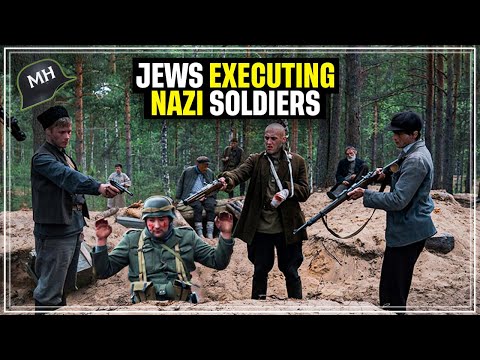
They slipped into ghettos under cover of night, whispering hope to the doomed. “We have a camp. We have guns. Come with us.” By early 1942, forty fighters. By mid-1942, over a hundred. They ambushed patrols, blew up bridges, and executed collaborators without mercy. One family of twelve informers who had betrayed two Jewish girls? Wiped out. Every last one.
The Nazis put a price on Tuvia’s head: 100,000 marks. But the forest swallowed them. They built underground shelters, a hospital, even a synagogue. Children were born in those woods. And when German troops stormed the swamp, the partisans tied themselves to trees to sleep—chest-deep in water—so they wouldn’t drown. They refused to die.
By 1944, they had executed nearly 400 enemy troops. And when the Soviets finally liberated Belarus, 1,236 Jews walked out of the forest—a line a kilometer long. The Bielski brothers had done the impossible. But their war was not over. The NKVD was waiting.
The NKVD interrogators were not interested in heroism. They wanted gold, weapons, and confessions. “You have hidden treasure,” one officer spat at Tuvia. “Where is it?” Tuvia stared back, exhausted but unbroken. “We buried our dead,” he said. “That is all we buried.”
The Soviets had no evidence of a hoard, but they didn’t need it. They needed control. Tuvia and Alexander were ordered to work for the new administration in Nova Grudok—a quiet humiliation meant to break them. Asael, the third brother, was simply conscripted into the Red Army and sent west.
In February 1945, during the brutal Battle of Königsberg, a letter arrived. Asael had been killed in action. The official notice called it a heroic death. The brothers called it something else. “He survived the Nazis,” Alexander said, crushing the paper in his fist, “only to die for Stalin.”
That was the moment they knew they could not stay. The same government that had abandoned them in 1941 was now swallowing their homeland whole. In late 1945, Tuvia, Alexander, and Aron slipped out of Poland with forged papers and a handful of photographs. They crossed into Czechoslovakia, then Austria, then a displaced persons camp in Italy. From there, a ship to America.
New York was loud, gray, and free. Tuvia found work as a truck driver. Alexander opened a small grocery. Aron, the youngest, went to school and learned English from comic books. They rarely spoke of the forest. But at night, Tuvia would sometimes wake up gasping, still smelling the swamp.
In 1955, a journalist tracked them down. He wanted the full story—the 1,236 survivors, the 400 dead Nazis, the underground synagogue. Tuvia refused at first. “We did not do it for newspapers,” he said. But Alexander convinced him. “If we don’t tell it,” he argued, “they will say it never happened.”
So Tuvia talked. He talked about the night his parents died. About tying children to trees in the swamp. About the girl born in the forest whom they named after a flower that grows in Belarus. The journalist wrote it all down, but when the article was published, it was buried on page twelve. America in the 1950s did not want Jewish avengers. It wanted quiet survivors.
But the story refused to stay buried. In 1993, a filmmaker named Richard found himself in a cramped Florida apartment, staring at a frail old man with sharp eyes. Aron Bielski was the last one left. Tuvia had died in 1987, Alexander in 1995—waiting, it seemed, for someone to ask. “Tell me about the forest,” Richard said. Aron leaned forward. “Which part?”
For three days, Aron talked. He described the smell of pine and gunpowder, the sound of his mother’s voice before the massacre, the weight of a rifle he barely knew how to fire. He spoke of Tuvia’s cold fury and Alexander’s quiet courage. And he spoke of the line—that kilometer-long line of 1,236 Jews emerging from the woods, blinking in the sunlight, alive.
Richard turned the tapes into a film. When it premiered in 2008, audiences wept. Critics called it a story of resistance and dignity. But the most striking moment came during a question-and-answer session. A young woman stood up. “Why didn’t they just run?” she asked. “Why stay and fight?”
Aron, then in his eighties, rose slowly to his feet. The room fell silent. “Because running is not living,” he said. “My brothers understood that. If you run from evil, it follows you. But if you stand—even in a swamp, even with no bullets—you make it afraid.”
The audience erupted. But Aron was not finished. He pulled a worn photograph from his jacket pocket—four young men in ragged coats, rifles slung over their shoulders, eyes blazing with defiance. “This is my family,” he said. “Not victims. Fighters.” He placed the photo on the podium and walked off the stage.
That photograph now hangs in the United States Holocaust Memorial Museum in Washington. Beneath it, a simple caption: The Bielski Partisans. They saved 1,236 lives. But the story has another chapter, one that historians are still piecing together.
Recently declassified Soviet documents reveal that the NKVD never stopped hunting the Bielskis. Even in America, the brothers were watched. Their phones were tapped. Their mail was opened. The Soviets believed Tuvia had smuggled out a fortune in gold and diamonds—the so-called “Bielski treasure.” They were wrong.
But the treasure was real. Not gold. Not diamonds. Memory. Tuvia kept a diary in the forest, written in Yiddish on scraps of paper and hidden in a tin box. He buried it before the liberation. In 1997, a team of archaeologists—following directions Aron had drawn from memory—dug it up near the old campsite.
The diary was water-stained and barely legible. But one entry, dated July 1944, survived: “Today we walked out of the forest. The sun was so bright it hurt. A child asked me if we were still in danger. I told her no. But I lied. The danger never ends. It only changes its face. So we must remember. Always remember.”
The diary now sits in a glass case in Jerusalem, beside a rusted rifle and a child’s shoe. Historians call it the most important partisan document ever recovered. But for the descendants of the 1,236, it is something simpler: a promise kept.
Every year, on July 8th, they gather. Not in a museum. In a clearing near Nova Grudok, where the forest still smells of pine and rain. They light candles. They read names. And they tell the story again—to their children, to strangers, to anyone who will listen.
In 2019, a great-granddaughter of Tuvia Bielski stood in that clearing. Her name was Maya. She was nineteen, born in Tel Aviv, never having met her famous ancestor. She held a translation of the diary in one hand and a microphone in the other. “My great-grandfather wrote that the danger never ends,” she said. “He was right. But neither does the courage.”
The crowd was silent. Then an old woman stepped forward. She was ninety-two, frail, leaning on a cane. Her name was Rivka. She had been six years old in the forest—one of the children tied to trees in the swamp. “I am here,” she said, her voice cracking, “because Tuvia Bielski did not run. I am here because he stood.”
Maya embraced her. Cameras flashed. But the moment belonged to no one but them—the living and the dead, bound by a line a kilometer long.
Today, the Bielski story is taught in schools from Warsaw to Washington. Films have been made. Books have been written. And yet, Aron’s warning echoes: “The danger never ends. It only changes its face.”
In an age of rising hatred, of new ghettos and new tyrants, the Bielskis remain a mirror. They ask us a question that has no easy answer: when evil comes, will you hide? Will you run? Or will you tie yourself to a tree in the swamp and refuse to drown?
The forest is quieter now. The partisans are gone. But the line—that long, improbable line of survivors—still walks. It walks in their children, their grandchildren, their stories. And it asks us, every one of us, to decide where we stand.
So here is the question, dear reader: If the forest called you tomorrow—if you heard the whisper of Tuvia Bielski in the wind—would you join the line? Or would you look away?
Tell us in the comments. Because the danger never ends. And neither, if we are brave, does the memory.
Report this article
Select a reason for reporting:






