The oxygen mask fogged with every breath as the lone P-51 Mustang climbed to 11,000 feet. Below, a formation of B-17 bombers limped westward, smoke trailing from three of them. The pilot, James Howard, pulled the trigger. Nothing happened. Three of his four guns had jammed, frozen solid at altitude—exactly the flaw mechanics had warned about. He had one working gun left, and thirty Luftwaffe fighters were converging from every direction.
Six months earlier, veteran pilots had called this aircraft a death trap. They said its wings were too thin, its fuel system too fragile, its guns too unreliable. They were wrong about almost everything else, but not about the guns. Not today.
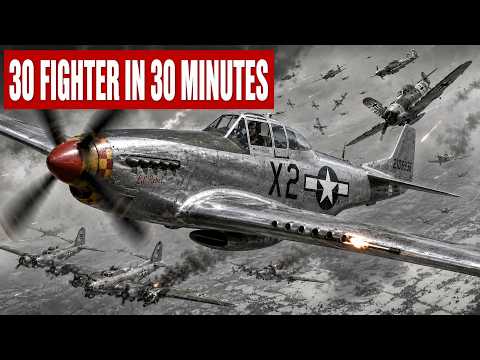
Howard was no stranger to combat. He had already earned six confirmed kills with the Flying Tigers in Burma, flying obsolete P-40s against a superior enemy. He knew that speed and positioning mattered more than numbers. But this was different. This was thirty against one.
As the German fighters closed in, Howard made a split-second decision. He pushed the throttle forward and dove into the fray. The Mustang accelerated hard, wind screaming over the canopy. He picked his first target—a twin-engine Messerschmitt—and fired. The German aircraft exploded.
But the odds were impossible. The fighters swarmed him like wolves, and within minutes, his last working gun fell silent. He was now flying an unarmed fighter. Every instinct said run. But below, ten men in each bomber were watching, hoping for a miracle.
Howard didn’t run. He kept diving at the enemy, bluffing with empty guns. The Germans, rattled by his aggression, began to break off. One by one, they turned away, until the sky was clear.
Thirty minutes later, the battered bombers flew on, saved by a single pilot who refused to give up. Howard landed back at base, his hands still shaking. He didn’t yet know that his actions would become legend.
Word of the engagement spread through the 354th Fighter Group before Howard had even finished cleaning up for dinner. Ground crews who had counted the mission’s returning aircraft repeated his account to anyone who would listen. And the story grew stranger and more improbable with each retelling, the way stories about impossible odds always did among men who understood exactly how impossible those odds actually were.
What made this story different was that it did not need embellishment. The eyewitnesses were not exaggerating. Crews aboard the 401st Bomb Group’s battered B-17s filed their own reports independently, describing a defense so persistent and so effective that several crews initially assumed an entire squadron of Mustangs had come to their rescue. When intelligence officers began cross-referencing accounts, comparing flight logs, radio transcripts, and the positions of every American fighter recorded in the area that day, the truth proved more remarkable than the initial exaggeration. One aircraft, one pilot, thirty minutes.
The official tally credited Howard with destroying several German fighters outright, with additional probable kills and damage claimed against others. Though even decades later, different sources would settle on slightly different final numbers—the fog that settles over any battle fought at that speed and scale never quite lifting completely.
Howard’s own account of the engagement remained notably restrained, given what he had actually done. When asked how many aircraft he believed he had destroyed, he gave a modest figure, unwilling to claim credit for kills he had not personally confirmed through his own eyes rather than assumption. This reluctance to inflate his own record, even when witnesses were prepared to credit him with more, said something about the man that the medal citation alone could not fully capture.
He had not gone looking for glory that afternoon. He had gone looking for a way to keep ten strangers alive, and counting corpses afterward felt to him almost beside the point.
The gun camera footage from his aircraft, once developed and reviewed, removed any remaining doubt about what had happened over Oschersleben. Analysts and fellow pilots studied the film and saw a man executing maneuvers that should have been reckless in any aircraft, let alone one still carrying a reputation for structural fragility and unreliable weapons. The Mustang had done everything asked of it and more, absorbing the stress of sustained high-speed combat without a single mechanical failure beyond the frozen guns that had plagued the type since its earliest missions.
Engineers back in the United States would eventually trace the ammunition feed problem to its root causes and correct it. But on this particular day, the aircraft’s airframe and engine had proven every skeptic at Boxted wrong—even while its weapons betrayed the man flying it.
Recognition moved through official channels with a deliberateness that felt, to men who had lived through the actual event, strangely disconnected from the urgency of the moment itself. Months passed while reports worked their way up through the chain of command, verified, cross-checked, and finally approved. In June of 1944, Howard received the Medal of Honor, the highest decoration the United States military can bestow, becoming the only fighter pilot in the entire European theater of operations to receive it during the war.
The citation described his actions in the clipped formal language such documents always use—gallantry, intrepidity, disregard for personal safety—words that could never quite convey what it actually felt like to fly an unarmed fighter directly at an enemy formation and trust that fear alone would do the work his guns no longer could.
When the medal was presented, Howard did not use the occasion to celebrate his own accomplishment. He spoke instead about the men who had not returned from missions just as dangerous—pilots and bomber crews whose courage matched his own, but whose stories no camera had captured and no formation of grateful witnesses had survived to report.
He said, in words that would follow him for the rest of his life, that he felt himself a symbol for all those whose actions had gone overlooked and unrecognized—men who had given everything and received nothing in return beyond a name on a casualty list. It was not false modesty. Everyone who knew him understood that he meant it exactly as he said it.
The following February, Howard was promoted to lieutenant colonel and given command of the entire 354th Fighter Group—the same unit that had once worried openly about the aircraft they flew. Word of the Oschersleben engagement traveled through every fighter group in the Eighth Air Force within weeks, and the effect on the Mustang’s reputation was immediate and lasting.
A machine that pilots had called a death trap only months earlier was, by the summer of 1944, the aircraft every fighter pilot in Europe wanted to fly—the one with the range to reach Berlin and the performance to fight and win once it got there. Engineers continued refining the ammunition feed system, gradually solving the jamming problem that had nearly cost Howard everything. But the aircraft’s core reputation had already been settled in the minds of the men who flew it and the bomber crews who depended on it.
Howard continued flying combat missions through the following months, adding to his combined total of victories from two different theaters of a war that had by then stretched across most of the world. He commanded his group with the same quiet competence that had defined his time in Burma, training younger pilots—some of whom had heard the Oschersleben story so many times it had taken on the texture of legend before they ever met the man at its center.
He did not encourage the legend. When pilots asked him directly about the fight, he answered plainly, without embellishment, describing decisions and mechanical failures in the same measured tone he might have used to describe a routine training flight.
The war in Europe ended in the spring of 1945, and Howard, like millions of other men, eventually traded his uniform for civilian clothes and tried to build an ordinary life on the other side of an extraordinary war. The transition was not easy. He would later describe the years immediately following his return as a period of genuine difficulty—an adjustment that combat decorations and public recognition did nothing to soften.
He found his footing eventually, serving for a time as chief of aeronautics for the city of St. Louis before building a business installing communication systems—work that had nothing to do with fighter planes or medals and everything to do with the patient, practical competence that had always defined him beneath the wartime headlines.
In one of his rare later interviews, asked directly why he had turned back that day instead of flying home when every rule and every reasonable instinct told him to save himself, Howard gave an answer stripped of any grand rhetoric about heroism or duty. “There were ten men in that bomber. They had families waiting for them. I was in a position to help, so I did.”
When the interviewer pressed further, noting that the odds that day had been close to suicidal, Howard did not dispute the arithmetic. He simply said the arithmetic had never been the point.
James Howard died in 1995, decades removed from the thirty minutes that had defined how history would remember him—though never how he chose to define himself. He was buried with full military honors, a general officer’s rank eventually attached to a name that had first entered military records as a Navy ensign learning to fly.
The aircraft he flew that January morning—borrowed from another pilot, painted with someone else’s markings—no longer exists in any recoverable form, scrapped and recycled in the years after the war along with thousands of other machines the country no longer needed once the fighting stopped.
What survives is the record. The gun camera footage, preserved and studied at military academies where new generations of fighter pilots learn the same lessons Howard’s example still teaches: that courage is not the absence of fear but the decision to act despite it; that an aircraft’s reputation and its actual performance are two separate questions; and that mathematics, however brutal, does not always have the final word over what one determined person can accomplish.
Somewhere below him that January morning, ten men in a damaged bomber had no way of knowing whether help was coming. It came anyway—alone, undermanned, half its weapons already useless—and it stayed until the job was finished. That, in the end, was the only accounting Howard ever seemed to think mattered.
What would you have done in that cockpit—turn for home, or dive into thirty-to-one odds with three guns jammed?
Report this article
Select a reason for reporting:






