On April 27, 1941, the swastika was raised over the Acropolis. Athens, the cradle of democracy, had fallen to the Nazi war machine. The Greek people, who had just humiliated Mussolini’s forces, now faced a far more ruthless enemy. What followed was one of the darkest chapters of World War II—and one of the most inspiring stories of human resilience.
The occupation of Greece by the Axis powers was marked by brutality that stunned even seasoned war correspondents. From mass executions to deliberate starvation, the Greeks suffered a fate that surpassed that of almost any other occupied nation in Europe. Yet, they refused to bow. This is the story of a people who fought back with everything they had—and in doing so, changed the course of history.
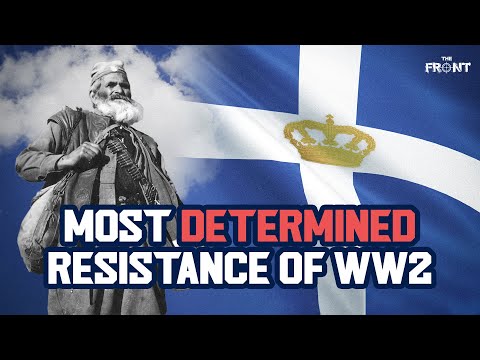
Between April 1941 and October 1944, Greece was divided among three occupiers: Germany, Italy, and Bulgaria. The Italians were considered the mildest, but the Bulgarians, eager to expand their territory, were particularly harsh in the north. The Germans, however, were clinical and efficient in their cruelty. Greece would suffer the greatest loss of life and destruction of any non-Slavic country in Europe.
Conservative estimates place the death toll at 300,000 out of a population of 7 million. 50,000 resistance fighters and civilians died in reprisals, 50,000 to 60,000 Jews were deported to concentration camps, and tens of thousands starved. Over 800 villages and towns were razed to the ground.
Life under German occupation was a waking nightmare. Curfews were imposed, censorship was strict, and anyone suspected of anti-German activity was arrested, tortured, or executed. In cities like Thessaloniki, Ioannina, and Corfu, Jews were systematically rounded up and sent to their deaths. The Germans also plundered the country’s wealth, emptying the national treasury and seizing livestock and food supplies.
The resulting famine was catastrophic. In the winter of 1941-1942, an estimated 300 people died daily in Athens alone. People ate weeds, stray animals, and even food scraps from German garbage. One witness, 90-year-old Logothetis, recalled: “My aunt picked large, juicy plants from the cemetery—the soil there was fertile.” Another, 89-year-old Alexandra Magou, remembered the terror of air raids and the harsh punishments for minor infractions: “One night my mother forgot to black out a window. The Germans took my father’s ID and demanded 30 eggs as punishment.”
But the worst was yet to come. When resistance fighters killed a German soldier, the reprisals were swift and savage. “One of ours for eight of yours,” the Germans declared after executing eight civilians for one Nazi. Entire communities were wiped off the map—more than 800 in total. These burnings were known in Greek as holocausts, meaning “completely burnt.”
The most infamous atrocity was the Kalavryta Holocaust. On December 13, 1943, German troops rounded up the town’s population. Women, children, and the elderly were locked in a schoolhouse while nearly 500 men were led to a hill overlooking the burning town. There, they were machine-gunned down as their homes turned to ash. The women and children managed to escape before the flames reached the school. In total, 677 unarmed civilians were executed.
Despite the relentless terror, the Greek spirit remained unbroken. On May 30, 1941, barely a month after the swastika was raised, two young men, Manolis Glezos and Lakis Santas, scaled the Acropolis and tore down the Nazi flag. It was a small act, but it sent a powerful message: Greece would not submit.
That defiant spirit spread like wildfire. By the autumn of 1941, organized resistance movements had taken root across the country. The most powerful was the National Liberation Front, known as EAM, founded by the Communist Party of Greece. Its military wing, the Greek People’s Liberation Army—ELAS—would grow into one of the largest resistance forces in occupied Europe.
From the mountains, ELAS fighters launched guerrilla raids on German outposts, sabotaged supply lines, and vanished before the occupiers could strike back. A smaller, more right-leaning group, the National Republican Greek League—EDES—operated in the northwest, and despite deep political rivalries, the two factions sometimes fought side by side against a common enemy.
The resistance was not confined to armed fighters. Ordinary citizens—women, the elderly, even children—played crucial roles. When the Germans ordered the roundup of Jews, Greek families hid Jewish children in their homes, knowing that discovery meant execution. In Athens, the funeral of the national poet Kostis Palamas turned into a massive demonstration against the occupation. Telecommunications workers staged one of the first strikes in occupied Europe.
On the island of Crete, the resistance took on a legendary quality. After German paratroopers landed in May 1941, villagers attacked them with knives, axes, and bare hands. British SOE officer Patrick Leigh Fermor later wrote: “Villagers, shepherds, old men, boys, monks, priests, and even women rose up without any plan, without weapons, and threw themselves at the invaders.”
Among the most celebrated figures was George Psychoundakis, a young shepherd who served as a runner, carrying intelligence between isolated British cells hidden in the mountains. Fermor described him as a man of boundless humor and courage: “If anyone could round Crete in forty minutes, it was him.”
Perhaps the most daring operation of the entire occupation came in April 1944. British officers and Cretan resistance fighters kidnapped General Heinrich Kreipe, the German commander on the island, right outside his headquarters. They smuggled him through the mountains for weeks while German search parties scoured the island. The operation was a humiliating blow to the Nazi high command and a triumph of Greek-British cooperation.
On the mainland, the resistance scored another decisive victory in November 1942. During Operation Harling, a joint team of ELAS, EDES, and British commandos destroyed the Gorgopotamos Bridge, cutting the vital railway line that supplied German forces in North Africa. It was the first major sabotage operation against the Axis in Europe, and it disrupted German logistics for months.
But the cost of resistance was staggering. For every German soldier killed, civilians paid with their lives. In the village of Distomo in June 1944, SS troops massacred 218 civilians in retaliation for a partisan attack. Babies were bayoneted in their cribs; women were raped and then executed. The village was then burned to the ground. Across Greece, similar scenes played out as the occupiers tried to crush the will of the people through sheer terror.
Yet the Greeks did not break. In the cities, they organized soup kitchens and secret schools. In the countryside, they smuggled food and medicine to the fighters. Alexandra Magou recalled how her family secretly charged batteries for the partisans’ radios: “We hid them under mulberry leaves during the day. At night, my neighbor carried them in baskets of manure to the vineyard, where the fighters picked them up.”
Even as the tide of war turned, the occupation grew more desperate and more brutal. But by the summer of 1944, the end was in sight. The Red Army was advancing from the east, and the Western Allies had landed in Normandy. On October 12, 1944, the German troops abandoned Athens. Two days later, British forces arrived to jubilant crowds. The government-in-exile returned four days after that.
Greece was free. But the scars of occupation ran deep. The country had lost 300,000 of its people, hundreds of villages had been erased, and its economy lay in ruins. And the political divisions sown during the resistance would soon erupt into a bitter civil war that would claim even more lives.
Yet the story of Greek resistance remains one of the most remarkable chapters of World War II. Winston Churchill declared: “The word heroism does not do justice to the smallest of those self-sacrificing acts of the Greeks.” Franklin Roosevelt praised their “heroic struggle.” And Joseph Stalin, after Stalingrad, said: “I regret that I am growing old and will not live long enough to thank the Greek people, whose resistance decided the Second World War.”
From the mountains of Epirus to the streets of Athens, from the beaches of Crete to the villages of the Peloponnese, the Greeks fought with a ferocity born of desperation and a love of freedom that no occupier could extinguish. They were outgunned, outnumbered, and starved. But they never surrendered.
Their story is a reminder that courage is not measured in weapons or numbers, but in the willingness to stand up against overwhelming odds. And in that, the Greeks stood taller than giants.
The price of liberation, however, was not measured only in ruins and graves. It was measured in the fracturing of the nation itself. No sooner had the Germans withdrawn than the old rivalries between the resistance factions—EAM-ELAS on the left and EDES and the returning exile government on the right—exploded into open conflict. The very men who had fought side by side in the mountains now turned their guns on one another.
In December 1944, just weeks after the last German soldier left Athens, British troops found themselves fighting street battles against ELAS partisans in the capital. The Dekemvriana, as it became known, was a bitter prelude to the Greek Civil War. The dream of a united, free Greece began to dissolve in blood and suspicion.
For the villagers who had risked everything to hide fighters and feed the resistance, the new war was a cruel twist. Neighbors who had shared bread during the famine now denounced one another as traitors. The same mountains that had sheltered guerrillas became battlegrounds between Greeks.
Yet even in this darkness, the memory of the occupation years endured as a source of pride. When the Civil War finally ended in 1949, Greece emerged scarred but not broken. The generation that had torn down the swastika and charged German paratroopers with farm tools would go on to rebuild their country from the ashes.
Today, in villages like Kalavryta and Distomo, memorials stand where houses once burned. Every December 13, the people of Kalavryta still gather at the hill of Kappys, where their fathers and grandfathers were executed, to light candles and remember. The clock in the town’s church remains stopped at the hour of the massacre—a silent witness to what was lost.
And in Athens, on the rock of the Acropolis, a small plaque commemorates the night two teenagers climbed the ancient walls and tore down the flag of the Reich. It bears the names Manolis Glezos and Lakis Santas—ordinary Greeks who proved that defiance, even in the smallest act, can echo through history.
The story of Greek resistance did not end with liberation or civil war. It lived on in the people who survived—in the shepherd who ran messages across Crete, in the women who charged batteries by night, in the children who learned to read in secret schools. Their courage became the foundation on which modern Greece was rebuilt.
Alexandra Magou, who hid partisans in her attic, lived to see her grandchildren grow up in a free country. Logothetis, who ate weeds from the cemetery, saw Athens rise again from rubble. They never forgot the hunger, the fear, or the friends they lost. But they also never forgot that they stood together.
Historians still debate the numbers, the politics, the mistakes. Yet one truth remains beyond dispute: a small nation, abandoned by many and outmatched by all, refused to surrender its soul. From the ashes of Kalavryta to the flag that flew again over the Acropolis, Greece proved that freedom is not given—it is claimed.
So when we ask what the Greek resistance means today, the answer is simple. It means that even in the darkest hour, ordinary people can do extraordinary things. It means that courage is contagious, and that hope can survive a holocaust of fire and blood.
What would you have done if you were in their place—would you have hidden a Jewish child, charged a partisan’s battery, or torn down a flag? Share your thoughts below.
Report this article
Select a reason for reporting:






