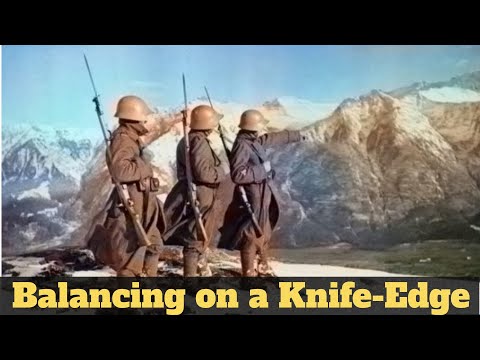
September 1939. As German tanks roll into Poland and Britain and France declare war, three nations stand at the precipice. Turkey, Sweden, and Switzerland—each clinging to neutrality—are about to discover that staying out of the fight is the most dangerous game of all.
Surrounded by Axis powers and Allied demands, they must navigate a minefield of diplomacy, trade, and espionage. One wrong move could mean invasion. One misstep could mean annihilation.
In Turkey, President İsmet İnönü faces a brutal calculus. The Straits are a strategic prize coveted by both Hitler and Stalin. “We must balance between the devil and the deep sea,” his advisors warn. German victories in 1940 embolden Berlin’s demands, but British offers of military aid complicate everything. Every decision risks dragging Turkey into a war it cannot afford.
Sweden’s dilemma is equally stark. Its iron ore fuels the German war machine, making it a target for Allied sabotage and Nazi coercion. When Germany invades Norway in April 1940, Sweden is encircled. “We are a mouse between two cats,” a Swedish diplomat confides. The government must choose: allow German troop transits or face invasion.
Switzerland, fortified in its Alpine redoubt, mobilizes 430,000 troops under General Henri Guisan. But military readiness alone cannot stop the pressures of total war. “Neutrality is not a shield; it is a constant negotiation,” Guisan declares. As German planes violate Swiss airspace and Allied spies flood its cities, the Confederation becomes a hub of espionage and economic bargaining.
As 1941 approaches, the neutral states are already deep in the fray—not with armies, but with trade deals, transit rights, and intelligence networks. Their survival hinges on a delicate balance of concessions and defiance. But the war is only escalating, and the hardest choices are yet to come.
By early 1941, the pressure on all three states had sharpened into something more dangerous than mere diplomacy. Each government now understood that neutrality was no longer a refuge—it was a performance, staged daily for audiences in Berlin, London, and Moscow. The question was not whether they would be tested, but how severely, and how soon.
In Ankara, İnönü’s cabinet watched the German advance through the Balkans with mounting alarm. Bulgaria’s accession to the Axis in March 1941 brought Wehrmacht divisions to Turkey’s European doorstep. “The Balkans are falling like dominoes,” Foreign Minister Şükrü Saracoğlu warned the cabinet. “We are next in line—unless we give Berlin a reason to leave us alone.”
The result was the Treaty of Friendship signed with Germany on June 18, 1941—just four days before Operation Barbarossa. It was a masterstroke of timing, offering Berlin a diplomatic victory without binding Turkey to anything beyond non-aggression. Yet Turkish generals privately admitted the army was in no condition to fight anyone.
Mobilized troops along the Thracian frontier trained with rifles dating back to the First World War. “We have the men,” one Turkish colonel confessed to a British attaché, “but we lack the guns, the trucks, the tanks. If the Germans come, we can hold the Straits for perhaps two weeks.” That estimate, passed quietly to London, shaped Allied expectations for the rest of the war.
Sweden’s reckoning arrived with the same German sweep. The occupation of Norway in April 1940 had sealed its western flank; now the Balkans and Finland threatened the east and south. “We are a corridor,” a Swedish general told his staff, “and corridors exist to be marched through.”
When Berlin demanded permission for the Engelbrecht Division—some 15,000 troops—to transit Swedish railways from Norway to Finland in June 1941, Stockholm faced its gravest decision of the war. Refusal risked immediate invasion. Consent would stain Sweden’s neutrality before the entire world.
The government approved the transit, but only after extracting assurances that the troops would carry no combat role against the Allies and that the arrangement would end once the Finnish front stabilized. The Swedish press, under censorship, reported it as a “technical transport.” Privately, King Gustav V told his ministers, “We have chosen survival over honor. History may judge us harshly.”
That same month, Swedish intelligence intercepted German communications revealing preparations for Barbarossa. Stockholm passed warnings to London through diplomatic channels—a quiet act of defiance that would later be cited in Sweden’s defense.
Switzerland’s test came from the sky. In the summer of 1941, Allied bombers bound for Italy began crossing Swiss airspace with increasing frequency. Swiss fighters, following Guisan’s orders, intercepted where possible, but the Luftwaffe’s shadow loomed larger. “Every plane we shoot down,” Guisan warned the Federal Council, “is a note in Berlin’s ledger of grievances against us.”
When German aircraft violated Swiss airspace in pursuit of Allied bombers, the government lodged protests—and quietly ordered its pilots to avoid engagement unless Swiss territory was directly attacked. The compromise infuriated hardliners but preserved the fragile equilibrium. “We are not fighting a war,” a Swiss officer wrote in his diary. “We are managing one.”
The economic vise tightened as well. In the autumn of 1941, the Allied blockade committee in London began compiling lists of Swiss and Swedish firms suspected of supplying the Reich. Swiss watchmakers, whose precision instruments guided German bombers, found themselves named in British newspapers. Swedish ball-bearing factories, essential to Luftwaffe engines, became targets of Allied economic warfare.
“Every bearing we ship to Germany,” a Swedish industrialist confided, “is a bomb that may fall on London. But every worker we dismiss is a family that may starve.” The moral arithmetic of neutrality had become unbearable—and the war had only just begun to reveal its full demands.
By the winter of 1941–42, the neutral states had settled into a grim rhythm of endurance. Each month brought new demands, new concessions, and new reasons to fear that the arrangement might collapse at any moment. Yet collapse did not come. Instead, the war widened, and with it the margin for error narrowed to almost nothing.
In Ankara, the German drive toward the Caucasus in the summer of 1942 sent fresh tremors through the capital. When Wehrmacht units raised the swastika over Mount Elbrus, İnönü summoned his commanders to an emergency session. “If the Germans reach Baku,” he told them, “they will be two hundred kilometers from our border. We must decide now what we will do if they ask for passage.”
The answer, after three days of debate, was nothing short of a gamble. Turkey would reinforce its eastern frontier—over a million men under arms—while quietly signaling to London that it would resist any German demand for transit. To Berlin, Ankara offered only vague assurances of continued friendship and chromium deliveries. “We are walking a wire stretched between two cliffs,” Saracoğlu wrote in his diary. “Below us, only fire.”
The wire held. German forces never reached Baku, and the crisis receded as Stalingrad began to consume the Wehrmacht’s strength. But Turkish leaders emerged from that autumn convinced of one thing: the war would be decided in the East, and Turkey’s future depended on backing the winner—without ever appearing to choose sides too early.
Sweden’s crisis came not from armies but from factories. In early 1942, Allied intelligence identified Swedish ball bearings as a bottleneck in German aircraft production. British planners drew up Operation Bridford—a scheme to bomb the SKF works at Göteborg—and only the intervention of cooler heads in London postponed it.
Instead, the Allies applied economic pressure. “We are asked to choose between starving and burning,” a Swedish cabinet minister remarked. “The Allies offer us coal if we refuse Germany steel. Germany offers us steel if we refuse the Allies coal. We have neither, and both.”
Sweden’s response was a masterclass in bureaucratic evasion. Export licenses were granted, then delayed. Shipments were routed through intermediaries in neutral ports. When Allied inspectors demanded figures, Stockholm produced ledgers so complex that verification became impossible. “We are not lying,” one trade official insisted to his British counterpart. “We are simply telling the truth very slowly.”
The strategy bought time, but it also bred resentment. In London, Swedish neutrality was increasingly described as a fig leaf for collaboration. In Berlin, German officials complained that Swedish deliveries fell short of promises. Caught between two dissatisfied giants, Sweden survived on the narrowest of margins—and on the growing conviction in Stockholm that Germany would eventually lose.
Switzerland’s winter was defined by a different kind of siege. The Allied blockade had cut off coal supplies, and the Federal Council faced a stark choice: negotiate with Germany for fuel or watch Swiss industry freeze. “We will trade with the devil if the devil has coal,” a Swiss banker told the cabinet, “but we will keep the receipts.”
The resulting agreements were carefully calibrated. Switzerland would export precision instruments and machine tools to Germany in exchange for coal, but quantities were capped and deliveries monitored by Swiss officials. When Allied protests arrived, Bern pointed to the caps as proof of restraint. When German pressure mounted, Bern cited the caps as proof of its limits. The same document served as both shield and alibi—a diplomatic ambiguity that Swiss officials perfected into an art form.
Espionage flourished in this hothouse of ambiguity. In Bern, the OSS station run by Allen Dulles became a clearinghouse for intelligence from across occupied Europe. German officers disillusioned with Hitler made contact through Swiss intermediaries; Allied agents passed information on troop movements through Swiss couriers. “Bern is a city of whispers,” Dulles later wrote. “Every café table holds a conspiracy, and every conspiracy holds a waiter who reports to someone.”
Swedish intelligence operated in similar shadows. The C-byrån, Sweden’s secret service, ran networks in Norway and Denmark that monitored German naval movements in the Baltic. Information flowed to London through Swedish diplomatic pouches—a channel that Berlin suspected but never proved. “We are neutral in public,” a Swedish intelligence officer confided, “and partisan in private. The trick is never to let the two meet.”
Turkey’s intelligence services played a different game. With agents in the Balkans and the Caucasus, Ankara gathered information on German and Soviet intentions alike. Some of it was shared with the British; some was withheld. “Information is our only export that both sides want,” a Turkish intelligence chief observed. “We sell it carefully, and we never sell the same fact twice.”
By the spring of 1943, the neutral states had survived the war’s most dangerous phase. Stalingrad had broken the myth of German invincibility; Allied convoys were reaching Murmansk; and the tide in North Africa had turned. Yet survival had come at a price. Each state had accumulated a ledger of compromises—transits, exports, financial dealings—that would be scrutinized for decades to come.
In Stockholm, a government commission quietly began compiling records of wartime decisions, anticipating the day when questions would be asked. In Bern, Swiss bankers started shredding documents that might prove embarrassing—a process that would haunt the country half a century later. In Ankara, Turkish diplomats prepared for the delicate task of abandoning neutrality without appearing to betray it.
The war was not yet won, but the neutrals could see its end approaching. The question now was not how to survive the fighting, but how to survive the peace.
By early 1945, the neutral states read the shifting tide and moved to secure their places in the coming order. On February 23, Turkey declared war on Germany and Japan—a symbolic blow that opened the door to the United Nations. Sweden had already curtailed iron exports and extended humanitarian aid, while Switzerland quietly reduced trade with Berlin under Allied pressure.
The war in Europe ended in May. For Ankara, Stockholm, and Bern, the fighting was over—but the reckoning had just begun. Allied investigators demanded answers about gold, ball bearings, and chromium. Each nation defended its record as survival, not collaboration.
Sweden’s rescue missions and Turkey’s late alignment earned grudging respect. Switzerland’s banking secrecy drew sharpest scrutiny. Neutrality had preserved their sovereignty, but it left a moral ledger that would never fully balance.
Was their tightrope walk between Hitler and the Allies a triumph of survival—or a compromise too far? What would you have done?
Report this article
Select a reason for reporting:






