In the late 1930s, a box of piston rings arrived at Toyota. They were built by a young mechanic who had staked everything on them. Toyota’s inspectors tested them one by one. The way the story is usually told, 50 went in, three passed. The mechanic’s name was Soichiro Honda.
Within a few years, Toyota would own 40% of his company. Then an American bomber and an earthquake would take his factories, and Toyota would buy what was left. By 1982, that same reject was building cars in Ohio—six years before Toyota built one in America on its own.
And the stubbornness that carried him past Toyota, his own government, and Detroit would one day turn on his own company.
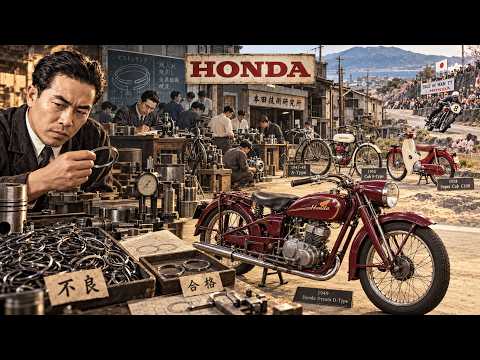
Komyo was not a place where anything was supposed to happen. It was a farming village in Shizuoka Prefecture, in the hills north of Hamamatsu, more than 100 miles southwest of Tokyo. It had rice paddies, dirt roads, and paper windows.
On November 17th, 1906, a boy was born there to a blacksmith named Gihei Honda and his wife Mika. They named him Soichiro. He was their eldest son.
The family was poor. They were not desperate, but they were poor in the way that leaves no room for waste. Gihei worked iron at the forge. When bicycles began appearing in Japan, he started fixing those, too. Then he started buying broken ones, rebuilding them, and selling them on.
The boy grew up inside that shop among sparks, grease, and the ring of a hammer on hot metal. He learned with his hands long before he learned anything from books.
Then when he was still very small, something came down the village road that almost no one in Komyo had ever seen: an automobile. It rattled, it smoked, it threw dust over everything it passed. The boy did not run from it. He ran after it as hard as his short legs would carry him until it pulled away and was gone.
Decades later, as the head of one of the biggest companies in Japan, he was still describing that moment. He trembled as it came closer. The dust swallowed him as it passed, and the oil it left behind on the road had a smell he never forgot. To him it was sweeter than perfume.
Most children forget their first obsession. He built a life on his.
School went badly. He was bright, but he had no patience for anything he could not take apart. When his report cards came home with marks he did not want his parents to see, he carved a copy of the family seal out of a rubber bicycle pedal and stamped the cards himself. Even his forgeries were engineering.
In 1917, when he was 10, word spread that an American pilot was coming to the military airfield at Washiyama, near Hamamatsu. His name was Art Smith, a stunt flyer from Fort Wayne, Indiana, who was touring Japan with a biplane that could loop and roll in ways no one there had ever seen.
Soichiro took one of his father’s bicycles and pedaled off to watch. He saw an American machine do the impossible in the sky over his home. He went back to Komyo knowing exactly what he wanted: machines, engines, speed.
The way out arrived in a magazine. Near the end of his schooling, Soichiro was paging through a trade publication called Bicycle World when he found an advertisement for a Tokyo company called Art Shokai. It serviced automobiles, motorcycles, and gasoline engines.
In April 1922, at 15, he left the village and went to Tokyo as an apprentice. It was not what he had imagined. The new boy got the menial jobs. He swept, he fetched, and for a while he thought about quitting. He stayed.
Slowly the owner, Yuzo Sakakibara, began to notice the apprentice who understood machines faster than men twice his age.
On September 1st, 1923, the Great Kanto Earthquake tore through Tokyo and Yokohama. Fires burned across the region for days, and more than 100,000 people died. Out of that ruined year, Sakakibara did something almost reckless. He started building race cars.
The first was the Art Daimler, built around a second-hand Daimler engine. The second was far wilder. Sakakibara’s team took a Curtis aircraft engine, an American V8 designed to pull an airplane through the sky, and bolted it into the chassis of an American Mitchell, a car built in Racine, Wisconsin. They called it the Curtis.
On November 23rd, 1924, the Curtis lined up for the fifth Japan Automobile Competition. Sakakibara’s younger brother, Shinichi, drove. Sitting beside him as riding mechanic was a 17-year-old from Komyo. The Curtis won.
That car still exists. It sits in Honda’s own museum in Japan, and it still runs.
In April 1928, Soichiro finished his apprenticeship. Of all Sakakibara’s trainees, he was the only one granted the right to open his own Art Shokai branch. He chose Hamamatsu, back home.
The doors opened on April 25th, 1928. On that same day, half a world away on the sand at Daytona Beach, Florida, the American racer Frank Lockhart was killed chasing the world land speed record. One racing man’s story ended that day; another was just beginning.
The branch started with a single employee. Within a few years, it had more than 30. They repaired cars, they built a fire engine with a heavy-duty water pump. They converted buses to carry more passengers and built dump trucks. And Soichiro built a race car of his own. He called it the Hamamatsu.
On June 7th, 1936, Japan opened its first real racetrack, the Tamagawa Speedway outside Tokyo. Soichiro was in the opening race, driving the Hamamatsu with his younger brother Benjiro beside him as mechanic.
Then another car came back onto the track from a pit stop directly into his path. He could not avoid it. The Hamamatsu flipped. Soichiro was thrown clear and walked away. Benjiro was not so lucky. His spine was fractured.
It was the kind of moment that makes a man reconsider everything. Soichiro did. But he did not decide to slow down. He decided he was finished fixing other people’s machines. He wanted to build his own.
And the first thing he chose to build would humiliate him in front of a young company called Toyota.
In 1937, Soichiro Honda was 30 years old and he had everything a mechanic in provincial Japan could want. He had a busy shop, more than 30 employees, a reputation across Hamamatsu, and money in the bank. He was also bored.
Repair work meant he was always fixing what someone else had designed. He wanted to manufacture. He wanted to make a part that went inside other people’s engines, a part they could not build without him. He chose the piston ring.
To most people, it is nothing. It is a thin metal hoop smaller than a bracelet that sits in a groove around the piston and seals it against the cylinder wall. But without it, an engine loses compression, burns oil, and dies. Every car, every truck, and every airplane engine in Japan needed them by the thousands. And Japan was building more engines every year.
Soichiro saw a market. He did not see how hard it would be.
With financing from an acquaintance named Kato Shichiro, he founded a company called Tokai Seiki, the Eastern Sea Precision Machine Company. He still ran the Art Shokai branch by day. At night, he went back to the workshop and tried to cast piston rings.
They kept failing. The molten iron would not behave. The rings came out brittle. They cracked. They would not hold their shape. He worked through the night, slept at the shop, and tried again. Then again.
The money he had saved over nine years of repair work began to drain away. According to accounts of those years, his wife Sachi pawned her own jewelry to keep the operation alive. Still, he pressed on until Tokai Seiki had something to sell.
He landed the most important contract of his life. It was with a new automaker in Aichi Prefecture that had only just been spun off from a loom company. Toyota.
He sent them a batch of piston rings for quality inspection. Toyota tested 50. Three passed. 47 of his rings, out of 50, failed the standard. Honda’s own company history records that number plainly.
For a man who had spent his life being the best mechanic in every room he walked into, it was a public verdict. He did not know how to do the thing he had bet everything on. The contract was lost.
Most men would have gone back to fixing cars. Soichiro went back to school.
He walked into the Hamamatsu Higher Technical School, the local engineering college. A grown man past 30 with a business to run. He sat in classrooms with students half his age. He took his failed rings to the professors there and asked them what was wrong.
The answer was chemistry. His iron did not have enough silicon. He had been trying to solve a metallurgy problem with a mechanic’s instincts, and no amount of effort could fix what he did not understand.
So he learned it. He attended the lectures he needed and ignored everything else. He did not sit for the exams. When the school told him that without exams he would never receive a diploma, he was unmoved. He reportedly answered that a diploma was worth less than a movie ticket. A ticket at least got you into the theater. A diploma guaranteed nothing.
It was arrogant. It was also exactly the attitude that would build his company.
He did not stop at the classroom. He traveled to factories across Japan to study how serious manufacturers controlled quality—the same discipline that had just exposed him. Then he went home and rebuilt his process from the ground up. It took years.
By 1941, Tokai Seiki was mass-producing piston rings that Toyota would accept. Soichiro had designed an automated process so precise that even unskilled workers could run it. The rejected supplier was now a trusted one. He was shipping parts not only to Toyota, but to the aircraft builder Nakajima and to the Imperial Japanese Navy.
The humiliation had become a business. But 1941 was not an ordinary year to succeed in Japan. In December, Japan attacked Pearl Harbor, and the country went to total war with the United States. Now, everything Soichiro built belonged, in one way or another, to the war—and the company that had rejected him was about to take a piece of what he had made.
Tokai Seiki was placed under government control. Production quotas came from Tokyo. Men from the factory floor were drafted one after another, and the people who replaced them had never touched a machine tool in their lives. Then in 1942, Toyota bought 40% of the company. Soichiro Honda was removed as president and demoted to senior managing director of his own firm.
He did not quit. He found a problem nobody else could solve. Japan’s warplanes still flew on propellers carved from wood, and carving one by hand took skilled craftsmen about a week. Soichiro designed a machine that could cut them automatically. When it ran, it turned out two propellers every half hour.
By 1944, American B-29 bombers were flying over Japan’s industrial cities almost at will. One raid destroyed Tokai Seiki’s Yamashita plant. Soichiro still had his other factory at Iwata. On January 13th, 1945, the earth moved. The Mikawa earthquake struck before dawn, in the middle of winter, in the middle of a war. The Iwata plant collapsed. In less than a year, he had lost both factories—once to American bombs, once to the ground beneath his feet.
On August 15th, 1945, Emperor Hirohito’s voice came over the radio and told the nation that the war was over. Soichiro was 38 years old. He had built a company from nothing, survived the humiliation of Toyota’s inspection, taught himself metallurgy, and made himself indispensable. Now his factories were rubble, his country was occupied, and his industry had no customers left.
He looked at what remained of Tokai Seiki, and he made a decision that surprised everyone who knew him. He sold it. The buyer was Toyota. The price was ¥150,000. The rejected supplier, then the demoted executive, now handed the last of his first company to the automaker that had shaped every chapter of it.
On paper, Toyota had won. Soichiro took the money and went home. And then he did something even stranger: nothing at all. He told his family he was taking what he called a human holiday.
For roughly a year, the most driven man in Hamamatsu stopped working. His wife, Sachi, later described him sitting on a rock in the garden from morning until night. Around the neighborhood, he picked up a reputation as a genius at doing nothing.
But he was not as idle as he looked. Sachi began hearing rumors around town. Her husband had built a salt-making machine. He had built a machine for making ice pops. He was tinkering with a new kind of loom. He never mentioned any of it to her. He also never finished any of it. Every one of those projects was abandoned halfway through.
He was not resting. He was searching.
Outside his garden, Japan was in ruins. Gasoline was rationed almost out of existence. People rode trains packed so tight they hung from the doors. What the country needed was not salt or ice pops or looms. It needed a way to move.
And somewhere in a warehouse, the Imperial Army had left behind a pile of tiny engines that nobody wanted.
In the fall of 1946, a new sign went up on a small building in Yamashitacho, Hamamatsu. It read, “Honda Technical Research Institute.” It was a grand name for a wooden shack of roughly 170 square feet. Inside worked a dozen men with a handful of tools and almost no plan.
Soichiro Honda had paid for it with the money Toyota gave him for the ruins of his first company. What he did not have yet was a product.
Then a friend named Inukai showed him something an acquaintance had left behind. It was a tiny two-stroke engine about the size of a loaf of bread, built to run the generator for the Imperial Army’s number six field radio. With the army gone, nobody needed it.
Soichiro looked at that engine and saw his wife. Like millions of Japanese in those years, Sachi spent hours on a bicycle pedaling into the countryside to find food. If an engine could charge a radio, it could push a bicycle.
He tracked down the leftover stock, about 500 of them. He did not simply strap them on and sell them. He reworked them, built his own mounting and drive parts, and fitted the first one to a bicycle. Then he brought it home and told Sachi to ride it.
She rode it through town. When she came back, her clothes were splattered with black oily soot. Fuel and oil were blowing back out of the carburetor and spraying the rider. It was another failed test, and he had another problem to solve. He fixed it.
The motorized bicycles went on sale that same fall, and Honda never had to advertise them. Word of mouth did the work. People traveled all the way from Tokyo, Nagoya, and even Osaka to Hamamatsu to buy one. In a country with no cars, no gasoline, and trains packed to the doors, a bicycle that pedaled itself was freedom.
But 500 engines do not last forever. When the army surplus ran out, Soichiro designed his own. In November 1947, the A-type went into production. It was the first engine ever to carry the Honda name. It ran on the poor quality fuel postwar Japan could actually get, and it made a rattling exhaust note that earned it a nickname: the Batabata.
Even the fuel tank was a lesson in making do. For its teardrop shape, Honda borrowed an idea from cast aluminum hot water bottles made in Hamamatsu, and ordered the tanks from the same company.
On September 24th, 1948, the Institute became a corporation: the Honda Motor Company. It had 34 employees counting the president, and capital of 1 million yen.
A year later, Honda built its first complete motorcycle. Honda designed and made both the frame and the engine, a 1948cc two-stroke making 3 horsepower. At the party to celebrate its completion, someone said it felt like a dream. The name stuck. The Dream D-Type.
And it nearly sank the company.
The Dream arrived in the middle of a brutal recession. The bikes did not sell. The money ran short. Soichiro Honda was a genius in the workshop, and he was hopeless with a ledger.
In August 1949, a mutual friend introduced him to a 38-year-old salesman from Tokyo named Takeo Fujisawa. Fujisawa had heard about the technical wizard in Hamamatsu who used to supply piston rings to the aircraft maker Nakajima. The two men talked, and something clicked almost at once.
In October 1949, Fujisawa joined Honda as managing director. From then on, the arrangement was simple. Honda made the machines. Fujisawa sold them. It would become one of the great partnerships in industrial history. And 20 years later, it would end with one of the hardest conversations in it.
Under Fujisawa, the business steadied, then grew fast. Then, in October 1952, the two partners made a decision that looked like madness. They committed to buying ¥450 million worth of precision machine tools from the United States, Switzerland, and West Germany. At the time, Honda’s entire capital was 6 million yen. They were betting 75 times the value of the company on equipment that could build parts to world standards.
Soichiro believed that if Honda could not match the precision of Western factories, it would never compete with them. He was right. But the timing was nearly fatal.
In 1954, everything broke at once. Honda’s first scooter, the Juno, turned out to be a failure. The Dream 4E developed problems serious enough that sales were halted, leaving warehouses full of motorcycles nobody could sell. The economy turned down again. Payments on the imported machine tools kept coming due, and Honda fell behind on them.
Seven years after the shack, the Honda Motor Company was staring at bankruptcy. Fujisawa stood in front of the workers at the Saitama factory and told them the truth. Soichiro, in a wrinkled oil-stained white work uniform, apologized to his own employees.
Any sensible company would have cut back. Honda did the opposite. In March 1954, at the moment his company was closest to collapse, Soichiro Honda declared that Honda would enter and win the Isle of Man TT.
It was the most prestigious motorcycle race on Earth, a contest dominated for half a century by the best factories in Britain, Germany, and Italy. People laughed. A tiny Japanese company that could barely pay its bills was going to beat Europe at its own game.
First though, it had to survive. And for that, it needed one machine so good that nobody could resist it.
The idea did not start in a laboratory. It started on a sales trip. In 1956, Soichiro Honda and Takeo Fujisawa toured Europe, studying the small mopeds and scooters that filled the streets of post-war cities. Honda kept looking at the machines. Fujisawa kept looking at the people riding them.
He came home with a challenge for his partner. Build a small motorcycle, around 50cc, with the engine, wires, and hoses hidden away so it looked clean and friendly. Make it so simple that a delivery boy from a soba noodle shop could ride it with one hand while balancing a tray of noodles in the other. “If Honda could build that,” Fujisawa said, “he could sell it to every noodle shop in Japan.”
Honda took the challenge personally. At the time, nearly every small motorcycle in the world ran on a two-stroke engine. Two-strokes were cheap and simple, but they were smoky, noisy, thirsty, and fragile. Honda decided to build a four-stroke instead. It was harder to engineer and more expensive to make, but it was cleaner, quieter, longer-lasting, and far more economical.
Then he attacked every other problem the delivery boy would face. A normal motorcycle needs a clutch lever, and the delivery boy only had one free hand. So Honda fitted an automatic centrifugal clutch. The rider simply pressed the gear pedal and twisted the throttle. There was no clutch lever and no stalling. Japan’s roads were rough, and small scooter wheels fell into every pothole. So Honda used large 17-inch wheels. The engine sprayed oil and mud on riders’ legs. So Honda wrapped the front in a curved shield made of polyethylene, a plastic almost no one was using on motorcycles yet. Riders in skirts or business suits could not swing a leg over a fuel tank. So the frame dipped low in the middle and became a step-through.
In August 1958, Honda launched it as the Super Cub C100. Here is what it was: a 49cc air-cooled overhead-valve four-stroke single. It made 4.5 horsepower at 9,500 rpm, a remarkable figure for an engine that size. It had a three-speed transmission with the automatic clutch, weighed well under 150 pounds, and could reach about 43 mph. In Japan, it cost ¥55,000. That was still a lot of money, more than six months of the average Japanese worker’s monthly wage. But it was a machine that could carry a man to work, a merchant to market, and a family’s income for years.
Then Fujisawa made a prediction that stunned his own staff. He said they could sell 30,000 of them. His people assumed he meant 30,000 a year. Honda’s best-selling models at the time moved two or three thousand units a month.
To make that possible, Honda built an entirely new factory at Suzuka, designed to produce 30,000 Super Cubs a month on one shift and 50,000 on two. Outside observers thought it was reckless for a company that had nearly gone bankrupt four years earlier. A plant that size looked like suicide. Nobody believed the market was that big.
They were wrong. Within three years, Super Cub production was running at more than half a million a year. The noodle delivery bike had become the most important machine in Japan.
And Fujisawa was already looking across the Pacific.
In 1959, Honda opened its first company outside Japan: American Honda Motor Company, in a modest building on West Pico Boulevard in Los Angeles. To run it, Fujisawa sent a 39-year-old sales manager named Kihachiro Kawashima. The goal was modest, too: 1,000 motorcycles a month.
Reality was harsher. By the end of 1959, American Honda had sold 170 motorcycles in the entire United States.
Kawashima understood the problem. America in 1959 was a country of V8 sedans and wide-open highways. Motorcycles meant one thing to most Americans: big, loud, leaking machines and the tough-looking men who rode them. Hollywood had cemented that image with Marlon Brando in The Wild One. And one American company owned that world: Harley-Davidson. Indian, Harley’s last great American rival, had stopped building motorcycles in Springfield in 1953. Harley was the only American motorcycle maker left. Its Milwaukee factory built heavy V-twins that cost $1,000 or more. In 1959, it built fewer than 8,000 motorcycles in total.
Honda did not try to beat Harley at its own game. It invented a different game.
In America, the Super Cub was sold as the Honda 50. It listed at $295 at a time when a student could rent an apartment for about $50 a month. There was no clutch lever to master, no kickback, no oil-soaked pants. It looked less like an outlaw’s machine and more like a household appliance on two wheels. And it was aimed squarely at people who had never ridden a motorcycle in their lives: college students, young professionals, housewives, retirees, and teenagers with summer jobs.
In 1963, American Honda launched an advertising campaign built around a single sunny line: “You meet the nicest people on a Honda.” The ads, produced by Grey Advertising, showed smiling couples, moms with grocery bags, and a young man in a tuxedo. There was not a leather jacket in sight. The story goes that the slogan began as a UCLA student’s class project. It changed American motorcycling forever.
In 1964, Honda spent $300,000 on two commercials during the Academy Awards broadcast. By that year, nearly one out of every two motorcycles sold in the United States was a Honda.
The numbers tell the rest. According to figures reported in the American business press in the mid-1960s, Harley-Davidson’s sales grew from $16.6 million in fiscal 1959 to $29.6 million in 1965. That was respectable growth for an old Milwaukee company. Over roughly the same years, Honda’s American sales went from about half a million dollars to $77 million. In six years, the noodle delivery bike had grown more than two and a half times as large in America as the company that had owned American motorcycling for half a century.
Harley’s leaders did not panic at first. Honda’s bikes were small, and Harley’s customers wanted big machines. For a while, that comforting belief seemed true. It would not stay true.
But that is another story.
The Super Cub never stopped selling. It is still in production today. In 2017, Honda built the 100 millionth Super Cub. It is the most produced motor vehicle in human history. It began as one man’s answer to a noodle shop.
But for Soichiro Honda, selling motorcycles was never enough. He needed the world to admit that Honda built the best ones, and there was only one place to prove that: a tiny island in the Irish Sea.
The Isle of Man is a rock in the Irish Sea, about 30 miles long, halfway between England and Ireland. For a few weeks every year, its public roads close and become the most dangerous racetrack in the world. They called it the Tourist Trophy, or the TT. The main circuit, the Snaefell Mountain Course, runs almost 38 miles. It goes through villages, past stone walls, telegraph poles, and front doors, over a mountain and back down to the sea. There are no run-off areas. A mistake does not end with a spin into the gravel. It ends against a house.
In the 1950s, winning the TT was the closest thing motorcycling had to a world championship of honor. It belonged to Europe: to Norton and AJS from Britain, to Gilera and MV Agusta from Italy, to NSU from Germany.
In June 1954, three months after he had publicly promised to win it, Soichiro Honda went to see it for himself. Nobody recognized him. He walked through the paddock with a notebook, a small man from a company the Europeans had never heard of. He watched the machines, studied them, and listened to them. What he saw shook him. The European racing engines were producing far more power from the same displacement than anything Honda could build. He had promised his workers he would beat these machines. Now he understood that Honda was not even close.
He went home and did the math. Honda’s engineers calculated that a 125cc racer would need at least 17 horsepower just to be competitive. They set their target at 20, which works out to about 160 horsepower per liter. In the mid-1950s, that was a number most engineers would have called fantasy.
It took five years.
On May 5th, 1959, a small Honda team arrived on the island. Their passports listed them as temporary employees of a trading company. They brought five RC142 racers, twin-cylinder 125s with four valves per cylinder. In a class where most rivals still raced single-cylinder machines, the team manager was a young engineer named Kiyoshi Kawashima. Their lead rider, Naomi Taniguchi, would become the first Japanese rider ever to compete at the TT.
The Europeans greeted them with amused smiles. The Japanese riders had almost no experience racing on pavement. Their bikes had been set up for dirt tracks. Their front suspension had to be changed for the island. Even the hotel food was a battle. The kitchen kept serving mutton, and the team learned to eat what they were given.
On June 3rd, 1959, in the 125cc race on the shorter Clypse Course, Honda finished sixth, seventh, eighth, and 11th. Taniguchi’s sixth place was more than seven minutes behind the winner, Italy’s Tarquinio Provini, on an MV Agusta. It was not a victory, but four of Honda’s five machines had made it to the finish against a field full of famous names, and that consistency won Honda the manufacturers’ team prize.
After the race, Kawashima telephoned Soichiro in Tokyo with the news. It was respectable. It was not what he had promised.
In 1960, Honda came back to the full mountain course, now in both the 125cc and 250cc classes. In the 125 race, Hondas finished sixth through 10th. In the 250, they took fourth, fifth, and sixth. They were getting closer.
So Honda did something many Japanese companies of the time would never have done. It began hiring the best Western riders it could find: Australia’s Tom Phillis, Rhodesia’s Jim Redman, Switzerland’s Luigi Taveri, and Scotland’s Bob McIntyre. And it gave modern Honda machinery to a 21-year-old Englishman whose wealthy father was determined to make him a champion. His name was Mike Hailwood.
June 1961, the 125cc Ultra-Lightweight TT. Three laps of the mountain course, 113 miles of public road. The grid is heavy with Europe’s best. Hondas fill the field alongside them, small, screaming, high-revving machines that sound like nothing else in the paddock.
The flag drops. Hailwood is on it from the start. On the first lap, he breaks the 125cc lap record. On the second, he breaks it again. Behind him, his own Honda teammate, Luigi Taveri, answers by breaking the record himself and reeling Hailwood in. Two Hondas fighting each other for the lead of the race Honda could never win.
On the third and final lap, Hailwood holds on. He takes the checkered flag in 1 hour, 16 minutes, and 58.6 seconds at an average speed of 88.23 mph. For the first time in history, a Japanese motorcycle has won the Isle of Man TT. And it is not just one Honda. When the results are posted, Honda machines fill the top five places.
The same day, there is a second race: the 250cc Lightweight TT, five laps of the mountain course this time, almost 190 miles. Honda brings its four-cylinder 250, the RC162, an engine that spins to heights the European singles cannot reach. The man to beat is Bob McIntyre, the tough Scot riding a Honda of his own. McIntyre is fast, ferociously fast. He sets a new lap record of 90.58 mph—close to 100 on a 250, on roads lined with stone walls—and he builds a commanding lead. Then his engine seizes. McIntyre is out.
Hailwood inherits the lead. He has already raced 113 miles that day. Now he has nearly 190 more to go. He does not crack. Lap after lap, through the villages, over the mountain, down to the sea. He crosses the line in 1 hour, 55 minutes, and 3.6 seconds, averaging 98.38 mph. Honda wins again. And again, when the order is posted, the top five are all Hondas: Hailwood, Phillis, Redman, Kunimitsu Takahashi, and Naomi Taniguchi—the same rider who had finished more than seven minutes behind the winner two years earlier.
Two races, two victories, 10 Hondas in the top 10 places. The newspapers called Hailwood’s double brilliant. And before the week was out, he would win the 500cc Senior TT on a Norton, too. He became the first rider ever to win three TT races in a single week. Later that season, he would ride a Honda to the 250cc world championship, and Honda would take the manufacturer’s title.
In Europe, the amused smiles were gone. Seven years earlier, Soichiro Honda had stood in this paddock with a notebook, a man nobody recognized, staring at machines his company could not hope to match. Now the whole world knew his name. He had promised it in 1954, when his company was nearly bankrupt and people laughed. Now he had done it.
Most men would have rested on that. Soichiro Honda wanted cars. And the most powerful ministry in Japan was about to tell him he could not build them.
In post-war Japan, one government ministry held more power over industry than any other: the Ministry of International Trade and Industry, known as MITI. MITI decided which industries would grow, which companies would merge, and who got access to foreign currency, licenses, and technology. It did not usually give orders. It gave guidance. In practice, few companies dared to ignore it.
In May 1961, MITI turned its attention to the auto industry. Japan was about to open its market to foreign cars. MITI’s planners looked at Detroit’s giants and concluded that Japan’s small car makers would be crushed. Their answer was consolidation: fewer companies, bigger companies, stronger companies.
The plan became a piece of legislation, the Temporary Measures Bill for the Promotion of Specified Industries. It sorted Japanese automakers into three groups: mass-market passenger cars, special vehicles such as luxury models and sports cars, and mini cars. Each group would be limited to just two or three companies. The bill also set rules for mergers, and it would make it extremely difficult for any new company to enter the business. It was written for Toyota and Nissan. It was not written for a motorcycle company.
If the bill passed, Honda’s dream of building cars would be over before it began. The door would close, and the government would hold the key.
Soichiro Honda went to see MITI’s Under Secretary, Shigeru Sahashi, in person. He did not go to negotiate. By his own account years later, he unloaded a flood of complaints. He told the ministry he had every right to build automobiles. No law should protect the companies already in the business while locking everyone else out. If MITI wanted Honda to merge with somebody, he said, the government could buy Honda shares and propose it at a shareholders meeting like anyone else. Honda was a public company, and the government could not tell him what to do.
Later, retelling the confrontation on Japanese television, he summed up his attitude in one line: “To hell with the Specified Industry Promotion Law.”
In Japan in the early 1960s, a businessman did not talk about a ministry that way. Not publicly, not ever. Soichiro Honda did. But shouting would not stop a bill in the Diet. Honda needed something stronger than anger. It needed a production record. If Honda was already building and selling cars before the bill passed, it would be far harder to shut out.
So, in January 1962, Honda’s management sent an urgent order to its research and development team: Stop experimenting. Build real cars now. The plan was two small sports cars and two mini trucks. The team had about four and a half months. Engineers worked through nights and weekends, and the car section grew from a handful of people to around 15. Soichiro gave them one more instruction. The sports car had to be red.
The prototypes were finished at midnight on June 4th, 1962, in a warehouse at the new Suzuka Circuit, which was still under construction. The next morning, in front of Honda’s dealers from across Japan, a red 360 roadster rolled onto the unfinished track. Soichiro Honda was behind the wheel. He blasted past the grandstand grinning, with his young project manager, Yoshio Nakamura, in the passenger seat.
That October at the Tokyo Motor Show, more than a million people came to the exhibition halls at Harumi Wharf. Honda’s booth was mobbed. On display were three machines: the S360 and S500 sports cars, and a tiny T360 pickup truck. The S360 never reached production. Honda chose to widen and lengthen the design for a bigger engine and a world market instead.
In June 1963, Honda ran a newspaper ad asking the public to guess the price of its new sports car. More than 5.7 million people sent in guesses, a record for a contest of its kind. The answer was ¥459,000, well below what rivals were charging for comparable cars.
In August 1963, the T360 mini truck went on sale. It was Honda’s first production automobile, and it was a work truck with a twin-cam four-cylinder engine that revved past 8,000 rpm. In October came the S500. It had a 530cc twin-cam four, four carburetors, and 44 horsepower at 8,000 rpm. The rear wheels were driven by chains like a motorcycle. Only 1,363 were built in a single year of production, but it put the world on notice. Honda was a car company now.
The bill was submitted to the Diet in March 1963. The session ended in July without a vote. It was resubmitted in 1964, and it failed again. In the end, the bill was simply abandoned. It never became law. The motorcycle maker had stared down the most powerful ministry in Japan and won.
But victories like that do something to a man. They teach him that the experts can be wrong, that the rules can be broken, and that his instincts are always right. That lesson would carry Soichiro Honda to the highest level of motor racing. Then it would start to turn against him.
In 1964, only a year after selling its first truck, Honda entered Formula 1. No Japanese company had ever tried it. Formula 1 was the summit of motor racing, a world of Ferrari, Lotus, BRM, and Brabham, and British engineering shops that had spent decades learning how to win.
Honda arrived with a machine nobody had seen before. The RA271 was powered by a 1.5-liter V12 mounted sideways behind the driver. At its debut, Honda claimed 220 horsepower, the most of any Grand Prix engine of its time. And Honda handed it to Americans. Its first driver was Ronnie Bucknum, a 28-year-old from California with no Formula 1 experience at all. He made his debut, and Honda’s, at the 1964 German Grand Prix on the most terrifying circuit in the sport: the Nürburgring.
The first season brought three races and three retirements. For 1965, Honda added a second American, 35-year-old Richie Ginther, a veteran known as one of the best development drivers in the business. The new car, the RA272, was fast but fragile. Ginther led the opening laps in the Netherlands, then faded. Engines failed, parts broke. At the United States Grand Prix at Watkins Glen, with Soichiro Honda himself watching, the best Ginther could manage was seventh.
One race was left in the season, and in the 1.5-liter formula: Mexico City, October 24th, 1965. Mexico City sits about 7,300 feet above sea level, and the thin air robs engines of power. Honda’s team manager, Yoshio Nakamura, a former aircraft engineer, had set up the car specifically for the altitude.
Ginther started third. When the flag fell, he went past Jim Clark and Dan Gurney before the first corner. He never looked back. Sixty-five laps, Ginther led every one of them. Gurney chased him all afternoon and crossed the line less than three seconds behind. Honda had won a Formula 1 Grand Prix. It was the first victory for a Japanese car, a Japanese engine, and a Japanese team, 18 months after the T360 went on sale. Bucknum finished fifth. Nakamura sent a three-word telegram home to Tokyo, borrowed from Julius Caesar: Veni, vidi, vici. I came, I saw, I conquered.
Two years later, with former world champion John Surtees driving, Honda won again at Monza.
Soichiro Honda had beaten Toyota’s quality inspectors, Europe’s best motorcycle factories, his own government, and now Formula 1. He had been right every single time, and somewhere along the way he began to believe he could not be wrong.
His great conviction was air.
Honda’s motorcycles were air-cooled. Their engines had fins on the outside, and the air rushing past carried the heat away. To Soichiro, the radiators, pumps, hoses, and coolant of a water-cooled car engine were needless complication. His reasoning was simple: a water-cooled engine still depends on air in the end to cool the radiator. So why not cool the engine with air from the start? No leaks, no freezing, no boiling over. Easier to maintain anywhere in the world.
For a while, the market agreed with him. In 1967, Honda launched the N360, a tiny four-seat car with a 354cc air-cooled two-cylinder engine making 31 horsepower. It was cheap, peppy, and roomy for its size, and it became one of the best-selling cars in Japan. Air cooling had won again.
Soichiro pushed it further. He ordered his Formula 1 engineers to build an air-cooled racing car. John Surtees tested the car, the RA302, and refused to race it. He considered it dangerous. The air-cooled V8 was not ready, and the chassis was skinned in magnesium, a light metal that burns with ferocious heat once it catches fire.
Honda entered it anyway through its French operation for the 1968 French Grand Prix at Rouen. At the wheel was a 40-year-old Frenchman named Jo Schlesser, making his first Formula 1 start at home: July 7th, 1968. Rain was falling on the circuit. Only a few laps into the race, Schlesser lost control at a fast downhill corner called Six Frères. The Honda slid into the bank and came to rest sideways. It was carrying fuel for 58 more laps. The car erupted in flames. The magnesium burned. Schlesser had no chance. He died in the car Soichiro Honda had insisted on building.
That same afternoon, Surtees finished second in Honda’s conventional water-cooled car. Honda built a second RA302. Surtees refused to drive that one, too. At the end of the 1968 season, Honda withdrew from Formula 1. It would not return as a full team for more than a decade.
But the air-cooled conviction did not die at Rouen. It moved into Honda’s most important car project yet.
Inside Honda’s research center, a group of young engineers had developed a proposal for a modern, water-cooled small car. It was turned down. Soichiro had his own vision. It would be called the Honda 1300. It would be Honda’s first serious mass-market passenger car. Its ticket into the world of real automobiles. It would be technically brilliant, packed with ideas no other carmaker would dare. And it would be cooled by air.
The engineers working on it had doubts. Air cooling made sense on a motorcycle sitting in the wind. Inside the closed nose of a family car, it was a different problem entirely. And the world was changing. Governments, especially in the United States, were about to demand cars that ran far cleaner than ever before. Some of the engineers believed air cooling could not get there.
Nobody told the old man no. In Honda, nobody ever had.
In May 1969, the Honda 1300 went on sale. On paper, it was a marvel. The 1.3-liter four-cylinder engine was cooled by air, but had no fins on the outside. Honda called the system Duo Dyna air cooling. Fans pushed and pulled air through jackets cast into the engine itself, in the space where a normal engine carries water. The engine revved like a motorcycle. The top versions ran four carburetors. Power came to around 100 horsepower, which was huge for a small Japanese sedan of the time.
Soichiro Honda had shaped almost every part of it. Throughout development, whenever he saw a better way, he ordered changes. His engineers rebuilt and rebuilt again. The result was brilliant, and it was a mess. The clever air cooling system was complicated, heavy, and expensive to make. The weight sat in the nose. The car was costly to build and difficult to sell at a profit. Japanese buyers looked at it, admired it, and bought something simpler. Sales came in far below what Honda needed.
Inside Honda’s research center, the young engineers who had built the car knew what was wrong. Many of them had worked on Honda’s air-cooled car engines since the N360. They had seen the limits up close, and they could see something worse coming. Around the world, governments were turning against dirty exhaust. Smog choked Los Angeles and Tokyo alike. Japan was moving towards strict emissions rules. In the United States, Congress was preparing legislation that would demand cars far cleaner than anything on the road. To meet those rules, an engine needed precise control over its temperature. A water-cooled engine could do that. An air-cooled engine, sealed inside the nose of a car, would struggle.
The leader of those engineers was Tadashi Kume. He believed that if Honda did not abandon air cooling for cars, and soon, the company would be locked out of the future. But nobody could tell the old man.
Soichiro Honda had been right about the piston rings. He had been right about the Super Cub, the Isle of Man, MITI, and Formula 1. Inside Honda, his instinct had become something close to law. And Soichiro still believed in air.
So the engineers went to the only person in the company who could stand in front of Soichiro Honda as an equal: Takeo Fujisawa.
Fujisawa was not an engineer. He could not argue about cooling jackets and cylinder temperatures. But he understood people, and he understood that this argument was not really about engines. It was about whether one man’s genius could still run the whole company.
In 1969, Fujisawa went to see his partner. By one account, Soichiro dismissed the concern. Air cooling could do everything water could, he said, and perhaps it was simply hard for a non-engineer to understand.
Fujisawa did not argue the engineering. He asked one question. Did Soichiro want to remain president of the Honda Motor Company, or did he want to remain at Honda as an engineer?
There was a moment of silence. Then Soichiro Honda gave his answer. “You know, I think I’ll stay on as president.”
With those few words, the debate was over. The president would let his engineers decide. The ban on water-cooled car engines was lifted. Kume and his team were free.
Twenty years earlier, Soichiro Honda had built a company around a simple division of labor. Honda makes, Fujisawa sells. Now, for the first time, the man who made things had been told to stop making the decisions that mattered most.
You can read the decision two ways. You can read it as a great founder choosing his company over his pride. He was a man who had never accepted the word no from Toyota, from Europe, or from his own government, and he accepted it from his partner. Quietly, because the company mattered more than being right. Or you can read it as the moment a stubborn genius was finally cornered. This was a man whose certainty had already produced a failed car and a racing machine that a world champion refused to drive and another man died in. He had sometimes humiliated his own workers, and by his own later admission, had even slapped some of them. He gave way only when his oldest friend left him no other choice.
Honest history holds both readings at once. The certainty that built Honda had become the greatest threat to it. And the greatest thing Soichiro Honda did for his company was to let go of it.
Letting go took time. In April 1970, Honda’s shareholders approved a new structure. Day-to-day leadership passed to four younger senior managing directors. Fujisawa stopped coming to headquarters. Soichiro kept going to the research center every day, because that was where he had always been happiest. But the young engineers felt the company still needed a full handover. Someone had to tell the old man.
The job fell to a director named Michihiro Nishida. He went to the research center on other business, and Soichiro invited him to lunch. They sat down together over bowls of soba noodles, the same noodles a delivery boy had once carried one-handed on a Super Cub. Nishida made small talk. Then, nervously, he raised the real subject. Honda now had many capable people in research and development. Would the founder consider handing over the reins?
Soichiro took out a handkerchief and wiped tears from his eyes. He thanked Nishida for telling him. Then, in his usual rush, he said that if they wanted, he could quit that very day.
In April 1971, Soichiro Honda stepped down as president of Honda R&D, the place he cared about most. Later, he joked about the first weeks of retirement. In the mornings, he would leave his house and start heading to work out of pure habit. Halfway there, he would remember that he was not the president anymore, and he would turn around and go home.
Once, a box of piston rings had been sent back from Toyota, and a young mechanic had been told he did not know enough. Now, an old mechanic was being told the same thing by the company that carried his own name. This time, he did not fight.
And inside the research center he had just left, the young engineers he had finally set free were building the engine that would make Honda famous in America.
On December 31st, 1970, President Richard Nixon signed one of the toughest environmental laws in American history: the Clean Air Act of 1970. Its author in the Senate was Edmund Muskie of Maine, and its demands on the auto industry were brutal. By the 1975 model year, new cars sold in the United States would have to cut their emissions by roughly 90% compared with 1970 levels.
Detroit said it could not be done. The Big Three argued that no engine could burn clean enough to meet those numbers. Several of the world’s largest automakers went to court against the federal government, arguing the standards were impossible. Where they did plan to comply, their answer was to clean the exhaust after it left the engine using a new and expensive device called a catalytic converter.
Honda did not join the lawsuit. Honda had been quietly studying air pollution since 1965, when it set up a small research group of about 10 people to follow America’s emerging clean air laws. Now, with the air-cooled ban lifted, the young engineers took that work in a new direction. Lean combustion required precise temperature control. That meant water cooling, the very thing Soichiro had resisted.
The idea they built was called CVCC: compound vortex controlled combustion. Here is how it works in plain language. A normal engine has trouble burning a lean mixture, one with lots of air and very little fuel. Lean burning is cleaner, but a weak mixture is hard to ignite. So Honda gave each cylinder a tiny second chamber, a pre-chamber, with its own small intake valve. The spark plug fires a small rich mixture inside that pre-chamber. That flame shoots out like a torch into the main chamber, where it reliably lights a lean mixture that would never burn properly on its own.
The result was cleaner exhaust from inside the engine itself. No catalytic converter, no add-on device, just a smarter cylinder head.
The first CVCC test engine, a single cylinder fitted to a small Honda N600 hatchback, ran in January 1970. In October 1972, at a hotel in Tokyo, Honda presented the CVCC to the world. Soichiro Honda stood at the front of the room. His engineers had built it, but it carried his name.
Then the Environmental Protection Agency invited Honda to prove it. The test took place at the EPA’s laboratory in Ann Arbor, Michigan, barely 40 miles from Detroit. The standards required more than a quick sniff of the tailpipe. They covered durability over the equivalent of 50,000 miles. On December 14th, 1972, the results came in. The CVCC engine passed. It became the first engine in the world to meet America’s 1975 emission standards, two years before the deadline, without a catalytic converter. The engine Detroit said could not exist had been certified a short drive from Detroit.
But the story did not end there. According to accounts from Honda’s American side, General Motors leadership doubted that CVCC could work on a big American V8. Honda answered without a word of argument. It took a 1973 Chevrolet Impala with a 350 cubic inch V8, flew it to Japan, and designed and fitted CVCC cylinder heads to the Chevy engine. Then it flew the car back to the EPA lab in Ann Arbor. The Impala passed the 1975 standards, too. A Japanese motorcycle company had cleaned up a Chevrolet better than Chevrolet had. Ford and Chrysler both moved to license the technology. So did Toyota, the company that had once rejected Honda’s piston rings. GM passed.
In December 1973, the Civic CVCC went on sale in Japan. It arrived in America in 1975, just as the oil crisis had made gasoline expensive and scarce. It ran on leaded or unleaded fuel without damage. It was cheap to buy and own, and it topped the EPA’s fuel economy rankings four years in a row from 1975 through 1978. Honda was no longer a motorcycle company that made cars. It was a car company Americans trusted.
Soichiro Honda did not stay to run it. In March 1973, Takeo Fujisawa quietly decided to retire at the end of the fiscal year. Soichiro was away in China, so a director met him at Haneda Airport with the news. Soichiro thought for a moment. Then he said he could not be president without Fujisawa. If his partner was leaving, he would leave, too.
In October 1973, on Honda’s 25th anniversary, the two founders retired together. Soichiro was 66. Fujisawa was 62. The new president, Kiyoshi Kawashima, was only 45, and he was not a member of either founder’s family.
At a gathering afterward, Soichiro caught Fujisawa’s eye and called him over. The two men agreed it had turned out all right. They agreed it had been a happy life, and they thanked each other. That was all.
Six years later, Honda opened a motorcycle plant in the farm country of Central Ohio. Then, on November 1st, 1982, at a new plant in Marysville, a silver-gray Honda Accord rolled off the line with a license plate reading USA 011. It was the first car ever built in the United States by a Japanese automaker. Toyota would not open a plant of its own in America for six more years. That first Ohio Accord now belongs to the Henry Ford Museum in Dearborn, Michigan, the heart of Detroit country. The reject had come home to the Motor City.
Soichiro Honda did not retire quietly into a garden this time. He stayed with Honda as a supreme advisor, and he spent his later years on the Honda Foundation, which he and his younger brother Benjiro established in 1977. In his 60s, he and his wife Sachi both earned private pilot’s licenses. He never lost his need to see how things worked from above.
The honors came from the country that had once seemed impossible to reach. In 1980, the American Society of Mechanical Engineers created the Soichiro Honda Medal in his name. In 1989, he was inducted into the Automotive Hall of Fame in Michigan, the first Japanese automotive executive ever chosen. He also looked back honestly. In his memoirs, he expressed regret for the times he had been harsh with his employees, humiliating them, and sometimes even slapping them. The man who had refused to accept the word no spent his last years admitting where he had been wrong.
Soichiro Honda died of liver failure on August 5th, 1991. He was 84 years old. Six days later, at the Hungarian Grand Prix, the drivers of the McLaren Honda team raced with black armbands over their suits. Ayrton Senna started from pole position, held off Nigel Mansell for 77 laps, and won. He dedicated the victory to the man who had once built engines in a wooden shack in Hamamatsu. Senna would win the world championship that season with Honda power behind him.
Today, the shack is gone. The machines are not. The Super Cub is still in production more than 65 years after its launch. In 2017, Honda built the 100 millionth one. No motor vehicle in history has been produced in greater numbers. The little S-series sports cars that Honda rushed into existence to beat MITI’s deadline are now serious collector cars. Owners in North America keep their history alive through the Honda Sports Registry, tracking surviving S500s, S600s, and S800s one chassis at a time. And their prices tell a story of their own. On June 1st, 2024, at RM Sotheby’s Dare to Dream auction in Toronto, a 1965 Honda S600 sold for $67,200. Hagerty later reported a world record sale for an S600 on Bring a Trailer of $109,200 including fees. That is for a car with a 600cc DOHC engine. When it was new, Honda priced the S500 that came before it at ¥459,000, well under what rivals charged, so that ordinary Japanese buyers could afford a sports car. Today, collectors pay six figures for the chance to hear one of those little four-cylinder engines scream toward its redline.
The Civic CVCC, the car that embarrassed Detroit, has become a cult classic among enthusiasts who remember a time when a small Japanese hatchback made America’s biggest car companies look slow. And the plant in Marysville, Ohio, where that first silver-gray Accord rolled off the line in 1982, never stopped. On March 20th, 2014, it built the 10 millionth Accord made in the United States. The boy who chased a car down a dirt road had built a company that now builds cars in the heart of America.
Soichiro Honda left behind a philosophy as much as a company. He believed that failure was not the opposite of success. It was the raw material of success. A line often attributed to him says that success is the 1% of your work that comes from the 99% that is failure. His life proves it. Forty-seven rejected piston rings out of 50 taught him metallurgy. Two destroyed factories taught him to start over. A seventh-place finish at the Isle of Man taught him what world-class really meant. A government ministry taught him to fight. A failed air-cooled car taught him to listen. And the hardest failure of all, the moment his own partner asked whether he wanted to be an engineer or a president, taught him to let go.
That is the paradox at the center of his story. The stubbornness that carried a failed piston ring maker past Toyota, past Europe, and past the most powerful ministry in Japan was the same stubbornness that nearly trapped his company in the past. Honda’s greatest triumph in America, the clean engine that beat Detroit, came only after the man who never accepted no finally heard it from someone he trusted.
Soichiro Honda’s genius built the company. His humility saved it. Toyota once sent back his rings. Today, the company he built is one of the most respected automakers on Earth. And it still carries his name on every car. If there is one principle the brand is remembered for, it is this: build it better than anyone believes you can, and never be too proud to be told you were wrong.
If you have ever owned a Honda Civic CVCC, driven one, or wrenched on one, drop a comment below. Tell us the model, the year, and whether that strange little pre-chamber engine ever needed its third carburetor barrel cleaned to run right. The people who drove these machines know more about what was lost than the people who sold them. Subscribe if you want to keep building this archive with us. We have the story of another Honda empire coming next, and you will not want to miss how it ends.
Report this article
Select a reason for reporting:






