The stench hit them first—a thick, sweet rot that clung to the back of the throat and refused to leave. Then came the silence, broken only by the distant crackle of flames and the low moan of the dying. When Easy Company stumbled upon the camp at Landsberg, they thought they had seen war. They were wrong.
Major Dick Winters had led his men through the hell of Normandy, the frozen hell of Bastogne, and the bloody push into Germany. He had seen death in every form it could take. But nothing—nothing—had prepared him for this.
The camp wasn’t hidden. It sat near a small town, its sunken barracks and barbed wire visible to anyone who cared to look. The locals claimed ignorance, but the prisoners in their striped uniforms had been marched through the streets for years. The smell alone should have told them everything.
Winters walked through the gates, his boots crunching on the frozen mud. “It just stops you,” he would later recall. “You’ve never seen anything like this. It’s a complete shock. It just stops every feeling of emotions that you have.”
Bodies lay stacked like firewood, their limbs twisted at impossible angles. The survivors—if you could call them that—were little more than skeletons, their eyes sunken and vacant. Some were too weak to move, lying in their own filth, waiting for death. Others had already been burned alive by the fleeing SS, locked inside barracks that were doused with fuel and set ablaze.
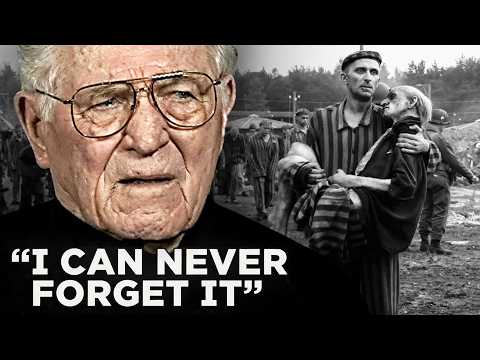
Winters had seen men killed in battle. He had seen the suffering of civilians in France, Holland, and Belgium. But this was different. “You can never forget it,” he said. “And never understand it. How anybody could think like this, act like this, do something like this to fellow man.”
He wasn’t alone in his shock. The men of Easy Company—hardened paratroopers who had faced death a hundred times—stood frozen, their faces pale. Some turned away. Others stared, unable to comprehend the scale of the cruelty before them.
Frank Perconte, who had been with Winters since Toccoa, had been the one to stumble upon the camp during a patrol. He radioed back to Winters, his voice trembling as he described what he had found. “You need to come see this, Major,” he said. “It’s… it’s beyond anything.”
Winters arrived to find rail cars filled with corpses, their bodies stacked like cordwood. Mass graves yawned open, the earth stained dark with blood and waste. And everywhere, the living dead—prisoners who had been starved, beaten, and left to rot.
The camp was Kalfering 4, a subcamp of Dachau. It had been established in September 1944 to house 500 to 800 prisoners, but by the time Easy Company arrived, over 3,000 had been crammed into its barracks. They were forced to work in underground tunnels, building factories for German fighter planes. When they could no longer work, they were sent to die.
Typhus raged through the camp, killing hundreds. The SS guards refused to enter the barracks, leaving Jewish doctors to do what they could without medicine or equipment. Prisoners died from disease, starvation, exhaustion, and execution. By the time the camp was liberated, only a few dozen to a couple hundred survivors remained.
Winters walked through the barracks, his stomach turning. He had seen death before, but never like this. “I can understand shooting a man,” he said. “We’ve seen that down the line. But not to this extent.”
As he stood among the dead and dying, a single thought crystallized in his mind—a thought that would stay with him for the rest of his life. “Now I know why I’m here.”
It wasn’t about glory or duty or even victory. It was about this. It was about stopping the kind of evil that could reduce human beings to skeletons and stack their bodies like garbage. It was about making sure that the sacrifice—the blood, the pain, the loss—was worth something.
“This made any sacrifice that I’m giving of myself or the rest of us are giving… this is worth it,” Winters said. “This is worse than death. This is worse than being shot at.”
But the horror wasn’t over. The SS had fled, but the locals remained—men and women who had lived beside the camp for years, who had seen the prisoners marched through their streets, who had claimed they knew nothing. General Maxwell Taylor declared martial law and ordered every able-bodied German to bring shovels and rakes to help clean up the camps and bury the dead.
It was a forced confrontation with the truth. The citizens of Landsberg would have to look at the bodies. They would have to smell the stench. They would have to bury the dead. And they would have to live with the knowledge of what had happened in their own backyard.
For Winters, the camp was a turning point. He had always been a soldier, but now he understood his purpose on a deeper level. He had been fighting for something greater than himself—for humanity, for decency, for the belief that such evil must never be allowed to stand.
As he walked away from the camp, the images burned into his memory, he knew that his life would never be the same. “You can never forget it,” he said. “And never understand it.”
But he would carry it with him always—the horror, the sorrow, and the unshakeable conviction that what he had seen must never be allowed to happen again.
The work of burying the dead began almost immediately, but it was slow and grim. German civilians from Landsberg arrived in trucks, their faces drawn and pale, clutching shovels and rakes as if they were weapons they had never learned to use. Some wept openly. Others worked in stony silence, their jaws set, their eyes fixed on the ground. A few refused to look at the bodies at all, turning their heads away as they dug.
Winters watched them from a distance, his arms folded across his chest. He felt no pity for them. “They knew,” he said later. “They had to know. The prisoners marched through their town every day. The smell was everywhere.” He remembered the baker in the series, the one who complained about soldiers taking his food, the one Webster confronted with a pistol in his hand. That scene, fictional or not, captured something true: the willful blindness of people who had convinced themselves that not seeing was the same as not knowing.
But the liberation was not only about the dead. It was also about the living—the handful of survivors who had somehow endured. They emerged from the barracks like ghosts, their bodies wasted, their eyes enormous in their skulls. Some could barely walk. Others could not speak. They reached out with trembling hands, touching the sleeves of the American uniforms as if to confirm that their rescuers were real.
The medics did what they could, but they were overwhelmed. The survivors needed food, water, medicine, and shelter—and they needed it immediately. Yet even feeding them was dangerous. “We gave them some of our rations,” one soldier recalled, “and later we learned that doing so could kill them.” Refeeding syndrome, the doctors called it—the body so starved that sudden nourishment could stop the heart. The men of Easy Company had to watch as the people they had just saved were forced to stop eating, to go slowly, to trust that the help would still be there tomorrow.
For Winters, the most haunting part was the children. There were not many, but there were some—young boys and girls who had somehow survived the typhus and the starvation, their faces old before their time. They did not cry. They did not ask for anything. They simply stood and watched, as if they had forgotten how to be children.
He thought of his own youth, of the small-town Pennsylvania boy who had enlisted because it was the right thing to do. He thought of the men he had trained at Toccoa, the ones who had not made it this far. He thought of the ones who had. And he understood, with a clarity that cut through the exhaustion and the horror, that this was the reason for all of it—the marches, the battles, the frozen foxholes of Bastogne. This was what they had been fighting against. This was what they had been fighting for.
General Eisenhower had ordered that every soldier who could be spared should see the camps with his own eyes. He wanted witnesses. He wanted documentation. He wanted to make sure that no one, ever, could claim that this had been propaganda or exaggeration. Winters understood that order now in a way he had not before. “You can never forget it,” he said. “And never understand it.”
But understanding was not the point. Remembering was. And as the sun set over Kalfering 4, casting long shadows across the freshly dug graves, Dick Winters made a silent promise to himself and to the men who had died there: he would remember. He would tell the story. He would make sure that the world knew what had happened in this place.
The war was not over. There were still battles to fight, still miles to march, still men to lead. But something had shifted in him, something permanent. He had seen the worst that humanity could do—and he had decided, in that moment, to spend the rest of his life standing against it.
In the years that followed, Winters rarely spoke of Kalfering 4. He built a quiet life, raised a family, ran a business. But the camp never left him. “You can never forget it,” he said, decades later. “And never understand it.” The words were not a confession of defeat but a quiet admission that some things are beyond comprehension—and that remembering is its own form of resistance.
He was not alone. Thousands of American soldiers carried similar memories home, their silence a shared burden. “Now I know why I’m here,” Winters had said that day, and the phrase became a kind of creed—a reminder that the fight against such evil was worth every sacrifice. The men of Easy Company had not liberated the camp first, but they had borne witness, and that witness mattered.
Today, the site of Kalfering 4 is marked by a memorial—a simple stone, a few words. Visitors come, some searching for meaning, others for connection. They stand where Winters stood, look at the ground where bodies were stacked, and try to imagine. Most cannot. That is the point.
Dick Winters lived to see the world remember. He saw the films, the books, the documentaries. He knew that Hollywood had exaggerated the size of the camp, that the men in the barracks were more numerous on screen than in reality. But he also knew that the truth was worse than any fiction—and that the truth needed to be told.
What would you have done if you had been there—would you have been able to forget, or would you have spent your life making sure the world never did?
Report this article
Select a reason for reporting:






