In the quiet confines of a small English churchyard lies a man who didn’t just change the world—he made us see it in a completely new way. His name was Frank Whittle, and his invention, the jet engine, would go on to shrink the globe, but not before he faced nearly insurmountable odds, bureaucratic indifference, and personal sacrifice.
Born in 1907 in Coventry, England, Whittle was a dreamer from the start. Fascinated by flight from the age of four, he built model airplanes and devoured every piece of aviation knowledge he could find. But his path to greatness was anything but smooth. Rejected by the Royal Air Force (RAF) for being too small, he refused to give up. He followed a strict diet and exercise regimen, grew three inches, and tried again—this time succeeding.
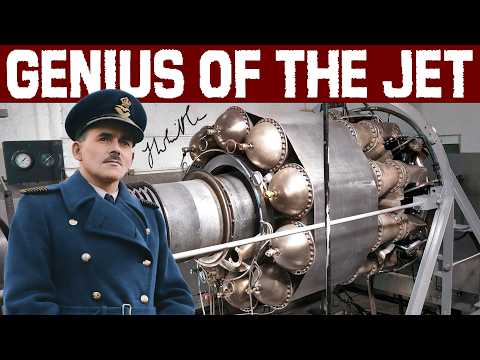
As a young RAF officer, Whittle’s obsession with speed and altitude led him to a radical idea: replace the piston engine and propeller with a gas turbine that could propel aircraft at unheard-of speeds. In 1928, while still a student at Cranwell, he wrote a thesis outlining the concept of a jet engine. His professor didn’t fully understand it but gave him top marks anyway.
Whittle’s vision was clear: aircraft flying at 500 mph at 50,000 feet, where piston engines couldn’t function. But the road from idea to reality was littered with obstacles. The British Air Ministry showed little interest, and even the great aerodynamicist A.A. Griffith dismissed his calculations. Undeterred, Whittle patented his design in 1930, but without funding, it seemed destined for oblivion.
Then, in 1935, a letter arrived that changed everything. An old friend, Rolf Dudley-Williams, wrote that he had found interested investors. Together with another former RAF officer, they formed Power Jets Ltd in 1936. Whittle’s engine, the WU, was built by British Thomson-Houston in Rugby. On April 12, 1937, it roared to life for the first time, proving that jet propulsion was possible.
But the British government remained skeptical. Meanwhile, in Germany, Hans von Ohain had independently developed a jet engine, and the Heinkel He 178 became the world’s first jet aircraft in 1939. The Nazis were racing ahead, and Britain risked being left behind.
As war loomed, Whittle’s team worked tirelessly, but financial struggles and official indifference plagued the project. It wasn’t until 1941 that the Gloster E.28/39, powered by Whittle’s engine, took to the skies. The jet age had begun, but the battle for recognition was far from over.
Whittle’s story is one of genius, perseverance, and betrayal. His engine would go on to power the Gloster Meteor, Britain’s first operational jet fighter, but he would be sidelined by bureaucracy and corporate interests. Yet his legacy is undeniable: the jet engine revolutionized travel, warfare, and the way we connect.
As we trace Whittle’s journey from a curious boy in Coventry to the father of the jet age, we uncover a tale of triumph and heartbreak, of a man who dared to dream of speed and silence, and who, against all odds, gave us wings.
By the time the war ended, Whittle’s health had deteriorated. The stress of years of fighting bureaucracy, financial crises, and technical setbacks had taken a heavy toll. He suffered several nervous breakdowns and was eventually declared unfit for flying in 1948. That same year, he was knighted, but the honor felt hollow. The industry he had created had no place for him.
Power Jets was nationalized in 1944, and Whittle received a lump sum of £10,000—worth about £3 million today—but no ongoing role. He watched as companies like Rolls-Royce and de Havilland reaped the rewards of his invention. The jet engine had become the future, but Whittle was left behind.
In 1948, he retired from the RAF at the rank of air commodore. He tried to find work in the industry, but his fame made him difficult to place. No engine manufacturer would hire him. He was a hero without a job.
Meanwhile, the world moved on. The de Havilland Comet, the world’s first jet airliner, entered service in 1952, promising to revolutionize travel. Whittle had consulted for BOAC on the Comet’s introduction and had warned about the dangers of its square windows. His advice was ignored. Two catastrophic crashes in 1954 revealed the fatal flaw: metal fatigue around the window corners. The Comet was grounded, and Britain’s early lead in jet airliners slipped away.
Whittle, now in his forties, retreated from public life. He traveled, wrote his memoirs, and tried to recover his health. He had sacrificed everything for his idea, and now he watched others profit from it. Yet he never expressed bitterness publicly. Instead, he focused on his family and his passions.
In the 1960s, the jet engine became the standard for both military and civilian aircraft. The Boeing 707, powered by Pratt & Whitney engines, brought long-distance air travel to the masses. The turbofan engine, which Whittle had patented in 1936, finally entered service, proving the superiority of his early vision. But Whittle was not part of it.
He moved to the United States in 1976, where he felt more appreciated. He became a professor at the United States Naval Academy and reconnected with Hans von Ohain, his former rival. The two became close friends, united by their shared love of aviation.
In 1986, Queen Elizabeth II awarded him the Order of Merit. It was a late recognition of his contribution, but it meant something. He was finally being remembered as the father of the jet engine.
Whittle died in August 1996, at the age of 89. His ashes were buried in Cranwell, the place where his journey had begun. A memorial service was held at Westminster Abbey, and the RAF honored one of its own.
Today, billions of people fly safely and cheaply thanks to Frank Whittle. His invention made the world a smaller place. Yet his story is a reminder of how visionaries are often treated: ignored, sidelined, and forgotten until it’s too late.
As his son Ian recalled, “I asked my father if he ever flew alone, or if he had a companion. He just smiled.” Perhaps, in the end, Whittle found his peace in the skies he loved.
But the story doesn’t end with the man. It continues in every engine that spools up on a cold morning at Heathrow, in every fighter that breaks the sound barrier, in every child who looks up and wonders how something so heavy can fly so fast.
What Whittle understood—perhaps better than anyone of his generation—was that the future belongs to those who see it first, not to those who wait for permission. He was twenty-two when he conceived the jet engine, and he spent the next decade fighting to make others believe it was possible. Most of them never did. They saw a young officer with no engineering degree, no corporate backing, and no political allies. What they didn’t see was a mind that had already solved problems they hadn’t yet imagined.
The tragedy of Whittle’s story isn’t that he failed. It’s that he succeeded so completely that the world forgot it needed convincing. By the time the Comet flew and the Meteor entered service, the jet engine had become inevitable. No one remembered the years of rejection, the letters unanswered, the contracts dangled and withdrawn. They remembered only the result.
And yet, there is a kind of justice in that. Whittle never sought fame. He sought speed, efficiency, the elegant solution to an impossible problem. When asked late in life what he was most proud of, he didn’t mention the knighthood or the Order of Merit. He mentioned the moment the WU ran on its own for the first time—that terrifying, exhilarating instant when the machine he had drawn on paper became real.
That moment belonged to him alone. No ministry, no corporation, no rival could take it away.
Today, the churchyard at Cranwell is quiet. The two Meteor and Vampire jets that flew over his funeral are long retired, museum pieces now. But the engines they carried—descendants of Whittle’s design—still roar in the skies above every continent. The world he imagined in 1928 is the world we live in now. We cross oceans in hours, not weeks. We take for granted what he had to fight to prove.
His son Ian once said that his father never stopped thinking about aircraft, right up to the end. Even on his deathbed, he was sketching improvements, theorizing about aerodynamic refinements. The mind that conceived the jet engine never truly rested.
Perhaps that’s the real legacy: not the engine itself, but the restless curiosity that built it. The willingness to ask, ‘Why not?’ when everyone else says, ‘Because that’s how it’s always been done.’
Frank Whittle gave us wings. But more than that, he gave us permission to imagine the impossible. And in a world that still needs dreamers, that gift may be the most valuable one of all.
Ian stood at the graveside long after the small crowd had dispersed, the sound of the two Meteor jets fading into the Lincolnshire sky. He thought of that morning in Hong Kong, the way his father’s eyes had flickered open at the words, “Let’s get dressed and go flying.” The smile that followed was the last he ever saw.
Perhaps, Ian reflected, his father had gone flying that night. Perhaps he had finally climbed into that open-cockpit biplane they had always promised each other—the one where they would loop and roll and dive together. “I asked my father if he ever flew alone, or if he had a companion. He just smiled.”
The world measures legacies in engines and honours, in knighthoods and orders of merit. But Ian measured his father’s life differently: in the quiet persistence of a man who sketched aerodynamic refinements on his deathbed, who never stopped asking why not.
Above the churchyard, a commercial jet traced a white line across the clouds—a descendant of that first sputtering WU, carrying hundreds of passengers who would never know the name Frank Whittle. They crossed oceans in hours, thanks to a young officer who once refused to accept that the future had limits.
Ian touched the cold stone, then turned toward the car. The sky, as always, was waiting.
So here’s the question worth asking: if you had an impossible idea—one the world dismissed as fantasy—would you spend a decade fighting for it, even knowing you might never be the one to profit? Or would you let it go?
Report this article
Select a reason for reporting:






