March 1946. Berlin lay silent under a fresh layer of snow—soft white on black ruins. The air smelled of wet ash and coal smoke, and thin children dug in the rubble for potato peels and burned bread. Germany had surrendered eleven months ago, but for Anna Schaefer, the real war was just beginning. It wasn’t against bullets; it was against hunger.
Her radio had sworn that American soldiers were monsters—thieves, brutes who would shame and hurt her. Yet the man she now walked toward carried a rifle on his shoulder and a bar of chocolate in his pocket. He came from a country overflowing with meat, coffee, and sugar. She came from a city where bread was cut with sawdust and hope was given out in crumbs. In a world that had just learned how to burn cities from the sky, one quiet choice on this snowy corner would weigh more than all his ammunition—and reach all the way to a grave in Brooklyn.
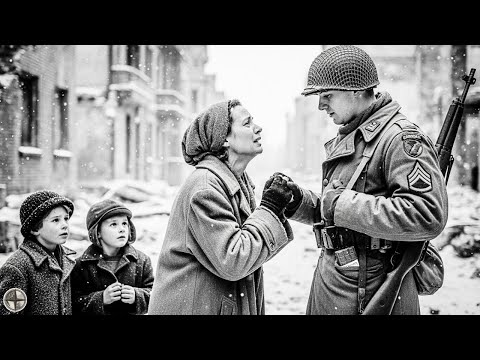
Anna, twenty-eight, wore shoes with holes stuffed with paper. Her coat was too thin for the bitter air. On her hip she carried her four-year-old son, Klaus, his legs like sticks under wool stockings. With her free hand she held her six-year-old daughter, Lizel, who stared at the snow as if she wanted to eat it. They had not eaten a real meal in weeks. Most days they shared a single boiled potato. Anna had not eaten at all for three days so the children could have her share.
In her pocket were three ration cards and nothing left to buy. Every step she heard the voice of the Nazi radio: the Americans were monsters, they would burn, steal, and shame every German woman. Neighbors whispered stories of robbery and revenge. To Anna, the enemy wore a round steel helmet and carried a gun and an unknown language.
Yet as she came around a corner past a burned-out tram and a frozen fountain full of ice and bricks, she saw one of those enemies standing alone. An American soldier, tall in his heavy wool coat, helmet pushed back. A rifle hung from his shoulder. Dog tags flashed silver at his neck. He was twenty-two with a boy’s face under the chin strap. His name was Private First Class James O’Connor from Brooklyn, New York.
In his mouth he rolled a piece of Wrigley’s chewing gum. In his pocket he carried something almost no German child had seen since before the war: chocolate.
Anna watched him from the shadow of a doorway. She could smell him even from there—soap, tobacco, the faint animal warmth of wool that had been dry all winter. He looked bored, not cruel. For a moment he seemed like just another young man far from home. Then he shifted his rifle, and she remembered every warning she had ever heard.
She looked down at her children. Klaus’s lips had a blue line. Lizel’s fingers were thin as matchsticks inside her mittens. Their eyes were too big for their faces. They were past hunger now, moving into something worse—a slow fading. Anna knew that if she did nothing, one of them might not live to see the spring.
“The only people in Berlin who still clearly had food were the men she had been told to fear the most.” Pride shouted at her to turn away. Fear told her to hide. Another voice, quieter but stronger, said, “If I do nothing, my children will die.”
She stepped out from the doorway into the open street, into the falling snow. Each step toward the soldier felt like walking off the edge of a roof. “Bitte,” she called, her voice rough from cold and hunger. Then again, louder: “Bitte!”
James heard her and stopped chewing. He turned and saw a thin woman with two children clinging to her in the ruins of his enemy’s capital. For a heartbeat, two worlds faced each other. The victor with a full stomach and a rifle. The defeated mother with empty hands and empty children. This wasn’t propaganda. It was reality—and it cut through every story both sides had been told.
Anna forced the English words from her memory, learned at school before the war. “Please,” she said, her voice breaking. “My children are hungry. Do you have anything?”
She waited for the shout, the insult, the raised gun. Instead, James O’Connor slowly reached into the pocket of his field jacket. What he drew out would not match anything Anna had been taught to expect—and it would lead her family toward a very different kind of future.
James’s hand came out of his pocket holding a brown paper bar with a silver edge—a Hershey chocolate. Then another. Then a small round tin with English words on the side: Spam. The smell of meat and fat rose when he tapped the lid with his thumb. His other hand still held the rifle, but now it hung loose, almost forgotten.
Anna stared. Her mind could not join the picture. An American helmet, an American gun, an American chocolate held out toward her children. Behind her, Lizel pressed her face into her mother’s coat. Klaus just stared at the bar as if it were a toy from another life.
“Here,” James said softly in English, then slower. “For Kinder.” He pointed to the children. His voice had the flat sound of Brooklyn streets—hard and friendly at the same time.
The children did not move. All their lives they had been told: never take anything from the enemy. Never trust them. Anna felt tears burn in her cold eyes. She bent her head close to Lizel’s ear. “It’s all right,” she whispered. “Take it.”
The girl looked up at the strange soldier. Her small hand shook. James saw her fear. Slowly he peeled back the paper on one bar himself, broke off a square, and put it in his own mouth. He chewed, then grinned, showing her the half-melted chocolate on his tongue like a silly trick. “See?” he said. “Yum.”
The smell hit them first. Rich, sweet, almost impossible. At last Lizel reached out, quick as a bird, took the bar, and held it tight. Klaus grabbed at the second one. They bit in, eyes wide. Later Anna would say, “It was like watching color come back into a black-and-white picture.”
James was not done. He pushed the tin of Spam into Anna’s hands, then a pack of Wrigley’s gum. She felt the hard weight of the meat, heavier than anything she had carried in weeks. It seemed wrong that one tin could feel like hope.
Then he looked up and down the empty street as if checking for someone. “Come,” he said, waving toward the end of the block. “Food.” He pointed to his mouth, then down the road. His face asked a question: Do you trust me?
Here was the sharpest paradox of all. The only person in Berlin willing and able to feed her children was a man in the uniform she had been taught to hate. For a moment Anna could not move. A German woman later wrote: We stepped toward the people we had called devils because hunger is stronger than fear.
At last Anna nodded. “Yes,” she said. “We come.”
They walked ten minutes through the ruins, past burned-out trucks and walls full of bullet holes. The snow squeaked under their thin shoes. Finally low tents appeared, ropes stiff with frost. From inside came a smell that almost made Anna dizzy—coffee, fried fat, baking bread. It was the American mess.
James led them in. Warmth hit their faces. A few soldiers looked up, surprised to see a German woman and two children. A cook sergeant with a stained apron listened as James spoke fast English. The man shrugged once, then got to work.
Minutes later he set a metal tray on a table: thick slices of dark rye bread, a bright square of butter on each plate, two fried eggs per person, mugs of warm pale milk made from powder, and a bowl of canned peaches in heavy golden syrup. The steam rose in soft curls.
Anna stood frozen. She had not seen so much food in one place since 1941. Her legs went weak. James pulled out a chair for her, then for the children, like a waiter in a small café back home.
Klaus climbed up and began to eat with both hands, yolk running down his chin. Lizel tried to use her fork, then gave up and did the same. No one laughed. Anna lifted her first piece of bread slowly. The crust was firm under her fingers. The butter melted in yellow lines. When she bit it, the taste hit her so hard she had to close her eyes. She started to cry—silent tears running down cheeks already burned by the cold.
When the plates were empty, the sergeant filled them again without a word. Before they left, James took a paper bag and put in more bread, two cans of beans, a jar of peanut butter, another chocolate bar. He closed the top and placed it in Anna’s arms.
She looked from the bag to his face. “You feed children of your enemy,” she said at last in slow English. The words felt heavy, important.
James shifted, embarrassed. “Kids didn’t start the war, ma’am,” he answered. “They just got stuck under it.”
For the next three weeks, he made sure they did not stay stuck. Every day he found a way to bring extra rations—a blanket here, a tin of peaches there, powdered eggs, more bread. Quietly, like a small crime, he moved food from the American side of the line to the German. No one counted every egg. No one wrote down each can.
Little by little, color came back to the children’s faces. Their bellies stopped swelling from hunger. Anna’s strength returned. A life was being built from other people’s surplus.
One morning she came to the street carrying the only whole thing left from her old home: a small porcelain angel wrapped in newspaper. She tried to press it into James’s hand as payment. He shook his head and tried to give it back. She closed his fingers around it. “Thank you for my children,” she said.
He kept the angel in his pocket for an hour, then, fearing trouble, quietly slipped it back into her coat when she wasn’t looking. “No pay,” he told her. “Just be okay.”
She found it later at home and set it on the table where everyone could see. They did not know it yet, but this quiet exchange of food and a fragile angel would echo far beyond that winter.
One morning, after three weeks of quiet meetings, James was not at the corner. Anna waited until her feet went numb, watching every patrol that passed. He never came back. Like thousands of occupation troops, he had been rotated home.
Back in the basement room, the porcelain angel sat in the middle of the rough wooden table. On birthdays the children touched its tiny wings and whispered, “Thank you, American daddy,” before blowing out their candles—even when the cake was only dark bread with a bit of sugar.
The hunger did not end with his departure. But slowly, other American help arrived—not from one soldier’s pocket now, but from ships and trains. Marshall Plan aid, care packages, powdered milk. Anna trained as a nurse. Klaus became an engineer. Lizel taught English. Peter, the baby she carried that winter, became a surgeon.
In 1962 she wrote to Brooklyn. The Red Cross found him. A fireman now, James crossed the ocean again—this time as a guest, a friend, almost a father. In 2011, four Germans flew 6,000 kilometers to stand at his coffin. Anna, in her nineties, placed the porcelain angel on the flag over his casket.
They had come as conquerors. They left as family.
What small act of kindness in your own life might echo further than you ever imagined?
Report this article
Select a reason for reporting:






