The bullet tore through his helmet’s chin strap and grazed his skull, leaving him concussed and bleeding. Yet Bill Fraser kept commanding his men. It was June 1941, and the young Scottish officer had just led his section ashore into a hail of Vichy French fire during the invasion of Syria. Most men would have collapsed. Fraser, already struck once, continued to direct the assault until the position was taken. This was not an isolated act of bravery—it was the pattern of his entire war.
William Fraser was born in Aberdeen in 1917, into a family steeped in military tradition. Both his stepfather and grandfather had served in the Gordon Highlanders, and from an early age, military life was familiar. Tall, thin, with a boyish face and prominent ears, he earned the nickname “Skin” among his peers. At 19, he joined the Gordon Highlanders, and his early record was exemplary: promoted to Lance Corporal, qualified as a marksman, and commissioned as an officer—the first in his family.
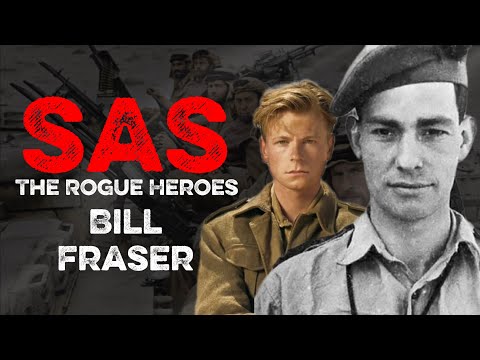
When war broke out in 1939, Fraser deployed to France with the British Expeditionary Force. But the campaign collapsed swiftly under the German blitzkrieg, and he was evacuated back to Scotland. Rather than settle into conventional service, he volunteered for the newly formed Commandos. “He encouraged several fellow Gordons to join him,” and was appointed commander of B Section, A Troop, No. 11 Scottish Commando.
Intensive training in amphibious raiding followed, and in early 1941, Fraser sailed with Layforce to the Mediterranean. His baptism of fire came during Operation Exporter—the Allied invasion of Vichy-controlled Syria. Near the Litani River, his section landed directly in front of prepared enemy positions. “Many prisoners were taken,” Fraser later reported, “in addition to those killed or wounded.” It was during this chaotic fight that a bullet struck his helmet, leaving him concussed. He handed over command only briefly before returning to lead his men.
Later that year, No. 11 Commando was disbanded, and Fraser transferred to David Stirling’s newly formed Special Air Service—then known as L Detachment. He trained at Kabrit in Egypt, but a parachute accident prevented him from joining the first SAS mission, Operation Squatter. Instead, he worked with the Long Range Desert Group in the recovery party. This twist of fate would soon prove fortunate, for Fraser was about to embark on a series of desert raids that would cement his reputation.
In December 1941, he led a patrol toward the Agdabia airfield. His report describes a meticulous approach: avoiding enemy posts, moving stealthily among parked aircraft and anti-aircraft guns, and placing charges with precision. The raid destroyed 37 aircraft and an ammunition dump, with fires burning for over an hour. It was a stunning success—one that barely features in popular portrayals of the SAS.
But the desert tested more than his tactical skill. On a later patrol, his men ran out of water after a failed rendezvous with the Long Range Desert Group. Fraser recorded desperate measures: “We tried to distill water from salt marshes, and at one stage drained a German truck radiator for water.” He fell ill from drinking the brackish liquid, and at one point, Italian troops passed within 200 yards of his hiding spot. Under bright moonlight, with discovery imminent, Fraser made a bold call: instead of crawling and risking encirclement, “they should stand up and walk through the enemy position.” They did—and lived to fight another day.
By 1942, Fraser’s tally of destroyed enemy aircraft had reached 38. His leadership and endurance earned him the Military Cross. Yet he often felt out of place in the formal officers’ mess; within the SAS, he found men who valued initiative over rank. When David Stirling was captured and the unit reformed as the Special Raiding Squadron under Paddy Mayne, Fraser was given command of No. 1 Troop. His war was far from over—and the most dramatic chapters were yet to come.
In July 1943, Fraser took part in Operation Husky—the invasion of Sicily. His war diary records the landing at Cape Murro di Porco in the early hours, the men carrying heavy loads through rough seas. As they approached the shore, they spotted airborne glider troops struggling in the water—and pulled them out. It was a rescue that popular dramatizations of the SAS have ignored or reversed entirely.
Within minutes of landing, Fraser’s men captured one gun battery, and another several miles away was quickly neutralized. He led bayonet charges during the close-quarters fighting that became known as the Battle of the Pig’s Snout. Around 150 Italian troops were killed, hundreds more taken prisoner, and the guns destroyed. A green flare arced into the sky, signaling success to the invasion fleet waiting offshore.
From Sicily, the unit pushed into mainland Italy. At Bagnara and later Termoli, they met ferocious German counterattacks. During the fighting at Termoli, a mortar round struck a truck carrying SAS men and civilians. Seventeen people were killed instantly. Fraser was badly wounded—unconscious and bleeding heavily. He recovered and returned to duty, only to be injured again later in the campaign. His reputation grew: an officer who led from the front whenever he was physically able.
In early 1944, Fraser returned to Britain as the SAS prepared for operations in occupied France. The regiment resumed its name, and Fraser took command of A Squadron. On June 6th, the advanced party entered France as part of Operation Houndsworth. Fraser parachuted in five days later to join them.
The mission: disrupt German communications and slow reinforcements moving toward Normandy—especially elements of the 2nd SS Panzer Division Das Reich. Fraser established a hidden woodland base and worked closely with the French Resistance. Railway lines between Paris and Lyon were targeted repeatedly. His unit destroyed vehicles, attacked supply depots, and—most crucially—marked targets for RAF bombing runs.
In August 1944, German forces attempted to surprise the SAS camp. But Fraser’s resistance contacts warned him beforehand, and the attack was fended off. It was a testament to the trust he had built with the local fighters—and to his instinct for survival.
By March 1945, the war had moved into Germany itself. During one action, Canadian paratroopers had been pushed back from a wood. Fraser advanced with twelve jeeps from the flank, approaching to within thirty yards before being spotted. Enemy machine-gun fire forced his jeep into a ditch, and he was wounded in the hand. His men destroyed several enemy positions, allowing the Allies to keep pushing forward.
Near the end of the war, Fraser took part in reconnaissance that brought SAS troops near Bergen-Belsen—before the concentration camp was liberated. After Germany surrendered, he traveled to Norway with the SAS to supervise the disarmament of German forces. He received a bar to his Military Cross and was awarded the French Croix de Guerre with palm.
But peace did not suit him. Fraser returned to the Gordon Highlanders, was demoted for being drunk on duty, and eventually left the army in 1948. Civilian life proved unsettled: he faced burglary charges before finding steadier work as a baker, then a costings clerk. Bill Fraser died in 1975 at just 58 years old.
His story, however, deserves more than a quiet fade into civilian obscurity. In the decades after the war, the SAS legend was built on a handful of names—Stirling, Mayne, Lewes—while men like Fraser slipped into the footnotes. Yet his wartime reports, now held in archives, reveal a commander of remarkable consistency. Patrol after patrol, he combined meticulous planning with a willingness to improvise when the plan fell apart.
Consider the desert raids. Destroying 38 aircraft on the ground was not the work of a reckless adventurer. It required patience, night navigation, and the discipline to place charges precisely while enemy sentries walked nearby. Fraser’s own writing shows a mind that catalogued every detail: the direction of the wind, the spacing of the tents, the timing of the guard rotations. He was, in essence, a professional.
The French campaign revealed another side of him. Working with the Resistance demanded more than military skill—it required trust, diplomacy, and the ability to disappear into a landscape that was both hostile and welcoming. Fraser built a network of contacts who warned him of German movements. When the attack on his woodland base came in August 1944, it was those contacts who saved him. He understood that the SAS could not operate alone; it needed the local population as much as it needed ammunition.
His later years offer a darker coda. The demotion, the burglary charge, the struggle to settle—these are not the stuff of heroic legend. But they are human. Many men who endured years of extreme danger found peace impossible to adjust to. Fraser had led men through deserts and forests, watched friends die beside him, and carried wounds that never fully healed. The war had shaped him, and perhaps broken something too.
Today, the television series SAS: Rogue Heroes has reintroduced these men to a new audience. Fraser appears as a minor character—a few lines, a background presence. Yet the real Fraser was central to some of the regiment’s most audacious operations. His first raid on the Agdabia airfield, the destruction of 37 aircraft, is barely mentioned on screen. His rescue of glider troops off Sicily is omitted entirely. Viewers who rely on the drama might never guess how vital he was.
Perhaps that will change. If the series continues, there is ample material for Fraser to step forward: the moonlit walk through an Italian position, the bayonet charge at the Pig’s Snout, the jeep assault in Germany with a bullet in his hand. These are not invented heroics—they are documented history.
For now, his legacy rests in the archives: yellowing reports, handwritten after long nights in the desert, describing with clinical precision how a small group of men destroyed aircraft, blew up railways, and slipped away into the dark. They are not glamorous. They are better than that. They are true.
And yet, for all the archival precision, one question lingers. Why did men like Fraser vanish so completely from the story they helped write? The answer may lie in the nature of legend itself. Legends favor the loud, the photogenic, the insubordinate genius—not the quiet professional who simply did the job.
Fraser never sought the spotlight. He led from the front, took the wounds, and then faded into a baker’s shop and a clerk’s desk. But the SAS he helped build outlived him, and its myth grew around other names. That is the quiet injustice of history: the men who endure often outlive their own recognition.
Still, the record remains. In dusty files and fading reports, Bill Fraser is there—concussed at the Litani, walking through enemy lines under moonlight, pulling glider troops from the Sicilian surf, destroying thirty-eight aircraft, and rising again after every wound. He was not a footnote. He was a foundation.
So the next time a dramatized version of the SAS parades across the screen, remember the men behind the legend. Remember Skin Fraser. His story does not need a rewrite—it only needs to be told. And perhaps, in the telling, we finally give him the recognition he never asked for.
Which unsung hero of the SAS should we uncover next—and why do you think history keeps forgetting men like Fraser?
Report this article
Select a reason for reporting:






