December 1944. The Ardennes Forest, Belgium. A bitter cold settles over the snow-covered hills, and an eerie quiet hangs in the air. But beneath the stillness, a storm is brewing—one that will unleash the last great German offensive of World War II. In the path of this juggernaut stands a handful of young Americans, their breath visible in the freezing air, their hearts pounding with a mix of fear and determination.
They are the men of the 394th Infantry Regiment’s Intelligence and Reconnaissance Platoon—22 soldiers, led by 20-year-old Lieutenant Lyle Bouck. Handpicked for their intelligence, marksmanship, and grit, they are the eyes and ears of their regiment. But now, they are the only thing standing between the German war machine and the vital crossroads at Lanzerath. As the first shells scream overhead at 5:30 a.m. on December 16, Bouck and his men are jolted into wakefulness. “This isn’t just some spoiling fire,” Bouck thinks. “This is something much bigger.”
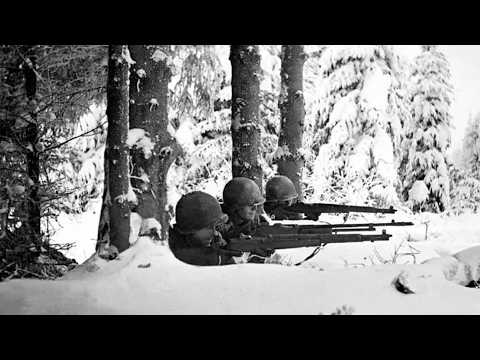
Within minutes, the bombardment shifts, and the first German infantry emerge from the fog. The I&R platoon, dug into foxholes along a wood line overlooking the village, holds their fire. They wait. And wait. Then, a young girl steps out of a house, pointing directly at their positions. The Germans now know they’re there. The element of surprise is gone.
But the Americans are ready. As the Germans advance, Bouck gives the order: “Fire!” A hail of bullets tears into the enemy column. Germans fall. The attack is repulsed. But more will come. And they do—again and again. Each time, the platoon’s machine guns and rifles cut them down. The snow is stained red.
By afternoon, the Americans have beaten back three assaults. But ammunition is running low, and the wounded are piling up. Private Kalil takes a rifle grenade to the face, yet somehow survives. The .50 caliber machine gun is disabled. Communications are lost. Bouck knows they can’t hold forever. He resolves to fight until dusk, then retreat. Two men are sent for help, but they never return.
As the sun sets, a new attack comes—this time from the flank, through the village. The Germans have found a way around. “They hit us from the right side,” Bouck recalls. “We didn’t know they were there.” In the chaos, Bouck fires at shadows, then feels a gun barrel poke into his foxhole. He shoves his comrade aside, but it’s too late. The platoon is overrun.
Captured and marched into Lanzerath, Bouck and his men begin a long journey into captivity. But their stand has not been in vain. They have delayed the German advance for over 12 hours—time that the Allies desperately need. The 22 men of the I&R platoon have done the impossible: they have held off 500 German paratroopers and disrupted the timetable of an entire panzer army.
Yet, for decades, their story remains untold. The survivors go home, build lives, and rarely speak of the war. It isn’t until 1981 that their heroism is finally recognized. They receive the Presidential Unit Citation—the most highly decorated American platoon for a single action in World War II. But the real legacy is not in the medals. It’s in the snow-covered slopes of Lanzerath, where 22 young men stood their ground against overwhelming odds, and in doing so, helped turn the tide of the Battle of the Bulge.
But the story of Lanzerath Ridge does not end with the medals or the citations. It lives on in the quiet courage of ordinary men who, when history called, answered with everything they had. And it lives on in the lessons they left behind—lessons about sacrifice, about duty, and about the extraordinary power of a few determined souls.
In the years after the war, Lyle Bouck returned to St. Louis and built a quiet life as a real estate broker. He rarely spoke of Lanzerath, not out of bitterness, but because, like so many of his generation, he believed he had simply done his job. “We were soldiers,” he would later say. “We did what soldiers do.” Yet the weight of those twelve hours never fully left him. He thought often of the men who didn’t come home—Private Billy Queen, the only fatality on the ridge, and the others who carried wounds, visible and invisible, for the rest of their lives.
For decades, the men of the I&R platoon scattered across America. Some became teachers, some businessmen, some farmers. They raised families, attended reunions, and quietly carried the memory of that frozen hillside in the Ardennes. It wasn’t until the 1970s, when a young historian named John S. D. Eisenhower—son of the general—began researching the Battle of the Bulge, that the story of Lanzerath Ridge began to resurface. Eisenhower’s book, The Bitter Woods, brought fresh attention to the platoon’s stand, and soon journalists and filmmakers came calling.
But recognition came slowly, and not without frustration. The Army’s bureaucratic machinery moved at its own pace, and many of the men had grown weary of waiting. “We didn’t do it for medals,” one survivor said. “But it would have been nice if someone had noticed sooner.” Finally, in 1981, after years of lobbying by supporters and historians, the Pentagon relented. The Presidential Unit Citation was awarded, and individual decorations followed—the Distinguished Service Cross for Bouck and three others, Silver Stars for five, and Bronze Stars with Valor for nine.
By then, the men were in their late fifties and sixties, their hair gray, their bodies slower. At the ceremony, Bouck stood stiffly at attention, his face betraying little emotion. But those who knew him saw the glint in his eye. “This isn’t for me,” he said quietly. “It’s for the men who never got to grow old.”
The legacy of the I&R platoon extends far beyond the medals. Their stand at Lanzerath delayed Kampfgruppe Peiper long enough for American reinforcements to solidify their lines. The Germans, convinced they faced a far larger force, hesitated—and that hesitation cost them precious hours they could never recover. The dash to the Meuse River, which Peiper had hoped to achieve in a single day, stretched into a week. By then, the Allies had regrouped, the weather had cleared, and the German offensive had stalled.
Historians now agree that the Battle of the Bulge was won not by any single dramatic charge, but by a thousand small stands like the one at Lanzerath—soldiers who held their ground when everything told them to run. “They were the quiet heroes,” one historian wrote. “The ones who bought time with their blood and their courage, and asked for nothing in return.”
Today, a small monument stands near the site of the old foxholes, overlooking the village of Lanzerath. It is a simple stone, engraved with the names of the men who fought there. Visitors come from around the world—veterans, schoolchildren, history buffs—to stand where those 22 young Americans stood, to look out over the snow-covered fields, and to remember.
And in the quiet of the Ardennes winter, when the wind whispers through the pines and the snow falls softly on the ridge, it is almost possible to hear them still—the crack of rifles, the shout of orders, the steady beat of young hearts refusing to yield. They were ordinary men. But on one December day in 1944, they became something more.
Years later, a young officer visiting the ridge asked Bouck what he remembered most. The old man was silent for a long moment. “The quiet after the firing stopped,” he said. “And the snow. It covered everything—the foxholes, the fence, the men. Like it was trying to make it all clean again.”
He paused, then added: “We were just kids. We didn’t know we were making history. We only knew we couldn’t let them through.”
The wind stirred the pines. Somewhere below, Lanzerath slept beneath its blanket of white. The crossroads were still there—the same road Peiper’s tanks had never reached.
What would you have done, standing in that foxhole, with the enemy closing in and no order to retreat?
Report this article
Select a reason for reporting:






