May 1945. The Nazi shadow finally lifts, and Europe erupts in celebration. But as the cheers fade, a chilling truth emerges: the war may be over, but the violence is far from finished. No sooner have the arms been laid down than another war looms. The continent remains soaked in blood, and an iron curtain is about to descend, plunging millions into a new kind of tyranny.
In the aftermath, over 40 million displaced people wander the ruins, desperate to go home. Germany is carved into four occupied zones, its cities reduced to rubble. The cleanup operation will take months, even years. In 1946, the torturing buildings and old bunkers are destroyed, sometimes with a bit of help from the zoo. Little railways haul off tons of debris, and in Warsaw, trams run again, drawing crowds to tears. A Polish journalist describes an atmosphere of noise, dust, and work—but also of hope.
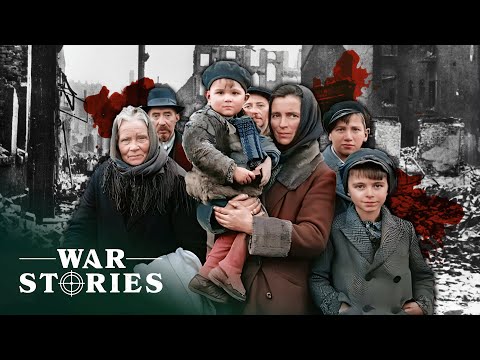
Stalingrad too comes back to life. Schools open amidst the ruins, and in Berlin, women learn the art of masonry, recycling old bricks and using German helmets as colanders. “Just knowing we’ve survived is what gives us the strength to start again from scratch,” one Berlin woman says. The optimism is palpable, but it hides deep scars. Hundreds of thousands of orphans roam the streets, and in Poland alone, nearly a million children are lost. News campaigns reunite some 300,000 families, but the pain lingers.
As months roll by, people adapt to the postwar world. Italy abolishes its monarchy, France ushers in the Fourth Republic, and women finally get the vote. In France, the Social Security system is put in place; in Britain, the National Health Service is founded. Architects rethink entire cities, and a baby boom offers a glimmer of promise. But in the east, Moscow calls the tune. Stalin installs communist pawns in key positions across Eastern Europe, and Churchill’s warning of an “iron curtain” falls on deaf ears.
Old scores are settled with brutal efficiency. Germans are expelled from Czechoslovakia, Poland, and elsewhere—more than 12 million refugees converge on Germany in one of history’s largest forced migrations. Ethnic cleansing scars the continent, from Yugoslavia to Greece. The violence seems endless, as if the war had obliterated all moral codes. And yet, in the west, Jews who survived the Holocaust set sail for Palestine, only to be turned back by the British, sparking a global outcry that leads to the partition of Palestine.
By 1947, the displaced have mostly made it home, but German prisoners of war still languish in Soviet gulags, a million souls lost to the wasteland. Europe seems incapable of unity—until Washington steps in. Truman declares, “I believe that it must be the policy of the United States to support free peoples who are resisting attempted subjugation.” The Marshall Plan pours billions into rebuilding Europe, but Stalin forbids Eastern Bloc countries from accepting the aid, tightening his grip.
Communist parties in France and Italy launch strikes that bring nations to the brink of civil war. The French government calls up 80,000 reservists, and order is restored at the cost of lives. But the Marshall Plan works: economies reboot, harvests surpass pre-war levels, and prosperity returns. Yet Stalin is not done. In Czechoslovakia, a coup d’état in February 1948 installs a communist government, and the foreign minister, Jan Masaryk, is found dead beneath his ministry’s windows—suicide or murder? Democracy is assassinated.
With the Prague coup, the West realizes co-managing Germany with the USSR is impossible. They combine their zones and introduce the Deutschmark, prompting Stalin to blockade West Berlin in June 1948. For 11 months, Allied planes airlift food and supplies to 2 million Berliners, earning the nickname “Candy Bombers” for dropping chocolate to children. The blockade fails, and Stalin lifts it in May 1949. A democratic West Germany is born, and NATO is formed. But the USSR tests its first atomic bomb, and the GDR rises on the Soviet side. The world is divided in two, and the postwar truths will last barely four years.
But the division of Europe is not the only fault line cracking open. Across the Atlantic, another storm is gathering, one that will shake the old colonial order to its foundations. In the sweltering cities of Asia and Africa, the war has taught millions that the empires which ruled them are not invincible. In India, the cry for independence has grown too loud to ignore. Britain, exhausted and bankrupt, finally concedes. In August 1947, the subcontinent is partitioned into two nations—India and Pakistan—and the celebration is drowned in blood.
Millions flee across the new borders, Hindu and Muslim alike. Trains arrive packed with corpses. Whole villages are burned. No one knows the true toll, but some say a million die, perhaps more. The birth of two free nations becomes one of the century’s great human tragedies, and the British withdraw as the fires still burn.
Elsewhere, the same story repeats. In the Dutch East Indies, nationalists declare independence, and the Dutch send troops to crush them. In Vietnam, Ho Chi Minh proclaims a republic, and France prepares to fight to keep its colony. The old empires are bleeding out, and they will not go quietly. In Algeria, in Madagascar, in Kenya, the violence of the postwar years takes on a new shape: the colonized have learned the language of the victors, and they are demanding to be heard.
Meanwhile, in the ruins of Europe, the great powers are already looking ahead. The Americans and the Soviets may have been allies in war, but now they are rivals in everything. In 1949, the arms race begins in earnest. The Soviet bomb ends America’s monopoly, and the Pentagon responds with a crash program to build a far more terrible weapon—the hydrogen bomb. Scientists who helped build the first bomb now warn of a fire that could consume the world.
In the United States, fear of communism turns inward. Senator Joseph McCarthy waves lists of supposed traitors in the State Department, and careers are destroyed by rumor and suspicion. In Hollywood, actors and writers are blacklisted for refusing to name names. The enemy, it seems, could be hiding in any office, any classroom, any neighborhood. The war had been fought against a visible foe; this new conflict has no front line.
And in the shadows, spies are everywhere. In Britain, a brilliant young physicist named Klaus Fuchs confesses to passing atomic secrets to the Soviets. In America, the Rosenbergs are arrested and, in 1953, sent to the electric chair. Each revelation feeds the paranoia, and each execution hardens the divide. The world is no longer divided simply by geography; it is divided by ideology, by fear, by the bomb.
Yet even as the Cold War tightens its grip, ordinary life pushes on. In Britain, the Festival of Britain opens in 1951, a celebration of design and recovery. In France, a young writer named Simone de Beauvoir publishes a book that asks what it means to be a woman, and the question echoes far beyond Paris. The postwar world is not only a place of ruins; it is also a place of new beginnings. But the peace, such as it is, remains fragile—and the next crisis is already taking shape on the horizon.
In Korea, that crisis arrives with the dawn of a new decade. On June 25, 1950, North Korean tanks roll across the 38th parallel, and the fragile peace of the postwar world shatters once more. Truman does not hesitate: American forces are committed under the banner of the United Nations. For the first time, the Cold War turns hot, and soldiers who had just come home from Europe find themselves fighting in a distant land they barely know.
The fighting is savage. Seoul falls and is retaken; the North pushes south to the Pusan Perimeter, and then the Americans land at Inchon and drive all the way to the Chinese border. But when Mao’s armies pour across the Yalu River, the war becomes a grinding stalemate of hills and trenches. By 1953, the guns fall silent near where they started, and a divided Korea becomes the first permanent scar of the Cold War.
Back in Europe, the same logic of division hardens into stone. In 1955, West Germany joins NATO, and Moscow responds by forming the Warsaw Pact. Two alliances now face each other across the continent, each armed with the bomb. The Iron Curtain is no longer just a speech—it is barbed wire, watchtowers, and minefields. Families who once crossed the same street now live in different worlds.
And nowhere is that division more visible than in Berlin—the city still split in four, still ringed by Soviet territory, still the fault line where East and West press against each other. In the years after the airlift, a new crisis begins to simmer. East Germans are fleeing by the thousands, crossing into West Berlin and escaping to the West. Doctors, engineers, teachers—the best and brightest of the GDR simply walk away.
In the Kremlin, Khrushchev grows impatient. In 1958, he issues an ultimatum: the West must leave Berlin, or he will hand control of the access routes to the East Germans. The city becomes the most dangerous place on earth. Western leaders refuse to budge, and for a time, the world holds its breath. Yet the crisis passes—for now—and the flow of refugees continues, a daily humiliation for the communist regime.
Meanwhile, the space race begins. In 1957, the Soviets launch Sputnik, a small metal sphere that beeps its way across the sky, and Americans scan the heavens in fear. If they can put a satellite in orbit, they can put a bomb there too. The same rockets that carry dogs and cosmonauts could carry warheads to any city on earth. The sky itself has become a battlefield.
In Washington, a young senator named John F. Kennedy wins the White House on a promise to close the missile gap. In Moscow, Khrushchev bangs his shoe on the table at the UN and boasts that communism will bury capitalism. Both sides speak of peace, but both sides build for war. Each test of a bomb is answered by a bigger one; each new missile by one that can fly farther and faster.
And in the shadows, the intelligence war intensifies. A U-2 spy plane is shot down over Soviet territory in 1960, and its pilot, Gary Powers, is paraded before the world. The summit collapses, and the thaw turns to frost. The trust that had briefly flickered after the war is gone, replaced by suspicion and the certainty that the enemy is always watching.
Yet even in this atmosphere of fear, ordinary people find ways to live. In Western Europe, the Marshall Plan’s prosperity deepens. Factories hum, highways stretch across the countryside, and families buy their first cars and televisions. The postwar generation grows up in a world of supermarkets and rock and roll, and the memory of rubble begins to fade. But the shadow of the bomb is always there, a quiet hum beneath the music.
In the East, life moves to a different rhythm. The state celebrates the worker, the tractor, the steel mill. Propaganda posters promise a radiant future, even as the secret police knock on doors at midnight. In Hungary, in Poland, in Czechoslovakia, the people learn to speak in two voices: one for the Party, one for the kitchen table. The Iron Curtain is not just a border; it is a way of living.
And as the decade turns, the pressure builds once more. In 1961, the refugee flow through Berlin reaches a breaking point. On the night of August 13, the East German authorities begin to seal the border. Barbed wire is unrolled, streets are torn up, and the first bricks are laid. The wall is rising.
The Wall rises overnight, a scar of concrete and wire through the heart of a city. Families wake to find their streets severed, their neighbors suddenly unreachable. In the years that follow, the Wall becomes the Cold War’s most brutal symbol—a monument to division built by a regime terrified of its own people.
And yet, in the shadow of the Wall, the world does not end. It endures. The decades grind on—missile crises, proxy wars, the slow exhaustion of ideology—until at last, in 1989, the gates swing open and the people pour through. The Wall falls, and with it, a world divided begins to stitch itself back together.
Looking back on that May morning in 1945, when Europe wept with relief and dared to hope, one wonders: was the peace they dreamed of ever truly possible? Or does every ending simply seed the next conflict?
What do you think—did the postwar generation build a better world, or just a different one?
Report this article
Select a reason for reporting:






