In 1926, a Model T Ford punched through the deck of the Bartonsville Covered Bridge and plunged into the Williams River below. The driver climbed out soaking wet. The bridge did not move. Not one timber shifted. Not one joint opened. It had stood since 1870, built by a man named Jonathan Wolcott with white pine, hand-cut oak, and wooden pegs he shaped himself. That bridge would go on standing for another 85 years, carrying milk trucks, school buses, and modern pickup loads across its original timbers—until Hurricane Irene finally took it in 2011. Not rust. Not rot. Not neglect. A flood of biblical proportion. And even then, the wreckage floated downstream in large intact sections because Wolcott’s joints refused to separate.
That is the story I want to tell you. Not a story about nostalgia or scenic backroads. A story about engineering so precise and so quietly brilliant that we have spent 150 years failing to fully understand how they did it.
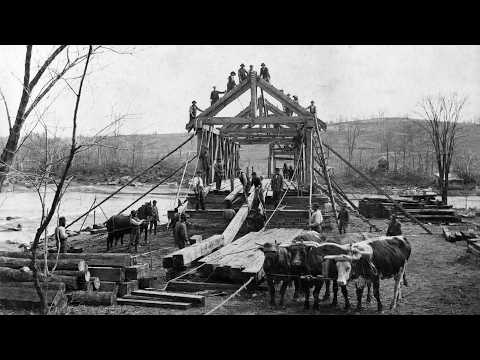
At the peak, around 1860, approximately 14,000 covered bridges stood across America. They crossed rivers that had no other crossing. They connected towns that would have been islands without them. And they were built almost entirely by farmers, millwrights, and self-taught carpenters who never set foot inside a university. Today, roughly 700 of those bridges survive. Some of them still carry vehicle traffic. Some of them still hold loads that would buckle a modern wooden structure in a single season. And the question that haunts every structural engineer who examines them is the same question I’ve been asking since I first walked through one in New Hampshire more than 20 years ago. How is that even possible?
The problem was water. It was always water. Before the covered bridge, America built open wooden bridges. Pine and oak spans thrown across creeks and rivers with iron bolts and exposed joinery. They worked for about 15 years. Then the rain got into the grain. The freeze-thaw cycles of New England winters split the fibers apart, slowly, invisibly, from the inside out. Ice crystals formed in the cells of the wood each December, expanding the grain, opening microscopic cracks that would never close again. The joints swelled in the wet spring, shrank in the dry summer heat, then loosened in autumn. Fungus colonized the hardwood through the cracks the ice had opened. Carpenter ants followed the fungus into the softened wood. And within two decades, a bridge that cost a town its entire annual budget was sagging at mid-span, cracking at the joints, and threatening to drop the next heavy wagon into the current below.
This was not a minor inconvenience. This was an existential crisis for rural America. In the early 1800s, rivers were not scenic backdrops for painters and poets. They were barriers, lethal, impassable barriers that divided communities and isolated families. A river without a bridge meant a ferry, and a ferry meant waiting, sometimes for hours, sometimes for days in flood season when the current ran too fast for the ferrymen to risk the crossing. It meant paying a ferryman who set his own prices and answered to nobody. It meant livestock drowning during crossings when the water surged. It meant children who could not get to school on the far bank, the sick who could not reach the doctor, grain rotting in barns because the farmer on the wrong side of the water could not get his harvest to the mill. A town on the wrong side of an unbridged river was a town slowly strangling. Bridges were not architecture, they were survival.
But wood was the only material available in sufficient quantity. Iron was expensive, scarce, and required foundry work that most rural communities could not access. Stone arch bridges demanded trained masons, enormous labor forces, and years of construction. Wood was everywhere. The forests of New England, Pennsylvania, and the Ohio Valley were dense with white pine, oak, hemlock, and spruce. Straight-grained timber that could be felled, hewn, and shaped with an axe, a broad axe, and an adze. The raw material stood right there on the hillsides, waiting to be cut.
The problem was not getting the wood. The problem was making it last long enough to justify the expense and the labor of building a bridge at all.
If you have followed this channel for any time, you know we do not tell simple stories here. We tell the stories of people who solved problems that should have been unsolvable using nothing but their hands, their tools, and the knowledge passed down from the generation before them. If that is the kind of history you want to keep hearing, subscribe now because these stories are not taught in any classroom I have ever seen and they deserve to be remembered before the last of the evidence rots away.
The answer to the water problem was, on its face, absurdly simple. Put a roof on the bridge. Cover the structural timbers so rain and snow never touch them. Protect the trusses the same way you protect the frame of a barn. Shelter the wood and the wood will outlast the builder, the builder’s children, and the builder’s grandchildren. That single idea turned a 15-year structure into a 200-year structure. It is the single most consequential innovation in the history of American timber construction.
But the simplicity of the concept hides a staggering complexity in the execution. A roof over a bridge is not a barn roof. A barn roof sits on walls anchored to a stone foundation. The loads travel straight down. Gravity does all the work. A bridge roof sits on trusses that are spanning open air over running water, carrying dynamic loads that shift and bounce with every wagon wheel, every horse hoof, every footstep. The roof must be rigid enough to shed rain and snow without pooling, but light enough that it does not collapse the span it protects. The trusses beneath that roof must carry the weight of the roof, the roadway deck, and every load that crosses while flexing just enough to absorb vibration and thermal movement without cracking at the joints. Too rigid and the bridge snaps under shock. Too flexible and it sways itself apart. The builders had to find the exact balance and they found it without engineering tables, without load calculators, without stress diagrams. They found it by feel, by accumulated experience, by watching what held and what fell.
Three men solved this problem in three different ways across three decades, and between them, they created the structural vocabulary that would define American bridge building for the rest of the 19th century.
The first was Theodore Burr. Born in Torrington, Connecticut in 1771, Burr was a bridge builder and self-trained engineer with an obsession for span length that bordered on mania. He wanted to build wooden trusses that could reach across rivers that had defeated every previous attempt. He studied the physics of the arch, how a curved structural member converts downward force into lateral thrust that pushes outward against stone abutments, rather than pulling down on the vulnerable midspan. In 1817, he patented the Burr arch truss. The design combined a traditional multiple king post truss, which uses vertical posts and diagonal braces to create a rigid triangulated framework, with a long sweeping arch that ran from one stone abutment to the other, passing through and connecting to the truss members along its entire length, binding the whole structure into a single self-reinforcing system. The arch carried the compression loads. The truss framework carried the tension loads. Together, they distributed weight across the entire span in a way that no single structural system could achieve alone.
The Burr arch changed what was possible. A standard king post truss was limited to perhaps 60 or 70 ft before the timbers began to sag dangerously under load. The Burr arch could span 100 ft, 150 ft, even 200 ft of open water. And it accomplished this with nothing but timber and wooden pegs, no iron, no steel. Wood and geometry and the precise hands of the men who cut the joints.
I need you to understand what wooden pegs means in this context. These are tree nails. Hardwood dowels, usually white oak or black locust, turned on a simple foot-powered lathe or shaped by hand with a drawknife. Then driven with a mallet into bored holes to pin mortise and tenon joints together. No iron in the original structural frames. No bolts. No nails holding the trusses together. The original Burr Arch bridges were held together entirely by the geometry of their joints and the friction of wooden pegs swelling tight inside wooden holes.
Think about what that means in practice. When the humidity rose in spring, the oak pegs expanded inside the mortise holes and every joint in the bridge cinched a fraction tighter. When the air dried in autumn, the natural compression of the tenon shoulder bearing hard against the mortise cheek held everything firm. The bridge was, in a very real sense, a living system. It breathed with the seasons. It swelled in the wet and tightened in the dry. It moved with temperature changes, expanding in summer heat and contracting in winter cold, but never enough to open a joint. Never enough to lose its shape.
That capacity for controlled movement is one of the critical reasons these structures have lasted so long. They flex where a rigid bolted connection would crack under the same forces. They absorb loads that a welded steel joint would resist until it fractured. They do not fight the forces acting on them. They negotiate. They give where they must and hold where it matters. And they keep standing.
Three years after Burr patented his arch, a Connecticut architect named Ithiel Town looked at the same crisis and saw something the educated men had missed. Most rural towns had no skilled framers who could cut a Burr’s precise mortise and tenon joints. What they had were farmers with axes, adzes, and crosscut saws. Men who could cut a straight plank, drill a round hole, and drive a peg. That was the entire available skill set. And Town designed his truss to match it.
The Town lattice eliminated complex joinery altogether. Overlapping planks, three inches thick, arranged in a diagonal crisscross and pinned at every intersection with treenails. A massively redundant web. If one plank cracked, the load redistributed. If a peg sheared, fifty others picked up the slack. The bridge did not depend on any single member. It depended on the web. Town charged a dollar per foot for the license, two if you skipped it, and he was willing to go to court over it. Builders paid willingly, because a crew of local farmers could raise a lattice bridge in days.
The third innovator was William Howe. In 1840 he patented a truss that introduced vertical iron tension rods into the wooden framework, the first true hybrid structure in American bridge engineering. The wooden diagonals carried compression, the iron rods carried tension. And it solved what neither Burr nor Town could address: adjustability. If a timber shrank and a joint developed play, a builder simply turned a nut with a wrench. The Howe truss became the standard for railroad covered bridges, where a single locomotive could weigh fifty tons and the hammering of steel wheels would have shaken a lighter all-timber truss to pieces within a few seasons.
Between these three men, American builders possessed the tools to cross almost any river on the continent. By 1860, roughly 14,000 covered bridges stood in the United States. Pennsylvania alone had well over a thousand. These were not quaint roadside decorations. They were the circulatory system of a growing nation, carrying grain and timber and livestock and mail from one side of the water to the other, one crossing at a time.
But here is what haunts me. The men who actually built those 14,000 bridges were not the patent holders. They were farmers between seasons, millwrights between harvests, carpenters who learned their trade standing beside their fathers on previous projects. Watching how a tenon was marked and cut. How a treenail was driven so the peg would swell in the hole rather than split the timber. Jonathan Wolcott, who built the Bartonsville bridge that shrugged off a Model T in 1926, appears in almost no published history. We know he took the contract in 1870. We know he shaped every joint by hand. We know the result lasted until 2011. But we do not know where he learned his trade, or where he is buried. His grave, if it survives at all, is almost certainly unmarked.
That silence is the true story of the covered bridges. For every Theodore Burr whose name survived in a patent filing, there were hundreds of Jonathan Wolcotts whose only lasting monuments are the bridges themselves. Standing over rivers in small towns where nobody remembers who built them or how.
Think about what it took to raise one of these spans. Before a single truss timber could be placed, the builders had to set falsework in the river itself, heavy posts driven into the bed or set on stone cribs, a plank platform laid across the top. Men worked in cold water up to their waists, wrestling timbers against the current, driving posts with sledgehammers while the river tried to sweep them downstream. No harnesses. No hard hats. If you lost your footing on a wet timber sixty feet above the water, you fell. And the records, such as they are, suggest that falls were common.
I have stood inside the Bridgeport Covered Bridge in California at sunrise, watching the light enter through the lattice in angled shafts that fall like cathedral light across the deck planks. The floor is worn smooth in two parallel tracks where 150 years of wheels have polished the grain to a surface no sandpaper could achieve. And the treenails are still in place. Still tight. Still bearing their share of every load that crosses.
I have driven across the Cornish-Windsor Bridge, 449 feet of Town lattice connecting New Hampshire to Vermont, built in 1866, still carrying daily pickup trucks and school buses 160 years later. You can hear the floorboards creak under your tires the way they creaked under iron-rimmed wagon wheels in 1866. And if you stop in the middle, which I have done, though you should not, you can feel the whole structure shift beneath you. Not failure. Not weakness. Breathing. The bridge flexing under your weight the way it has flexed under every weight for a century and a half, absorbing the load, distributing it through the lattice, and standing.
The enemies of covered bridges were never the loads they carried. The trusses were more than sufficient. The enemies were fire, flood, and the slow erosion of memory that we call neglect. Arson destroyed more covered bridges than any engineering failure. A dry timber span with an enclosed interior acted as a natural chimney draft. Once the fire took hold, the bridge was gone in fifteen minutes, and a crossing that had served a community for decades vanished in a column of sparks and smoke.
Floods struck with a violence that could erase an entire region’s infrastructure in a single night. The 1869 Vermont flood destroyed 200 covered bridges in one terrible spring. Rivers rose so fast that spans which had withstood decades of weather were lifted clean off their stone abutments and tumbled downstream in churning masses of timber and shattered planking. The Connecticut, the White, the Winooski, the Lamoille, every major waterway in Vermont became a covered bridge graveyard. Communities that had depended on those crossings for every aspect of daily life were suddenly cut off, isolated by the same rivers the bridges had tamed.
But the ones that survived the fires and the floods kept standing because the men who built them understood wood at a depth we have largely lost. Wood is not static. It absorbs moisture and releases it. Its fibers cure and harden over decades, developing internal compression stresses that actually tighten certain joints as the years pass. A fifty-year-old treenail is tighter than a new one. A hundred-year-old treenail is tighter still. The old builders knew this, not in the language of polymer chemistry, but in the language of hands and eyes and a lifetime of working the material. They selected timber in winter when the sap was down. They seasoned it slowly, sometimes a full year under cover, before cutting a single joint. They oriented the grain of each member to resist the specific forces it would face. Compression members with grain running straight along the axis. Tension members selected for interlocking grain that resisted splitting. They were material scientists who never used the term. They called it knowing your wood.
If you have stayed with me this far, you are exactly the kind of person this channel exists for. Someone who believes the men who built this country with hand tools and hardwood pegs deserve to have their work remembered. If you feel that way, I am asking you directly: subscribe. Share this with someone who cares about this history the way you do. Because these bridges are still disappearing, one by one. To fire, to flood, to the quiet indifference of communities that have forgotten what they have. And when a bridge goes, the story it carried in its timbers goes with it. Forever.
Pennsylvania has the most surviving covered bridges of any state, and walking through them is like reading a physical textbook of American timber engineering. You can see the evolution from simple king post trusses on short creek crossings to elaborate Burr arches reaching across wide valley rivers. Each bridge is a record of the community that funded it, the river it was built to cross, and the specific builder whose craftsmanship determined whether the structure would last a lifetime or three.
Preservation has become its own stubborn, unglamorous war fought mostly by volunteers. Retired engineers, local historians, former timber framers, and the grandchildren of the original builders. They tap timbers with hammers and listen for the hollow dead sound that means the hardwood has rotted. They probe joints with steel awls, feeling for the softness that signals decay. They park loaded trucks on the deck and sight along the bottom chord to measure deflection, the same test the original builders used before removing the falsework and letting the first wagon cross. They raise money one donation at a time. They show up at public hearings and make the case year after year that these structures are worth saving. Not as antiques. Not as sentiment. As evidence. As proof of what people can build when they understand their materials and trust their craft.
When Hurricane Irene destroyed the Bartonsville bridge in 2011, the town decided to rebuild. Not with steel. Not with concrete. They rebuilt on the same stone abutments Jonathan Wolcott set in 1870, using the same Burr arch design, with timber cut and joined by traditional methods. The new Bartonsville is not a replica built for tourists. It is a continuation. The same river, the same crossing, the same faith in wood and geometry and the precision of human hands. In the winter of 2014, that rebuilt bridge carried a fully loaded fire truck during an emergency call. The timbers held. The joints held. The treenails held. Wolcott’s design, tested again a century and a half after he first drew it, still worked.
I think sometimes about the moment a covered bridge builder walked out onto a finished span for the first time. The falsework still standing below. The river visible through gaps in the fresh deck planking. The smell of green pine and oak shavings and the faint sweetness of linseed oil rubbed into the end grain. He would have walked the full length, feeling the deck flex slightly beneath his boots. A quarter inch of deflection at midspan. Maybe less. But enough to register in the soles of his feet. Enough to tell him the structure was responding to his weight. Alive. Transferring his load through the trusses to the abutments and down into the bedrock. He would have looked up at the underside of the roof framing, the simple gable roof that existed for one reason only, to keep the rain off his trusses. And he would have known with quiet certainty that the thing he built with his hands and his tools and his wooden pegs would still be standing when his grandchildren had grandchildren of their own.
He was right.
The covered bridges of America are not relics of a simpler time. They are not postcards. They are physical, load-bearing, still-functioning proof that human beings working with nothing but wood, hand tools, and an understanding of structural forces they could never have written as equations built structures that have outlasted nearly everything the industrial age produced in the century that followed. The steel highway bridges of the 1950s are already being torn out and replaced. The concrete overpasses of the 1970s are crumbling from the inside, rebar corroding, surfaces spalling in the same freeze-thaw cycles the old builders dealt with two centuries ago using nothing but white pine and oak pegs. But the wooden covered bridges of the 1840s, the 1850s, the 1860s, they stand. The Burr arch still transfers compression through its curve. The Town lattice still distributes load across its web of pinned planks. The treenails are still tight. The roofs still shed the rain.
There is a particular sound a covered bridge makes when you drive through it. No metallic hum. No expansion joint clatter. No concrete rumble. A deep wooden resonance, a kind of drumming that rises up through the deck planks, through the floor of your vehicle, and settles into your chest. It lasts maybe eight seconds on a short span. Maybe twenty on a longer one like the Cornish-Windsor. And in those seconds, you are inside the work of a man whose name you will never know. Writing on timbers he selected from a forest that no longer exists. Held together by pegs he shaped with a drawknife on a cold November morning two hundred years ago.
I have put my hand flat against treenails that were driven before the Civil War. The oak has cured to a density that approaches stone. Glass-smooth where generations of weather have polished the exposed ends. Those pegs will not come out. I have tried with pliers and with hammers and they will not budge. They are part of the bridge now, fused by 160 years of expansion and compression into something that is no longer a peg in a hole but a single continuous, inseparable piece of the structure.
We owe these builders a debt we have never acknowledged and cannot repay. They did not charge into battle or sign declarations or sit for portraits. They showed up at a riverbank in November with axes and adzes and crosscut saws, with rope and block and tackle, with oxen to drag the heavy timbers into position. They stood in cold water setting stone abutments. They climbed falsework sixty feet above a river to drive treenails with oak mallets while the wind tried to push them off. They solved the problem of wood and water and time with nothing but ingenuity, patience, and an unshakable faith in what their own hands could do. And when the bridge was done and the first wagon crossed safely to the other side, they went home to milk their cows and mend their fences and plow their rocky fields, and never wrote a single word about what they had accomplished or why it mattered.
Roughly 700 of their bridges still stand. Some in excellent condition, maintained by communities that understand the magnitude of what they inherited. Some barely holding on, roofs sagging, abutments eroding, future measured in years rather than centuries. Each one is a document written in wood by a hand that has been still for generations. Each one says the same thing. We were here. We built this. And it held.
I drove across the Cornish-Windsor last October. Late afternoon, the light going amber over the Connecticut River Valley. 449 feet of Town lattice truss, 1866, the river still gray and slow beneath the span. The deck planks singing under my tires. That deep wooden note you feel in your ribs more than you hear with your ears. And for twenty seconds, I was inside the work of men who believed with everything they had that wood and craft and care and hand-driven pegs could outlast the river, the weather, the centuries, and everything the world could throw at them.
They were right. 160 years later, they are still right. And the bridge still stands.
So here is my question for you: the next time you cross one of these old spans, will you slow down enough to feel it breathing beneath you, or will you drive past without ever knowing what your own hands could have built?
Report this article
Select a reason for reporting:






