Imagine sharing a last name with one of history’s most notorious monsters—and using it as a weapon to save lives. Albert Göring, younger brother of Nazi Luftwaffe chief Hermann Göring, was the ultimate insider with a conscience. While Hermann rose to become Hitler’s second-in-command, Albert despised everything the Nazis stood for. He turned his brother’s infamous name into a get-out-of-jail-free card, risking his life to defy the regime at every turn.
One day, Albert witnessed civilians forced to scrub streets on their knees while SS guards watched. Without hesitation, he grabbed a brush and joined them. The guards panicked—they couldn’t be seen humiliating a Göring. “Stop immediately!” they shouted, and the punishment was halted. It was a small victory, but Albert knew he could do more.
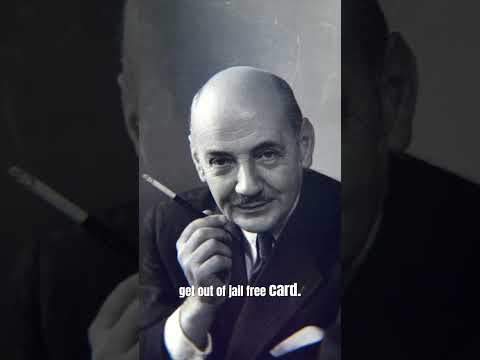
He began forging his brother’s signature to free prisoners from concentration camps and help dissidents escape. Each forged document was a death sentence if discovered. The Gestapo desperately wanted to execute him, but Hermann always intervened, saving Albert’s neck—perhaps out of twisted family loyalty. “You are a fool, Albert,” Hermann reportedly said. “But you are my brother.”
Albert’s double life was a tightrope walk over an abyss. Every act of defiance could have been his last. Yet he persisted, driven by a moral compass that refused to bend to the Nazi ideology. He saved Jews, political dissidents, and others marked for death, using his brother’s name as both shield and sword.
The tragic irony came after the war. The Allies, suspicious of anyone named Göring, refused to believe Albert’s story. He was shunned by society, died penniless and alone, his heroism unrecognized for decades. But his legacy lives on—a testament to the power of individual courage in the darkest of times.
But the tightrope grew thinner with every passing month. In 1943, Albert was summoned to the Gestapo headquarters in Berlin. An officer slid a forged release order across the desk—one Albert had signed three weeks earlier. “This signature is your brother’s,” the officer said, tapping the paper. “And yet the ink is fresh, the paper is new, and the prisoner vanished the same night. Explain.”
Albert didn’t flinch. He leaned back and smiled. “My brother signs many things. Perhaps you should ask him.” The bluff worked—for now. The officer dismissed him with a warning, but Albert knew the Gestapo had started keeping a file with his name on it.
He grew more careful after that. He learned to mimic Hermann’s handwriting so precisely that even clerks in the Reich Chancellery couldn’t tell the difference. He cultivated contacts in the railway service, arranging for dissidents to be smuggled across the border in freight cars. Each escape required a dozen small lies, a dozen signatures, a dozen prayers.
Then came the night that nearly broke him. A Jewish family he had hidden in a factory cellar was betrayed by a neighbor. The SS arrived at dawn, and Albert arrived minutes later, still in his dressing gown. He stood in the doorway and demanded to see the commanding officer. “These people are under my protection,” he said. “Unless you wish to explain to Reichsmarschall Göring why his brother’s property was raided, you will leave. Now.”
The officer hesitated. Albert could see the calculation behind his eyes—the fear of crossing a Göring versus the suspicion that this Göring was lying. The silence stretched unbearably. Somewhere down the street, a dog barked. Albert kept his face calm, though his heart hammered against his ribs.
Finally, the officer saluted stiffly and ordered his men to withdraw. Albert watched them go, then closed the door and leaned against it, trembling. He had won another round. But he knew, with a cold certainty, that his luck could not hold forever.
The family escaped that same night, hidden beneath a tarp in a coal truck bound for the border. Albert watched it disappear into the dark and allowed himself a single moment of relief—then buried it. There was no time for relief. The Gestapo file on him was thickening, and somewhere in Berlin, someone had begun to connect the forged signatures to a single, careful hand.
Weeks later, the blow he had feared finally landed. Two agents seized him outside his apartment and drove him to a gray building he had never seen. No shouting, no theatrics—just a small room, a single lamp, and a man in a plain suit who introduced himself as Kriminalrat Weber. “We have compiled seventeen documents bearing your brother’s signature,” Weber said softly. “All of them freeing enemies of the Reich. All of them traced, eventually, to you.”
Albert said nothing. Weber slid a photograph across the table—the Jewish family, taken from a neighbor’s window. “You will write a full confession,” Weber continued, “or this photograph goes to the Reichsmarschall himself, and we shall see how long his patience with his little brother lasts.”
Albert stared at the photograph and felt the floor tilt beneath him. This was the trap he had always known would come—not the threat of his own death, but the weaponization of Hermann’s protection. If the confession was written, everyone he had saved could be hunted down through it. If he refused, Weber would hand Hermann the proof and the shield would shatter from the inside.
He asked for a glass of water to buy time, and his mind raced through every contact, every favor, every debt he had ever collected. There was one name left—a clerk in Weber’s own office who owed him a life. “I’ll need paper and a pen,” Albert said slowly. “And privacy. A confession of this size takes time to write properly.”
Weber smiled and left him alone. Albert picked up the pen, and instead of a confession, he began to write something else entirely—a letter, in his brother’s unmistakable hand, ordering the immediate transfer of Kriminalrat Weber to the Eastern Front.
He folded the letter, sealed it with wax from the desk candle, and slipped it into the clerk’s tray when the guard turned his back. The clerk, a thin man with nervous hands, recognized the seal and went pale—but he owed Albert a life, and debts like that are paid in silence. By morning, Weber was gone, reassigned to a frozen outpost near Minsk, his file on Albert misfiled and forgotten.
Albert walked out of the gray building a free man, though he knew the reprieve was borrowed. He kept saving people until the bombs stopped falling, until the Reich collapsed into rubble and ash. “You were never one of them,” a liberated prisoner told him, gripping his hands. “You were the only Göring who ever mattered.”
But the Allies saw only the name. They stripped him of everything, questioned him for months, and released him into a world that spat at his shadow. He died in a rented room with no money and no mourners—yet the people he saved lived on, married, had children, told stories.
History has a long memory but a slow one. Today, plaques bear Albert’s name, and historians call him the righteous Göring. The monster’s brother, who chose the harder path.
So here’s what I want to know: if your own family stood for everything you despised, would you have the courage to betray them—or would you stay silent? Tell me in the comments.
Report this article
Select a reason for reporting:






