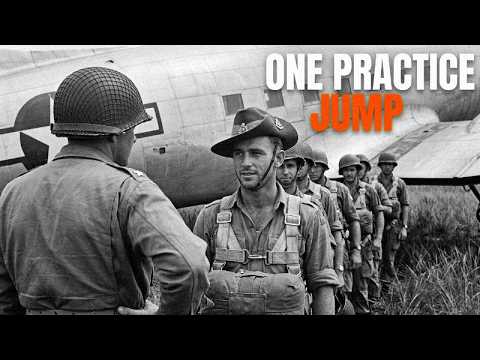
September 1943. A dusty airstrip outside Port Moresby. A American colonel walks down a line of Australian artillerymen, offering each a way out. His name is Kenneth Kinsler, commander of the 503rd Parachute Infantry Regiment, and in days his men will make the first combat jump of the Pacific War. The Australians before him are field gunners from the 4/2nd Field Regiment, most of whom have jumped from an aircraft exactly once. Kinsler insists on speaking to them personally. No one steps forward.
They had volunteered two weeks earlier. The American regiment had no artillery of its own, and the assault ahead needed guns on the ground. So the guns would have to come from the Australians. Four officers and thirty men put their names down. The American paratroopers put them through about fourteen days of jump training and one practice jump over an airstrip the troops called “Mile 30.” By the time Kinsler spoke to them, three of the volunteers had already been injured in that single training landing.
Eight new 25-pounder guns arrived from the 10th Advanced Ordnance Depot in Port Moresby on August 23, less than two weeks before the jump. Two went straight to training. The other six were inspected and condemned for serious assembly and manufacturing defects. The two guns the gunners would take into the Markham Valley were hand-built from those six rejected weapons. When jump day came, only one was ready to fly.
The Americans were about to launch the first major airborne attack of the war against Japan. General Douglas MacArthur decided to watch it from the air. His air commander, George Kenney, told him he intended to fly over the drop zone. MacArthur’s first response was to remind him of orders forbidding it—and of the loss of Brigadier General Kenneth Walker over Rabaul in January on a raid he was told not to fly. Kenney said the paratroopers were his men, and he would go to see them do their job. MacArthur replied that they would both go, because they were his men too.
So it was that on the morning of the jump, the commander-in-chief of the Southwest Pacific Area flew over the Markham Valley in a Flying Fortress above a regiment that had never been in combat, and a handful of Australians behind them with one jump each. David Dexter’s volume of the official Australian history traces those guns from the ordnance depot to the drop zone. The Australian War Memorial holds a photo of the gun position taken in the Markham Valley ten days after the jump, with a caption noting that many of the Australians had trained as paratroopers for only fourteen days.
The moment with the American colonel comes from one gunner, Ian Robertson, who told the regimental historian about it more than 50 years later. Each Dakota aircraft unloaded its cargo in 10 seconds. Robertson’s first jump was over a friendly airfield. His second would be into the Markham Valley, about 40 km upriver from the Japanese base at Lae. The objective was Lae.
By mid-1943, Lae was the main Japanese base on that part of the New Guinea coast, and the plan to take it, Operation Postern, aimed at it from two sides. The Australian 9th Division was to land on beaches about 27 km east of the town on September 4, carried by Admiral Daniel Barbey’s U.S. amphibious force—the first major seaborne landing by Australian troops since Gallipoli. The 7th Division would attack from the west through the Markham Valley. The original idea was for the 7th to march in and secure its supplies overland, a plan its commander, Major General George Vasey, described as a dog’s breakfast. So it was decided to fly the 7th Division in. For that, the old abandoned airfield at Nadzab, about 42 km northwest of Lae, had to be seized first and made ready to receive transport aircraft. Taking it was the job of Kinsler’s regiment.
The 503rd was formed in the United States, shipped to Australia in late 1942, and trained in Queensland for most of a year without ever making a combat jump. It was a full three-battalion regiment of about 1,500 men who would jump from the aircraft at Nadzab. In 1943, a parachute regiment carried its rifles and mortars with it as it jumped. What it did not have was field artillery. At Nadzab, the solution was two Australian guns with the men trained to work them.
The gun they would use was an Australian design that had only entered production that year. The short 25-pounder, known as the “baby 25,” was a cut-down version of the standard British field gun and was designed for jungle warfare. It weighed 1,315 kg, about 300 kg less than the full-sized gun. It could be towed by a jeep or broken down into 13 parts and carried by air. No Australian artillery had ever been dropped by parachute onto a battlefield before. At Nadzab, the gun would come out of the aircraft in pieces under parachutes, and the crew on the ground had to find every piece in the grass before they could fire a single round.
The men of the light aid detachment did not jump, but the guns would not have fired without them. When six new guns came back destroyed, the task fell to them. They stripped the six weapons down. They sorted the serviceable parts from the unserviceable, and from the six they assembled two working guns. Each was then fired 20 rounds to prove it would hold together. The first was finished in time for the flight. The second had to follow separately after the gunners had left.
The volunteers came from a regiment that had been at war for three years. The 2/4th Field Regiment was raised on May 7, 1940, at the Caulfield Racecourse in Melbourne as part of the 7th Division and sailed for the Middle East at the end of that year. Its gunners served in Egypt and Palestine, and entered Syria and Lebanon in the campaign against the Vichy French in 1941. After that, the regiment stayed in Syria on garrison duty until the end of the year. They had begun the war with 18-pounder guns left over from the previous war. By 1943, they were in New Guinea with the 7th Division, and jumping from aircraft was not part of a gunner’s trade.
The training jump was on August 30. The Australians jumped from over 30 miles at 1,200 feet, and Vasey was on the airfield below to witness it. Three of them landed badly. One was Lieutenant Evans, whom the gunners called “Buck,” and his place in the detachment went to another officer, Lieutenant Alan Clayton, who volunteered to go in his stead. The detachment commander was Lieutenant Johnny Pearson, and under him were Lieutenants Frank Ross and Frank Faulkner. The others returned to training, and a few days later, Kinsler came to speak to them.
On the morning of September 5, 302 aircraft lifted from eight airfields and met over “Tsili Tsili” airstrip at seven minutes past ten. Seventy-nine Dakotas carried the paratroopers, with more than 100 fighters flying cover above them. Forty-eight Mitchell bombers went in first to pound the drop zone, and a group of Havoc bombers laid a smoke line along its edge. Five more Dakotas flew behind the main force, and those five carried the Australians and their guns.
MacArthur and Kenney flew above in the Flying Fortresses, and so did Vasey. The drop began at twenty-two minutes past ten. Each Dakota put its men out in about 10 seconds, and the entire regiment was out of the aircraft in four and a half minutes. Three men did not survive the drop. Two died when their parachutes failed, and a third fell through a tree and dropped about 20 meters before hitting the ground. Another thirty-three were injured in the rough landings.
The three battalions then formed up in their assembly areas amid the kunai grass and began work on the airfield. The Australians jumped from the first two of their five aircraft. The other three dropped the guns in pieces. One gunner, Lidgetwood, came down in a tree and injured his shoulder. The rest landed in the long kunai grass and began searching for their gun. An American liaison officer, Lieutenant Armstrong of New York, went with them.
Sergeant Wally Minan’s crew was the first to find a complete set of parts. They assembled it, and according to Dexter’s account, the first gun was together within two and a half hours of the landing. That same evening, men of the 2/20th Pioneer Battalion and the 2/6th Field Company crossed the Markham River using folding boats and a pontoon bridge they built from local timber to reach the Americans.
Dexter’s official history says the first gun was ready within two and a half hours, but he delayed firing registration rounds until the next morning. The regimental historian, Arthur Burke, notes that the two Flying Fortresses dropped 192 shells at a quarter past three that afternoon, and the gun was brought into action. Dexter says the second gun, whose pieces were scattered across the valley nearly a mile away, took three days to assemble. Burke records that Sergeant Jimmy Thompson’s crew put it together the next day.
The numbers do not match either. Thirty-four men volunteered according to the Army’s own figures, while Burke counts 31 men who actually jumped. Both statistics exist in the printed records. Robertson and Ross moved forward with an American infantry company to a village called Gabsonkek as a scouting force. Faulkner joined the pioneers on the southern flank.
On September 6, the 7th Division began arriving by air. Though bad weather over the Owen Stanley Range delayed most of it for days. On the seventh, a Liberator bomber crashed on takeoff from Jackson airfield onto trucks full of men of the 233rd Battalion waiting to board. Fifteen men died instantly, and forty-four more did not survive their injuries. Another ninety-two were wounded. Nevertheless, the 233rd Battalion flew into the Markham Valley on schedule.
By September 16, the two Australian divisions were racing to reach Lae. The 9th Division was about a mile and a half east of the town. The 7th was about 7 miles west of it. On paper, the 9th Division was the one that would win. The 7th moved at dawn led by its brigade commander, Brigadier Ken Eather, who walked at the front as chief scout and arrived first.
Most of the Japanese garrison had already slipped away through the mountains to the north. As they entered, the advancing troops were strafed and bombed by aircraft of the Fifth Air Force, wounding two men. Then the 9th Division’s 25-pounders shelled them and hit another.
On September 15, a photographer gathered four of the gun officers and the lieutenant from New York for a picture that still sits in the Australian War Memorial collection. The caption, written in 1943, reads: “These officers landed with the American paratroopers and hemmed in the remnants of four Japanese divisions at Lae and Salamaua.” The records do not support that. Salamaua fell on September 11 and Lae on the 16th. Around the time Lae fell, nearly 9,000 Japanese soldiers withdrew across the Buso River and set off over the Saruwaged and Finisterre Ranges toward the north coast. Between 600 and 1,000 of them did not survive that march.
Their route led north through the mountains, away from the Markham Valley and Australia’s two guns. There was no battle at Nadzab. The Japanese were not there, and the Americans and Australians who came down into the valley that morning met no one on the ground. Robertson’s forward platoon fired two shots at a Japanese bunker near Gabsonkek, the village where the Americans set up their regimental headquarters, and in Burke’s account, that was all they fired.
As for that moment on the airstrip—the American colonel’s offer, the line of gunners who did not move—it rests on the memory of one man, told to the regimental historian half a century later. Lae fell 11 days after the drop. Lieutenant Colonel John Tolson, who led the 3rd Battalion out of the aircraft that morning, later described Nadzab as perhaps the model airborne operation of the Second World War. MacArthur was awarded the Air Medal, and the citation stated that he personally led the American paratroopers and directed that historic operation with skill.
The Australian gunners stayed in the Markham Valley with the 503rd until Lae was secured. Their regiment then followed the 7th Division into the Finisterre Range, and their guns fired in support of the infantry when they took Shaggy Ridge on December 27. In 1990, at a luncheon marking the 2/4th Field Regiment’s fiftieth anniversary, American combat jump wings were presented to the surviving artillery paratroopers of Nadzab, according to Arthur Burke. Forty-seven years had passed since September 5. It was the same badge Kinsler’s men had earned over the Markham Valley that morning. Five years after the luncheon, Burke sat with Ian Robertson in Borood, Melbourne. Robertson told him about the airstrip outside Port Moresby, the American colonel who offered them a way out, and the line of gunners who stayed in place.
So here is the question: when the record depends on one old soldier’s memory told fifty years on, do we honor the story—or the silence of the men who never stepped forward?
Report this article
Select a reason for reporting:






