The fighter plane was broken before it ever left the deck. The supercharger would not hold pressure. The wings would not lock all the way home. On the morning of June 19th, 1944, in the largest carrier battle the world had ever seen, a 25-year-old Lieutenant Junior Grade from a steel town in Indiana was strapped into the worst airplane on the ship. He could not climb with his squadron. He could not catch them. He watched them shrink into the haze above the Philippine Sea and disappear. And then he was alone with two other stragglers, orbiting slow and low between the enemy and the American carriers.
The Imperial Japanese Navy had read the specifications of the machine he was flying and found them ridiculous. 12,000 lb of airplane built around armor plate and self-sealing tanks and bulletproof glass. Everything their Zero had deliberately thrown away. Heavy, slow, wrong.
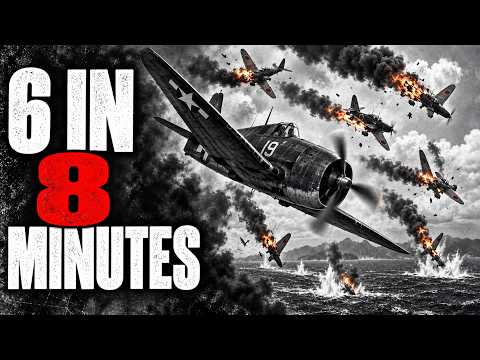
Eight minutes later, six Japanese dive bombers were burning in the water and Alexander Vraciu was landing on the deck of the Lexington with 360 rounds gone from his guns and six fingers held up over his head for a photographer he never saw coming. What happened in those eight minutes did not begin that morning. It began with a dead man.
The steel mills of East Chicago, Indiana ran all night and the boys who grew up there grew up under an orange sky. Alexander Vraciu was born into that light on the 2nd of November, 1918, nine days before the guns of the First War went quiet. His father, Alexandru, and his mother, Maria, had come out of Romania in the years when the mills were pulling men across the Atlantic by the trainload and they had settled in the smoke on the southern rim of Lake Michigan and raised their children there.
He went to Washington High School. He won a scholarship to DePauw University. He graduated in 1941 with no particular intention of going to war. What he had instead was an accident that turned into a life. In the summer of 1940, the government was quietly teaching college students to fly, and Vraciu signed up for it the way a young man signs up for anything that sounds better than the alternative. He came out of it with a private license and something he could not put down.
Within weeks of graduation, he enlisted as a naval aviation cadet. He began instruction that October. He pinned on gold wings and a commission in August of 1942 with 254 hours in his logbook, 89 of them with an instructor breathing down his neck. He learned to land on a carrier in the middle of America. There were no ships to spare on either ocean, so the Navy had taken an old Great Lakes paddle steamer, bolted a flight deck across the top of it, named it the Wolverine, and sent it churning back and forth across fresh water while young men slammed airplanes onto it. Eight arrested landings on Lake Michigan.
Then the Grumman Wildcat, short and blunt and honest, the airplane that had held the line at Midway and Guadalcanal, because there had been nothing else to hold it with. In March of 1943, Vraciu was assigned to fighting squadron three, and the man who ran it was Lieutenant Commander Edward Henry O’Hare. Every man in naval aviation knew that name. On the 20th of February 1942, defending the first carrier Lexington in the waters off Rabaul, O’Hare had taken a single Wildcat into a formation of Japanese bombers and shot down five of them in a matter of minutes. He was the first naval aviator of the war to be given the Medal of Honor. His photograph had run in every newspaper in the country. Chicago would one day put his name on its airport.
Vraciu flew as his wingman for 5 months. What stayed with him afterward was not the fame. It was the repetition. O’Hare taught the way a good mechanic teaches by grinding a thing down until it no longer requires thought. Watch your fuel. Stay with your leader. Get close before you shoot. Closer than feels reasonable because bullets that miss are only noise. And one more said before every flight, said on the ladder said over the radio in the middle of a quiet patrol when nothing at all was happening said until it stopped being advice and became a muscle in the back of the neck. Check your six. The rear quadrant. The blind cone behind the tail where a fighter cannot see and cannot answer. Vraciu would snap his head around and find empty sky a thousand times. The thousand and first time there would be something there and that would be the entire difference between a man who came home and a telegram to a house in Indiana.
By the time the squadron was redesignated Fighting Six that July, Vraciu had close to 700 flight hours, 40 carrier landings and a new airplane. Across the ocean that same airplane was being read about rather than flown. Through the autumn of 1943 intelligence on the Grumman F6F Hellcat filtered into the air groups of the Imperial Japanese Navy 12,000 lb fully loaded. More than 200 lb of steel plate wrapped around the pilot. Fuel tanks lined with rubber that swelled shut around a bullet hole, a windscreen thick enough to stop a rifle round, an engine so large the fuselage had to be built wide to hold it.
The airplane the Japanese flew weighed less than half of that. The Mitsubishi A6M had come from a designer named Jiro Horikoshi who had been handed a specification that should not have been possible to satisfy all at once. The Navy wanted the range of a bomber, the climb of an interceptor, and the turn of a stunt plane in an airframe light enough to fly off a carrier. Horikoshi got there the only way anyone could have. He removed everything that did not make the airplane go faster, farther, or tighter. No armor, no protected tanks, structure paired back until the spars were closer to jewelry than to engineering. And for 18 months it had worked so completely that it reshaped the map. Zeros had cleared the sky from the coast of China to the Java Sea. They had turned inside every Allied fighter put in front of them. They had shown up over targets a thousand miles from any airfield that had a right to reach. Men who tried to dogfight a Zero died. Men who tried to run from one died as well. And the pilots inside them had started training three years before the war began, had entered combat with 700 hours already logged, and had been fighting without a pause since before Pearl Harbor.
So the reaction to the Hellcat report was not alarm. Nobody wrote down the names of the men who heard it first, or the room, or the hour. But the response is legible in everything that came afterward. It is in a training syllabus that did not change. It is in a doctrine that stayed exactly where it stood. The Americans, having been beaten in the turn for two straight years, had answered by building a fighter twice as heavy as the one beating them. To a naval air arm that had won every fight it had ever picked, that was not a threat. It read like a confession.
Vraciu had his hands on the thing they were dismissing, and he understood something they could not read off a page. The weight was not a mistake. The weight was the argument. The Pratt & Whitney Double Wasp in the nose made 2,000 horsepower at sea level and was still turning out more than 1,600 at 25,000 ft. An altitude where a Zero was gasping, the Hellcat climbed at better than 3,000 ft a minute. In a dive, it became a falling anvil, and the heavier it was, the harder it fell and the faster it went. A Zero could not follow it down because above roughly 300 mph, the Zero’s controls went stiff as stone in a pilot’s hands, and the airplane simply stopped answering. And the six Browning .50 caliber guns in the wings did not need to stay on a target. They needed to touch it once, correctly. There was nothing behind a Zero pilot’s seat and nothing wrapped around his fuel. What those guns found, they took apart.
None of that came from where the legends later said it came from. In the summer of 1942, a nearly intact Zero had been discovered upside down in a bog on Akutan Island in the Aleutians with its young pilot dead in the cockpit. It was crated, shipped to San Diego, rebuilt, and flown against every American fighter in service. The story that grew up afterwards said the Hellcat was designed from that wreck. It was not. The Hellcat prototype had already lifted off in June of that year before any American had ever taken a Zero into the air. What the Akutan machine changed was not the metal. It was the knowledge. It turned suspicion into measurement. American pilots had believed the Zero got heavy on the controls at speed. Now they had the number. They had believed it could not follow a dive. Now it could be printed in a manual and taught to a 19-year-old in Florida. They had believed it would burn. Now they had walked around it on the ground and seen exactly where the fuel sat and exactly what was not protecting it.
The Hellcat was never built to beat the Zero at what the Zero did best. It was built to make what the Zero did best stop mattering.
Vraciu got his first one on the 5th of October 1943 over Wake Island, flying from the light carrier Independence with O’Hare leading the division. A Zero crossed his nose and he shot it down, and what he felt afterward was not triumph. It was a flat ringing quiet. The feeling of having performed a procedure correctly.
On the 20th of November he burned a twin-engine Betty bomber near Tarawa. Six days later the ground moved under him. On the night of the 26th of November 1943 the Japanese came at the American ships in the Gilberts in darkness, at the hour when carriers were nearly blind and radar was still a young and clumsy thing. O’Hare went up into that blackness with a night intercept team assembled almost on the spot, groping toward bombers nobody could see. Somewhere out over the water he was gone. No wreckage, no body, no radio call anyone could ever make sense of.
The man who had taught Alexander Vraciu how to stay alive did not stay alive. Vraciu was 25 years old and had two victories to his name. He did not make a speech about it. He did not ask to be sent home. He did something quieter and more private than that. He set himself a piece of arithmetic that appeared in no operational order and no squadron log. 10 Betty bombers. 10 of the twin-engine machines most likely to have been in the sky that night. He would take them one at a time and nobody else needed to know he was counting.
He would never get to 10. He would get five, and long before he stopped counting, the war would hand him something he had not asked for and could not have imagined.
The counting started in the Marshall Islands on the 29th of January 1944. Flying from the carrier Intrepid over the island of Roi, Alexander Vraciu found three Betty bombers and burned all three of them out of the sky in a single mission. Three victories in one flight put him past the number that makes a man an ace. The squadron knew it. The ship knew it. The intelligence officer wrote it down and somewhere in a filing cabinet in Washington a card was updated. In the ready room they slapped his shoulder and said the things men say. Vraciu did the arithmetic that nobody else was doing. Four Betty bombers of 10.
He was not celebrating. He was working through a debt, and the ledger had been opened on a night in November when a man went out over black water and did not come back. Nobody in the squadron knew the number. It was not the kind of thing you said out loud, because saying it out loud would have made it sound like grief, and grief was not something you carried into a cockpit.
What was happening to the Japanese in those months was not what they thought was happening. They believed they were losing to luck, to numbers, to the sheer weight of American production. Some of them believed they were losing to a temporary decline in the quality of their own replacements. What was actually killing them was a change in the geometry of air combat so complete that skill had been quietly demoted from the first thing that mattered to the third.
American fighter pilots had been taught a doctrine before they ever crossed the Pacific, and it was almost insultingly simple. Keep your speed, keep your altitude, never trade either one away to gain a firing position, because speed and height are the only currency in the sky, and everything else is borrowed. Attack from above and from behind. Fire, and then climb straight out of the fight before anyone can answer you. If an enemy gets close enough to force a turning contest, do not accept it. Push the nose down, let the airplane run away downhill, and come back 30 seconds later from a better place. Do not fight him. Outlast the geometry.
For a Japanese pilot, this was an unbearable thing to fly against, because every instinct he had been trained into for years told him to close, to turn, to work himself around behind the enemy, and hold on. He would begin that turn, and the American would simply be gone, falling away in a dive at a speed the Zero’s controls could not follow, and by the time he had rebuilt his own energy, the American would be back above him with the sun at his back. Skill still mattered. It mattered enormously. But it had been placed underneath physics, and physics does not get tired and does not lose its nerve.
Vraciu flew that doctrine the way a man plays an instrument he has stopped having to think about. He was not a natural. What he was, by every account of the men who flew beside him, was patient. He would let a target grow in the gun sight until other pilots would have started shooting, and then let it grow more, and then fire a burst so short it sounded like a cough, and the airplane in front of him would come apart.
In the early spring of 1944, he was transferred to fighting squadron 16 aboard the second carrier to carry the name Lexington, the flagship of Vice Admiral Marc Mitscher’s Task Force 58. It was the most powerful naval formation that had ever existed. It was the center of the war. And in the two months that followed, Alexander Vraciu lost two airplanes.
The first went down in March. His engine failed on the approach to the ship at the worst moment in the worst place, low and slow with nothing underneath him but water. He put the Hellcat into the sea, got out of it, and discovered that his life vest would not inflate. He hung in the swell in the Pacific Ocean with a dead airplane sinking beneath his boots and a piece of equipment that had one job and had not done it, waiting for a destroyer to find him.
The second went down on the 29th of April. Anti-aircraft fire found him, opened up his engine, and he ditched again. Two airplanes in eight weeks. He started telling people he was Grumman’s best customer, and it was funny the way things are funny in a war, which is to say that everyone laughed and nobody thought it was funny.
This is the part of the story that gets edited out when it is told badly. The man who would become one of the most famous naval aviators of the Second World War spent the spring of the greatest year of his life in the water twice, watching expensive machinery go down without him, wondering whether the thing he was good at was going to be enough. He was 25 years old. His score was climbing toward 12. He had a private count of Betty bombers that would stop at five, and he had no idea that he was eight weeks away from the morning that would define the rest of his life.
While Vraciu was swimming, the Imperial Japanese Navy was quietly running out of the one resource it could not manufacture. Not airplanes. Japan built airplanes until the last months of the war. What Japan could not build was the man in the seat.
Before the war, the Imperial Navy’s flight training was among the most brutal and most selective in the world. It ran for something close to three years. It rejected the overwhelming majority of applicants. It produced pilots who arrived at their first squadron with roughly 700 hours of flight time and a level of individual airmanship that American pilots who fought them in 1942 spoke about for the rest of their lives.
Those men had been spent. They had been spent at Coral Sea and Midway, over the Solomons, in the long attritional grinding above Rabaul and Bougainville and New Guinea, in 100 engagements where Japan won on points and still lost the men it could not replace. By the early months of 1944, the training pipeline had been cut roughly in half. Fuel was short. Instructors had been pulled forward into combat units. The need for warm bodies in cockpits had become more urgent than the need for excellence. And so a new naval aviator was arriving in a fleet squadron with something in the neighborhood of 300 hours, going up against Americans who arrived with as much or more in a better airplane with a radio that worked, flying a doctrine designed specifically to defeat him.
The Japanese pilots who had laughed at the Hellcat specifications had been right about one thing. In the hands of a truly great pilot, the Zero was still capable of extraordinary things. The problem was that Japan was running out of truly great pilots, and America was manufacturing adequate ones by the thousand.
On the morning of the 19th of June, 1944, those two curves crossed.
Report this article
Select a reason for reporting:






