Hollywood has always been a place where passion and ambition collide, but sometimes the spotlight illuminates a darkness that ends in tragedy. These are the stories of romances that spiraled into violence, leaving behind shattered lives and unanswered questions.
From starlets to studio executives, no one is immune to the deadly consequences of love gone wrong. In a world where image is everything, the truth is often buried beneath glamour and lies.
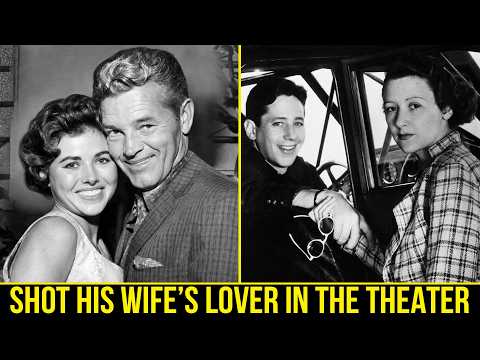
Consider the case of Paul Kelly and Dorothy Mackaill. In 1927, Kelly confessed his love for Mackaill to her husband, Ray Raymond. The confrontation turned physical, and Raymond, drunk and weakened, collapsed after being struck. He died two days later. Kelly was convicted of manslaughter, and Mackaill for concealing the fight. After prison, they married—a union forged in scandal and blood.
Then there’s Gig Young and Kim Schmidt. Young, an Oscar-winning actor, married Schmidt in 1978. Just 22 days later, police found both dead in their Manhattan apartment. Young had shot Schmidt and then himself. The motive remains a mystery, but the diary on the wedding date read, “We got married today.”
The silent film era had its own share of horrors. Mary Miles Minter, a teenage star, was devoted to director William Desmond Taylor. When Taylor was found murdered in his bungalow, Minter’s love letters were discovered, and she was forever linked to the scandal. No one was ever convicted, but Minter’s career was destroyed.
In 1966, Barbara Ann Thomason, Mickey Rooney’s fifth wife, was found dead alongside actor Milos Milos in Rooney’s home. The official ruling was murder-suicide, but rumors of revenge persisted. Rooney was in the hospital at the time, providing a solid alibi.
These stories are just a few of the many that haunt Hollywood’s history. Each one serves as a reminder that behind the glitz and glamour, human emotions can turn deadly.
And the pattern only deepens as the years roll on. Take Clara Phillips, a former chorus girl who, in 1922, bought a 15-cent claw hammer and asked the clerk whether it could kill a woman. The next day she lured Alberta Meadows, the bank clerk she suspected of seeing her husband, to Montecito Heights. There she attacked her and left a heavy stone over the body. Convicted of second-degree murder, Clara was sentenced to ten years to life.
Decades later, the same lethal jealousy resurfaced with Dorothy Stratten and Paul Snider. Stratten, Playboy’s 1980 Playmate of the Year, was trying to sever both her marriage and her business ties to Snider. He hired a private investigator to track rumors of her affair with Peter Bogdanovich. On August 13th, Snider bought a used 12-gauge shotgun and told friends he was taking up hunting. The next day, Stratten went to his rented West Los Angeles house to discuss money and the divorce. Police found both bodies inside, the shotgun beneath Snider’s body. She was just 20.
The 1930s offered no shortage of cautionary tales. Ross Alexander, a Warner Brothers contract actor, and his wife Aletta Freel saw their marriage buckle under private accusations. Henry Fonda, their best man, said Freel had learned Alexander was involved with other women. On December 7th, 1935, Freel took a .22 rifle from the gun rack in their home and died the next morning. Her family pushed for a review, and New Jersey Governor Harold Hoffman asked California to investigate. Thirteen months later, Alexander was found behind his Van Nuys home with a .22 pistol.
Perhaps no case better captures the studio’s grip on a scandal than that of Jean Harlow and Paul Bern. Harlow, MGM’s platinum blonde star, married the studio executive on July 2nd, 1932. On September 5th, Bern was found dead in their Beverly Hills home while Harlow was staying with her mother. The first call from the house was not to police, but to MGM. Studio men arrived before investigators and had time alone in the house before the official inquiry began.
Near Bern lay a note. Dearest dear, wipe out my abject humiliation. I love you, Paul. It ended, You understand that last night was only a comedy. Then police learned Bern had been supporting Dorothy Millette, a former common-law wife. The next day, Millette boarded the Delta King. Her cabin was empty when the boat arrived. Her coat and shoes were found on deck.
The same era gave us Thelma Todd and Roland West. Todd, a comedy star and cafe owner, was found on December 16th, 1935, in her chocolate brown 1934 Lincoln Phaeton inside the garage of West’s estranged wife, Jewel Carmen. She wore a silver and mauve gown, mink wrap, and jewelry. The coroner called it accidental carbon monoxide poisoning, though the garage door was raised only three or four inches.
And then there is the riddle of Thomas Ince, Marion Davies, and William Randolph Hearst. In November 1924, Hearst invited Ince onto his yacht Oneida for a birthday weekend and a business deal. Davies was aboard, gossip tied her to Charlie Chaplin, and Hearst’s jealousy was already part of her career. During the cruise, Ince became violently ill after champagne and salted almonds, both forbidden because of ulcers. He died on November 19th. The official cause was heart failure after acute indigestion. The rival rumor said Hearst had fired at Chaplin and hit Ince instead.
By the late 1950s, the darkness had moved from yachts and bungalows into the living rooms of America. George Reeves, television’s Superman, had ended his long affair with Tony Mannix and was planning to marry Leonore Lemmon. After 1:00 a.m. on June 16th, 1959, Reeves came downstairs at his Benedict Canyon home and complained about the noise from Lemmon and her guests. He returned to the bedroom. Lemmon told the room, “He’s going upstairs to shoot himself.” Then a shot was heard.
Police ruled it self-inflicted, but no fingerprints were found on the gun. No gunpowder residue was reported on Reeves’s hands, and three bullets had been fired from the same weapon. One shell casing was found under his body. The questions never stopped.
The pattern repeated itself with terrible precision in the case of Dominique Dunne and John Sweeney. Dunne, a 22-year-old actress who had appeared in Poltergeist, had left Sweeney weeks before. On October 30th, 1982, she was at her West Hollywood home rehearsing lines with actor David Packer when Sweeney broke back into her night by phone. She told a friend, “Oh God, it’s Sweeney.” Then she agreed to speak with him outside.
Packer stayed inside. He heard smacks, screams, and a thud. Weeks earlier, friends had seen marks on Dunne’s neck after another attack by Sweeney, but much of that history was kept from the jury. Dunne died five days later at Cedars-Sinai. Sweeney was convicted of voluntary manslaughter, sentenced to six and a half years, and served two and a half.
That same courtroom leniency shadowed the case of Carole Landis and Rex Harrison. By July 1948, Landis wanted Harrison to leave his wife, Lilli Palmer. On July 4th, he spent the evening at her Pacific Palisades home, then returned the next afternoon after failing to reach her by phone. Harrison and the maid, Fannie May Bolden, found Landis on the bathroom floor. The official finding was death by Seconal overdose.
Harrison did not call police immediately. A doctor was contacted first. At the inquest, he denied knowing any motive and denied knowing about a second note. Landis left a note to her mother asking forgiveness and telling her to find the will. She signed it, “Your baby.”
Not every death was ruled a murder, and not every killer was a stranger. Tom Neal, the film noir actor whose career had already been wrecked by the Barbara Payton-Franchot Tone brawl, found himself back in the headlines in 1965. Separated from his third wife, Gail Bennett, he returned to their Palm Springs house on April 1st claiming he wanted a reconciliation. At trial, he said they argued after he accused Bennett of seeing other men and that a gun went off during a struggle. Police found Bennett on the couch, partly covered by a blanket. Neal was convicted of involuntary manslaughter and sentenced to one to fifteen years.
Then came the case that turned a movie star’s bedroom into a courtroom stage. Lana Turner and Johnny Stompanato. On April 4th, 1958, Stompanato, her mob-connected lover, came to Turner’s rented house at 730 North Bedford Drive in Beverly Hills. Turner said she tried to end the relationship that night. The argument moved into her bedroom. Stompanato threatened to kill Turner, her mother, and her daughter Cheryl, and made gangster threats about breaking bones and cutting Turner’s face.
Cheryl, just 14, had been listening nearby. She grabbed a kitchen knife and came through the bedroom door as Turner moved toward it. Turner testified she never saw the blade. Stompanato died from a single wound. On April 11th, the coroner’s jury ruled it justifiable homicide.
Four years later, in the San Fernando Valley, another woman would face the same split-second decision. Sandra Edwards, a Warner Brothers actress and Playboy Playmate, had left her estranged husband, Tom Gilson, and was staying at her sister Connie Davis’s Van Nuys home with her children. She told police Gilson drank heavily, beat her, and had attacked her while she held her baby. Police had been called repeatedly when he tried to force his way into the house.
On October 6th, 1962, Gilson phoned drunk, demanded to see their 9-month-old son, and said he was coming over. Richard Davis gave Edwards a 12-gauge shotgun and left again. Around 2:00 a.m., Gilson broke through the rear door. Edwards warned him. He answered, “If you don’t shoot, Sandra, I’ll kill you and the kids.” Edwards fired once. The coroner’s jury ruled it justifiable homicide.
Not every tragedy ended in a courtroom verdict. Lupe Velez, Hollywood’s Mexican Spitfire, was pregnant with actor Harold Ramond‘s child in 1944. She ended the relationship and ordered him out. On December 13th, she dined with friends, then went to her bedroom. Her secretary found her the next morning. She had taken Seconal. In her note to Ramond, Velez wrote that he had faked love for her and the baby.
Seventeen years later, Spade Cooley, the Western swing star, let jealousy consume him. His wife Ella Mae Evans had asked for a divorce. On April 3rd, 1961, at their ranch, Cooley attacked her while their 14-year-old daughter witnessed part of it. He waited hours before seeking help, later claiming she had fallen in the shower. A jury convicted him of first-degree murder.
The earliest scandal set the template. In 1906, Evelyn Nesbit told her millionaire husband, Harry Thaw, that architect Stanford White had taken advantage of her as a teenager. Thaw became obsessed. On June 25th, he walked into the rooftop theater at Madison Square Garden during the finale and shot White. Witnesses heard him say, “You ruined my wife.” Thaw was found not guilty by reason of insanity.
And then there is Natalie Wood. On Thanksgiving weekend, 1981, she was aboard the yacht Splendour with her husband Robert Wagner, Christopher Walken, and Captain Dennis Davern. The evening included drinking and arguments. Wagner later admitted arguing with Wood before she vanished. Her body was recovered the next morning about a mile from the yacht. The original ruling was accidental drowning. In 2012, the death certificate was changed to drowning and other undetermined factors, citing fresh bruises before she entered the water.
These are the stories Hollywood would rather forget—romances that turned fatal, leaving behind shattered lives and unanswered questions. The spotlight may fade, but the shadows remain.
Which of these cases do you find most haunting, and why?
Report this article
Select a reason for reporting:






