The jungle was suffocatingly silent. For fourteen hours, four Australian SAS soldiers lay motionless in the pitch-black Vietnamese jungle, their bodies numb, their minds sharp. Fifteen meters ahead, a Viet Cong supply trail cut through the darkness—a highway for the enemy. Intelligence suggested tonight would be busy. They had no idea they were about to make history.
Sergeant Bob’s legs had gone numb hours ago. Mosquitoes feasted on every exposed inch of skin, but he didn’t twitch. None of them did. They were waiting. Watching. Because in the jungle, patience was the deadliest weapon of all.
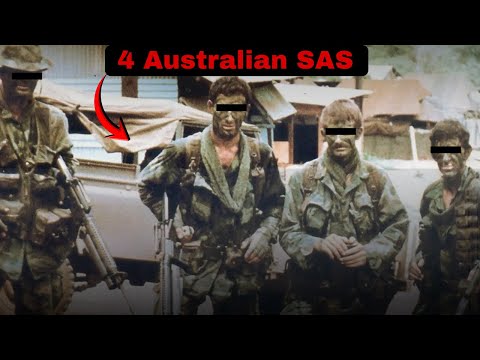
The trail had been under surveillance for three days. Corporal Jack, the patrol scout, had discovered it during a reconnaissance sweep. Fresh boot prints. Broken vegetation at shoulder height. Scattered grains of rice. This wasn’t just a path—it was a lifeline for the Viet Cong. And the four Australians had positioned themselves in a textbook L-shaped ambush, ready to sever it.
Sergeant Bob anchored the corner, his eyes commanding the entire kill zone. Corporal Dave, the signaler, covered one end with his L1A1 rifle. Corporal Jack held the long arm of the L, his weapon aimed straight down the trail. Private Tom, the medic, watched their backs. They were invisible. They were ready.
At 03:45, Bob heard it. Not the crashing noise of amateurs, but the calculated movement of experienced soldiers—the soft pad of feet on packed earth, the whisper of equipment, low voices speaking Vietnamese. Then he saw them: seven Viet Cong fighters, moving in tactical formation, AK-47s at the ready, scanning the jungle with the awareness of men who had survived countless patrols. They were good. But the Australians were ghosts.
Bob counted silently as the VC entered the kill zone. One. Two. Three. Four. Five. Six. Seven. The SAS doctrine was clear: wait until maximum enemy in the zone. Wait until they’re so close you cannot miss. Wait until the shock will be absolute. When the seventh man reached the center, directly in front of Bob’s position, he fired.
One aimed shot. The lead VC dropped. It was the signal.
All four Australian weapons erupted simultaneously. The L-shaped crossfire meant the VC had nowhere to run. Jack fired down the length of the column. Dave blocked the far escape route. Bob controlled the middle. Seven seconds of controlled fire. Seven VC bodies. Zero return fire.
The patrol immediately executed their extraction drill. Jack moved forward, checking bodies, grabbing documents and weapons. The others provided security. Ninety seconds later, they had recovered four AK-47s, one light machine gun, medical supplies, and intelligence documents—and they were gone. Melted back into the jungle like smoke.
By dawn, they were three kilometers away, calling for extraction. Zero Australian casualties. Seven enemy dead. Four weapons captured. Intelligence that would map VC supply networks across the entire province. But the real weapon wasn’t the bullets. It was the message.
We can kill you anywhere, anytime. And you’ll never see us coming.
This single ambush, like hundreds of others conducted by Australian SAS, would create a legend. The Viet Cong would come to call them Ma Rung—the jungle ghosts—and they would fear them more than any force America could field.
To understand why Australian SAS ambushes were so devastatingly effective, you have to understand that they operated on a completely different philosophy than American forces. The American approach to Vietnam was firepower and mobility. Find the enemy, fix them in place with superior firepower, destroy them with artillery and air support. It was a doctrine built on America’s industrial advantage—unlimited ammunition, helicopter fleets that could move battalions in hours, jet fighters and bombers on call.
But this approach was predictable. The Viet Cong learned to detect American operations before they began. They could hear helicopters from kilometers away. They could see preparatory artillery fire. They knew American forces would sweep through an area then leave. So they developed a simple counter-strategy: avoid contact during the sweep, ambush the Americans during extraction or movement, attack isolated outposts after the main force departed.
The Australian SAS approach was the opposite. Instead of firepower, they relied on stealth. Instead of mobility, they used patience. Instead of sweeping areas, they occupied positions and waited.
Historian David Horner writes in Phantoms of the Jungle that the SAS philosophy came from British special forces experience in Malaya, where patience had proven more effective than aggression. The basic concept was simple but extraordinarily difficult to execute: Study enemy patterns. Predict where they’ll be. Get there first. Hide so perfectly they can’t detect you. Wait for as long as it takes. Strike when you have overwhelming advantage. Disappear before they can react.
This required a level of patience that most military forces simply couldn’t sustain. Conventional soldiers couldn’t lie motionless in an ambush position for 12 or 24 or even 48 hours. The physical discomfort was extreme. The psychological pressure was enormous. The fear of compromise was constant. But SAS selection had weeded out everyone who couldn’t master this discipline.
The men who made it through selection had proven they could suppress every natural human instinct to move or make noise or give up. They could enter a state of calm awareness where they monitored their surroundings while conserving energy. They could wait with the patience of predators.
One SAS veteran described it as becoming part of the jungle. “You’re not hiding in the jungle. You become the jungle. You breathe with it. You move with it. You wait with it. And when the moment comes, you strike with all the sudden violence of a python taking a rat.”
This patience gave the SAS an overwhelming tactical advantage because by the time they initiated an ambush, every variable was controlled. They’d selected the exact position that gave them maximum advantage. They’d studied the approaches and knew where the enemy would appear. They’d calculated fields of fire so every weapon could engage without crossing fires. They’d planned multiple escape routes. They’d preposition support if needed. And most importantly, they’d waited until the enemy was completely committed to the kill zone with no possibility of escape.
The result was ambushes that lasted seconds but achieved near-perfect kill ratios. The L-shaped ambush became the signature SAS tactic in Vietnam. And understanding its geometry reveals why it was so effective.
Imagine looking down from above at a trail running through the jungle. The SAS would position themselves along two sides of the trail, forming an L shape. The long arm of the L ran parallel to the trail with operators positioned to fire lengthwise down the trail. The short arm of the L was perpendicular to the trail, positioned at one end of the killing zone. This created interlocking fields of fire that caught the enemy in a crossfire from two directions simultaneously.
Historian Peter Haran explains in his book Crossfire that the L-shaped ambush solved several tactical problems. First, it maximized firepower. Every weapon in the ambush could fire into the kill zone without risk of hitting friendly forces. In a linear ambush where all shooters are on one side of the trail, you risk hitting your own people if someone fires too far. But in an L-shaped ambush, the geometry prevents fratricide. Second, it eliminated escape routes. Enemy forces caught in the kill zone faced fire from their front and their flank simultaneously. They couldn’t advance because the short arm of the L blocked that direction. They couldn’t retreat because the long arm covered their rear. They couldn’t flee left or right because both directions had shooters. The only option was to leave the trail and push into dense jungle, but that meant turning their backs to the shooters. Third, the L-shape created psychological shock. Most ambushes come from one direction, and soldiers are trained to react by returning fire toward the threat while moving to cover. But when fire comes from two directions simultaneously, that training breaks down. Soldiers don’t know which way to face, which direction offers cover, where the main threat is located. This hesitation is fatal in an ambush measured in seconds.
The mechanics of setting up an L-shaped ambush required careful planning. First, the patrol commander had to select the ambush site. He would look for a trail section that was straight for at least 30 meters, had good concealment on both sides where his men could hide, offered solid backstops like earth banks or trees that would stop bullets and prevent them from traveling too far, and most importantly showed signs of regular enemy use.
Once the site was selected, the patrol would approach from a direction that wouldn’t leave tracks on the trail itself. They might parallel the trail for hundreds of meters, then carefully move into position from the side. The approach to the final ambush position could take hours, moving at a crawl. Placing each hand and knee carefully, freezing at any sound.
The patrol commander would position himself at the corner of the L where he had visual command of the entire kill zone. This was the trigger position. He would initiate the ambush by firing the first shot, which signaled everyone else to open fire. The signaler would typically be positioned near the commander on the short arm of the L. His role was to maintain communications and be ready to call for support or extraction. The scout, who had the best fieldcraft, would often be positioned at the far end of the long arm, his weapon oriented to fire down the entire length of the trail. The medic would either be on the long arm or in a security position, watching for enemy forces approaching from an unexpected direction.
Once in position, each man had to establish his field of fire. This meant identifying exactly what sector he was responsible for covering, picking aiming points along the trail where he would engage targets, and understanding where his teammates’ fields of fire were so he didn’t stray into them. The patrol would also establish hand signals for communication. A clenched fist meant freeze. Pointing indicated direction of enemy movement. A throat-cutting gesture meant enemy very close. These signals had to be visible in darkness, which meant they were large deliberate movements.
The ambush then entered the waiting phase. This could last hours or even days. During this time, the patrol maintained absolute noise and light discipline. No talking, no unnecessary movement, no smoking, no lights. They would eat cold rations if they needed to eat at all. They would urinate in place rather than risk movement. They became living statues.
When enemy forces finally entered the kill zone, the patrol commander had to make rapid calculations. How many enemy? Are they bunched or spread out? Are they moving fast or slow? Do they appear alert or relaxed? Are there more coming behind this group? Based on these factors, he decided when to initiate. The ideal moment was when maximum enemy were in the kill zone, they were relaxed, not alert, and no friendly forces were in danger of being caught in the crossfire.
The commander would aim at the lead enemy soldier, take up trigger pressure, and fire. That shot was the signal. Every other weapon fired simultaneously. The ambush lasted as long as targets were visible and threatening, typically 5 to 10 seconds. When the firing stopped, the patrol immediately transitioned to the next phase.
The moments immediately after an ambush were as critical as the ambush itself. SAS doctrine emphasized speed and aggression during this phase. The patrol had achieved surprise and inflicted casualties, but the situation could reverse in seconds if VC reinforcements arrived. The exploitation phase had multiple objectives: confirm enemy casualties, recover weapons and intelligence, and withdraw before reaction forces arrived.
The drill was rehearsed until it became automatic. The moment firing stopped, the patrol commander would assess. If all enemy appeared to be casualties and there was no return fire, he would signal the exploitation phase. Typically, the scout would move forward to the kill zone because he had the best tactical awareness. He would move rapidly but carefully, checking each body. Dead enemies were checked for documents, maps, notebooks—anything that might provide intelligence. Weapons were collected, but only those that could be carried without significantly slowing the patrol.
If there were wounded enemy, the patrol had to make a difficult decision. Wounded VC could provide intelligence through interrogation, but they also slowed the patrol and created a security risk. SAS practice varied. Some patrols would attempt to secure wounded prisoners if the tactical situation allowed. Others would follow the harsh calculus of combat and ensure all enemy in the kill zone were permanently neutralized.
This exploitation phase lasted no more than 90 seconds. Any longer and you risked being caught by VC reinforcements. One SAS after-action report from February 1967 describes the exploitation in clinical detail: “Ambush initiated at 0615 hours. Seven enemy in kill zone. Firing ceased at 0615 hours plus 7 seconds. All enemy down. Corporal Jack moved forward to conduct exploitation. Recovered three AK-47 rifles, one SKS carbine, two cloth pouches containing documents, one map case, multiple ammunition magazines. Enemy personal effects left in place due to time constraints. Patrol withdrew from ambush site at 0616 hours plus 90 seconds. Total time in kill zone: 90 seconds.”
The withdrawal phase was as carefully planned as the ambush itself. The patrol didn’t simply run away. Instead, they moved to a pre-designated rally point 50 to 100 meters from the ambush site. This was a concealed position that offered good observation and fields of fire. At the rally point, the patrol would stop and listen. They were listening for sounds of VC reaction forces—shouting, movement, vehicles. If they heard VC forces arriving at the ambush site, they would note the direction and numbers. This intelligence about VC reaction time and procedures was valuable.
If after 30 minutes there was no reaction, the patrol would begin moving away from the ambush site using a carefully planned route. This route was designed to break any tracking attempt. It might involve multiple stream crossings, movement over rocky ground that didn’t hold tracks, false trails, and changes of direction. The patrol would move through a series of pre-planned checkpoints. At each checkpoint, they would stop, observe, and listen. If they detected any sign of being followed, they would prepare a hasty ambush or call for extraction.
Typically, the patrol would move at least three kilometers from the ambush site before calling for helicopter extraction. This put distance between them and any VC forces searching for them. Extraction itself was a vulnerable moment. Helicopters made noise that attracted attention. The patrol had to expose themselves by moving to an open landing zone. And there was always the risk of the LZ being hot—meaning under fire. SAS extraction procedures emphasized speed. The helicopter would approach the LZ at high speed, flare to land. The patrol would sprint to the aircraft, jump aboard, and the helicopter would immediately lift off. Total time on ground: often less than 30 seconds.
Back at Nui Dat, the patrol would go through an extensive debrief. The patrol commander would provide a detailed account of the ambush, sketching the ambush site, describing enemy appearance and equipment, explaining his decision-making process. The signaler would provide exact coordinates and timings. The scout would hand over any captured documents or equipment. The medic would describe any enemy casualties he’d observed. Intelligence officers would question the patrol about every detail. What direction were the enemy moving? What were they carrying? Did they appear to be a combat patrol or a logistics element? Did they seem alert or relaxed? Were there any signs of other enemy forces in the area?
This intelligence would be compiled into a patrol report that became part of the larger intelligence picture. The captured documents would be translated. Captured weapons would be analyzed to determine their origin and route of supply. The location of the ambush would be marked on situation maps. Over time, this accumulation of patrol reports created an extraordinarily detailed picture of VC operations in Phuoc Tuy province. Task force commanders could see patterns emerge. Certain trails were used more heavily than others. Certain base areas were occupied seasonally. Supply routes ran in predictable directions. Enemy forces tended to move at certain times of day. This pattern analysis allowed the SAS to predict where future ambushes would be most effective. It also allowed conventional forces to plan operations based on solid intelligence rather than speculation.
While most SAS ambushes were small-scale actions against patrols or logistics elements, several operations achieved results significant enough to be recorded in official histories. Operation Hayman, conducted in November 1966, was one of the first large-scale SAS ambush operations. Three SAS patrols were inserted into the Nui Thi Vai hills with orders to locate and ambush VC forces believed to be operating in the area. The patrols spent five days conducting reconnaissance, mapping trails, and identifying patterns of enemy movement. On the sixth day, two of the patrols established coordinated ambushes on parallel trails approximately one kilometer apart. At 0700 hours on November 23rd, both ambushes were triggered simultaneously. The northern ambush engaged a VC platoon of approximately 30 fighters moving in column. The southern ambush engaged a smaller element of about 12 fighters. Both ambushes were over in seconds. The after-action reports documented 18 confirmed VC killed, seven wounded captured, 12 AK-47 rifles captured, two RPG launchers, 160 mortar bombs, and documents identifying the enemy unit as part of the D445 battalion. SAS casualties: zero.
Historian David Horner notes that Operation Hayman demonstrated the effectiveness of coordinated small-unit actions. By positioning multiple patrols in the same area, the SAS could cover more ground and had a higher probability of making contact. Operation Canberra in February 1967 took this concept further. Five SAS patrols were deployed across southern Phuoc Tuy province in a coordinated reconnaissance and ambush operation. The operation lasted two weeks, during which the patrols conducted continuous surveillance of key trails and base areas. The patrols established temporary ambushes at promising locations, sometimes sitting in position for 24 hours before moving to a new location. Over the two-week period, the five patrols conducted eight successful ambushes. The cumulative results were impressive: 31 confirmed VC killed, 15 weapons captured, including several heavy weapons, and most importantly, a treasure trove of documents that revealed the location of a major VC base camp. This intelligence led to Operation Paddington, a follow-on operation where infantry from the 6th Battalion, Royal Australian Regiment, conducted a cordon and search of the base camp. They discovered bunkers containing weapons, ammunition, medical supplies, and enough rice to feed a battalion for a month. The intelligence chain from SAS reconnaissance to conventional follow-on operations became a template for Australian operations throughout the war.
One particularly notable ambush occurred on March 15th, 1967, when an SAS patrol commanded by Sergeant Mike ambushed what they thought was a standard VC logistics element. The patrol was in position on a trail known to be used for supply runs. At approximately 0500 hours, they heard movement. As the enemy element came into view, Sergeant Mike realized this wasn’t a normal logistics patrol. The VC were carrying what appeared to be new weapons still wrapped in protective covers. He counted at least 20 fighters heavily laden with equipment. Mike made the decision to initiate despite being outnumbered five to one. The ambush was textbook perfect. The VC were caught in the kill zone with no cover. SAS fire was accurate and controlled. Within 10 seconds, the trail was littered with bodies, and the surviving VC had fled into the jungle. The exploitation revealed an intelligence windfall. The VC had been transporting a shipment of new AK-47 rifles from a cache to a combat unit. The patrol recovered 17 rifles, all Chinese-manufactured, dated 1966, along with 2,000 rounds of ammunition. The loss of this weapons shipment probably disarmed an entire VC company.
Another significant operation occurred in August 1967 when an SAS patrol discovered and ambushed a VC courier. Couriers were high-value targets because they carried messages between headquarters elements. This particular courier was traveling with two armed guards. The SAS patrol watched them approach, allowed the guards to pass, then simultaneously killed all three men with suppressed fire. The exploitation recovered a dispatch case containing operational orders for an upcoming VC attack on the district capital of Ba Ria. The intelligence warning allowed Australian and South Vietnamese forces to reinforce Ba Ria. When the VC attack came on August 21st, it was met with overwhelming defensive fire and failed completely. The VC lost over 50 fighters killed without achieving any objectives. All because an SAS patrol had ambushed a courier two weeks earlier.
These documented operations represent only a fraction of SAS ambush activity. Between June 1966 and December 1967, SAS patrols conducted over 150 ambushes. The statistics compiled from after-action reports are remarkable: 423 confirmed VC killed, over 200 weapons captured, countless intelligence documents recovered, and SAS casualties during this period were five wounded, none killed. This represented a kill ratio of approximately 85 to 1. Historian Terry Burstall analyzed these statistics and concluded that pound-for-pound, man-for-man, the Australian SAS was the most effective combat force in Vietnam.
While most SAS ambushes occurred during dawn or dusk when the Australians could exploit the low light to their advantage, some of the most psychologically devastating ambushes occurred in complete darkness. Night ambushes required skills and discipline that went beyond normal operations. The challenges were substantial: you couldn’t see targets clearly, you couldn’t use hand signals to communicate, movement made noise that carried in the quiet jungle night, and the risk of friendly fire was higher. But night ambushes also offered advantages: the Viet Cong moved more freely at night, believing darkness provided security. Many VC logistics operations occurred after dark, and the psychological impact of being ambushed in pitch darkness was extreme.
SAS night vision techniques were based on understanding how human eyes adapt to darkness. The human eye has two types of light receptors: cones that work in bright light and see color, and rods that work in low light but only see shades of gray. It takes approximately 30 minutes for rods to fully adapt to darkness. Any exposure to bright light resets this adaptation. So SAS operators preparing for night operations would avoid all bright light for at least an hour before darkness fell. They wouldn’t use flashlights, wouldn’t look at fires, would turn away if a flare went up. Some operators wore red-lensed glasses during the day before night operations because red light doesn’t degrade night vision as much as white light.
Once darkness fell and their eyes were fully adapted, SAS operators could see surprisingly well. Not as clearly as daylight, but enough to detect movement and identify shapes at close range. They learned to use peripheral vision, which is more sensitive in low light than direct vision. If you looked slightly to the side of a target rather than directly at it, you could see it better. They learned to distinguish shades of darkness, recognizing that a vertical shadow might be a tree trunk, while a horizontal shadow might be a log. Movement was the key. Even in near-total darkness, you could detect something moving.
Sound discipline became even more critical at night. Any noise carried clearly: the click of a weapon safety, the rustle of cloth, the scrape of equipment. SAS patrols moving into night ambush positions moved with glacial slowness, taking hours to cover the final 100 meters to their ambush site. Communication at night was done through physical touch. A patrol member could reach forward and tap the man in front to signal stop. Two taps meant danger. A squeeze on the shoulder meant resume movement. This required the patrol to move very close together at night—maybe two meters apart instead of the five meters used during daylight.
The ambush itself required different techniques at night. Shooting at night without tracers was like shooting blind. You aimed at where you saw or heard the target, fired, and couldn’t see where your rounds went. Some SAS patrols used a technique of loading one tracer round as the third or fourth round in each magazine. This meant your first shots were non-tracers that didn’t give away your position. But after the ambush was initiated, you would see where your subsequent rounds were going. Other patrols avoided tracers completely because they gave away your exact position. Weapon-mounted lights were not yet common in the 1960s. Some SAS operators experimented with taping small flashlights to their weapons. They would wait until the target was very close, suddenly switch on the light, and fire at the illuminated target. This worked but required absolute fire discipline because the moment the light came on, you were visible.
One documented night ambush from July 1967 illustrates the technique. An SAS patrol had been observing a trail junction for two days. They’d noticed that VC movement occurred primarily between 0200 and 0400 hours. On the third night, they established a night ambush. At 0230 hours, the patrol commander heard movement. He couldn’t see the VC, but he could hear them—multiple individuals moving tactically. He waited until the sound indicated they were in the kill zone, approximately 10 meters away. Then he switched on a powerful flashlight aimed down the trail. The beam illuminated six VC fighters frozen in place, temporarily blinded by the sudden light. The patrol opened fire. Within seconds, all six VC were down. The patrol immediately switched off the light and withdrew. They didn’t conduct exploitation because staying at the ambush site after giving away their position with the light would have been suicidal. They moved to their rally point and waited. Thirty minutes later, they heard VC forces arriving at the ambush site—voices, lights, commotion. The patrol noted this and continued their withdrawal. The after-action report documented six confirmed killed based on intelligence reports from VC radio intercepts mentioning the ambush.
Another night ambush technique used sounds to aim. If you heard enemy movement and had a good sense of where they were based on sound, you could aim at the sound and fire. This was called reconnaissance by fire, and it sometimes worked. More often, SAS patrols would use noise to locate enemy positions, then mark those positions with phosphorous grenades, which burned brightly and allowed accurate fire. One patrol commander described his night ambush philosophy: “We didn’t seek night contact, but if it happened, we used it to our advantage. The VC were confident at night. They moved less carefully. They talked more. They used lights. We would remain absolutely silent and dark. And when they revealed themselves with noise or light, we would kill them, then disappear back into the darkness.”
The psychological impact of night ambushes on VC morale was severe. Captured prisoners reported that after several night ambushes in an area, VC units refused to move at night without extremely heavy security. This meant more resources devoted to security, slower movement, and reduced operational capability.
As SAS ambushes continued to inflict casualties throughout 1967, Viet Cong commanders attempted to develop counter-tactics. Captured documents and prisoner interrogations reveal the evolution of VC thinking—and why their adaptations ultimately failed. The first VC response was to increase security on patrols. Instead of moving in small groups of 5 to 10 fighters, VC patrols would move in larger groups of 20 or more. The theory was that larger groups could fight their way out of an ambush. This tactic failed for several reasons. First, larger groups made more noise and were easier to detect. SAS patrols could hear them coming from further away. Second, larger groups left more obvious tracks, making them easier to follow. Third, and most importantly, SAS patrols simply declined to ambush larger groups. They would observe the large patrol, note its composition and direction, report it to headquarters, and wait for a smaller, more vulnerable target. The SAS had patience. They didn’t need to engage every enemy force they saw. They could wait for targets that offered favorable odds.
The second VC adaptation was to increase the number of scouts and security elements. A VC patrol might now have two or three scouts moving ahead of the main body, security teams moving parallel to the main trail, and rear security following behind. This created what military theorists call defense in depth. The idea was that scouts would detect any ambush before the main body entered it. This tactic had some success. There are documented cases of VC scouts detecting SAS ambush positions and the VC patrol withdrawing before contact. But the tactic also had major drawbacks. Maintaining scouts and security teams required more personnel. It slowed movement to a crawl because scouts had to carefully check everything before the main body advanced. And it created multiple small dispersed groups that were themselves vulnerable to ambush. SAS patrols adapted by ambushing the scouts or security teams rather than the main body. These smaller elements were easier targets, and their elimination still disrupted VC operations.
A third VC adaptation was to vary routes and timing. Instead of using the same trails repeatedly at predictable times, VC units would change routes daily, use different trails for each movement, and vary their timing randomly. This tactic made it harder for the SAS to predict where to position ambushes, but it also had severe drawbacks for the VC. Using unfamiliar trails meant they might get lost or stumble into areas where other Allied forces operated. Varying timing meant logistics operations became unpredictable, which disrupted supply schedules. And most importantly, creating and maintaining multiple trail networks required extensive labor. The VC had to clear and mark numerous trails, establish way stations and rest areas along each route, and maintain local guides who knew each trail. Some VC units began moving cross-country, avoiding trails entirely. This eliminated the ambush risk but made movement extremely slow and exhausting. A journey that took four hours on a trail might take two days moving cross-country through dense jungle. This reduced VC operational tempo significantly.
A fourth VC adaptation was to establish standing orders that units should avoid contact with Australian SAS forces. Captured documents show that by mid-1967, many VC units had explicit orders: If you encounter Australian special forces, do not attempt to engage. Withdraw immediately. Call for support. Do not pursue if they withdraw. These orders show the psychological impact had reached the point where VC commanders felt their units couldn’t effectively fight SAS patrols. But this adaptation created its own problems. It meant VC units were ceding terrain to a numerically tiny force. Areas where SAS were known to operate became no-go zones for the VC. This disrupted their logistics and operations. It also created a morale problem. Soldiers ordered to run away from an enemy they outnumber develop a defeated mindset.
Some VC units attempted to create hunter-killer teams specifically trained to track and ambush SAS patrols. This was the most sophisticated counter-tactic. Specialized teams of experienced fighters would be tasked with finding SAS patrols and eliminating them. There are documented instances of VC forces attempting this. In one case, a VC tracking team followed an SAS patrol for two days. The SAS became aware they were being followed through their own counter-tracking skills. They established a hasty ambush and killed the tracking team. Another time, a VC unit attempted to encircle an SAS patrol that had established an ambush position. The SAS detected the encirclement movement, called for helicopter extraction, and were pulled out before the trap could close.
The fundamental problem with all VC counter-tactics was that they required matching or exceeding SAS fieldcraft and patience. But the SAS had been training these skills for years. The British SAS had been perfecting jungle warfare techniques since the Malayan Emergency in the 1950s. The Australian SAS had refined them during the Borneo campaign. By the time they arrived in Vietnam, they were operating at a level the VC couldn’t match. One captured VC officer put it bluntly during interrogation: “We tried everything to counter the Australian special forces—larger patrols, more security, changing routes, avoiding contact. None of it worked consistently. The problem is they are better at jungle warfare than we are. They move more quietly. They hide more effectively. They wait longer. They shoot more accurately. And they always escape. Our commanders eventually decided it was better to avoid areas where they operate rather than try to fight them.”
This admission from an experienced enemy officer represents the ultimate success of SAS psychological warfare. They had achieved dominance not through superior numbers or firepower, but through superior skill, creating a climate where the enemy chose not to fight.
The cumulative strategic impact of hundreds of small SAS ambushes far exceeded the body count. Every ambush of a supply column meant food, ammunition, or weapons never reached their destination. Historian Ian McNeill estimates SAS operations disrupted at least 30% of VC logistics in Phuoc Tuy province. Units that should have been well supplied ran short—making them less willing to fight and less able to launch major operations.
Beyond the casualties, the ambushes gathered intelligence that enabled conventional operations. Documents captured in the jungle revealed VC organization, plans, and base locations. Multiple large-scale Australian operations in 1967 and 1968 were built on intelligence first gathered by a handful of silent men in the dark.
And the ambushes denied terrain itself. Areas where SAS operated became no-go zones. The VC couldn’t move freely, rest securely, or establish permanent camps. Essentially, 120 SAS operators were controlling terrain that would normally require thousands of conventional troops.
When the Australian SAS withdrew from Vietnam in 1971, they left behind a record rarely matched: over 1,200 reconnaissance patrols, hundreds of successful ambushes, thousands of enemy killed or captured—and fewer than 20 operators lost in the entire deployment. A loss rate under 2%.
The Viet Cong’s admission that they feared the jungle ghosts more than any American force was the ultimate tribute. An enemy that had defeated the French and would outlast the Americans openly conceded they couldn’t counter 120 Australians who mastered patience, stealth, and sudden violence.
Four men with skill could defeat forces twenty times their size—and a perfect ambush measured in seconds could achieve effects that lasted for years. That is the legacy of the jungle ghosts, and it still shapes special operations doctrine today.
So here’s a question for you: if patience and fieldcraft could defeat overwhelming numbers, why do so few modern militaries truly prioritize them over firepower—and what would you have done, lying motionless in that jungle for fourteen hours?
Report this article
Select a reason for reporting:






