In the spring of 1938, Adolf Hitler’s personal pilot, Hans Baur, aimed a small color camera at the ancient streets of Naples. The footage he captured that day would become part of a hidden archive—amateur films that offer an uncensored glimpse into the private world of the Nazi elite. Six months later, as the world teetered on the edge of catastrophe, these images were approved for public viewing in the Third Reich. But they revealed far more than the official propaganda ever intended.
The state visit to Italy was meant to be a triumph of fascist solidarity. Hitler expected Mussolini’s blessing for his planned annexation of the Sudetenland, and the Italians, after some hesitation, gave it—once Hitler publicly declared the Brenner Pass an eternal border. But beneath the ceremonial pomp, tensions simmered. The official host, King Victor Emmanuel III, skillfully sidelined Mussolini, and Hitler, repulsed by the obsequious court rituals, made no secret of his disdain.
On May 5th, the Führer’s entourage traveled to Naples, where cheering crowds greeted them. Hans Baur filmed the city at the foot of Mount Vesuvius, decked out in festive garb for its visitors from the north. Yet Hitler grew irritated by the little king who stole the spotlight. “Mussolini had no alternative but to put on a brave face,” Baur later recalled. To divert attention, Hitler had his old friend walk alongside him, ensuring the cameras captured the Führer, not the monarch.
Three days later, the Italians staged a maneuver of their air force north of Rome—a calculated show of strength. In the Rome-Berlin Axis, Mussolini had already been relegated to junior partner. He secretly feared Hitler would drag Europe into war over Czechoslovakia, and privately decided to keep Italy out of any conflict. The German guests, however, were impressed by the display of Italian forces. “It was a case of staged saber rattling,” Baur noted, unaware of the duce’s true intentions.
Back in Germany, Hitler spent most of August 1938 at the Berghof, his mountain retreat on the Obersalzberg. There, on the terrace with its sweeping views, he studied plans for the invasion of Czechoslovakia. One frequent guest was Albert Speer, the ambitious architect who had become part of Hitler’s inner circle. “The little time the Führer allowed himself was often spent with his architect,” a witness remembered. Hitler, who once dreamed of being an architect himself, found in Speer the ideal executor for his colossal building plans.
Speer had also befriended Eva Braun, Hitler’s mistress, who took these color pictures in 1938. A keen amateur photographer, Braun had developed a passion for color film. These images of the dictator were supposed to have been destroyed after her death, but in October 1945 they fell into the hands of the American Secret Service. Now preserved in the National Archives in Washington, they are probably the only uncensored pictures of Hitler’s private life.
In his memoirs, Speer later claimed that the Berghof society merely engaged in small talk and killed time waiting for the master of the house. But this was a self-serving attempt to downplay his own involvement in Nazi crimes. In truth, many political decisions were taken on the idyllic Obersalzberg. Murders were even planned there. “At this time, peace in Europe was hanging by a thread,” a historian observed. Hitler wanted war, but Britain and France were not yet prepared to fight. With Mussolini’s help and far-reaching concessions at Munich, they forced the dictator to the negotiating table.
While Hitler was away, Eva Braun edited her footage into color film shows presented in the evenings at the Berghof. Accompanied by her parents, friends, and relatives, the athletic 26-year-old was the center of attention on trips to Bavaria’s lakes. Her sister Gretl also filmed and photographed, while friend Sophie Stork drew the film links. The Germans had no idea that Hitler had a mistress. As a Reuters correspondent in Munich, Ernest Pope speculated in his book Munich Playground: “The buxom Eva Braun is Adolf’s secret mistress. She cooks fine meals for him and serves him in every way you would expect from a German wife.” Rumors of a secret marriage circulated, but German propaganda insisted no mortal woman could become Frau Hitler.
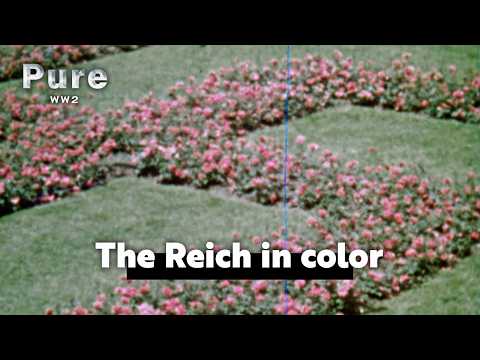
These amateur films—by Eva Braun, Hans Baur, and others—do not always document the decisive stations of the Third Reich. Yet they provide eloquent testimony to the nature of the National Socialist dictatorship. “It is only through color that the flower-clad swastikas at this children’s festival in Thuringia have such an oppressive impact,” a narrator notes. On May 1st, 1939, Berlin was festively decorated for Labor Day. Only six years had passed since the Nazis declared May 1st a national holiday, a move designed to bind the German working class to the regime through slogans and prophecies. It had proved successful.
Berlin journalist Ruth Andreas-Friedrich described such events in her diary: “District leaders, factory representatives, block leaders, shop stewards, leaders from the Federation of German Girls and the Hitler Youth—in fact all the state-appointed ideological controllers of the German people ensure that only acolytes turn up to cheer on official occasions. Anyone who is politically unreliable, anyone who has roused even the slightest suspicion of being a naysayer is to be kept away.” The yes-men knew what was expected. They cheered spontaneously at the right place and the right time.
March of the Golden Standards is the title of a color film taken on this particular day by an unknown cinephile. He was part of a delegation from the Siebel aircraft works, a Nazi model plant honored by Hitler the day before and allowed to provide one of the 200 flag bearers. In his speech, the Führer adopted a pacific tone and castigated an alleged international clique of Jewish war-mongers. But in actual fact, four weeks previously, he had ordered his military leaders to prepare the invasion of neighboring Poland. The rearmament of Nazi Germany was taking place at full speed. Consequently, on this May 1st, it was mainly arms factories who participated in this parade of the golden standards.
To the sound of marching music, the golden standard of the Siebel aircraft works was rolled up. This was the last May holiday to be celebrated in such grandiose style in the Third Reich. The outbreak of the Second World War was only a few weeks away. In Berlin in the summer of 1939, there appeared to be little enthusiasm for a renewed call to arms. Memories of the Great War were too traumatic. “Everyone is against war,” an American reporter observed. “How can a country start a decisive war with a people so tired of war?” An internal note stated that faith in the Führer would now be put to the test more than ever before. A German journalist noted that the observer cannot help thinking that people are deliberately indulging in unrestrained enjoyment. It was a dance on the volcano.
The recently completed Reich Chancellery was deserted. Albert Speer had adapted the huge building entirely to the Führer’s wishes. But Hitler preferred to forge his plans for conquering Poland on the Obersalzberg, far from the capital. Only occasionally did he show himself to his people. On July 16th, 1939, Munich was dedicated to National Socialist Creative Activity. Hitler wanted the Day of German Art to be celebrated as a true festival of peace. Members of an amateur film club were positioned at various points in the city to document all important events. The first item was the laying of a wreath at the grave of architect Ludwig Troost. Local branches of the Association of German Amateur Filmmakers were commissioned more and more often by party officers to document major events on 16mm color film, because there was still no satisfactory process for professional cinema productions. On this day, members of the Munich branch had passes and armbands allowing them access to all prime filming locations.
In the afternoon, anybody who was anybody in the Third Reich took their seat in the VIP stand to marvel at a three-hour procession of live images from 2,000 years of German culture. Not only was Germany’s future to be National Socialist, so was its past. The program declared: “The German eagle towers above the whole procession. With it ends this manifestation of our history. At the same time, it gazes into the eternal future keenly and calmly, with pride and assured of victory, announcing the greatness of our era and our willingness to act. It is the herald of our doing and our plans.” American reporter Ernest Pope commented, “The Nazi procession is the admission of the Führer’s restless plans for conquest.”
As the summer of 1939 drew to a close, the color films captured a nation blissfully unaware of the catastrophe to come. The cameras kept rolling, recording the last days of peace before the world plunged into darkness.
The color footage from that summer shows a Germany dressed in its Sunday best, marching in perfect columns beneath garlands of swastikas and flowers. Amateur filmmakers, granted unprecedented access, captured the smiles, the salutes, the festive atmosphere. Yet behind every frame, the machinery of war was already turning. The Siebel aircraft works, honored on May 1st, would soon shift entirely to military production. The golden standards, rolled up and stored away, would not be paraded again.
By late August, the Reich Chancellery stood empty while Hitler remained at the Berghof, finalizing the details of the Molotov-Ribbentrop Pact. On August 23rd, 1939, the world was stunned by the news of the non-aggression treaty between Nazi Germany and the Soviet Union. “The news hit Berlin like a bombshell,” Ruth Andreas-Friedrich wrote in her diary. “No one believed it possible. The enemy of our enemy had become our ally.”
Nine days later, on September 1st, German tanks rolled across the Polish border. The color films of marching bands and flower-clad children were suddenly relics of a vanished world. In Washington, the American Secret Service stored away the confiscated reels, including Eva Braun’s private films, not realizing they had captured the last peaceful summer of the Third Reich.
Hans Baur survived the war and later recalled those final weeks with bitter clarity. “We filmed everything,” he said. “The parades, the festivals, the Führer laughing on the terrace. But the cameras never captured what was really happening—the plans, the orders, the deaths that were being prepared.” The amateur filmmakers had documented a regime’s public face while its true nature remained hidden in shadow.
In the National Archives today, the reels sit in climate-controlled vaults. Scholars study them for clues about daily life under the swastika, but they also serve as a warning. “These films show how easily a nation can be seduced by spectacle,” one historian observed. “The color makes it all the more disturbing—the flowers, the flags, the smiling faces. It looks like a celebration. Only later do you realize it was a funeral.”
The cameras kept rolling until the very end, capturing the last gasps of a regime that had promised a thousand-year Reich and delivered only ruin. When the films were finally screened decades later, viewers could see the truth that the amateur filmmakers had missed: a nation dancing on the edge of an abyss, unaware that the ground beneath its feet was already crumbling.
What do you think—could the same thing happen again today, with cameras everywhere and no one willing to look away from the spectacle?
Report this article
Select a reason for reporting:






