Somewhere over Germany in early 1944, a Mustang pilot was flying the best escort fighter in the war—and he never saw what killed him. A Messerschmitt slid in from behind, directly into the cone of sky the pilot couldn’t see. The cockpit was framed like a greenhouse. Behind his head, the fuselage rose into a solid metal spine. That spine made the plane fast and stable, but it also made it blind.
The men who fixed it didn’t add a mirror or a warning. They used a saw to cut the plane apart. Here’s exactly how that happened.
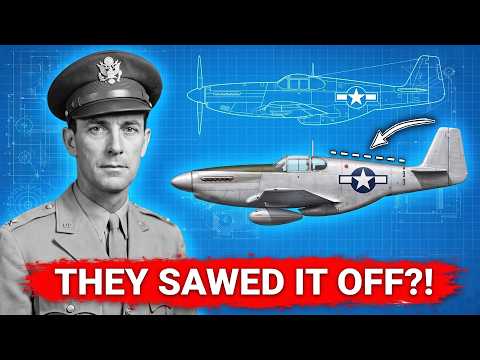
To understand why anyone would deliberately butcher a working fighter, you have to understand what the Mustang had become. Less than a year earlier, the P-51 was a disappointment—a brilliant airframe with the wrong engine. Its American Allison engine choked at high altitude, where the bombers flew and the fights happened. Then the British bolted in the Rolls-Royce Merlin, the same engine that powered the Spitfire, and the plane’s nature changed overnight.
Suddenly, the Mustang could climb high, run fast, and do it for hundreds of miles, all the way to Berlin and back. This was the P-51B and its Dallas-built sister, the P-51C. On paper, it was near perfection. It hit about 441 mph. It carried enough fuel to escort heavy bombers deep into Germany—something no other Allied fighter could do at the time. American planners were begging for this exact plane while their bomber crews died in daylight over Europe.
And here’s the strange part. This near-perfect fighter had a flaw so fundamental it seems invented. The pilot couldn’t see behind him.
Look at a P-51B from the side and you’ll notice it immediately. Behind the cockpit, the top of the fuselage doesn’t slope down. It stays high, a solid metal ridge running toward the tail. That ridge is why it was called the “Razorback.” The canopy mounted in front of it was a framed box of flat glass panels. Pilots called this style the “birdcage” or “greenhouse.” Thick metal frames chopped your vision into pieces. The raised spine behind blocked the rest.
Now imagine yourself in that seat. Aerial combat in 1944 wasn’t two knights jousting. The vast majority of pilots shot down never saw who did it. The killer came from behind and below—from the six o’clock position—closing fast and squeezing the trigger before the victim knew anything was wrong. Every pilot in every air force learned the same desperate habit: check your six. Twist in your seat, again and again, because the sky behind you was where death lived.
In a Razorback Mustang, you could twist all you wanted. The metal was in the way. A German fighter could sit in that blind cone and calmly set up a killing shot. The very shape that made the Mustang fast and stable was the shape that hid the enemy. That’s the core tension of this story, and it doesn’t go away easily.
To see behind him, a pilot would have to remove that raised section of the fuselage. But that section was doing a job.
The British spotted the problem first and came up with the first real solution. It didn’t come from North American Aviation in California—it came from a small British firm called R. Malcolm & Co. Their fix was clever and cheap. Instead of the flat-paneled canopy, they made a single piece of Perspex—acrylic—blown outward into a bulge, then mounted it on rails so it slid back instead of awkwardly hinging to the side. That bulge let the pilot push his head into the glass and look down past his shoulder and along the fuselage in a way the flat panels never allowed.
Developed initially for the Spitfire, when fitted to the Mustang it became famous as the Malcolm hood. The Royal Air Force loved it. They fitted it to most of their Mustang IIIs. And here’s the crucial detail: American pilots wanted it too. The Eighth and Ninth Air Forces in England updated their P-51B and P-51C fighters in the field with the Malcolm hood because it was better than what the factory gave them. It slid back for easier entry, gave noticeably improved visibility, and barely affected speed.
Some pilots who flew both types would insist for the rest of their lives that a Razorback Mustang with a Malcolm hood was the best Mustang ever—lighter, faster, and more precise in control than anything that came after. Hold that thought; it will return. And when it does, it will mean something different, because the Malcolm hood, good as it was, didn’t actually solve the problem. It mitigated it.
There were still frames. There was still that raised spine behind your head. You could see better into the rear quarter, but you couldn’t twist and look straight back over the tail, clearly and uninterrupted, the way you needed to. It was a patch on a fighter flying deep into enemy territory every month, escorting bombers through the most dense fighter defenses on Earth. A better patch wasn’t good enough. The plane itself had to be fixed.
The idea for how to do that came from Britain too—and it landed on one American officer’s desk. In January 1943, the U.S. Army sent Colonel Mark Bradley from Wright Field to England. Wright Field was where America tested and evaluated its aircraft, and part of Bradley’s mission was to find out what the British were doing that the Americans weren’t. What he saw changed the shape of American fighters for the rest of the piston era.
The British were flying planes—late-model Spitfires and the massive Hawker Typhoon—with a completely different kind of cockpit. It wasn’t a bulging box. It was a single, teardrop-shaped piece of clear acrylic sitting on top of the fuselage with nothing behind it. A pilot inside one could turn his head and see the entire sky, a true 360-degree view.
Bradley went home. By June 1943, he was back at Wright Field, pushing hard to apply the bubble canopy to American fighters. And here’s a common myth that many people believe, and it’s easy to see why. The bubble canopy is so closely associated with the P-51D—it’s the defining symbol of that plane—that people assume it was an American idea. The gleaming Mustang with the glass dome over the cockpit looks like the embodiment of American wartime engineering. It looks American-made. But it wasn’t.
The all-around teardrop canopy was a British development for the Typhoon and late Spitfires, and the Americans adopted it after Bradley saw it in action. If you want proof by dates, look at which American fighter got it first. It wasn’t the Mustang at all—it was the P-47 Thunderbolt. In the summer of 1943, engineers took a standard razorback Thunderbolt, serial number 42-8702, chopped down the rear fuselage, and fitted a clear bubble canopy taken from a Hawker Typhoon. They redesignated it XP-47K, and it was flying by July 1943.
The idea, the shape, the whole design was inspired by a British fighter. The Americans didn’t invent the bubble canopy; they recognized its quality and rushed to copy it. That’s a less flattering story than one of pure American genius, but it’s the truth. What the Americans were truly brilliant at was the next part—taking a smart idea from someone else and manufacturing it in enormous numbers. Which brings us back to the Mustang and the saw.
To be fair, North American wasn’t asleep at the switch. Its engineers had already built a wooden mock-up of a Mustang with a cut-down rear fuselage and a clear canopy, and put it in a wind tunnel to see how it affected airflow. So the infrastructure was there. But turning a razorback into a bubbletop wasn’t trivial. For the pilot to see clearly over his head, everything behind his head had to go. That solid structure—the razorback—had to be removed.
They took two P-51B airframes off the production line, serial numbers 42-106539 and 42-106540, under a modification order, and rebuilt them. They leveled the top of the rear fuselage and mounted a single-piece teardrop canopy over the cockpit, a canopy borrowed from the Typhoon design. The plane first flew on November 17, 1943, with North American test pilot Bob Chilton at the controls in Inglewood, California. For the first time, a Mustang pilot could sit down, close the canopy, and look straight back over the tail to see nothing but sky.
And so the problem that started this story was solved—but its solution immediately created a new one. Remember what that spine was for? It wasn’t just dead weight; it was surface area running along the fuselage. That area acted like fletching on an arrow, helping keep the plane straight, giving it directional stability, and holding its nose precisely on course. Removing it meant losing a big chunk of that stabilizing area.
The bubbletop Mustang was less stable in yaw than the razorback. It tended to wander, to swing its nose in a way the older plane didn’t. And the situation got worse under one specific, common condition. To give the Mustang the range to reach Berlin, they added a fuel tank behind the cockpit. When that rear tank was full, the plane’s center of gravity sat dangerously far aft. Combine an aft center of gravity with reduced tail area, and you get a fighter that’s a handful on takeoff with full fuel. Twitchy, unstable, unforgiving to a careless pilot. The machine designed to help ordinary pilots survive had a new problem.
The fix was a small triangular piece of metal. They added an extension to the fin ahead of the rudder—a dorsal fin. You’ll hear it called the dorsal fin extension, running forward along the top of the fuselage, restoring some of the vertical surface area lost when the spine was cut down. It was cheap, light, barely affected drag, and it worked. It entered production in the middle of the P-51D run, and field crews retrofitted earlier Mustangs, even some razorbacks, to match.
According to some accounts, an entire shipment of the modified fins was lost when a German submarine sank the ship carrying them, slowing the fix’s arrival to the squadrons. A saw caused the problem; a triangle of aluminum quietly fixed it.
Now, let’s return to those pilots who swore the Malcolm-hood Razorback was the better plane. Here’s why. The bubbletop gave you the sky, but it cost you some stability, some speed, and a little of that precision and crispness. The P-51D topped out around 437 mph versus 441 mph for the older Mustang. What looked like a straight upgrade was actually a trade-off. More visibility for a slightly slower, slightly less precise fighter. The men who preferred the old plane weren’t being sentimental; they were weighing a real cost.
But the high command had a different view, and they were right. Because what you can’t put in a spec sheet is how many pilots come home alive when they can see who’s trying to kill them. Once that decision was made, the focus shifted from design to the factory and the numbers. In July 1943, before the prototype even flew, a contract was signed for over 2,000 of the new bubbletop Mustangs. North American built them in Inglewood, California, and Dallas, Texas. The P-51D became the most produced Mustang of all. The version most people picture when they hear the name.
There’s a small human detail in the transition that shows how fast all this happened. The first four P-51Ds to leave the production line still carried the old birdcage canopy because bubbletop production hadn’t caught up. The paperwork changed faster than the tooling. For a few airframes, you had a D-model that looked like a B-model.
And it wasn’t just visibility that got fixed. The birdcage’s guns had a habit of jamming under the high-G forces of a sharp dogfight—the worst possible moment for a gun to fail. And it carried only four heavy machine guns. The D-model got a redesigned gun installation that ended the jamming problem and carried six .50-caliber guns instead of four. So the plane that could see the enemy could also throw more lead at him. More visibility and more firepower in the same new design.
Now, the prototype had flown, and the factory was humming, but none of it meant anything yet. Combat has a vote, and combat hadn’t voted. P-51Ds began reaching Europe in large numbers in the spring of 1944. Among the first to convert was the 55th Fighter Group, which traded its twin-engine P-38 Lightnings for the new bubbletop Mustangs. The timing couldn’t have been better. This was the run-up to the invasion of France and the all-out campaign to break the German Luftwaffe in the air. The months when American fighters were finally unleashed to hunt German fighters instead of just clustering around the bombers.
And here’s where the title pays off in the clearest way possible. The entire German pilot’s tactic against escort fighters depended on getting into that blind spot behind the tail. Against a razorback, he could do it. Against a bubbletop, the Mustang pilot could lay his head back, look straight down his spine where there was now only curved glass and open sky, and see his opponent coming. The slow, unseen killing shot from six o’clock was no longer a safe option. It was now a fight starter instead of a fight ender.
Think about what that did to the survival math. The deadliest thing in air combat is the attack you never see. Remove that, give a pilot even a few seconds of warning, and a huge share of those lopsided kills evaporate. The pilot breaks, turns into the threat, and the German who expected a helpless target finds a Merlin-powered fighter wheeling to meet him deep over the Reich, with other Mustangs circling above.
The bubble didn’t win the air war by itself. It turned ambushes into fair fights—and a fair fight was one a Mustang pilot could win. That’s the mechanism behind the numbers you’ve probably heard: more aerial victories than any other American fighter in Europe.
Be honest about the rest, though. The Luftwaffe was already bleeding out—veterans dying faster than replacements could train, fuel too scarce to fly. The Mustang was one link in a chain, but the link that touched the man in the seat. The difference between spotting your killer and never knowing he existed.
After the war, the teardrop canopy stopped being a clever fix and became the standard. Look at the jets that followed—Korea, and everything after. The bubble is simply how you build a fighter cockpit. The razorback, the framed birdcage, vanished with the war that exposed them.
So return to that opening scene. Everything on the plane that killed him was doing its job. The fix wasn’t a better mirror or a smarter tactic. It was a decision that a pilot’s ability to see the sky behind him was worth cutting a working aircraft apart.
The German pilots stopped slipping into Mustangs not because the plane got faster or stronger—though it got all three—but because they finally removed the blindfold.
Which would you have chosen: the faster, sharper Razorback, or the slower bubbletop that let you see death coming?
Report this article
Select a reason for reporting:






