What if the Allies didn’t just fight the Nazis—they hired them? While the world celebrated victory in 1945, far from the cheering crowds, quiet handshakes were exchanged in shadowed rooms. Files were rewritten. Secret flights took off under cover of darkness. Some of Hitler’s most trusted men didn’t die or disappear. They defected. They collaborated. They became assets.
These are not redemption stories. These are escape stories—of generals, spies, and ideologues who changed flags without changing beliefs. Twenty-five men who served the Reich and then served its enemies. You were never supposed to know their names. But now, you will.
It starts with a man who looked nothing like a traitor. Fritz Kolbe wore wire-rimmed glasses, blended into staff meetings, and was treated like wallpaper by men who assumed he was loyal because he was boring. In 1943, Kolbe was a mid-level courier in the German Foreign Office—no swastika armband, no SS insignia, just a satchel and eyes that burned with quiet fury. What made him dangerous wasn’t what he believed, but what he no longer believed in. The Reich disgusted him.
So he carried their secrets in his briefcase straight to the Americans in Switzerland. Under the code name George Wood, he gave the OSS a flood of classified material: troop movements, sabotage plans, internal memos between Nazi ministries. Alan Dulles, future CIA director, called Kolbe the most valuable spy of the war. The Nazis called him nothing—they never even knew. Kolbe was never caught. After the war, West Germany rejected him as a traitor, which tells you exactly what postwar forgiveness actually meant.
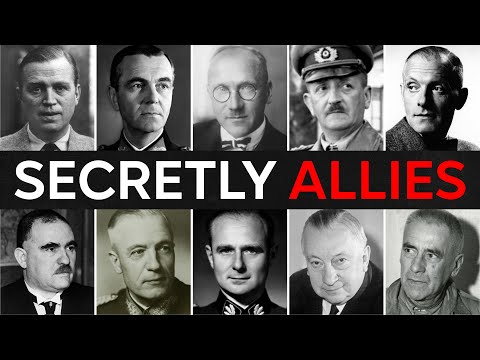
But Kolbe was not alone in his quiet rebellion. Another man, far higher up and far better dressed, was already playing both sides from Switzerland—just a train stop away. Hans Bernd Gisevius had a résumé that would normally guarantee postwar execution: Gestapo founding member, Abwehr agent, Nazi diplomat. But the more terrifying his title sounded, the less loyal he actually was. While officially working under diplomatic cover, he made himself indispensable to the OSS. Dulles relied on Gisevius for insider intelligence on Hitler’s internal chaos—not just names and dates, but motives, betrayals, and the hollow sound inside Hitler’s cabinet.
Yet Gisevius didn’t switch sides out of love for democracy. He hated Hitler, sure—but mostly for turning Germany into what he saw as a clownish death cult. So he played a long game: helped bring down the Reich, survived the collapse, then stepped into the power vacuum with clean hands and a cleaned-up résumé. He testified at Nuremberg, wrote books, lived comfortably. Was he a hero? Depends who’s writing the story. But one thing is clear: if Gisevius was the insider cynic, the next man was the true escape artist—a defector with a suitcase, a wife, and a ticket out before the Gestapo could blink.
Erich Vermehren wasn’t supposed to be in the Abwehr. He was a lawyer, a Catholic, a monarchist, and married to a baroness—not exactly Nazi poster material. But the Abwehr, ever full of aristocratic oddballs and quiet resistors, brought him in anyway. Which turned out to be a mistake. In early 1944, after catching wind that the Gestapo was about to arrest him, Vermehren did something spectacularly undramatic. He left. Just left. Disguised himself, took his wife Elizabeth, and defected to Britain via Turkey.
The moment they vanished, the Nazi security apparatus panicked. Hitler, in classic overreaction, dismantled large parts of the Abwehr in retaliation. The British, meanwhile, weren’t sure what to make of them. The Vermehrens weren’t driven by ideology or espionage glamour. They were driven by the simple human horror of watching their country cannibalize itself. Eric and Elizabeth gave the Allies information—yes—but more than that, they gave the Reich a psychological black eye. One couple, one defection, and entire departments collapsed in paranoia.
And yet, their escape had roots in something even older than politics. Something whispered, hidden, religious—a sense of divine duty. Which brings us to a quieter figure, the man whose betrayal began not with a suitcase, but with a letter. A very, very specific letter.
Baroness Elizabeth von Plettenberg came from old nobility. Catholic, sharp, unimpressed by goose-stepping ideologues who replaced scripture with slogans. Her marriage to Erich Vermehren was a partnership in the truest sense—ideological, moral, tactical. So when the Gestapo circled and Erich needed a way out, it was Elizabeth who helped engineer the escape. She didn’t just follow her husband into defection. She was the co-pilot.
In Turkey, they reached the British. And suddenly this aristocratic couple became weapons of perception. Nazis abandoning ship wasn’t new, but cultured Nazis—ones with titles, with families, who looked like the future of the Reich—leaving? That sent shock waves through the regime. Hitler’s rage was instant and theatrical. The fallout was immense. The Abwehr, already under suspicion, collapsed soon after.
And yet, even after the war, Elizabeth received little recognition. Her work was quiet. But in a regime obsessed with loyalty, her defiance was the deadliest thing of all: dignified. Which brings us to another figure with dignity and danger in equal measure—a scientist who leaked the Reich’s technological secrets in a brown envelope and nearly vanished because of it.
In 1939, long before the world had learned to flinch at the word Blitzkrieg, a plain envelope appeared at the British embassy in Oslo. No return address, no theatrics—just pages of neatly typed German military secrets. It would become known as the Oslo Report, one of the most valuable intelligence documents Britain received before the war fully exploded. And the man who sent it, Hans Ferdinand Mayer, was a research director at Siemens and a reluctant cog in the Nazi war machine.
Mayer wasn’t a spy. He was a physicist—but he had something more dangerous than a gun. Access. Radar systems, airplane specs, weapons tests. He saw everything. And unlike many of his colleagues, he didn’t think just following orders would look noble at the gallows. So during a business trip to Norway, he hand-delivered the report using clever misdirection and disposable typewriters. British intelligence didn’t know who he was for years. He kept his name off it. That’s how badly he didn’t want the glory or the gallows.
The Oslo Report went straight to Churchill’s desk. Mayer returned to Germany, silent and unsuspected. But in the increasingly paranoid Third Reich, silence was suspicious—which makes it all the more incredible that another insider, one embedded even deeper in the scientific elite, managed to stay invisible for the rest of the war while feeding the Allies everything.
Paul Rosbaud smiled too much for a man surrounded by death factories. As the science editor for Springer Verlag, Germany’s largest scientific publishing house, Rosbaud had unrestricted access to the Reich’s scientific community—its labs, its researchers, its war crimes in progress. And what did he do with that access? He told the British everything.
Under the code name Griffin, Rosbaud became MI6’s quiet man on the inside. His reports helped the Allies understand Nazi atomic research, secret weapons projects, and the technical infrastructure powering Hitler’s war. While top physicists flirted with building the bomb, Rosbaud sabotaged their timelines one cable at a time. He wasn’t flashy. He wasn’t paid. He did it because he knew where all this was going, and he couldn’t stomach it.
Even as his own Jewish wife and daughter fled the country, Rosbaud stayed behind—maintained appearances, printed scientific journals by day, smuggled classified information by night. His life was a contradiction wrapped in a lab coat, and somehow he survived. After the war, he didn’t cash in. No victory lap, just silence.
But resistance, it turns out, didn’t always come from spies or soldiers. Sometimes it came from lawyers in pinstriped suits carrying letters to the Vatican. Letters meant for London. Joseph Müller looked like a man who belonged in a courtroom, not a conspiracy—well-groomed, polite, Catholic to the bone. The kind of lawyer you’d trust with a will, not the future of Europe. Which is exactly why he worked.
Nicknamed Ochs—Ox—Müller had no military swagger, no spy glamour. What he had was access, discretion, and a moral code that didn’t bend easily. Through his legal work and Abwehr-linked contacts, Müller became a courier between the German resistance and the outside world. Not just any outside world—the Vatican. In the early years of the war, he carried messages from anti-Hitler officers to British intelligence via Rome. These weren’t love letters. They were desperate proposals: Remove Hitler. Negotiate peace. Stop the bleeding before Germany dragged itself into total ruin.
The British listened. They doubted. They stalled. History, as usual, did what it does best. Müller was eventually arrested by the Gestapo, interrogated, shuffled through prisons and camps. But somehow—through a combination of luck, faith, and bureaucratic chaos—he survived. After the war, he didn’t fade away. He became a prominent political figure in West Germany, helping shape a democracy built atop the wreckage he once tried to prevent.
Which raises an uncomfortable question: how many chances did history quietly ignore? Because while Müller was carrying letters through Rome, another man inside German intelligence was doing something far riskier—warning the enemy about invasions before they happened.
Hans Oster was the kind of man the Nazis should have feared most and never did. A senior Abwehr officer, a Prussian general, decorated, respected—and utterly convinced that Hitler was a disaster masquerading as destiny. Oster didn’t leak secrets out of guilt alone. He leaked them out of contempt. In 1939 and 1940, Oster repeatedly warned foreign governments—most famously the Dutch—about impending German invasions. Dates, routes, timelines, everything an enemy would need to prepare.
The warnings were so precise they should have been believed. They weren’t. That’s the cruelty of Oster’s story: he betrayed the Reich with accuracy and was ignored anyway. Inside Germany, Oster worked quietly to undermine Hitler’s authority, assisting resistance circles and supporting coup attempts that never quite ignited. He believed Germany could be saved from itself if only enough officers remembered their oaths were to the nation, not the man screaming from the podium.
Eventually, the net tightened. Oster was arrested after the July 20th plot, even though his resistance predated it by years. This time, there was no escape through paperwork or silence. But Oster’s quiet defiance planted a seed: loyalty could be selective. Obedience was optional. And one man watching all of this—learning how survival worked in the new Germany—would make his own escape, not with a warning, but with a disappearance.
Otto John survived by mastering the art of ambiguity. Officially, he was a lawyer. Unofficially, he was connected to the July 20th plotters. And after the failed attempt to remove Hitler, ambiguity became the difference between life and erasure. John didn’t stand trial. He didn’t make a speech. He vanished—using contacts cultivated through intelligence back channels.
John escaped to Britain. There he didn’t become a hero. He became a tool. British intelligence put him to work in psychological operations—propaganda aimed at convincing Germans that resistance was still possible, that not everyone had surrendered their conscience. After the war, John returned to Germany and rose to a position few would expect: head of the Federal Office for the Protection of the Constitution. The irony was thick enough to choke on—a former resistance-linked defector now guarding the new German state from extremism.
And then, years later, he disappeared again. This time into East Germany, under circumstances still argued about today. Defection? Abduction? A final act of confusion in a life built on blurred lines? Otto John never fit clean categories. Not hero, not villain—just proof that survival in the shadow of the Reich required constant reinvention.
And while these men operated in secrecy, others far more notorious would eventually negotiate with the Allies openly—wearing SS uniforms while doing it. Carl Wolff knew which way the wind was blowing. By 1945, the SS Obergruppenführer and Himmler confidant wasn’t interested in the Reich’s funeral—he was auditioning for the sequel.
As Germany crumbled, Wolff became the key liaison in Operation Sunrise, the secret negotiations with the OSS in Switzerland. High-ranking Nazi officers sat across from Allied spies—not as prisoners, but as partners. German troops in Italy surrendered weeks before the official end of the war. Wolff walked away alive, largely untouched by postwar justice.
He didn’t stop being a Nazi. He just stopped being loyal when loyalty became a liability. Which leaves one final question: how many more like him were never caught, never listed, never named—but still walked out of one regime and into the next without even changing coats?
So tell us—do you think these men were survivors, traitors, or something far more uncomfortable? And where in the world are you watching from tonight?
Report this article
Select a reason for reporting:






