Imagine waking up one morning with enough money in the bank to buy a house, and by sunset, that same amount can’t buy a loaf of bread. Not because you spent it, but because the government printed so much currency overnight that your life savings became worth less than the paper they were printed on. That’s not a metaphor—it’s what happened to millions of Germans between 1921 and 1923, one of the most devastating and misunderstood economic catastrophes in modern history.
Most people picture wheelbarrows of banknotes for a single egg, children playing with bricks of currency, housewives burning marks for fuel. By November 1923, one US dollar was worth 4.2 trillion German marks. The usual story: Germany lost WWI, got an impossible reparations bill, and printed money to pay it. Simple, tragic—but incomplete. The missing parts are the most important.
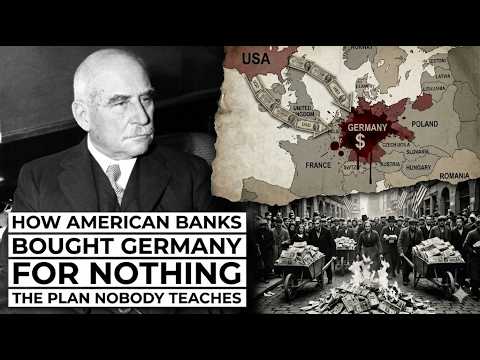
When you follow the money rather than the misery, a more disturbing picture emerges. Foreign speculators bet billions against the mark, accelerating its collapse. A small circle of industrialists knew what was coming and positioned themselves to become fabulously wealthy while neighbors starved. American banking houses rode in as saviors after the crash and walked away with extraordinary profits and control over the German economy. Decisions at the highest levels of international finance seem almost too convenient to be accidental.
Historians debate whether the hyperinflation was deliberately engineered or the result of catastrophic mismanagement, political cowardice, and a system under impossible strain. But the evidence of who knew what, who profited, and who pulled the strings of rescue afterward is real, documented, and deeply uncomfortable. That’s the story we’re going to tell.
To understand what happened to Germany’s money, you have to understand how Germany paid for its war. When the guns of August 1914 opened up, Germany faced the same question as every warring power: where does the money come from? Raise taxes—painful and politically dangerous—or borrow, pushing the pain into the future. Convinced it would win a short war and impose its own reparations, Germany chose to borrow almost everything. By the armistice in November 1918, Germany had accumulated internal war debts of 156 billion marks, borrowed from its own citizens and financial institutions in the expectation of victory. Instead, Germany lost. Those debts sat there, enormous and unpayable, at the foundation of the new Weimar Republic before it had even begun to govern.
Then came the Treaty of Versailles in June 1919. To say it was punishing is an understatement. Germany accepted sole responsibility for the war under Article 231, the war guilt clause. It lost 13% of its territory, its colonies, most of its merchant fleet, and a large portion of its railway stock. Its military was reduced to a shadow. And it was required to pay reparations in gold-backed currency. The Reparations Commission spent two years arguing before settling on 132 billion gold marks in 1921—north of $500 billion today. John Maynard Keynes called it a Carthaginian peace, predicting it would destabilize Germany and, through Germany, all of Europe. Modern historians debate whether reparations alone caused the hyperinflation, but the psychological and structural weight is undeniable. By 1920, industrial production had fallen to 61% of its 1913 level, and the mark had slipped from just over four to the dollar to 70. Inflation had begun, but it was not yet the monster it would become.
What transformed manageable inflation into a catastrophic spiral was a series of cascading decisions, both inside Germany and outside it. And this is where things get interesting. Because the question of who made those decisions, who had information ordinary citizens did not, and who stood to benefit from the resulting chaos is exactly what the standard textbook account glosses over.
Let’s talk about Rudolf Havenstein. He was president of the German Reichsbank, the central bank, from 1908 until his death in November 1923. Havenstein is one of the most baffling figures in financial history. He was not stupid or malicious. By all accounts, he was a dutiful, conscientious civil servant who genuinely believed he was doing the right thing. But his actions, sustained over years, turned a bad situation into an apocalypse. From the very beginning, his response was always the same: print more money. The government needed cash to pay debts, to pay striking workers, to keep public services running. And Havenstein provided it, every time, without limit. His reasoning, as historians reconstruct it, was that the Reichsbank’s duty was to keep the government liquid, to make sure the wheels of the state kept turning. He fulfilled that duty with extraordinary dedication.
By May 1923, the quantity of paper marks in circulation began spinning out of control. The money supply rose from 8.6 billion marks in May to 669.7 billion in August. By November, the number was so large it defies comprehension. Havenstein reportedly boasted about the efficiency of the printing presses, delighting in their capacity to produce ever more notes at ever greater speed, apparently unable or unwilling to connect that output with the destruction it caused. The Reichsbank had been made nominally independent in 1922 at the insistence of the Allied Powers as a condition for a temporary deferment of reparations. Yet under Havenstein, that independent institution continued to fund the government without restraint. The lesson resonates today: a formally independent central bank is no guarantee against catastrophic monetary policy. Independence means nothing if the leadership lacks either the understanding or the willingness to apply it.
But Havenstein was not the only actor. At the same time the printing presses ran hot inside Germany, something else was happening in international currency markets. Foreign speculators, primarily in the US and Britain, identified the falling mark as an extraordinary opportunity. They began short-selling the German currency on a massive scale—borrowing marks, selling them for harder currencies, waiting for the mark to fall further, then buying back at the lower price to repay the loan and pocket the difference. This is not speculation on my part. Hjalmar Schacht, the man eventually brought in to rescue the currency, later wrote explicitly about this. In his 1967 book, The Magic of Money, Schacht described how foreign investment betting on the mark’s falling value materially drove the inflation beyond what domestic money printing alone would have caused. The short-sellers needed the mark to keep falling to profit. Every time they sold marks, they pushed the exchange rate down a little further, triggering more panic, which made the printing press work harder, which drove prices higher, which justified more short-selling. It was a loop, and it was enormously profitable for those on the right side of it.
Consider a figure that puts this in sharp relief. In June 1922, during a period of relative stability, the mark sat at around 320 to the dollar. That same month, J.P. Morgan Jr. organized an international conference intended to address Germany’s reparations crisis and stabilize its currency. The conference produced nothing workable. By December 1922, the mark had fallen to 7,400 per dollar—a more than twentyfold decline in six months. The conference failed, the speculators won, and ordinary German workers watched their purchasing power evaporate.
Then came the Ruhr. In January 1923, Germany failed to deliver a scheduled shipment of timber to France as part of its reparations in kind. Technically, it was the thirty-fourth default in thirty-six months, though the defaults were often on small amounts and partly the result of Germany’s deliberate foot-dragging. French Prime Minister Raymond Poincaré, who harbored larger geopolitical ambitions including possibly detaching the Rhineland from Germany permanently, seized on the default as justification. French and Belgian troops marched into the Ruhr Valley, Germany’s most productive industrial heartland, on January 11th, 1923.
The Ruhr was not simply an industrial region. It was the beating economic heart of Germany. Its coal mines, steel works, and factories produced the bulk of German industrial output and provided the government with much of its tax revenue. When French troops occupied it and demanded that German workers submit to foreign direction, the Weimar government made a fateful decision. Chancellor Wilhelm Cuno declared a policy of passive resistance. German workers across the Ruhr were told to stop working, to refuse all cooperation with the occupying forces. In return, the government promised to keep paying their wages.
With its industrial heart shut down and tax revenues collapsing, the German government had precisely one way to fund the strike payments: the printing press. The Reichsbank began monetizing government debt at a scale that dwarfed everything before. From the beginning of 1923, the quantity of marks in circulation began to double, then double again, then again with increasing speed. By August, the monthly rate of inflation was approaching 30,000 percent. Not annually—monthly.
Prices were changing by the hour. Workers began being paid twice a day so they could spend their morning wages before they lost value before lunchtime. A loaf of bread that cost 160 marks at the end of 1922 cost 200 billion marks by late 1923. Shopkeepers stopped putting price tags on goods because prices changed while customers waited in line. Pensioners who had saved carefully their entire working lives watched those savings reduced to nothing—not over years, but over days. The elderly, the sick, those on fixed incomes, the middle class that had invested in government war bonds out of patriotic duty—all of them were obliterated financially within months.
One contemporary account describes workers lining up outside factory gates on Friday afternoons clutching enormous bags of banknotes representing their week’s wages, then sprinting to the nearest shop before prices rose further. Another describes a restaurant customer who ordered a cup of coffee at 5,000 marks, finished it, ordered a second, and found the price had already risen to 7,000 marks in the time it took him to drink the first. These are not anecdotes. They are documented experiences of systematic economic destruction.
And the social consequences were not neutral. They tore German society apart along class lines that would never fully heal. The working class suffered terribly, though trade unions initially managed to keep wages rising in rough tandem with prices. As 1923 wore on, even that protection failed. But the group that suffered most catastrophically—and whose suffering had the longest-lasting political consequences—was the German middle class, the Mittelstand. These were the civil servants, the teachers, the lawyers, the small business owners, the families who had invested their life savings in government bonds, life insurance policies, and bank deposits denominated in marks. Every single one of those savings instruments became worthless. Not devalued—worthless. A lifetime of thrift and self-discipline reduced to less than nothing.
The historian Eric Hobsbawm observed that it was this destruction of the bourgeois middle class, not the suffering of the working class, that proved politically most toxic in Germany. The middle class had believed in the Weimar Republic, in its institutions, in its currency, and in the basic contract between citizen and state that said responsible behavior would be rewarded. That contract was shredded by the hyperinflation. And the rage and humiliation that replaced it created precisely the kind of desperate, apocalyptic political atmosphere in which a figure like Adolf Hitler could begin to find his footing.
To be accurate about the chronology: most historians are careful to note that the direct electoral connection between the 1923 hyperinflation and Hitler’s seizure of power in 1933 is complicated. The Nazi Party was not a major electoral force during the inflation itself. What the hyperinflation did was more insidious and longer lasting. It shattered the psychological and material foundations of the German middle class, implanted a deep and permanent distrust of democratic institutions and paper money, and created a reservoir of resentment and disillusionment that later demagogues could tap. Hitler himself attempted his Beer Hall Putsch in Munich in November 1923 at the very height of the crisis, precisely because he understood that the chaos was creating an opening. He failed. He went to prison. But he filed the experience away.
Now, let us turn to a figure whose story reveals more clearly than perhaps anyone else’s exactly who was on the winning side. His name was Hugo Stinnes. By 1923, he was the richest man in Germany and possibly one of the richest in Europe. Time magazine called him the new emperor of Germany. He had not inherited his wealth—he had engineered it deliberately, by understanding before almost anyone else what the Reichsbank was going to do and positioning himself to profit.
Stinnes came from a family with roots in the Ruhr coal business. He was talented, ruthless, and extraordinarily well-connected. When the war ended and inflation began to creep upward, Stinnes saw what others could not. He recognized that Havenstein’s money printing was structurally unsustainable. He understood the paper mark was going to lose its value, and he devised a strategy of shocking simplicity. He borrowed enormous sums denominated in marks at low nominal interest rates, then used those borrowed marks to buy real assets—coal mines, steel works, shipping companies, railroads, newspapers, electrical utilities. Things that existed in the physical world and would hold their real value even as the currency around them disintegrated. He kept borrowing and buying. By the time the hyperinflation was at its worst, Stinnes had controlling interests in 1,535 separate businesses across 2,890 different plants.
Report this article
Select a reason for reporting: