The sky over England was a canvas of gray, and inside the cockpit of a Spitfire, a young pilot named James gripped the stick until his knuckles turned white. This was no ordinary fighter. This Spitfire had no guns. No armor. No radios. It was stripped to the bone, a ghost of its former self, built for one purpose: to fly higher and faster than anyone else.
James wasn’t a fighter pilot. He was a photographer, a spy in the sky. And today, his mission was to bring back the truth.
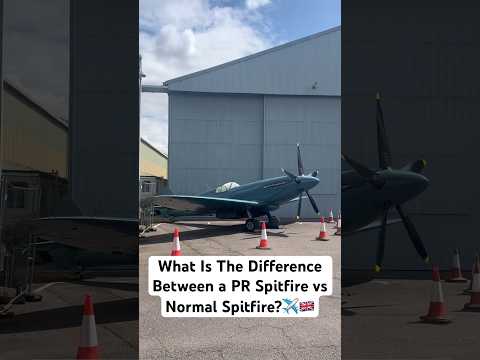
Across the Channel, the enemy was waiting. But James wasn’t there to fight. He was there to see. His Spitfire was a photographic reconnaissance variant—a PR Spitfire—and it carried cameras instead of cannon. Every ounce of weight had been shaved off: the guns, the armor plating, the radio equipment. In their place, extra fuel tanks and a pair of powerful cameras.
It was a gamble. Without armor, one bullet could end him. Without guns, he couldn’t shoot back. But the trade-off was speed and altitude—the ability to soar above the enemy’s reach and outrun their interceptors.
James climbed. The air grew thin, the engine hummed a lonely song. He was a solitary bird, gliding at 30,000 feet, where the sky turned black and the stars still shone at noon. Below, the enemy airfields were specks on the earth, but through his camera lens, they were everything.
He thought of his friend, Tom, a fighter pilot who flew a normal Spitfire—armed to the teeth, armored like a knight. Tom’s job was to intercept and destroy. James’s job was to reveal. Two different roles, both vital. Tom fought the enemy directly; James exposed their secrets.
As he banked over the target, the camera clicked, capturing images that would change the course of the war. But then, a shadow crossed the sun. A Focke-Wulf 190, a German fighter, had spotted him.
James’s heart pounded. He had no guns to defend himself. All he had was speed. He pushed the throttle forward, the Merlin engine roaring as he dove away. The enemy gave chase, but the PR Spitfire was faster, lighter, untouchable.
He escaped, but the mission was far from over. The photos he carried were more valuable than any victory in the air. They would tell the generals where to strike, where to avoid, and where the enemy was weakest.
As he landed back at RAF Benson, the ground crew rushed to unload the film. James climbed out, his hands still shaking. He had done his part. But the war was far from won, and tomorrow, he would fly again.
James barely had time to catch his breath before the intelligence officers descended on the film canister like hungry wolves. They didn’t even wait for him to remove his flight helmet. “The cameras caught something new,” one of them muttered, already unspooling the negatives in the darkroom.
He stood in the corner, still smelling of high-altitude cold and engine oil, watching their faces as the images developed. First came the familiar shapes—runways, hangars, fuel depots. Then something else. Something they hadn’t expected.
“That’s a launch site,” the senior officer said, tapping the photograph. His voice was flat, but his hand trembled. “Not for aircraft. For something bigger.”
James leaned in. The image was grainy, but the shapes were unmistakable—concrete ramps, storage bunkers, and long cylindrical objects that could only be one thing. V-weapons. The enemy was building rockets.
Within hours, the photographs were on a courier plane to London. James was summoned to the briefing room, still in his flight suit, his hair a mess. A group of men in pressed uniforms stared at him as if he had grown a second head.
“You’re certain these are what we think they are?” one of them asked.
“I just fly the plane,” James replied. “But yes. I’ve seen enough of their airfields to know when something doesn’t belong.”
The room fell silent. Then the man at the head of the table nodded slowly. “Then we need more. And we need them now. Can you get back up there tomorrow?”
James thought of the Focke-Wulf that had chased him, the way his hands had shaken on the stick. He thought of Tom, who had shot down two enemy fighters last week and was already back in the air. He thought of the cameras, waiting in the hangar, loaded and ready.
“Yes,” he said. “I can.”
But as he walked back to the hangar, he noticed something he hadn’t seen before. A new Spitfire was being wheeled into the maintenance bay. It was sleeker than his, with a different nose and a strange bulge under each wing. The ground crew was whispering.
“What’s that?” James asked.
The crew chief looked up, wiping his hands on a rag. “That, sir, is the future. A PR Spitfire with a pressurized cabin. She’ll fly higher than anything the enemy has. Higher than you’ve ever been.”
James stared at the aircraft. It looked like a ghost, silver and silent, waiting for its moment. And he realized, with a chill that had nothing to do with the altitude, that the war was about to change again.
The crew chief gestured for James to follow him toward the new aircraft. Its skin gleamed under the hangar lights, unblemished and cold. “She’s got a two-stage supercharged Merlin,” the chief said, running a hand along the cowling. “And that bulge under the wings? Extra fuel. She can stay up for hours.”
James walked a slow circle around the plane. His own Spitfire, parked a few bays down, suddenly looked old and tired. “When does she fly?”
“Tomorrow. Same mission as yours. Same targets.” The chief paused, then added quietly, “But there’s a catch. The pressurized cabin means no opening the canopy at altitude. If something goes wrong up there, you can’t just pop the hatch and bail out.”
James nodded slowly. Every advance came with a price. He had already traded guns for cameras. Now it seemed he would trade an escape route for altitude.
That night, he found Tom in the mess hall, nursing a cup of tea and a bruised knuckle from his last sortie. Tom looked up as James sat down across from him.
“Heard about the rocket sites,” Tom said. “Heard you’re going back up.”
“Tomorrow. In the new plane.”
Tom set down his cup. “The one without an escape hatch? I heard the rumors.” He leaned forward, his voice low. “You know what I do when I’m up there? I fight. I shoot. If I get hit, I’ve got armor behind me. You’ve got nothing but a camera and a prayer.”
James smiled faintly. “And yet here I am, still alive.”
Tom didn’t laugh. “Just come back, James. That’s all I ask.”
They sat in silence for a while, the clatter of the mess hall fading around them. Then Tom pulled something from his pocket—a small photograph, creased and worn. A woman, smiling, holding a baby.
“My sister,” Tom said. “And her little one. They live near the coast. If those rockets start falling…” He didn’t finish the sentence.
James took the photograph and studied it. “Then we make sure they don’t.”
He handed it back and stood up. Tomorrow, he would fly higher than he had ever flown. Tomorrow, he would see what no one else could see. And tomorrow, the war would learn a new kind of fear.
But as he walked out into the cool night air, he couldn’t shake the feeling that the new Spitfire was watching him—silver and silent, waiting for its moment. Waiting for him.
The morning came cold and clear, the kind of day that made the sky look infinite. James climbed into the pressurized cockpit and pulled the canopy shut with a soft, final click. No escape hatch. No turning back. The ground crew stepped away, and the Merlin coughed, then roared.
He climbed faster than ever before, the altimeter winding past 30,000, then 35,000, then 40,000 feet. The world below shrank to a map, the enemy airfields no bigger than postage stamps. His cameras clicked methodically, capturing the rocket sites in crisp, damning detail.
Then the engine coughed. A sputter, then a shudder that rattled his teeth. The two-stage Merlin was failing. He watched the temperature gauge climb into the red, and with it, his heart rate.
No armor. No guns. No way out. Just James, the cameras, and the thin, frozen air. He eased the throttle back, nursing the wounded engine, coaxing her home one mile at a time. The Channel appeared below, a ribbon of gray, and then the green fields of England.
He landed hard, the tires squealing, the engine dying the moment the wheels touched down. The ground crew swarmed him, and the chief yanked open the canopy. “You made it,” he breathed. “And the film?”
James held up the canister with a trembling hand. “Every frame.”
Weeks later, the bombers came for those rocket sites, guided by the photographs James had risked everything to bring back. Tom flew escort that day, and when he landed, he found James waiting on the tarmac.
“They hit every one,” Tom said, grinning. “Your pictures did that.”
James looked up at the sky, where the silver Spitfires would fly again tomorrow, and the day after. “We just reveal the truth,” he said quietly. “What they do with it is their business.”
But he knew, as he walked back toward the hangar, that the war had changed. The cameras had become weapons, and the quiet pilots who flew alone, unarmed and unseen, would shape its final chapter.
What would you have done, knowing one bullet could end it all—would you still fly?
Report this article
Select a reason for reporting:






