There were no windows in the hangar deck of the Akagi. The men working there on the morning of June 4, 1942, could not see the sky. They could not see the ocean, the other ships, or what was coming. What they could see was a long steel cave packed with folded-wing aircraft, fuel tanks filled with gasoline, and the remnants of a morning that had gone terribly wrong lying between the wheels. Torpedoes on their carts, heavy bombs left in any empty space on the floor because no one had time to return them to the magazines. For over an hour, these men had listened to their anti-aircraft guns pounding ceaselessly above their heads.
At 10:22, the first American bomb hit the neighboring carrier. By 10:28, three of the six carriers that had attacked Pearl Harbor six months earlier were ablaze, and within a day, all three would settle to the bottom of the Pacific. Six minutes—less than the time it takes to boil an egg. In that span, the Imperial Japanese Navy lost the core of the most powerful carrier force on Earth, and with it, any real hope of dictating how the Pacific War would end.
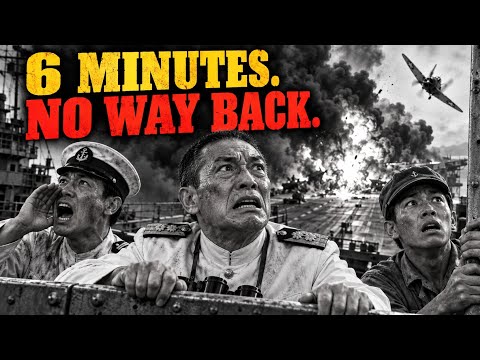
But those six minutes did not come from nowhere. They were shaped piece by piece over the preceding weeks: by a codebreaker in a basement working in his slippers, by a shattered ship that should have been in dry dock, by a squadron of obsolete torpedo planes that flew straight into a massacre, and by a single Japanese destroyer that happened to be in a hurry. Most of all, they were made possible by an admiral who changed his mind twice in a single hour.
The version you may have heard of those six minutes—the one that says Japan was one step away from victory—is not what happened. The truth is worse for Japan and far more interesting. To get there, we have to start with 16 bombers over Tokyo.
On April 18, 1942, 16 American B-25s launched from the deck of the Hornet and bombed Japan. As a military operation, the Doolittle Raid barely scratched the country, but American bombers had flown over the Emperor’s own capital, and the Navy that had sworn to protect it had not touched them. No one took that more personally than Admiral Isoroku Yamamoto, commander of the Japanese Combined Fleet.
Yamamoto had studied at Harvard and served in Washington. He had seen America’s oil fields and factories with his own eyes, and before the war he had warned Japan’s leaders that he could give them one year of victories. After that, he promised nothing. The problem was the American carriers. They had been at sea on December 7 and had survived. As long as they existed, the war could not be won quickly—and speed was Japan’s only path to victory.
Yamamoto’s answer was a pair of sand islands at the far end of the Hawaiian chain: Midway. An airstrip, a seaplane base, a few thousand Americans, and a great many seabirds. The island was never the real prize. The prize was what the Americans would do to defend it. Attack Midway, Yamamoto reasoned, and the U.S. Navy would have to come out and fight. And when their carriers arrived, the Japanese would be waiting.
The plan grew into one of the largest naval operations ever mounted, stretching from Alaska to the central Pacific. At its spearhead was the First Air Fleet, Kido Butai, under Vice Admiral Chuichi Nagumo. Four carriers: Akagi, Kaga, Soryu, and Hiryu. Yamamoto himself would follow hundreds of miles behind aboard the giant battleship Yamato.
There should have been six. Shokaku and Zuikaku had fought in the Coral Sea in May. One returned damaged, the other short of trained aircrews. Neither sailed, and almost no one thought it mattered. That was how great their confidence was.
In early May, planners ran war games for the operation aboard Yamato. According to officers who were there, the dice at one point decided that bombers from Midway hit the Japanese carriers nine times and sank two. The admiral running the game, Matome Ugaki, simply reduced the number of hits. One of the sunken carriers was quietly returned to service in the next round. The old samurai later gave that mood a name: victory disease.
The Americans were supposed to be surprised, slow, and late. In fact, they had been reading Japan’s mail for weeks.
In a windowless basement in Pearl Harbor that the staff called “the dungeon,” Navy codebreakers under Commander Joseph Rochefort had spent months cracking the Japanese fleet’s main cipher, which the Americans called JN-25. They never read it whole. On good days, they recovered fragments: a unit, a date, a place name abbreviated to two letters. Rochefort worked in a red smoking jacket and slippers, sometimes around the clock, because there was no time to go home.
All spring, one of those two-letter designators kept appearing: AF. Something big was aimed at AF. Rochefort was certain it meant Midway. Some in Washington were not. They feared for Hawaii or even the West Coast. With so few carriers left, a wrong guess could mean losing the Pacific in a single afternoon.
So the Americans set a trap—not for the fleet, but for the code. Over a secure undersea cable, they had Midway send a routine radio message in plain language complaining that its water distillation plant had broken down. A small, dull lie. Within two days, codebreakers intercepted a Japanese message reporting that AF was short of fresh water. AF was Midway.
Admiral Chester Nimitz, commander of the Pacific Fleet, decided to bet everything on that conclusion. His intelligence officer, Edwin Layton, gave him a prediction so precise it sounded like a horoscope: enemy carriers to the northwest, early on June 4, about 175 miles away.
Nimitz had three carriers to meet them, and one of them was not supposed to be there. Yorktown had limped back from the Coral Sea on May 27 with a bomb hole that pierced several decks. The first estimate for repairs was about 90 days. Nimitz put on his rubber boots, went down into the dry dock to inspect her hull himself, and gave the yard three days. Some 1,400 workers swarmed over her night and day, and when she sailed on May 30, a number of them went with her to finish the work at sea.
The other two carriers, Enterprise and Hornet, sailed under a man who was never supposed to command them. Vice Admiral William Halsey, the Navy’s most aggressive carrier commander, was in the hospital with a severe skin disease that made it nearly impossible for him to sleep. He recommended the officer who had been running his cruiser escort, Admiral Raymond Spruance—calm, precise, and entirely new to carrier command. Overall command at sea went to Admiral Frank Jack Fletcher aboard Yorktown.
On June 2, the three carriers met in an empty stretch of ocean northeast of Midway. The staff at Pearl Harbor had a name for that spot: Point Luck.
On the Japanese side, every early warning failed. A seaplane flight to scout Pearl Harbor was cancelled because the American ships were no longer at the remote reef where the planes were supposed to refuel. The submarines sent to watch the Americans arrived after the Americans had already passed. And as Kido Butai plowed through the fog toward Midway on the night of June 3, Nagumo had no idea that anyone was waiting for him.
At 4:30 a.m. on June 4, the Japanese carriers turned into the wind and began launching. 108 aircraft lifted off into the darkness, bound for Midway. The man who should have led them, Mitsuo Fuchida, the flight commander of Pearl Harbor, was aboard Akagi recovering from emergency appendectomy surgery. The strike role went instead to Lieutenant Joichi Tomonaga of Hiryu.
Nagumo also sent out seven search planes. It was a fragile search with wide gaps, and one of the scouts, a floatplane from the cruiser Tone, launched about half an hour late. Its search line ran almost directly toward the Americans.
But the Americans saw the Japanese first. At about 5:30, a Catalina flying boat from Midway came out of the clouds and spotted the carriers.
Within minutes, another plane reported a huge number of aircraft heading for the island. Midway threw everything it had into the air. The Marine fighter pilots who rose to meet Tomonaga were often flying Brewster Buffalos—short, obsolete machines—and the Zeros tore them apart. Of about 24 fighters that took off, 15 did not return.
Then the bombs fell. Hangars, fuel tanks, the seaplane base. On top of the power plant stood a Hollywood director in a Navy uniform, John Ford, who had made Stagecoach and The Grapes of Wrath and had been sent to Midway to film whatever happened. He stayed with a handheld camera as the bombs fell, was wounded in the arm, and kept filming. That footage reached American theaters a few months later and won an Academy Award. For millions, the Battle of Midway would always look like that: black smoke over a flat island, the frame shaking with each explosion.
Out at sea, far from any camera, the aircraft Midway sent against the fleet were being slaughtered. Six new Avenger torpedo bombers went after the carriers; five were shot down. Four Army B-26s followed, carrying torpedoes their crews had barely practiced with. One, badly hit, pulled up so late that it roared over Akagi‘s flight deck and barely cleared the bridge where Nagumo stood. Then came 16 Marine dive bombers led by Major Lofton Henderson. Many of the pilots had joined the squadron only days earlier. Henderson led them against Hiryu and never returned. Half his men did not either. Not a single bomb, not a single torpedo, hit a target.
No one filmed any of that. That was the shape of most of the war. For every moment caught by a camera, thousands passed with no witness but the men who lived them. And those stories last only when someone tells them whole.
Now rewind the clock to 7:00 on the bridge of Akagi.
At 7:00, a message arrived from Tomonaga to Nagumo. The raid had damaged Midway, but the island’s runways were still operational and its aircraft had clearly survived. He reported that a second attack was necessary.
Nagumo had a reserve force waiting below. A second wave armed with torpedoes and armor-piercing bombs, held back in case American warships appeared. After two and a half hours, none had. And within minutes of Tomonaga’s message, Midway’s bombers swooped down on his carriers, confirming his argument.
At 7:15, Nagumo gave his order. Remove the torpedoes. Load land-attack bombs. Aboard a Japanese carrier, this was no quick task. It was done inside the enclosed hangar decks, plane by plane, by crews wrestling with weapons weighing nearly a ton. For a full strike force, it took over an hour.
At about 7:40, the late floatplane from Tone reported 10 ships, apparently enemy, to the northeast. It did not identify their type.
At 7:45, Nagumo halted the rearming and demanded details. For half an hour, the answers were reassuring: cruisers, destroyers. Then at 8:20, the scout added something else. The enemy appeared to have a carrier with them.
Put yourself in Nagumo’s place on that bridge. Midway’s attacks were still arriving overhead. His fighters were landing, refueling, and taking off again to meet each attack. Tomonaga’s strike force had returned—some damaged, all low on fuel—circling and waiting to land. Below decks, the reserve force had been partially rearmed; some planes carried bombs for Midway, some still carried torpedoes, while the weapons that had been removed sat beside them.
From Hiryu, Admiral Tamon Yamaguchi, the most aggressive officer in the fleet, signaled the flagship: Launch now with everything you have.
Nagumo refused. And this is the decision on which the entire battle turns, so it deserves a fair hearing. Launching immediately would have meant sending bombers without fighter cover, because his fighters had spent the morning defending the fleet, and he had just seen what happened to bombers that attacked without escort. It would have meant leaving Tomonaga’s returning crews to ditch at sea. And Japanese carrier doctrine exalted one thing above all: a carrier’s aircraft striking together in one big wave. Nagumo chose to follow doctrine. He would land Tomonaga’s planes, rearm properly, and hit the American carrier with everything at once.
It took close to 40 minutes to bring Tomonaga’s aircraft down. Shortly after 9:00, with the last of them aboard, Nagumo turned the entire fleet toward the enemy. The time set for his counterstrike was 10:30.
Below, inside the hangar decks, the crews reversed their decisions, and the bombs that had been taken off the planes were set down where everything had been placed all morning. Not in the magazines, for there was no time, but on the hangar deck, stacked beside aircraft being fueled.
One more thing happened that morning, and at the time it seemed to mean nothing. At about 8:25, an American submarine, Nautilus, raised its periscope in the middle of the Japanese fleet and fired a torpedo at a battleship. The torpedo missed. A destroyer named Arashi was sent to deal with it, and while the carriers went on their way, Arashi stayed behind to depth-charge the water. Remember Arashi.
By the time Nagumo turned, the American aircraft had been in the air for over two hours. When the Catalina report came in, Spruance’s chief of staff, Captain Miles Browning, had done the timing carefully. Launching early from the maximum range might let them catch the Japanese carriers completely off guard while Midway’s attack planes were recovering and refueling. Some American crews might not have enough fuel to get back. Spruance accepted that risk.
Shortly after 7:00, Enterprise and Hornet began launching their aircraft. Things went badly. It took so long to get the full air group off that Spruance ordered Enterprise‘s dive bombers to go ahead without the rest. The American attack went in piecemeal, squadron by squadron, in different directions. Yorktown launched later, around 9:00. Hornet‘s group had the worst of it. Its commander, Stanhope Ring, led the dive bombers and fighters on a course that took them far from the enemy. Hornet‘s torpedo squadron commander, Lieutenant Commander John Waldron, was certain the course was wrong. He had protested before takeoff. Over the ocean, he argued again by radio. Then he simply turned his 15 torpedo-armed planes and led them alone.
Ring’s group found only empty sea. All of its fighters ran out of fuel and ditched. Waldron found the enemy.
He was a hard, stubborn man from South Dakota, of Sioux ancestry, who had trained his men mercilessly. Before the battle, he wrote them that if only one plane remained for the final run, he wanted that pilot to go in and hit the target. They were flying Devastators, slow torpedo planes that were nearly obsolete by 1942, and they had no fighter cover.
At about 9:20, Torpedo Squadron 8 came in low over the water, and the Zeros fell on them. To launch a torpedo, a Devastator had to fly low, straight, and slow—a fraction of the speed of the fighters hunting it—for what felt like an eternity. The Zeros shot the pilots down one by one. Of the 30 men who took off, 29 were killed. The lone survivor, Ensign George Gay, crashed into the sea near the Japanese ships with his rear gunner dead behind him. He pulled a seat cushion over his head so he would not be seen, and as he floated on the waves, he had the strangest seat in the ocean for what was about to happen next.
Minutes later, Torpedo 6 arrived from Enterprise. Its commander, Eugene Lindsey, had crashed into the sea landing on his carrier a week earlier and was still suffering from his injuries. He flew anyway and was killed leading his squadron against Kaga. Ten of his 14 planes did not return.
Then came 12 Devastators from Yorktown led by Lance Massey, with a handful of Wildcat fighters under Lieutenant Commander Jimmy Thach. Because there were so few of them, Thach’s pilots tried a maneuver he had worked out on his kitchen table with matchsticks: two fighters weaving across each other’s paths so that any Zero chasing one flew into the other’s guns. It kept them alive. It could not save the torpedo planes. Massey and most of his squadron were killed with him.
41 American torpedo planes attacked Kido Butai that morning. Fewer than a handful returned home. Not one torpedo hit. And yet those slow, doomed planes may have done more to win the battle than any others. For nearly an hour, they kept the Japanese carriers maneuvering at high speed, never steadying into the wind long enough to launch. They also pulled the Zeros down and away. The Japanese carriers had no radar and no real way to vector fighters from the ship. So each pilot chased what he could see. What they saw were torpedo planes skimming the waves. By 10:20, the fighters meant to protect the fleet were scattered low across miles of ocean, low on fuel and ammunition. No one was watching the sky.
Three miles up, Major Wade McClusky had his own problem. He was leading Enterprise‘s dive bombers, more than 30 aircraft. Around 9:20, he reached the position where the Japanese were supposed to be. Empty sea. Nagumo had changed course. Every minute spent searching burned fuel his pilots needed to get home. Some were already running low. Turning back was the safe decision. McClusky kept searching.
At 9:55, he saw a wake in the water. Far below, a single Japanese destroyer was racing northeast at full speed. It was Arashi, finished with the submarine Nautilus and hurrying to catch up with the carriers. She was not lost. She knew exactly where the fleet was, and her wake pointed straight to it like a finger on a map. McClusky followed it.
A few minutes after 10:00, Kido Butai lay spread out beneath him. At almost that moment, Yorktown‘s dive bombers arrived from a completely different direction. 17 planes under Lieutenant Commander Maxwell Leslie had launched after Enterprise‘s but taken a more direct route. Two attack groups from two carriers arriving over the same patch of ocean minutes apart, and no one had planned it. Leslie did not even have a bomb—a new arming switch had failed and dropped it into the sea just after takeoff, along with the bombs of three of his pilots. He led the attack anyway.
Below, the Japanese fighters were down near the waves. The carrier decks were crowded with fighters coming and going. The hangar decks were full.
It was 10:20. And at 10:22, the attacks began.
Every pilot rolled over from about three miles up and dropped toward the ship at a 70-degree angle. Dive brakes open, the carrier swelling from a slit in his sight to something filling the windshield. He released his bomb at about 2,000 feet and pulled up hard enough to gray out his vision.
McClusky’s attack did not go quite as planned. With overlapping radio calls, his Enterprise squadrons ended up diving on the same carrier, the nearest one, Kaga. At least four bombs hit her. One exploded near the bridge and killed her captain, Jisaku Okada, and most of the officers around him. The others punched through the hangar decks packed with fueled aircraft. In seconds, Kaga became a burning furnace.
Moments later, Leslie’s squadron dove on Soryu. Three bombs hit her, spaced along her length with the precision of someone measuring the distances between them. Fires erupted in her hangars, and she soon stopped dead in the water, burning from end to end.
Then it was Akagi‘s turn.
Lieutenant Richard Best was leading one of Enterprise‘s squadrons. As he began his dive, he saw that almost everyone was heading for Kaga. He broke away, and two pilots stayed with him, and the three of them went for the flagship. Three planes against the ship that had led the attack on Pearl Harbor. His two wingmen missed, though one bomb landed close enough astern to jam her rudder. Best did not miss. His single 1,000-pound bomb struck the middle of the flight deck, punched through, and exploded in the hangar below.
One bomb should not have been enough to kill a carrier that size. But the morning had turned Akagi‘s hangar into a time bomb. Fueled aircraft, armed aircraft, and around them torpedoes and bombs that had piled up with every change of plan. Best’s hit set them all off. Fire swept the hangar deck, and explosions followed one after another. A pilot who had changed his target in mid-dive had just killed the flagship of the Japanese fleet.
From the first dive to the last bomb, about six minutes passed.
For half a year, Japan’s carriers had dominated the Pacific. Now, three of the four that came to Midway were finished. Aboard Akagi, Nagumo did not want to leave the bridge. His chief of staff argued with him until he agreed to move his flag to another ship, but by then the fires had blocked the passageways. So the commander of the First Air Fleet climbed out a bridge window and lowered himself down a rope to escape his flagship.
If you have heard the story before, you may have heard it differently. For decades, the most popular account came from Mitsuo Fuchida, who was aboard Akagi that morning. After the war, he wrote that when the dive bombers appeared, the flight decks were packed with a fully armed strike force, engines running, the first fighter already beginning to move. Five more minutes, and they would have been away. Hollywood loved that story, history books repeated it, and it turned a defeat into bad luck rather than bad decisions.
It is not true. Historians who later reviewed the Japanese carrier records—most thoroughly Jonathan Parshall and Anthony Tully in their 2005 book Shattered Sword—found that Akagi was landing and launching defensive fighters right up to the moment of the attack. A deck busy with fighters cannot also hold a strike force waiting to take off. The bombers were still below, where Best’s bomb found them.
As for Hiryu, the one carrier left untouched, with every reason to hurry, she could not get even a small counterstrike into the air for almost half an hour. Japan was not five minutes from victory. Her strike force was still in the hangars, a long way from ready.
One Japanese carrier remained in the fight, and she hit back hard. Hiryu‘s first wave, 18 dive bombers with a few fighters, tracked the American planes back to Yorktown and found her around noon. Most of the attackers were shot down, but three bombs hit the ship, and one exploded in her funnels and snuffed out most of her boilers. Yorktown stopped dead and drifted. Then her crew did something remarkable. In about an hour and a half, they put out the fires, patched the deck, and got her moving again at nearly 20 knots.
Hiryu‘s second wave was led by Joichi Tomonaga, the man who had led the dawn raid on Midway. His plane’s fuel tank had been punctured over the island and never repaired. He knew he might reach the Americans and not come back. He went anyway. When his torpedo planes found Yorktown, she was underway with no visible damage, so they believed they had found a second, undamaged carrier. Two torpedoes hit her. Tomonaga’s plane was shot down, and Yorktown began to list so badly that her captain ordered her abandoned. The survivors from Hiryu reported hitting two American carriers. As far as they knew, the battle was now even.
It was not. At about 5:00 that evening, 12 dive bombers from Enterprise, some of them flown by Yorktown pilots whose ship was out of action, caught Hiryu and hit her four times. One of the pilots credited with a hit was Richard Best, who had destroyed Akagi that morning.
Hiryu burned through the night. Yamaguchi, who had urged Nagumo to attack immediately, refused to leave her, and so did her captain, Tomeo Kaku. A Japanese destroyer put a torpedo into her before dawn, but she stayed afloat for hours, and deep inside, a group of engineers left behind during the evacuation were still alive. They came out and escaped in a boat before she went down, and drifted for two weeks until an American ship picked them up.
The rest of Kido Butai was already gone. Kaga and Soryu had sunk that evening, and Soryu‘s captain, Ryusaku Yanagimoto, went down with his ship. That evening, the submarine Nautilus returned and fired at the burning Kaga. The only torpedo that hit her failed to explode, and Japanese sailors in the water clung to it to stay afloat.
Akagi lasted until dawn on June 5, when Japanese destroyers torpedoed her. Aboard Yamato, Yamamoto had already cancelled the operation. His battleships never fired a shot. When his staff worried about how to apologize to the Emperor, he was said to have replied that he would bear it alone.
The Americans had one more loss coming. Yorktown was still afloat. A salvage party had returned aboard, and the destroyer Hammann was alongside to help. On June 6, the Japanese submarine I-168 slipped through the screen. One torpedo broke Hammann in half, and she sank in minutes. Two more hit the carrier, and Yorktown capsized and sank the next morning.
Japan lost four carriers, a heavy cruiser, about 250 aircraft, and more than 3,000 men. The United States lost a carrier, a destroyer, about 150 aircraft, and a little over 300 men.
Then the battle moved to paper, and the two sides wrote very different things.
In Japan, the reports were lies. The public was told Midway was a victory. The wounded survivors were isolated, and many crew members were sent to distant postings before they could talk. Families learned little, and much of what they learned was not true.
In America, the official papers were honest but slow. In the days after the battle, each squadron filed its action report. Who attacked which ship, which planes did not return, who was last seen and where. At home, a telegram would arrive saying a son or husband was missing in action, and then often months of silence.
George Gay, rescued from the sea after about 30 hours, spent the rest of his life telling the story of Torpedo Squadron 8. Many of the men who fought at Midway told almost no one anything. What they left behind was a shoebox, a photograph in uniform, a badge, and a medal no one could explain. That box may be in your family. The young man in the photograph may be your grandfather, and no one ever knew what he really went through in the war.
If you have worn the American uniform, that has been documented, just as it was at Midway, and most of it can still be traced by name, photograph, and the things left behind. I’ve laid out how in a guide called Discover Your Grandfather’s War, linked directly below this video.
Joseph Rochefort’s papers told a stranger story. Nimitz recommended him for the Distinguished Service Medal. Washington turned it down. Within months, because of a turf dispute among naval intelligence offices, he was moved entirely away from codebreaking and commanded a floating dry dock for part of the war. He finally received the medal in 1986, 10 years after his death.
Codebreaking did not end with Yamamoto either. In April 1943, they read a schedule for an inspection tour he was making in the Solomon Islands, and American fighters were waiting for him. His plane was shot down over Bougainville on April 18, 1943. Exactly one year after the Doolittle Raid.
So did those six minutes cost Japan the war? Not in the sense that Japan would have won without them. Japan could never have won a long war against the United States, and Yamamoto knew that better than anyone. The first American Essex-class carriers entered service at the end of 1942, and more than a dozen sister ships followed before the war ended. Japan could build only a few new carriers in the same years. The name Yorktown returned to sea on a brand-new carrier in April 1943, less than a year after the old one sank. There was never another Akagi.
Japan had a window—a brief period when its carriers outclassed anything the Americans could send against them, and a chance to use that advantage to force a negotiated peace before American factories reached full power. Midway was supposed to be the decisive blow for that. Instead, the window was slammed shut on the morning of June 4. Japan never mounted another attack of that size. Two months later, American Marines landed on the beaches of Guadalcanal, and from then on, Japan was the one reacting to America’s moves.
Those six minutes did not decide whether Japan would lose. They decided how. Slowly, at enormous cost, over three more years. Exactly the kind of war Yamamoto had warned he could not win.
In September 2023, a research vessel lowered cameras more than three miles down where Kaga, Akagi, and Yorktown lie on the floor of the Pacific, and people around the world watched the images live. On the wrecks, several anti-aircraft guns were still pointed at the sky.
The ship was named Nautilus. Eighty-one years earlier, another Nautilus had fired at Kido Butai and missed. It hit nothing and sank nothing. All it did was delay one destroyer, then send her racing to catch up, drawing a line across the ocean for more than 30 American dive bombers to follow.
That is how the six minutes happened. Not as the result of one great decision, but because of dozens of small ones. A guess in a basement, a hull repaired, a doomed squadron, a torpedo that missed, and an admiral who chose to wait. Any one of them could have gone the other way. On the morning of June 4, 1942, they all pointed to the same six minutes.
The cameras that found Akagi in 2023 also found something else: her stern was gone. The explosion that started in her hangar had torn it clean off. What remained was a bow section sitting upright on the seabed, still bearing the chrysanthemum crest of the Imperial Navy.
For eighty years, the men who served on that ship kept their silence. Many took their stories to the grave, leaving behind only a photograph, a medal, a name.
But the ocean remembers what the living will not.
So here is the question worth asking yourself: if your grandfather left a shoebox, a uniform, or a name you never asked about—what story is waiting there for you to finally tell?
Report this article
Select a reason for reporting:






