The sun was sinking low over the Negev Desert on October 31, 1917, casting long shadows across the barren landscape. For three days, the men of the Australian Light Horse had marched through waterless terrain, their horses weary and their canteens empty. Ahead lay the town of Beersheba, fortified by Turkish forces and bristling with machine guns. Behind them, the desert stretched endlessly, a forbidding barrier that had already claimed lives. But there was no turning back. The fate of the entire Middle East campaign hung in the balance.
As the afternoon wore on, the situation grew desperate. The infantry attacks from the west and south had stalled, and the town’s vital wells remained in Turkish hands. If the wells were destroyed, the Allied forces would be forced to retreat across the desert, suffering catastrophic losses. Something had to be done—and fast. It was then that Brigadier General William Grant received the order: “Capture the wells before dark.” With only hours of daylight left, he turned to his men of the 4th Australian Light Horse Brigade and delivered a simple, chilling command: “We’ll charge them with the bayonet.”
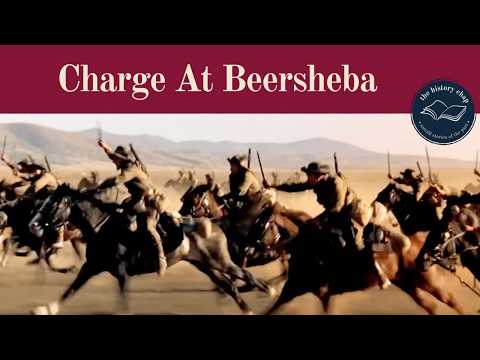
The men knew the odds. Eight hundred horsemen against entrenched machine guns and artillery. They had always fought as mounted infantry, dismounting to shoot. But now, there was no time for tactics. They would ride straight into the fire, bayonets fixed, hoping to overwhelm the defenders through sheer speed and shock. As they formed up, the horses sensed the tension, their ears flicking back and forth. The order came: “Draw swords!” — though in reality, they drew their bayonets, sharpened to a razor’s edge. Then, with a thunderous roar, they surged forward.
The charge was a spectacle of courage and chaos. Turkish artillery opened fire, shrapnel tearing through the air, but the Australians spread out, making themselves harder targets. German aircraft swooped low, dropping bombs, but still the horsemen galloped on. “It was a wild, reckless ride,” one trooper later recalled. “We knew we might not make it, but we were going to give those Turks a fight they’d never forget.” The ground shook beneath the pounding hooves, and the dust rose in great clouds, obscuring the sun.
As they neared the Turkish trenches, the fire intensified. Horses screamed and fell, men were thrown from their saddles, but the charge continued. Trooper Thomas O’Leary of the 4th Light Horse was among the first to reach the enemy lines. With a mighty leap, his horse cleared the trench, and he landed in the midst of the stunned defenders. “He captured a gun and thirty Turks single-handedly,” his citation would later read. Others followed, jumping into the trenches and engaging in brutal hand-to-hand combat. The Turkish soldiers, unprepared for such ferocity, began to waver.
Meanwhile, a group of about 150 men from the 12th Light Horse Regiment spotted a gap between the trenches and the redoubt on the left. Under Captain Roby and Captain Jack Davis, they wheeled right and raced towards the town. “We rode straight through the streets, firing as we went,” Roby recalled. “The Turks were so surprised they hardly fired a shot.” The speed of the charge had caught the defenders off guard, and within minutes, the Australians had reached the northern part of Beersheba, capturing guns and taking prisoners.
But the battle was not yet won. As Roby and Davis regrouped on the far side of the town, they came face to face with the main Ottoman withdrawal column, complete with nine guns. For a tense moment, the two sides stared at each other. Then, to the Australians’ amazement, the Turkish commander surrendered. “They didn’t know how few we were,” Davis later said. “They thought they were surrounded.” The charge had succeeded beyond all expectations. By 5:30 p.m., the town was firmly in Allied hands, and the wells were intact.
The victory at Beersheba was a turning point in the Sinai and Palestine campaign. It broke the Ottoman defensive line and opened the way for the Allies to advance towards Jerusalem. But the cost was high. Thirty-one Australians were killed and thirty-six wounded. Among the dead was the famous cricketer Tibby Cotter, one of the fastest bowlers of his generation. His loss was felt deeply by his comrades, but they took solace in the knowledge that his sacrifice had helped secure a crucial victory.
As the sun set on that fateful day, the men of the Light Horse could look back on a charge that would become legendary. “It was the greatest ride of our lives,” one trooper wrote. “We were young, we were scared, but we did it.” The charge of the 4th Light Horse Brigade at Beersheba remains a testament to the courage and determination of the Australian soldiers—a story of how a desperate gamble turned the tide of war.
Yet the story of Beersheba did not end with the setting sun. As darkness fell, the men of the 4th Light Horse Brigade dismounted in the town square, their horses lathered and trembling, their own hands still shaking from the adrenaline of the charge. “We sat down on the curb and just looked at each other,” one trooper remembered. “Nobody spoke for a long while. We couldn’t believe we were still alive.” Around them, the wells that had cost so much were already being pumped, the precious water flowing into canvas troughs for the exhausted horses.
But victory brought its own grim arithmetic. As the stretcher-bearers moved among the wounded, the roll call began. Thirty-one men would never answer. Among them was Tibby Cotter, the legendary fast bowler, who had ridden with the 12th Light Horse Regiment. “He was killed instantly by a machine-gun bullet,” a fellow trooper wrote home. “He died as he had lived—charging straight ahead.” The news would not reach Australia for weeks, and when it did, the nation mourned a sporting hero who had traded the cricket pitch for the desert.
For the Turkish and German defenders, the shock of the charge lingered long after the guns fell silent. A captured German officer later admitted to his Australian interrogators that his men had been told the Light Horse would never attack across the open desert. “We thought it was impossible,” he said. “You came out of the setting sun like madmen.” That disbelief had cost the Ottomans dearly—not just the town and its wells, but an entire defensive line that had held for months.
Within days, the full strategic picture became clear. The fall of Beersheba had unhinged the Ottoman position at Gaza, and on November 7, the British forces entered that city without a fight. The Turks were in full retreat, harried by the Australian Light Horse and British mounted troops across the coastal plain. “We chased them for miles,” recalled a trooper of the 12th Regiment. “Their guns, their supplies, their wagons—all abandoned in the dust.” The route to Jerusalem now lay open.
General Edmund Allenby, the commander of the Egyptian Expeditionary Force, wasted no time. He pushed his men northward through the Judean Hills, where the fighting became brutal and close-quarters. Unlike the open desert, this was a war of rocky ridges and narrow passes, where the Light Horse often fought on foot, scrambling up slopes under fire. The weather turned against them too—cold rains lashed the troops, a bitter contrast to the furnace of the Negev.
On December 9, 1917, Allenby entered Jerusalem on foot through the Jaffa Gate, a deliberate gesture of humility in a city sacred to three faiths. “The war is not over,” he told the gathered dignitaries, “but the deliverance of Jerusalem is a milestone on the road to victory.” For the Australians who had charged at Beersheba six weeks earlier, the moment was bittersweet. They had opened the door, but the road ahead would demand even more sacrifice.
The Ottoman Empire would fight on for another year, and the Light Horse would see further action at places like Es Salt and Amman, in conditions far removed from the glory of that October charge. But Beersheba became the touchstone—the battle that proved what mounted infantry could do when asked to become cavalry, and what young men from the Australian bush could achieve against impossible odds.
Years later, a veteran of the 4th Brigade returned to the town and stood at the edge of the old Turkish trenches. “I was only nineteen then,” he said quietly. “We didn’t think about history. We thought about water, and getting home. But looking back now—it was something, wasn’t it?” The sun was setting again over the desert, just as it had on that day in 1917, and somewhere in the distance, a horse whinnied.
The legacy of Beersheba lived on in the men who survived. Many returned to Australia and rarely spoke of that day, but the bond forged in the dust and fire endured. “We were brothers,” one veteran wrote decades later. “Not by blood, but by that ride.” Reunions were held each October 31st, where old men with trembling hands raised glasses to fallen mates and remembered the thunder of hooves.
The charge also reshaped military thinking. Though cavalry had seemed obsolete against modern machine guns, Beersheba proved that speed, surprise, and sheer audacity could still break a defensive line. Military academies studied the battle for generations, analyzing how Grant’s horsemen exploited gaps and turned a desperate gamble into decisive victory. “It was the last great cavalry charge in history,” historians would declare—though the Australians who rode it simply called it survival.
For the Ottoman Empire, the loss at Beersheba accelerated a collapse that would end centuries of rule in the region. Within a year, the empire would sign an armistice, its Middle Eastern territories carved up by the victorious Allies. The world that emerged was not the one the Light Horsemen had imagined, but they had played their part in shaping it.
Today, a memorial stands in Beersheba, honoring the 800 horsemen who charged into legend. Each year on October 31st, Australians and Israelis gather to remember. The horses are gone, the trenches filled in, but the story remains—of young men from the bush who rode against machine guns with bayonets as swords and won.
As the last Light Horsemen passed away in the 1990s, their stories were preserved in letters, diaries, and oral histories. One trooper’s account captured the essence of that day: “We weren’t heroes. We were scared boys who did what we had to do. But when the bugle sounded and we spurred our horses forward, something changed. We became something more.”
The sun still sets over the Negev, casting long shadows across the desert where history was made. And somewhere in that golden light, the ghosts of 800 horsemen ride on—not into battle, but into memory, their charge forever frozen in time.
What does the charge at Beersheba teach us about courage in the face of impossible odds? Share your thoughts in the comments below.
Report this article
Select a reason for reporting:






