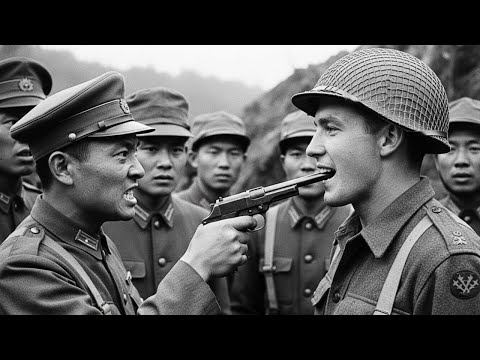
The jungle was a living oven, and the air hung so thick with heat and moisture that every breath felt like drowning. Private Tom Harrove of the Australian Army pushed through the bamboo thicket, his boots sinking into mud with each step, his uniform plastered to his skin like a second layer of torture. It was July 1945, near Balik Papan in Borneo, and the Australians were learning that fighting here meant fighting ghosts. The Japanese knew every trail, every hiding spot, every place to set an ambush. Tom’s squad of eight had walked straight into one that morning. Three of his friends went down in the first ten seconds. The rest scattered. Tom ran too, crashing through vines and bamboo, bullets snapping past his head like angry hornets. He burst into a small clearing and stopped cold. Dead end. Behind him, the sounds of pursuit grew louder. He spun around, rifle raised, but before he could fire, six Japanese soldiers burst into the clearing from different directions. Then eight more. Then ten more. Within seconds, twenty-four enemy soldiers surrounded him in a tight circle, all rifles pointed at his chest. The circle was only about eight meters across, the size of a small bedroom. They had him boxed in perfectly.
Tom’s finger tightened on the trigger. He could take maybe three of them before they cut him down, but that would be it. One of them, probably an officer, shouted something sharp. Tom didn’t speak the language, but the meaning was clear. Drop the weapon or die. His hands shook. The rifle felt like it weighed a hundred pounds. Every instinct screamed at him to fight, to go down shooting. That’s what they taught you. Never surrender. But twenty-four rifles pointed at you changes your thinking real fast. Tom slowly lowered his rifle to the ground. The moment it touched the mud, three soldiers rushed forward and grabbed him. They yanked his arms behind his back and tied his wrists with rough rope that cut into his skin. They searched him, taking his knife, his canteen, everything. The Japanese soldiers were laughing now, slapping each other on the back, making jokes Tom couldn’t understand. To them, this was easy. Another enemy soldier captured without a fight. They slung their rifles over their shoulders, casual as anything. Some lit cigarettes. They were already thinking about the march back to their base, about the hot meal waiting for them.
But Tom Harrove wasn’t regular army. Not really. Back home in Tasmania, he’d been a sheep shearer. For ten years, he’d worked the big stations, shearing thousands of sheep every season. It was brutal work that made your hands tough and your reflexes lightning quick. You had to grab a hundred-pound sheep, flip it, and hold it steady while your blade moved faster than the eye could follow. One wrong move, and you’d cut the animal or yourself. So you learned to be fast, precise, and to never hesitate. When the war started in 1942, Tom enlisted like everyone else. But the army didn’t know what to make of him. He asked too many questions. He did things his own way. His battalion commander called him too independent-minded, which was the military’s polite way of saying he was a pain in the neck. They kept him with the regular infantry instead of the special units. Fine by Tom. He didn’t need a fancy badge to do his job.
Now, with his hands tied and enemy soldiers all around him, Tom’s mind was working fast. He watched everything. The way the soldiers moved, how they held their weapons. Who was paying attention and who wasn’t. The Japanese officer shouted another command. Time to move. Two soldiers grabbed Tom’s arms and shoved him forward. The whole group started marching through the jungle, heading deeper into enemy territory. Tom stumbled along, his boots catching on roots and vines. But something was happening in his head. An idea. Crazy maybe. Probably suicide. But an idea. These soldiers thought he was finished. Beaten. No threat at all. They were celebrating, joking around, rifles slung over their shoulders like they were out for a Sunday walk. The closest soldier, the one on Tom’s right, had his Arisaka Type 99 rifle hanging loose on a strap. The barrel pointed at the ground. His hands were empty, reaching for a cigarette. That soldier was exactly 1.2 meters away from Tom, about four feet. Close enough to touch.
Tom had spent his whole life working with his hands. He knew exactly how fast he could move, how much force he could generate, what he could do in the space of a single heartbeat. These Japanese soldiers had made a mistake, a big one. They thought one captured prisoner was already defeated, already harmless, already finished. They were wrong. Tom’s face stayed blank, but inside something shifted. The fear drained away. His breathing slowed. His muscles relaxed into that familiar feeling from years of shearing, when your body knew exactly what to do before your brain even finished the thought. The officer up front was talking, waving his hand as he led the group through the trees. The soldiers around Tom were laughing at something. Nobody was watching the prisoner anymore. Not really. So Tom deliberately caught his boot on a root and stumbled forward, falling toward the soldier on his right. The guards laughed even harder. Clumsy prisoner can’t even walk straight. Tom was close now, six meters, two feet. His hands were tied behind his back, but they were tied in front of the soldier’s rifle. That rifle hanging so carelessly on its strap. The closest guard finally sensed something. His smile faded. His hands started moving toward his weapon. But sheep don’t wait for you to be ready. They fight. They kick. They twist. And when you’ve grabbed ten thousand of them, your reflexes become something else entirely. Tom’s tied hands shot up and grabbed the rifle in eight-tenths of a second. The guard’s eyes went wide, his mouth opened to shout, but Tom wasn’t trying to shoot yet. Not yet. The rifle swung up hard, the wooden stock cracking into the guard’s jaw with all the force Tom’s arms could deliver. The man’s head snapped back. He dropped like a stone. The laughing stopped. The other soldiers froze for half a heartbeat, trying to understand what just happened. Half a heartbeat was all Tom needed. He dropped to the ground behind the fallen soldier’s body, ripping the rifle free from the strap. His fingers found the bolt. His thumb found the safety. Every movement automatic from training he’d done a thousand times. Twenty-three rifles started coming up. Twenty-three soldiers started reacting. Tom’s first shot rang out across the jungle. The clock had just started. Fifty-five seconds to do the impossible. And Tom Harrove was already pulling the trigger again.
Tom hit the ground hard behind the fallen soldier, his shoulder slamming into mud, but his hands never stopped moving. The rifle came up smooth, stock against his shoulder, eye to the sight. Muscle memory took over. His brain wasn’t thinking anymore. His body just did what it knew how to do.
The first real shot cracked through the jungle. A Japanese soldier ten feet away jerked backward, a red spray bursting from his chest. He fell into the bamboo and didn’t move. Tom’s hands were already working the bolt. Pull back, push forward, lock down. Two-point-three seconds if you rushed. Less if you really knew what you were doing. Tom knew what he was doing.
Second shot. Another soldier dropped. Third shot. A man diving for cover went down midway. Five seconds had passed. Three men down. The Japanese soldiers were shouting now, total confusion, trying to figure out where the shots were coming from. They’d been walking in a loose group, bunched together like they owned the jungle. Bad mistake. They were packed into a space maybe eight meters across, like fish in a barrel.
Tom fired again. Fourth shot hit a soldier in the leg. The man screamed and collapsed. Fifth shot, the last in the magazine, took down the officer who’d been leading them. Five seconds of firing, five men down. But nineteen Japanese soldiers were still standing. And now they knew where Tom was. Bullets started smashing into the ground around him. Dirt exploded in his face. A round hit the dead soldier he was hiding behind, the body jerking from the impact.
Tom rolled hard to his left, coming up in a new position three feet away. His hands worked the rifle, ejecting the empty magazine, reaching for the dead soldier’s ammunition pouch. Fifteen seconds in. Tom’s heart hammered, but his hands stayed steady. He’d learned something important during his sheep shearing days. When things got crazy and fast, when a sheep was fighting and kicking and trying to break free, you didn’t speed up and get sloppy. You stayed smooth. Smooth was fast. Panic was slow.
Tom found two more magazines in the pouch. Ten more rounds. He slapped one into the rifle, worked the bolt, and fired before he’d even finished settling into his new position. A soldier running toward him went down hard, rifle flying from his hands. Tom rolled again, this time to the right. Never stay in one place. Keep moving. Make them guess. Another soldier appeared through the bamboo, trying to flank him. Tom’s shot caught him in the shoulder, spinning him around. The man crashed into the undergrowth.
Twenty seconds gone. Eight Japanese soldiers down. Sixteen still standing, but they were starting to panic now. Tom could see it in how they moved, jerky and wild. Some were firing at where he’d been, not where he was. Others were running for better cover, not sure whether to attack or defend. Tom had spent exactly zero time in special forces. The army had called him too independent, not a team player. But right now, that independent thinking was keeping him alive.
The rule book said a surrounded prisoner should surrender. The rule book said one man couldn’t fight twenty-four. Tom had never been good at following rule books. He fired twice more from his position behind a thick tree root. Two more soldiers dropped. One didn’t get up. The other crawled toward the bushes, leaving a trail of red in the mud. Tom worked the bolt fast, chambered another round, and shifted position again.
Thirty seconds had passed. The Japanese soldiers were spread out now, taking cover behind trees and rocks. That was better for them, harder to hit, but it also meant they couldn’t coordinate. They were individuals now, each man fighting alone. A soldier popped up from behind a fallen log, rifle coming to his shoulder. Tom was faster. His shot hit the log, spraying splinters, and the soldier ducked back down. Tom adjusted his aim, waited half a second for the man to peek again, and fired. The soldier jerked backward and disappeared behind the log.
Thirty-five seconds. Tom’s magazine clicked empty. He dropped behind a bamboo clump, hands moving automatic, ejecting the spent magazine, loading the last one he’d taken from the dead soldier. Five more rounds. That was it. After this, he’d have to take another rifle from a body. If he lived that long.
Three Japanese soldiers rushed him at once, coming from different angles. Smart move. Hard to shoot three targets at the same time. Tom picked the closest one, fired, watched him fall, swung to the second, fired, saw him stumble. The third was almost on him when Tom’s shot took him in the chest at less than ten feet. The soldier’s momentum carried him forward and he crashed into Tom, knocking them both into the mud. Tom shoved the body off, breathing hard.
Forty seconds. His arms ached. His shoulder throbbed where he’d hit the ground. The smell of gunpowder mixed with the jungle rot, thick enough to taste. He grabbed the dead soldier’s rifle, checked the magazine. Three rounds left. Better than nothing. Tom rolled away from the body and came up near a thick tree trunk. His eyes scanned the jungle. How many left? He’d lost count. Everything was chaos now. Smoke and noise and movement. Two soldiers were running away, crashing through the jungle, heading for safety. Tom let them go. Running men weren’t shooting at him.
He swung his rifle toward movement on his left. A soldier was trying to circle around, moving tree to tree. Tom led him, squeezed the trigger. The man went down. Forty-five seconds. Tom’s breath came in gasps now. His body was running on pure energy. That flood of strength you get when death is close. He’d felt it once before when a bull had charged him at a station in Tasmania. Your body finds power it didn’t know it had.
Three more soldiers were still fighting, still trying to kill him. They were smarter now, staying behind cover, taking careful shots. A bullet cracked past Tom’s ear, so close he felt the wind. Another hit the tree above his head, bark exploding. These men weren’t panicking anymore. They were getting organized. Tom shifted position again, moving low and fast. He came up behind a thick fern and spotted one of the soldiers peeking around a tree trunk. The range was maybe thirty feet. Tom aimed, held his breath, fired. The soldier dropped. Two left.
Fifty seconds had passed. Tom’s last rifle only had two rounds remaining. Two bullets for two enemies. Had to make them count. His hands were shaking now, not from fear, but from the effort. He’d been moving, shooting, rolling, running for almost a minute straight in ninety-seven-degree heat. His uniform was soaked through. Sweat dripped into his eyes. He heard movement behind him and spun. A Japanese soldier was charging, rifle with bayonet pointed straight at Tom’s chest. No time to shoot. Tom threw himself sideways. The bayonet missed him by inches, stabbing into the tree. The soldier tried to pull it free, but the blade was stuck in the wood. Tom brought his rifle up like a club and hit the man across the head. The soldier crumpled. Tom ripped the bayonet rifle from the tree, now holding two rifles. He dropped the empty one and kept the one with the blade.
One enemy soldier left. Tom could hear him moving through the bushes, trying to get an angle. Both of them were hunting each other now, circling through the jungle like animals. Fifty-three seconds. Tom’s muscles screamed. His lungs burned, but his mind was clear, sharp, focused on one simple thing. Survive. Win. Live. He caught movement through the bamboo. The last soldier raising his rifle. Tom dove forward, hitting the ground hard, and fired at the same instant. Both rifles cracked at once. Tom felt something hot graze his arm, burning like fire. His shot hit true. The last Japanese soldier staggered backward, his rifle falling from his hands. He took two more steps, then collapsed into the ferns.
Silence fell over the jungle. Tom lay in the mud, chest heaving, rifle still pointed forward. His ears rang from all the shooting. Smoke drifted through the trees. Birds that had fled from the noise started calling again in the distance. Fifty-five seconds from the moment Tom grabbed that first rifle to now. Fifty-five seconds of pure violence. Twenty-four Japanese soldiers down. Tom Harrove still breathing.
He slowly got to his feet, legs shaking. Blood ran down his arm from where the bullet had grazed him, but it wasn’t deep. He’d live. He looked around at the clearing that had become a battlefield. Bodies everywhere, some moving weakly, most still. The smell of blood mixed with gunpowder and jungle rot. Tom picked up the Arisaka rifle, checked it was loaded, and started walking back toward where his unit had been. His hands wouldn’t stop shaking now. The energy was draining away, leaving him hollow and cold despite the heat. He’d done something impossible, something that shouldn’t have worked. Every military manual said he should be dead or captured, but he was walking and they weren’t.
As he pushed through the bamboo, Tom started laughing. Not from joy, from the sheer crazy luck of still being alive. He’d seen their faces when he grabbed that rifle. The shock, the disbelief. They’d thought he was finished. They’d been wrong.
Word of what happened spread through the Australian camp like wildfire. By the time Tom stumbled back to his unit three hours later, bloody and exhausted, half the battalion already knew the basic story. One prisoner, twenty-four enemy soldiers, fifty-five seconds. The numbers seemed impossible. Nobody wanted to believe it at first, but the proof was in the jungle. A patrol went back to the clearing with Tom and found exactly what he described. Twenty-four Japanese soldiers scattered across the small space, most dead, a few barely alive. Shell casings everywhere. Blood soaked into the mud. The clearing was only eight meters across, just like Tom said. A killing ground where the impossible had happened.
The change in the numbers told the whole story. Before Tom made his move, the situation was hopeless. One captured Australian, twenty-four armed Japanese soldiers in control, three wounded Australians pinned down somewhere in the jungle. No help coming. After those fifty-five seconds, the math flipped completely. Twenty-four enemy casualties, zero Australian deaths from Tom’s counterattack, and an entire Japanese position wiped out. Tom had fired thirty-one rounds total using a rifle with a five-round magazine. That meant six complete reloads plus one extra bullet. All while under fire, all while moving and rolling and dodging.
The Australian command didn’t know what to make of it. This wasn’t how war was supposed to work. You didn’t win fights when you were captured and outnumbered twenty-four to one. Major General Thompson, who commanded the Australian forces in Borneo, called it the most remarkable act of combat he’d witnessed in three years of Pacific fighting. Within days, orders came down from headquarters. They wanted to study what happened. They wanted to understand how a sheep shearer from Tasmania had done what trained soldiers couldn’t.
By August 1945, just weeks after Tom’s fight, the Australian Army started teaching something new. They called it escape and evasion training. But really, it was about changing how soldiers thought about capture. The old rule had been simple. If surrounded and outnumbered, surrender to survive. The new rule was different. Capture doesn’t mean defeated. If you see a chance, even a small one, take it. Twenty-four hundred Australian soldiers went through the new training before the war ended. They learned about the two-point-three-second reload time on Japanese rifles. They learned about watching for moments when guards got careless. They learned that sometimes the most dangerous moment for your enemy is right after they think they’ve won.
The training used Tom’s fight as the main example. Officers would walk new soldiers through every decision Tom made, every movement, explaining why it worked. But not everyone was happy about this. The old military leadership, especially the British officers who still had influence over Australian forces, hated the new doctrine. Brigadier Sir Clive Hampton called it reckless and ungentlemanly warfare. He argued in official reports that teaching soldiers to fight after capture would just get more men killed. The proper thing to do when captured was accept defeat gracefully and wait for the war to end. Fighting back was savage, uncivilized, not how professional armies behaved.
The Americans had their own debate. Their training manual said soldiers should resist giving information if captured, but not fight back violently. The worry was simple. If prisoners started attacking their guards, the Japanese might retaliate by executing all prisoners. It was a real fear. Everyone knew the Japanese didn’t follow the Geneva Convention rules about treating prisoners well. And that fear came true in Borneo. After word of Tom’s escape spread, the Japanese forces in the region became paranoid about Australian prisoners. In the three weeks following the incident, Japanese commanders ordered the execution of fourteen Australian prisoners of war. They were shot in small groups, killed because their captors now saw every prisoner as a potential threat. Those fourteen deaths weighed heavy on the minds of the men who’d celebrated Tom’s victory.
But something else happened, too. Australian morale went through the roof. For years, soldiers in the Pacific had felt like the jungle belonged to the enemy, like they were always one step behind. Tom’s fight changed that feeling. Stories about the sheep shearer who refused to stay captured spread through every unit. Men started calling him the laughing prisoner because witnesses said Tom had laughed when the Japanese first surrounded him. Laughed like he knew something they didn’t.
The jungle itself had been part of the story in ways the official reports couldn’t quite capture. That clearing where the fight happened was a place of thick heat and heavy air. At ninety-seven degrees, every breath was work. The humidity made everything wet, made metal slippery, made hands slide on rifle stocks. The ground was mud mixed with rotting leaves, the kind that sucked at your boots and made quick movement hard. Bamboo surrounded the space, thick stalks that rattled when bullets hit them, creating confusion about where shots came from.
The sounds were what soldiers remembered most when they visited the site afterward. The initial gunfire had been shockingly loud in that enclosed space, echoing off the trees, making it seem like shooting came from everywhere at once. After the fight ended, the silence felt unnatural, heavy, broken only by the buzzing of insects that came back to feed on the blood. The smell of cordite, that sharp bitter smell of fired gunpowder, mixed with the constant rot smell of the jungle floor, creating something that burned your nose and stuck in your throat. One soldier who reached the clearing an hour after the fight wrote in his diary that the ground was torn up from boots and bodies, shell casings glinting in the patches of sunlight that made it through the canopy. Several rifles lay scattered, one still with its bayonet stuck in a tree trunk where it had been driven so hard it took two men to pull free. The physical evidence made it real in a way the numbers couldn’t.
In the months after Tom’s fight, Australian forces documented 127 instances of soldiers attempting similar counterattacks when captured or surrounded. The military tracked these carefully, wanting to know if Tom’s success could be repeated. The results were mixed. Only thirty-nine of those attempts, about thirty-one percent, succeeded in the soldier escaping or turning the tables on their captives. The rest ended badly, with forty-eight soldiers killed trying to fight back and forty others recaptured after failing. But even thirty-one percent was better than zero. Before Tom’s fight, the assumption had been that fighting back when captured was suicide, that success was impossible. Now there was proof it could work, and three out of every ten soldiers who tried it lived to tell the story. The math started making sense to commanders. If captured soldiers had nothing to lose anyway, why not try?
The Japanese adapted too. After Borneo, their standard procedures for handling prisoners changed across the Pacific theater. Guards were ordered to keep prisoners separated, never let them get close to weapons, and shoot immediately if a prisoner made any suspicious move. They also started binding prisoners’ hands more carefully, using wire instead of rope, making it nearly impossible to slip free. In a strange way, Tom’s fifty-five seconds changed how both sides fought for the rest of the war.
The ripple effects kept spreading. Australian special forces units started practicing something they called opportunistic reversal. The idea was to train until grabbing an enemy weapon became automatic, something your body could do faster than your brain could think. They used the exact movements Tom had made, refined them, added variations. By September 1945, when the war ended, this training had become standard for Australian commando units. Other Allied forces took notice. American Rangers requested information about the Australian training program. British Special Air Service commanders quietly copied the techniques despite the official disapproval from British high command. Even some Japanese prisoners of war who were interrogated expressed surprise that Allied forces were teaching such aggressive tactics. One captured Japanese officer said through a translator that it showed the Australians had learned to fight like the jungle itself, unpredictable and always dangerous.
The academic world got involved, too. Military psychologists wanted to understand the mental aspect of what Tom did. How does a captured man shift from defeated prisoner to lethal fighter in seconds? What goes through someone’s mind when they decide to attack twenty-four armed soldiers? The interviews with Tom revealed something interesting. He said later that the moment he decided to fight, his fear went away completely. His mind became quiet and clear. His body moved like it was shearing sheep again, smooth and automatic. He’d entered a mental state that trainers now call combat flow, where time seems to slow down and everything becomes simple.
Doctors examined Tom after the fight and found his heart rate was still elevated hours later. His body was flooded with chemicals that gave him strength and speed. They measured his reflexes and found they were significantly faster than the average soldier. But it wasn’t natural talent. It was ten years of working with his hands, training his nervous system to react instantly to struggling animals. The military realized that certain civilian jobs, especially ones requiring fast physical reactions, created soldiers with unusual advantages in close combat.
The lasting image from that day in July 1945 wasn’t the numbers or the tactics. It was Tom’s face. Multiple soldiers who saw him right after the fight described the same thing. He was laughing, but tears ran down his cheeks. His hands shook so badly he couldn’t light a cigarette. He kept saying over and over, “They thought I was done. They thought it was over.” The combination of triumph and trauma, of impossible victory and terrible violence, marked something deep in everyone who witnessed it. War wasn’t about heroes who never felt fear. It was about ordinary men who felt everything and did the impossible.
The war ended a month later, in August 1945. Tom Harrove went home to Tasmania with a chest full of medals, including the Distinguished Conduct Medal, second only to the Victoria Cross. He tried to go back to sheep shearing like nothing had happened. For a while, he even succeeded. The big stations welcomed him back and his hands remembered the work. But something had changed in those fifty-five seconds of jungle fighting. Something that never quite healed.
Tom rarely spoke about what happened in Borneo. His wife said he’d wake up at night sometimes, breathing hard, hands moving like he was working a rifle bolt in his sleep. The nightmares never completely stopped. When friends or neighbors asked about his medals, he’d shrug and change the subject. To most people in his small town, he was just Tom the shearer who’d done his time in the war like everyone else. But in military circles, Tom’s story lived on and grew.
By 1957, when Australia formed its Special Air Service Regiment, the training program included a full day devoted to what they officially called prisoner combat response. The instructors used Tom’s fight as the central case study, walking candidates through each decision point, explaining the timing, the weapon mechanics, the psychology. New recruits learned that the most dangerous person in any situation is someone who has nothing left to lose and everything to fight for.
The techniques Tom used that day became standard practice across special forces worldwide. By the 1960s, every NATO special operations unit trained in what they called weapon retention and improvised counterattack. The core principle was simple but powerful. The moment right after capture is the highest probability window for reversal. Guards are most relaxed then, most confident, most likely to make mistakes. If you’re going to act, act fast. Act in that first minute before they lock you down properly. Israeli Defense Forces took the concept even further. When they developed Krav Maga, their famous combat system, they included entire sections based on prisoner scenarios. How to grab a rifle, how to use tied hands as a weapon instead of a weakness, how to exploit the two-point-three-second reload gap. Military instructors started calling it the fifty-five-second principle, teaching that in those first moments after capture, the tactical advantage can flip completely if you move with precision and speed.
The impact spread beyond military training. By the 1970s, law enforcement agencies studying hostage situations looked at Tom’s fight for lessons. Psychologists researched what they called acute stress performance, trying to understand how some people maintain precise physical control even when their heart is pounding and death is imminent. Sports scientists measured reaction times of sheep shearers and found they were significantly faster than average, confirming that years of physical work with unpredictable animals created nervous systems wired for speed.
Tom lived quietly through all of this, mostly unaware of how his fifty-five seconds had rippled out into the world. He had three children who grew up knowing their father had done something important in the war, but not really understanding what. He worked the sheep stations until his body couldn’t handle it anymore, then retired to a small house near Launceston. He spent his final years fishing and working in his garden.
In 1982, Tom Harrove died of a heart attack at age sixty-three. The funeral drew a surprisingly large crowd. Veterans came from across Australia. Men Tom had never met who’d been taught his tactics in training. A general attended and gave a speech about how one sheep shearer had changed modern combat doctrine. But the most striking moment came when Tom’s daughter read from his private diary, words he’d written decades earlier and never shared publicly. The diary entry was from August 1945, just weeks after the fight. Tom wrote that he’d been having nightmares about the Japanese soldiers’ faces in those final seconds, the shock and fear in their eyes. He wrote that he kept thinking about their families, their wives and children who would never see them again. Then he wrote something that summarized everything. “They thought I was laughing with them. I was laughing at death itself. But death heard me laughing and has never stopped listening. I won those fifty-five seconds, but death waits patient. We all pay the cost eventually.”
Those words hit hard because they revealed the truth behind the legend. Tom hadn’t been fearless or invincible. He’d been terrified and desperate, and the violence he unleashed to survive had marked him forever. The victory in the jungle wasn’t clean or simple. It was complicated, painful, heavy, with the weight of twenty-four lives taken in less than a minute. Modern soldiers who study Tom’s fight learn this lesson too. Survival sometimes requires impossible things, and impossible things always come with a price.
The military continued evolving the lessons from Borneo. By the 1990s, armies around the world taught something called post-capture cognitive resilience. The training focused on maintaining mental clarity even in the most desperate situations, on seeing opportunities where others saw only defeat. Instructors told recruits that the human mind has a switch that can flip in crisis moments, turning panic into icy focus. Tom’s switch had flipped when he stumbled toward that first guard, when his body remembered sheep shearing and his mind went quiet and clear.
Business schools picked up on the story, too, using it as a case study in unconventional thinking. Leadership professors pointed out that Tom succeeded because he ignored the rules everyone else followed. When the experts said surrender, when conventional wisdom said fighting was suicide, Tom looked at the actual situation with fresh eyes and saw possibilities nobody else saw. His success came from treating the moment as unique, not as something that fit into existing categories. The contrast between Tom’s civilian skills and his military situation became a popular teaching point. Companies started looking for employees who had unusual backgrounds, people whose life experience gave them different ways of solving problems. The idea was simple. Sometimes the person with no formal training sees solutions that experts miss because they’re not trapped by what they’ve been taught is impossible.
Modern counterterrorism units still study the exact sequence of Tom’s movements. They use slow-motion video recreations to analyze his timing, his positioning, his target selection. The conclusion is always the same. What Tom did shouldn’t have worked based on probability, but it did work because he executed perfectly under impossible pressure. Every movement was efficient. Nothing wasted, no hesitation. It’s the standard they try to train others to reach.
The deeper lesson took longer to understand. Military psychologists eventually realized that Tom’s fight revealed something important about human nature. People are capable of far more than they believe in normal circumstances. The gap between what we think we can do and what we can actually do when survival demands it is enormous. Tom didn’t discover some secret technique. He discovered that when you have no choice, when it’s fight or die, the human body and mind can achieve things that seem impossible before they happen.
The final twist in Tom’s legacy came from an unexpected place. In 2010, a Japanese historian researching the Pacific War interviewed elderly veterans who’d served in Borneo. One old man, tears running down his face, told a story about his brother who’d been part of a unit that disappeared in the jungle in July 1945. Twenty-four men went on patrol and never came back. For decades, the family believed they’d been killed in an ambush by a large Australian force. Learning the truth, that one captured prisoner had killed them all, was devastating, but also brought a strange closure. The brother wrote a letter to Tom’s daughter saying he understood that war makes monsters of everyone, that his brother had probably treated prisoners badly too, and that forgiveness was the only path forward.
The philosophical impact of Tom’s story continues to resonate in a world that often feels overwhelming, where individuals can feel powerless against larger forces. The story reminds us that position is temporary, but mindset is everything. Tom was captured, tied up, surrounded, with every advantage against him. But he refused to accept that his story was over. He saw a sliver of possibility and seized it with everything he had. That concept applies far beyond combat. When businesses fail, when careers collapse, when personal crises make life feel impossible, the instinct is to surrender to the situation. Tom’s fifty-five seconds teaches the opposite lesson. The most dangerous moment isn’t when you’re defeated. It’s when your opponent thinks you’re defeated and stops paying attention. That’s when everything can change.
Modern militaries end their lessons on Tom’s fight with a question they ask officer candidates to consider. When you’re surrounded, outnumbered, outgunned, with every strategic advantage against you, what do you do? The correct answer isn’t to analyze tactics or calculate odds. The correct answer is simpler and harder. You look for the moment when your enemy’s confidence becomes carelessness. You wait for them to stop seeing you as dangerous. Then you move. Tom Harrove proved that defeat is a choice, not a condition. Those twenty-four Japanese soldiers made the fatal mistake of assuming the fight was over. They relaxed. They laughed. They let their guard down for less than a minute. That minute cost them everything.
Tom made the opposite choice. He refused to accept that being captured meant being defeated. He stayed alert. He looked for his chance. And when it came, he acted without hesitation. In that jungle clearing in July 1945, a sheep shearer from Tasmania changed warfare. He didn’t do it through strategy or technology or superior numbers. He did it by refusing to believe what everyone else believed, that one man couldn’t win against twenty-four. He laughed because he knew something his captives didn’t. Your situation isn’t your destiny. Your response to your situation is your destiny. And sometimes all it takes is fifty-five seconds of perfect clarity to turn certain death into impossible victory.
The cost was real. The nightmares, the weight of twenty-four lives, the trauma that never fully healed. But the lesson echoes across decades. When everything is against you, when defeat seems certain, when the experts say it’s over, that’s when you find out what you’re really made of. Not through hoping or wishing, but through seeing what is, understanding what’s possible, and acting with everything you have. Tom Harrove lived with the consequences of that for the rest of his life. But he lived. And in doing so, he taught us all that the most powerful weapon in any fight isn’t the rifle in your hands. It’s the refusal in your heart to accept that you’re finished. So the next time life surrounds you, ties your hands, and laughs, will you remember the sheep shearer who laughed back?
Report this article
Select a reason for reporting:






