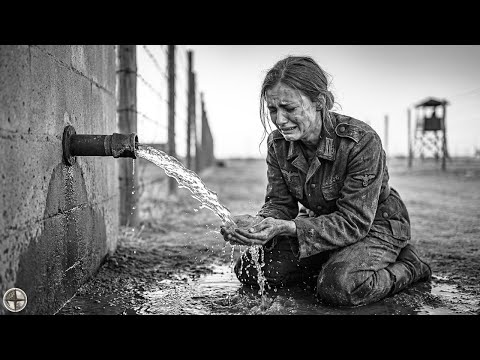
The August heat hit like a physical blow as the truck rattled to a stop inside the wire. Forty German prisoners sat packed on wooden benches, uniforms hanging loose from starved shoulders, eyes struggling to adjust from the dark canvas cover to the hard white Texas sky.
At the very back sat Lissellotta Schaefer—Lisa to anyone who still cared to use her name. She was 22, an auxiliary nurse who had followed wounded soldiers from Bremen to France. Her once-strong hands shook as she gripped her knees. Her tongue felt like leather. Her head throbbed with the dull, slow ache of long thirst.
For months, she had measured water in spoons and chipped cups.
In Bremen, after the heavy raids of 1943, the city had cut water to a few liters per person per day. The taps ran for one hour in the morning, one at night—if the pipes were not broken. You saved the gray water from washing to boil potatoes, then used it again to scrub the floor. On the transport to France, then to the coast, then onto a ship to America, it had been worse. Guards handed out exactly one canteen a day—about a liter, she guessed. It had to serve for drinking, washing, everything. Anyone who spilled it might as well have spilled blood.
German radio had promised that capture by the Americans meant shame and danger, especially for women. They spoke darkly about camps and showers, and everyone understood the hint. In the bunkers during air raids, other nurses had whispered that it was better to die at home than to be taken overseas. Lisa had half believed them. She had no strength left for belief in anything else.
“Off the truck,” an American voice called now.
The back gate banged open. Heat and light slammed into the prisoners like a wall. One by one, they climbed down, boots slipping on the metal step. The air smelled of dust, hot wood, and something sharp and unfamiliar—creosote from the fence posts, though she did not know the word.
When Lisa reached the ground, her legs wobbled. She blinked against the sun and looked up—and saw it.
A tall wooden water tower stood beyond the nearest barrack, its dark shape cutting against the sky. From its base ran a fat pipe, then a thinner one, and from that pipe water poured in a clear, steady stream into a long trough. The water splashed, glittered, and overflowed. Where it hit the baked earth, the dust turned to dark, sticky mud.
She froze. The line of prisoners moved around her, but she could not look away.
In one minute, she thought wildly, more clean water was spilling uselessly into Texas soil than her ruined street in Bremen had seen in a month. No guard shouted if it spilled. No one fought for it. No one treasured each drop. It simply ran and ran.
“Move it along, please,” the American sergeant with a clipboard said. His tone was firm, but not harsh. He gestured them into a line under a strip of shade beside the barracks.
Lisa obeyed with the others, but her eyes kept sliding back to the pipe, to the clear arc of water. Her throat burned now, simply from seeing it. On the ship, they had warned them about drinking too much at once. Some men, they said, had died that way after liberation, stomachs too empty to handle sudden plenty. Lisa had promised herself she would be careful, if she ever reached such a place—but she had never imagined this. Water so common that it could be allowed to spill into the dirt.
The sergeant walked slowly along the line, checking names against his list. He asked in simple English that even Lisa could half follow. “How many weeks?”
“Many weeks,” an older man answered in halting words. “From France.”
The sergeant nodded. When he came to Lisa, he stopped. Her gaze was still locked on the trough. Sweat ran down the side of her face, leaving pale tracks in the dust.
“Lisa?” he said quietly.
The word startled her. No one had called her anything polite in months. She swallowed. Her mouth was too dry for speech in English, so she whispered in German. “The water,” she said.
He followed her eyes, then let out a slow breath. For a moment, his face changed. The official look slipped, and something like pity showed through.
“Yeah,” he said softly. He turned to a younger guard near the barrack door. “Grab canteens. Full ones.”
The guard nodded and disappeared inside. A minute later, he came back with his arms full of metal canteens, the kind American soldiers carried on their belts. Lisa counted them without meaning to. Forty. One for each prisoner from the truck. They had guarded half that number of water bottles with rifles on the voyage over.
The guard walked down the line, pressing a canteen into each waiting hand. When he reached Lisa, she took it with both of hers. It was cool to the touch. Condensation had already formed on the metal, tiny drops that slid down and wet her fingers. The weight of it felt unreal, like something from a dream.
“It’s clean,” the guard said, speaking slowly so she could understand. “From the well.”
Her heart beat faster. She unscrewed the cap. The small metal sound seemed very loud in the still air. She lifted the canteen, and before the water even reached her lips, she could smell it. Nothing. And that nothingness was the miracle. No stink of rust, no swamp taste, no hint of chlorine from a damaged city pipe—just cold.
The first mouthful hit her tongue like ice. Pain shot through her teeth. She swallowed, and the water slid down her throat, simple and pure. It filled the dry crack that had lived inside her for so long she no longer noticed it. And suddenly she did notice. Her hand shook. She took another sip, smaller, as they had taught them. The metal rim touched her lower lip. She felt its smoothness, the faint trace of oil from some American machine shop.
Later, in a letter to a friend, she would write: “At that moment, I understood that everything they had told us could not be true.”
Now, though, she did not think in clear sentences. Her eyes blurred. Warmth rose from her chest into her throat. Tears spilled over and ran down her cheeks, mixing with the dust. The prisoners near her glanced over. Some looked away quickly. A few stared openly, as if they could not understand how simple water had done what months of war had not broken.
Someone opened a canteen and drank. The sergeant looked down the line, saw her shoulders shake, and for a moment his jaw tightened. He said nothing.
Lisa lowered the canteen and held it against her stomach with both hands, as if afraid someone might change his mind and take it back. She had crossed an ocean, expecting hunger and cruelty. Instead, her first gift from the enemy was more clean water than she knew how to drink. This was not propaganda. It was reality, and it stood there in her hands, heavy and cold.
“Get them processed,” the sergeant called to the guards after a time. “Then showers.”
The word showers slid through the line like a chill wind. Around Lisa, backs stiffened. For all the comfort of the water in her canteen, fear rose again, sharp and sudden. She had survived bombs and shells, but now one simple word made her knees weak. What waited behind that word would be the next shock of Texas—and it would cut even deeper than the first taste of clean water.
They led the line away from the water tower, past the long side of a barrack, and under the watch of the guard towers. The wire hissed slightly in the heat. Somewhere a generator hummed. Lisa walked with the others, canteen against her chest, every step heavy with one word the sergeant had used so casually.
Showers.
Rumors from home clung to that word like smoke. In Bremen’s cellars, women had whispered about camps in Poland. “They say there are false showerheads,” one nurse had told her once in the dark. Lisa had not wanted to believe it, but the war had taught her that the worst stories were often the true ones.
Now the guards opened a door into a low wooden building. Cool air flowed out, smelling of paper, sweat, and disinfectant. Inside was a wide room with tables. American clerks sat behind them with stacks of forms. A big board on the wall showed rows of numbers in chalk—29, Lisa thought, out of more than 800. A tiny island of women in a sea of uniforms.
“Men to the left, ladies to the right,” a corporal called. He had a pencil behind his ear and tired eyes. Lisa and a few other women—nurses, signals helpers, a cook in a stained white coat—moved as directed.
A woman in American uniform waited at a smaller table. She wore trousers, a khaki shirt, and a cap with short dark hair tucked under it. She asked in slow, careful German. Her accent was strange but clear. “Name?”
“Lissellotta Schaefer.”
The woman nodded, wrote it down, gave Lisa a small metal tag stamped with a number. “You keep this,” she said. “POW number.”
The tag was cold in Lisa’s palm. A number instead of a name, she thought. But the woman’s voice had not been cruel. It was the voice of someone doing a job.
They took basic information from each prisoner. Place of birth, unit, next of kin. An ink pad sat on the table for fingerprints. A little bowl of water stood beside it so the clerk could rinse her hands. No one watched that water. Drops fell onto the floor and dried. The waste of it felt like a constant shock.
When the last form was filled, the American woman stood up. “Now we go to showers,” she said.
At that word, the room seemed to tighten. Shoulders rose. A few women crossed themselves. The American woman noticed and her expression softened. “It is only water,” she said in German. “Hot water. For washing. Nothing else.” Her voice was flat, as if she did not quite believe her own logic.
They stepped through another door into a long tiled room. For a moment, Lisa simply stared.
White tiles covered the walls from floor to ceiling. Metal pipes ran overhead, feeding eight showerheads in two neat lines. A drain ran down the middle of the floor. Hooks on the wall held stacks of gray towels. A wooden bench held bars of soap and small bottles. The air was cool now, but it already smelled of soap and a faint sharp hint of bleach.
The American woman—her badge said Sergeant Mills—walked over to the nearest tap. “Look,” she said. She turned the handle. Water burst from the showerhead in a hard, clear stream. It hit the tiles with a loud, steady roar and sprayed fine mist into the room. After a few seconds, steam began to rise.
“Hot,” Mills said. She turned another handle. The water cooled. “Cold. You can mix. Careful with too hot.”
Eight showers, Lisa thought, for maybe thirty women. And the water again running without fear and without counting.
“Clothes there,” Mills said, pointing to a wooden bin. “Leave them. They will be burned or washed, depending.” She paused, looked at their faces. “It is only water,” she added softly.
Later, one of the other nurses would write in a Red Cross report: We feared a trap until we smelled the soap. Gas does not smell like that.
The women began to undress. Fingers fumbled with buttons stiff with old sweat. Cloth stuck to skin. Lisa peeled off her tunic and skirt, then her undershirt. Her body in the bright light looked like someone else’s. Ribs sharp, hips jutting, bruises yellow and green on her thighs from too many knocks in too many crowded train cars.
She folded her clothes by habit, then stopped. The fabric was so filthy it almost stood by itself. Brown rings marked the collar and cuffs. A dark line rimmed the hem where mud and dust had dried. It was not worth saving. She laid it on the pile and stepped barefoot onto the cold tile.
The first touch of water made her gasp. It hit her shoulder like rain from a high roof—hard, cold for a second, then warming quickly. She moved forward until the stream beat on her head. Heat spread down her neck, her back, her arms. The sound was like a storm on a tin roof, filling her ears, almost drowning thought.
Her skin prickled as blood came back to the surface. Dirt that had lived in the lines of her hands for months began to melt away in gray streaks. She reached for a bar of soap. It smelled of nothing more exotic than clean laundry, but the smell went straight to some deep place in her mind. Her mother hanging sheets on a line in the tiny yard behind their Bremen flat. Saturday baths when the war was still new and exciting. Before the firestorms.
She lathered the soap over her arms, her chest, her thin legs. The water turned darker as it rolled down her and into the drain. Beside her, another woman leaned her forehead against the tile and cried openly. The water hid her tears.
In that shower, Lisa would later tell a camp interviewer, “I felt shame and relief together. Shame that I had become so used to filth. Relief that someone had decided I was worth cleaning.”
The paradox cut deep. The place she had feared as a death room became the first safe space she had known in years. The water that could have hidden poison instead carried away sweat, fear, and the smell of burned cities. No one shouted at them to hurry. No one counted seconds.
When at last Lisa turned off the tap, her skin was pink from heat, her hair heavy with water. She stepped out into the cooler air and took a towel from the bench. It was rough but dry, smelling faintly of starch. She dried herself and reached for the new clothes laid out on another table.
Prisoner of War was stenciled on the back of the shirt. She pulled on the trousers. The fabric was thick and soft compared to her old wool. The shirt sleeves hung loose on her thin arms. For the first time in months, nothing itched.
A strange thought came to her. She was more comfortable now in clothes that announced prisoner to the world than she had been in any uniform of the Reich for a long time.
Outside, the sun was lower. Shadows stretched across the compound. From somewhere beyond the inner fence came a smell that made her stomach twist. Meat cooking. Bread. Something sweet.
A bell rang, clear and loud. Mess time.
Sergeant Mills said the water had washed away more than dirt. But the next proof that this camp was different would not come from a tap or a showerhead. It would come from a steel tray piled high—and from the cold, clear numbers on a scale.
The mess hall was bigger than any room Lisa had seen since before the war. Long wooden tables ran in straight lines. The air was thick with smells that hit her like a blow—meat frying, bread baking, hot coffee, something sweet with cinnamon.
“Take a tray, move along,” an American cook called. When Lisa reached the stack of metal trays, her fingers shook. As she moved down the line, cooks placed food on it. A thick slice of meatloaf, brown and steaming. Mashed potatoes with gravy. Green beans, bright and slightly crisp. A wedge of white bread with a pat of yellow butter melting slowly.
For a second, she could not move. All this for one meal. The last ration card she had seen in Bremen allowed about 1,000 calories a day. This one tray looked like more.
She found a place at a table with the other women. “Eat slow,” the older signals operator whispered. Lisa cut a small piece of meatloaf and bit. Salt, fat, real meat. Her body wanted to gulp, to shovel it in. She forced herself to chew carefully, count to ten, then swallow.
Around her, some women put down their forks after a few bites, faces pale, stomachs rebelling. Lisa ate about two-thirds before her body begged her to stop. Her hunger was still strong, but her stomach had shrunk.
When the meal ended, guards led them to a small building with a red cross painted on it. A metal scale stood in the corner. “Ladies first,” said the American doctor. His name tag read Capt. Harris. He spoke some German, broken but kind.
Lisa obeyed. The scale creaked under her bare feet. The needle swung and settled. “91,” Harris said, frowning. He glanced at the form on his clipboard. “65 meters. You should be what—55 kilos?” He made a quick note. “You are down more than 30 pounds from healthy.”
Lisa swallowed. Before the war, she had weighed about 58 kilos. She had not seen a scale in two years. She had known she was thin. Hearing the exact number made it feel more real, more dangerous.
Harris listened to her heart and lungs with a cold stethoscope, checked her gums, peered at her fingernails. “You have vitamin lack,” he said. “And anemia. But no fever, no active infection.” He wrote more notes. “You will have limited work at first.” He tapped the paper with his pen. “Extra rations,” he added. “Four meals a day for one month. More bread, more fat.”
The word sounded absurd. Extra food as a prescription. In Bremen, the hospital had run out of bandages and medicine by 1944. They had wrapped wounds with old sheets, boiled and used again. Here, the doctor’s main tool for healing her was bacon and butter.
A young American nurse handed her a small paper with her weight and POW number on it. “Dentist later,” she said. Lisa took the paper. The thin sheet felt heavier than it looked. It was proof that someone had measured her, counted her as a life worth fixing, not just a problem to move.
One by one, the other women went through the same routine. The numbers on the scale were often the same story. Twenty, thirty pounds lost since before the war. Harris shook his head again and again. “We will fatten you up,” he said more than once.
When they left the infirmary, twilight was pooling in the corners of the camp. Electric lights clicked on along the fences. A guard pointed them toward a low building set a little apart from the others. “Women’s barrack,” he said. “You sleep there.”
Inside, the room was plain. Two rows of bunks, a small stove, a table with a few books in German and English. Clean sheets lay folded at the foot of each bed. A bucket of water stood by the door with a dipper for drinking.
It was a small world bounded by wire and guards. But inside it, Lisa was beginning to see rules that made sense, food that came on time, and hands that did not hit. The next days would show her how this strange order worked—how people lived, worked, and even learned behind the high fences.
The first morning bell rang before sunrise, a harsh metal sound that bounced off the barrack walls. For a moment, Lisa did not know where she was. Then she smelled coffee from the mess hall and soap from the washroom and remembered. Texas. Camp. The women’s hut.
Outside, boots thudded on the hard ground as hundreds of men lined up for roll call. “Up, girls,” said the signals operator from the day before. “They count us twice a day. Six in the morning. Six in the evening.”
Twice a day, every day. Lisa learned the Americans counted their prisoners. Names, numbers, heads. The rules were clear, almost like hospital routines. Wake up at 5:30. Roll call at 6:00. Breakfast. Work from 8:00 to noon. Lunch. Work again from 1:00 to 4:00. Free time until supper. Lights out at 10:00.
“Eight hours of work,” the older woman said as they stood in their small line of twenty-nine women. “The Geneva Convention says that is the limit.”
Lisa had heard the phrase Geneva Convention in training, but it had sounded like something for officers, not for girls like her. Now it seemed to shape her days more than any order from Berlin ever had.
After breakfast—porridge, bread, coffee, weak but hot—a guard came into the women’s barrack with a clipboard. He was young, with sandy hair and a face that still had some boy in it. A German prisoner walked beside him, acting as interpreter.
“Work assignments,” the interpreter called. “Doctor says light duty for most of you.”
Some women were sent to the camp kitchen to peel potatoes and wash pots. Others to the sewing room to mend uniforms. Two nurses went to the infirmary to help with bandages and records.
“Schaefer, Lisa,” he said. “Laundry.”
The camp laundry building smelled of steam and soap. Big metal drums turned slowly, sloshing water and white cloth. Pipes rattled overhead. A warm fog hung in the air, coating Lisa’s skin with moisture. After months of dry dust and sweat, the damp was almost pleasant.
Her job was simple. Sort dirty uniforms, feed them into the washers, then help hang them on lines or fold them when they were dry. Her hands knew folding from hospital work. The motion was familiar.
The difference was what she was touching. In the last field hospital in France, sheets had been gray and stiff, washed by hand in cold water, and used until they ripped. Here, fresh shipments of cloth arrived by truck. If a uniform was too torn, it was cut into rags without fuss. Supplies were not a dream. They came on schedule.
“In Germany in 1944, I washed bandages until they fell apart,” she later told an interviewer. That contrast gnawed at her. Outside the wire, she knew German families were boiling nettles for soup. Here, inside a prison, she worked with soap, hot water, and more fabric than she had seen in a year.
At noon, the laundry whistle blew. They walked back to the mess hall, hands wrinkled from water, clothes damp from steam. The smell of food met them halfway. Beans, cornbread, a hint of onions frying. Someone had baked again.
In the afternoon, after the second work period, another notice came. “English class tonight,” it read. “7:00 in Barrack 12.”
Lisa asked Hannelore, the signals operator, who had introduced herself properly that morning. Hannelore shrugged. “Many do. The corporal who teaches is not unkind, and it passes the time. Some of the men say there are more than 200 in classes now. English, mathematics, even carpentry.”
Lisa could not believe it, but at seven, curious, she walked with a small group of women to Barrack 12. Inside, benches had been pushed together. A chalkboard leaned against the wall. About thirty prisoners sat waiting, men on one side, women on the other. At the front stood an American in uniform, sleeves rolled up, chalk dust on his fingers.
“I am Corporal Jenkins,” he said in careful German. “Tonight, English.”
The room smelled of chalk, wool, and the faint sour trace of old sweat that never quite left any barrack. Outside, cicadas hummed. Inside, voices repeated in uncertain rhythm. I am. You are. We are.
Lisa watched his face. He did not look like a monster. He looked like a tired schoolteacher. When he caught her eye, he gave a small, almost shy smile. Later, writing in a camp newsletter, one male prisoner would say: “It was the strangest sight. Barbed wire outside, grammar charts inside.”
After class, as they walked back to the women’s hut, a guard fell into step beside them. It was the same young man from that morning’s work assignment. He asked in broken German if she had understood the lesson.
“Yes,” Lisa said in broken English. He nodded.
“My sister,” he said, thumping his chest. “Learns German at college.”
The idea shocked her. His sister in an American college, her in a bombed German city.
Back in the barrack, the women sat on their bunks and compared impressions. Some still clung to anger. “They fatten us like pigs before slaughter,” one muttered. Others shook their heads.
At the small table by the stove lay a few books, dog-eared and passed from bunk to bunk. A German Bible, a French novel, and an English grammar. Beside them, a notice from the camp office explained that prisoners could earn small pay—about eighty cents a day in camp script—for certain jobs, and spend it in a canteen on cigarettes, chocolate, or writing paper.
“Behind the wire, we have three meals a day and sometimes even a cinema night,” one man wrote home.
Reading that much later, Lisa would feel the same twist in her chest she felt now, lying on her bunk with a full stomach and clean hair, listening to the quiet. She was a prisoner, but she was safer and better fed than she had been as a free woman under the falling bombs.
Day by day, routine wrapped around her like a strange, firm blanket. Roll calls, work, classes, evenings when guards played cards outside the hut, laughing. It felt wrong and right at the same time. The wires and watchtowers were real. So were the hot meals, the lessons, the way some Americans tried to say her name correctly.
Her old picture of the enemy was cracking, but no new one had yet formed. Soon the camp would offer another surprise—the chance to leave the fence during the day and see the country that fed all this abundance. And as she walked among Texas fields, a thin letter from Bremen would land on a desk, carrying a different world’s hunger and ruin.
By late October, the air grew softer, and Lisa’s cheeks were no longer hollow. The scale in the infirmary told the story in plain numbers. 91 pounds had become 103. Her color was better. The dark shadows under her eyes had faded.
“Still thin,” Captain Harris said, making a note. “But good improvement. You can do some outside work now.”
Outside work meant a chance to leave the fence during the day, to earn more camp money, and to see the country that fed this camp so easily. Many prisoners asked for it. American farms needed hands. Too many of their own men were overseas.
“Tomorrow,” the interpreter told the women’s barrack one evening, reading from a list, “a truck goes to a cannery in town. Tomatoes, beans, that kind of thing. Twelve workers.”
The next morning, Lisa climbed into the back of a flatbed truck with eleven others, men and women mixed. Two guards sat at the front, rifles across their knees. The engine coughed to life. As the truck rolled out of the main gate, past the last roll of wire, Lisa felt her stomach flutter. Freedom was only a few meters away, yet she was leaving it under guard.
The road ran through low, dry hills. Mesquite trees dotted the fields. In the distance she saw wide, flat squares of green—irrigated fields of alfalfa and vegetables. A silver line of water glinted along a ditch, running between rows like a narrow stream. The smell of damp earth rose into the dry air.
In Germany, she thought, we would fight over that ditch.
After half an hour they reached the cannery, a long metal building with high windows. Inside the air was warm and humid. Machines clanked and hissed. Metal belts rattled. The smell of tomatoes was thick and sharp—sweet, sour, a little rotten where bad fruit had been thrown aside.
A foreman showed them their place on the line. Endless rows of tomatoes rolled past on a belt under jets of water. The water splashed and ran in constant streams, washing mud from the fruit. It poured off the sides into drains and disappeared.
“Look,” whispered Hannelore, who had come too, pointing.
Lisa watched for a moment. Each jet hit the red skins and broke into clear drops. The plant, the foreman told them through the interpreter, processed up to 20,000 cans a day in harvest season. That much food sealed in metal, rolling out to feed soldiers and civilians across America and beyond.
Later, a German POW who had worked in a similar plant would write: “We saw rivers of fruit and waterfalls of water.”
At noon, they stopped the line for lunch. The American women who worked there brought out simple food. Thick sandwiches of ham and cheese, pickles, apples, large tin jugs of weak lemonade. The workers sat together in the yard, guards standing off to one side, watching but not hovering.
An older woman in a flowered dress sat down near Lisa and eyed her. “You’re the German girl?” she asked slowly.
“Yes,” Lisa answered. The word tasted strange.
The woman nodded. “My boys in France,” she said. “Fighting you. But you’re here now. You work hard, you eat.” There was no hate in her voice, just a simple rule. Work, then food.
Lisa chewed her sandwich and listened to the sound of trucks coming and going, the distant hiss of water still running inside the plant.
Through the fall she went out two or three days a week. Sometimes to the cannery, sometimes to a dairy farm where cows stood in long rows, tails flicking. A windmill there turned slowly, squeaking, pumping water up into a high tank. From the tank, pipes led down to troughs that ran along the pasture. Clean water flowed in a thin, steady line, enough to keep the troughs full. Birds splashed in the shallow ends. The ground around the troughs was always muddy.
On one of those days, the farmer, Mr. Allen, watched her repair a fence post and nodded with approval. “You Germans know how to use your hands,” he said. “This place is about 200 acres. Two hundred acres of grass, cattle, and water.”
In Bremen, streets had become open sewers, and whole city blocks were just black squares on the map.
Back at Camp Swift, the numbers told a larger story. By the end of 1944, almost 425,000 Axis prisoners were held in the United States, and tens of thousands of them—some estimates say over 200,000—worked on American farms and in food plants like this to keep up wartime production.
To Lisa, that was just a big number. What mattered was that she could see with her own eyes that the country which held her captive had no lines at the bakery door.
One cloudy afternoon after she returned from the dairy, Corporal Jenkins appeared at the women’s barrack door, a small stack of envelopes in his hand. “Mail call,” he said. His German had improved. He read names, passing letters through the doorway. “Schmidt. Weber. Hannelore. Krueger.” Each time a woman stepped forward with eyes wide, hands shaking.
The room went quiet. “Schaefer, Lisa.”
Lisa stood up on unsteady legs and took the thin envelope. The paper was gray, rough, covered in stamps and official marks. Prisoner of War Mail was printed at the top. Her mother’s handwriting crawled across the front, thin but still careful.
On her bunk, Lisa opened it with fingers that did not quite obey. There was only one page inside. Parts of it were blacked out by censors, thick bars where words had once been.
My dear L, it began. We received news through the Red Cross that you are in America.
The lines that followed painted a world she could see almost too clearly. Bremen burns, her mother wrote. They say 60 percent of the city is gone. Our street—you would not know it. The water main was broken for many weeks. We queued for hours at a single pump. Now there is some flow again, but weak.
Food was worse. The official ration, she wrote, was down to about 800 calories a day, mostly bread, a little sugar when it could be had, thin soup made from turnips and cabbage. We dig in the gardens for anything, her mother added.
Then one line that made Lisa blink hard. They say in the camps there is enough to eat. If that is true, be glad, my child.
Lisa stared at the words until they blurred. She heard again the rush of water from the trough, the endless hiss of the cannery jets. She felt the solid weight of American bread in her stomach. She was a prisoner, but she was safer, cleaner, and better fed than her own mother.
That night, lying awake, she turned the letter over and over. The paper was soft now from her fingers. The camp around her was quiet, except for the distant call of a guard and the hum of insects.
The war had begun for her with flags and promises. It was ending with numbers on ration cards and miles of broken pipe. Between those two pictures stood Texas—a country that locked her behind wire and then offered her water, work, and food. She could hardly bring herself to accept it.
Soon news from outside would grow even darker. Names of camps in Poland, photographs in newspapers. And in Camp Swift, the Americans would answer that darkness with something else entirely. Books, classes, and talk of rebuilding.
Spring came early in Texas. By March 1945, the fields beyond the wire were turning green again. In the women’s barrack, Lisa woke one morning to birdsong outside the small window and realized her first thought was not of hunger.
At the infirmary, the scale showed 115 pounds—nearly twenty-five pounds gained since arrival. “Almost back to normal,” Captain Harris smiled. “Well, work as you like now.”
Eating was no longer a struggle. Her body had remembered what it meant to feel full. Now her mind was the part that lagged behind.
News from Europe reached the camp in broken pieces. A guard’s newspaper left on a table. A few words from Jenkins in class. One afternoon he drew a rough map on the board. “War in Europe nearly finished,” he said, tapping Germany. “Russian army here. American and British here.” He hesitated, searching for a word. The room was very quiet. Some prisoners stared at their hands. Others stared straight ahead.
But home was no longer a clear idea. The Red Cross reported that in some German cities, more than half the buildings were destroyed. Five million homes had been damaged or lost. Lisa pictured Bremen’s broken streets and thought of the steady roofs over the camp.
That same month, a new kind of lesson began. Jenkins came to class with a bundle of newspapers and magazines. He spread them on a table. On the pages were photographs, some so dark and crowded that at first Lisa did not understand what she was seeing. Then her stomach turned. Piles of bodies in striped cloth, eyes open and empty, faces like skulls with skin.
“For years,” Jenkins said, “your radio said these places are work camps. Healthy. Necessary.”
No one answered. One man at the back stood up, face red. “It is Allied trick,” he said in German.
Jenkins nodded once. “Some of you think that,” he said calmly. He folded open another paper. “But these pictures come from many places.” He pointed to a caption under one photograph.
Later, Lisa wrote: “We had said the rumors were enemy lies. Then we saw the pictures.”
The paradox cut deep. The same country that had talked of honor and sacrifice had built these places of slow death. The same enemy who held her behind wire had opened the gates of those camps and given the survivors soup and blankets.
At night, lying on her bunk, she listened to the wind in the wires and thought of all the times she had repeated lines from speeches without asking if they were true. Now truth was in front of her in ink and photographs, and it made sleep hard.
In May the rumor became official. Germany had surrendered. The war in Europe was over.
They expected fireworks or cheers. There were none. At roll call the sergeant simply said, “For you, not much changes. Papers, transport, many things to arrange. You will go home.”
Time meant months, then years for some. The United States held hundreds of thousands of POWs spread across more than 500 camps. Moving them all back across an ocean was not simple. By early 1946, ships could carry home only about 50,000 a month.
In Camp Swift, life settled into a strange peace. Guards relaxed a little. Some no longer carried loaded rifles inside the fence. More classes opened. A notice on the board announced new programs: agriculture, carpentry, English, civics—to prepare for reconstruction in Europe.
Civics. The word was new to Lisa. Jenkins drew charts on the chalkboard showing three branches of government. “Not perfect,” he said. “We have problems. But when leaders lie, newspapers can say so. When leaders break law, courts can stop them. You must build something like this.”
One prisoner later wrote in his diary: “Our camps became small schools for democracy.” In agriculture class, they learned about crop rotation, soil tests, and machinery. In carpentry, they measured, cut, and planned small houses. Numbers and plans filled the blackboards. One American pamphlet said that Europe would need at least five million new homes after the war. The scale of rebuilding was almost beyond imagining.
Then came word of something else. A plan by the United States to send billions of dollars’ worth of aid to Europe over several years.
“The Marshall Plan,” Jenkins said, showing them a newspaper headline. “We help rebuild.”
Lisa stared at the words. The same nation that had dropped bombs on her city was now planning to send money and machines to help fix it. This was not propaganda. It was reality.
In the east, Hannelore said quietly one evening, thinking of the Soviet zone, they take factories away. The difference would shape Europe for decades.
But for Lisa, it was simpler. The people who had given her water, food, and books when she was helpless were now talking about doing the same on a far bigger scale for her whole country.
In 1946, lists finally appeared—names of those to be repatriated in the first groups. One hot afternoon, the interpreter came to the women’s barrack with a sheet of paper.
“Schaefer, Lisa,” he read.
Her heart jumped. For days she walked through the camp with new eyes, saying silent goodbyes. To the laundry with its warm steam and endless soap. To the library where she had struggled through simple English stories. To the classroom where democracy had been drawn in chalk.
On her last evening, she went alone to the fence near the water tower. The pipe still poured water into the trough. It still overflowed, turning dust to mud. The sound of the splash was the same as on her first day.
She stood there a long time, canteen in hand. This time her canteen was full because she had just filled it from a tap herself, without asking permission. She raised it and drank slowly. The water was cool and tasted of metal and stone. Tears came again, but they were different now—not only for what she had lost, but for what she had learned.
“I came here as part of an army,” she would say years later. They had marched out as conquerors and arrived as captives. Now they were going home with new pictures in their heads of how a country could be run, how enemies could behave, how lies could be broken by simple, stubborn truth.
As she turned away from the water tower and walked back to pack her few things, she knew Germany would not be the same. And because of places like this camp, perhaps she would not let it be.
Lissellotta Schaefer’s story was only one thread in a much larger fabric. Hundreds of thousands of German prisoners passed through camps like Camp Swift. They arrived expecting chains and hunger and found instead a strict but ordered world of hot meals, clean water, and books. Behind barbed wire, they discovered that their enemy did not match the picture painted by their leaders.
The paradox was sharp. They had come as conquerors. They left as students. Many went home to cities in ruins and families on rations, carrying memories of Texas fields, overflowing troughs, and classrooms where freedom was drawn in chalk.
In the long shadow of the war, those memories mattered. In the end, America’s greatest weapon was not its bombs, but its abundance—and its decision to meet hatred, not with revenge, but with the stubborn, everyday practice of humanity.
What would you have carried home from that Texas camp—the shame, the lessons, or the water?
Report this article
Select a reason for reporting:






