In the annals of naval warfare, few ships command as much respect and awe as HMCS Haida. This Canadian destroyer, a Tribal-class marvel, carved her name into history through a combination of groundbreaking engineering, relentless combat, and the indomitable spirit of her crew. But her story begins not in the heat of battle, but in the cold calculations of the British Admiralty in the 1930s, facing a rapidly escalating global arms race.
The Royal Navy’s standard destroyers were being outclassed. Japan’s Fubuki class, Italy’s Navigatori class, and Germany’s looming Narvik class all boasted heavier guns and greater displacement. Britain needed an answer, and that answer was the Tribal class—a radical departure from traditional destroyer design.
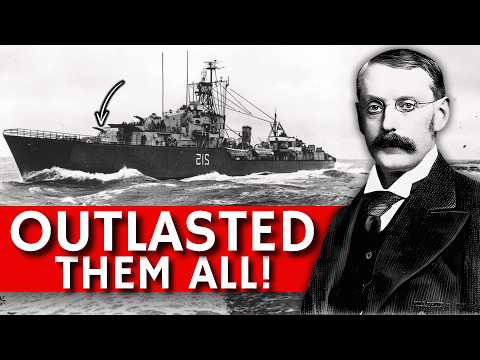
“The Tribal class wasn’t simply a new destroyer. It was a deliberate philosophical shift.” Every British destroyer before it had been optimized around torpedoes, with guns as an afterthought. The Tribals reversed that, mounting eight 4.7-inch guns in four twin turrets—a battery so heavy it was the only British destroyer class ever to carry such an arrangement. Critics inside the Navy called it a mistake, but they would be proven wrong in the brutal waters off Norway and the Mediterranean.
The engine at the heart of the Tribal class was a masterpiece. Two Parsons geared steam turbines, direct descendants of the technology Sir Charles Parsons had demonstrated at the Diamond Jubilee Naval Review in 1897, drove twin shafts producing 44,000 shaft horsepower. Three Admiralty three-drum boilers fed steam at 300 lb per square inch. The result: a ship 377 feet long, displacing nearly 2,000 tons, capable of 36.5 knots at full battle load—a speed achieved with ammunition and equipment aboard, unlike other nations’ light-displacement figures.
At 15 knots, the Tribals could range 5,700 nautical miles. As one naval historian wrote, they were “Magnificent in appearance, majestic in movement, and menacing in disposition.” This was the pedigree that would produce HMCS Haida, a ship destined to become one of the most feared vessels in the English Channel.
The keel of HMCS Haida was laid down at the Vickers-Armstrong yard at High Walker on the River Tyne on September 29, 1941—the same river where Charles Parsons had once launched his revolutionary Turbinia. The shipwrights there had already sent HMS Cossack down the same ways, the destroyer famous for boarding the German tanker Altmark to free 300 British prisoners. The Tyne knew how to build fighting ships.
Commissioned into the Royal Canadian Navy on August 30, 1943, at Newcastle upon Tyne, Haida carried a complement of 14 officers and 245 ratings. Her armament included three twin 4.7-inch gun mounts, one twin 4-inch mount, four 21-inch torpedo tubes, and a lethal array of anti-aircraft weapons: Oerlikon 20mm cannon and a quadruple two-pounder pom-pom. She was a complete weapon system, equipped with radar (types 268, 271, and 291) and sonar (type 144) that gave her eyes in the dark and the ability to hunt submarines as effectively as surface ships.
Her first commanding officer was Commander Harry George DeWolf, a veteran already tested in the chaos of Dunkirk and the rescue of 859 German and Italian prisoners from the torpedoed Arandora Star. Known for wrestling a live, malfunctioning torpedo on his own deck, DeWolf was not a man who panicked. He would need every ounce of that quality before the year was out.
Haida’s early service was far from the English Channel. She joined the British Home Fleet at Scapa Flow, escorting supply convoys on the brutal Murmansk run through Arctic waters that froze equipment and numbed crews, while German U-boats and Heinkel He 111 torpedo bombers hunted from above and below. The convoys were relentless, every mile within range of German aircraft from Norwegian airfields, and the Kriegsmarine’s surface units—Tirpitz, Scharnhorst, Lützow—lurked in the fjords like coiled springs.
On December 26, 1943, Haida was present at one of the most significant surface actions of the entire war: the Battle of the North Cape. The German battlecruiser Scharnhorst, a 51,000-ton behemoth with nine 11-inch guns, had sortied to attack convoy JW 55B. But the British, reading German naval signals through Enigma decrypts, had laid a trap. Admiral Sir Bruce Fraser’s flagship, HMS Duke of York, along with cruisers HMS Belfast, HMS Jamaica, and HMS Norfolk, and a screen of destroyers including Haida, closed in. The Scharnhorst, caught between a cruiser force to the north and Duke of York’s 14-inch guns to the south, was hammered into a burning wreck. Haida had earned her first battle honor, witnessing the end of a ship that had once terrified the entire Allied convoy system.
In January 1944, everything changed. Haida was reassigned to the 10th Destroyer Flotilla based at Plymouth, joining a striking force built for one purpose: to clear the Channel of German shipping in preparation for the Allied invasion of occupied France. The flotilla was a diverse force—British Tribals Ashanti, Eskimo, Nubian, and Tartar; Canadian Tribals Haida, Athabaskan, and Huron; and the Polish destroyer ORP Błyskawica, a veteran of the Norwegian campaign. Working with light cruisers HMS Black Prince and HMS Bellona, they formed Force 26.
Their mission had two code names: Operation Tunnel for mine-laying sweeps and Operation Hostile for direct anti-shipping strikes. By April, Haida had already participated in 19 such sorties. The Germans called these waters their private corridor. The 10th Flotilla was about to correct that assumption.
The night of April 25-26, 1944, was Haida’s first taste of direct surface action. The German 4th Torpedo Boat Flotilla was attempting a coastal transfer with three Elbing-class torpedo boats—T29, T24, and T27—each displacing over 1,400 tons and armed with a 105mm forward gun, equivalent to a mid-sized Allied destroyer. But they were not built to face Tribal-class ships operating in darkness with radar-directed gunfire.
Haida, in company with Black Prince, Ashanti, Athabaskan, and Huron, intercepted the formation. At 7,000 yards, Haida fired star shells, illuminating the enemy ships in cold white light. Then her 4.7-inch guns went to work. T29 was hit and hit again. She caught fire and sank. T24 was damaged and fled south. T27 retreated to Morlaix for repairs. DeWolf carved the first notch into Haida’s bridge rail. Splinters from return fire had already cut through his day cabin below, neatly severing the heads of his golf clubs. “Hard Over Harry,” his crew called him, for his habit of throwing the helm hard over at speed to dodge incoming fire. The nickname stuck.
Three nights later, the operation resumed. This time, the stakes were higher, and the cost was catastrophic. On the night of April 28-29, Haida and her sister ship Athabaskan, under Lieutenant Commander John Hamilton Stubbs, were on patrol as part of Operation Hostile, covering the area off Saint-Brieuc on the northern French coast. Two German Elbing-class torpedo boats, T24 and T27, were attempting a coastal transfer from Saint-Malo toward Brest. Coastal radar in southern England spotted them. At approximately 3:00 AM on the 29th, Haida and Athabaskan moved to intercept.
They closed the range from nearly 14,000 yards to 7,000 before opening fire. The German ships turned to run, then returned fire. Suddenly, Athabaskan erupted. A torpedo, almost certainly from T24, struck her near the stern. The explosion ignited her 4-inch ammunition magazine. A column of fire shot skyward, outlining the ship in terrible relief against the dark Channel waters. Captain Stubbs, standing on his burning bridge, calmly ordered damage control parties to their stations. Then a second torpedo struck. The already burning aft section became an inferno. Burning oil spread across the water. Stubbs gave the order to abandon ship. Athabaskan righted herself momentarily, her bow rising nearly vertically above the surface, then slid silently beneath the Channel. 128 men died that night. 44 were recovered by Haida. 83 were pulled from the water by German minesweepers and taken prisoner.
But in the moments after Athabaskan’s hit, DeWolf did not stop. He ordered Haida to lay smoke to cover the burning destroyer and then pressed the attack. He would not let the German ships escape while there was still a target to destroy. Haida pursued T27 southward through the darkness, firing continuously until the torpedo boat was alight from bow to stern. DeWolf drove her into the rocks of the French coast, a blazing wreck hard aground 5 miles south of the battle. T27 was later finished off by British motor torpedo boat 673. T24 escaped in the darkness.
Then DeWolf turned Haida around and went back. What followed was one of the most remarkable decisions of the naval war. DeWolf knew the dangers surrounding him with perfect clarity: the waters were laced with British-laid minefields, the shore batteries along the French coast were within range, and dawn was approaching, bringing German aircraft from bases just miles away. HMCS Haida carried no meaningful protection against dive bombers. A ship that had just lost one of her sister ships had every tactical and rational justification to leave immediately.
DeWolf stayed. “I was scared to death of mines,” he would say in an interview decades later. “Here we were drifting sideways and I thought any minute we can strike a mine and then we’ve lost two ships, not one.” He also understood the air threat. “What we were afraid of,” he said, “was air attack in daylight. We had no protection against dive bombers. And yet heavy scramble nets went over the side of Haida.”
The ship’s whaler was lowered into the oil-dark water. Haida’s sailors reached over the sides to pull exhausted, oil-soaked Athabaskan men from the Channel. From a raft in the water, the voice of Athabaskan’s captain, Stubbs, who had been so calm at the last, could be heard calling out, “Get away, Haida. Get clear.” DeWolf waited five more minutes after Stubbs told him to leave. He departed with 44 survivors on board and a piece of himself that he would never fully recover. Captain Stubbs drowned. DeWolf said later that that night haunted him for the rest of his life.
On the night of June 5-6, 1944, HMCS Haida was at sea in the English Channel. Overhead, almost continuously, the vast armada of transport aircraft and gliders moved eastward carrying the first wave of Allied paratroopers. Haida’s assigned role on D-Day itself was patrol duty north of the Channel Islands, screening the outer edge of the invasion corridor against any German surface attempt to reach the beaches. It was not the direct action her men had come to expect. That would come very shortly.
On June 8-9, 1944, three days after the Normandy landings, the German High Command made its inevitable response. The heavy ships lurking in Brest—the Narvik-class destroyers Z32 and Z24, the Dutch-built ZH1 (seized when Germany occupied the Netherlands), and the persistent T24—attempted to break through to the landing beaches to disrupt the Allied supply convoys pouring across the Channel. Force 26 intercepted them northwest of the Île de Batz. The engagement was fast, violent, and decisive. Haida and Huron combined to sink Z32 in the Battle of Ushant. ZH1 was destroyed. Z24 was damaged and fled. T24 escaped again, the same ship that had torpedoed Athabaskan, but the German attempt to reach the invasion corridor had been completely broken. The 10th Flotilla had held the door shut. DeWolf carved more notches into Haida’s bridge rail.
June 1944 brought a different kind of action, one that demonstrated Haida’s versatility. On the 24th, while on patrol off Land’s End, Haida and the British destroyer HMS Eskimo received word that aircraft of 311 Squadron RAF, flying a Consolidated B-24 Liberator, had made contact with a submarine and dropped depth charges. The two destroyers were directed to the datum point and began their own depth charge attacks. The submarine, German U-971, a Type VIIC boat on her first operational patrol, tried to survive the onslaught. After multiple depth charge patterns had shaken her hull, she surfaced and attempted to run on her diesel engines, perhaps hoping for darkness that was not coming. Haida and Eskimo opened fire with everything available. U-971 sank. Haida rescued six German survivors. The submarine that had been built to terrorize Allied convoys in the Atlantic had instead been destroyed by the same ship that had spent months hunting surface targets in the Channel.
In 20 years of service, Haida would lose only two men, both lost to a gun accident during an engagement in August 1944, not to any enemy vessel. The ship itself was never seriously damaged. On July 14-15, Haida and the Polish destroyer ORP Błyskawica intercepted a group of German vessels in the Île de Groix area near Lorient. The engagement was merciless. Two anti-submarine trawlers, UJ 1420 and UJ 1421, were destroyed. One merchant ship was sunk. Two others were left burning and sinking. DeWolf characteristically downplayed the action to his fellow commanders in the flotilla, crediting the results to good fortune and his Polish companion. His crew knew better.
Then on June 25, 1950, North Korean forces crossed the 38th parallel and the world went to war again. Haida was brought back from reserve, converted to a destroyer escort (DDE 215) to reflect her revised role in the age of the submarine threat, and refitted with modern armament. Her original 4.7-inch guns were replaced by twin 4-inch mounts. The after turret position received a pair of Squid anti-submarine mortars. New radar and sonar suites replaced the wartime fits. She was recommissioned on March 15, 1952, in a ceremony that carried historic significance of its own: HMCS Haida became the first Canadian warship commissioned by the new sovereign, Queen Elizabeth II.
She served two tours of duty in Korean waters between 1952 and 1954, operating under United Nations command alongside American, British, Australian, and other NATO Allied warships. Her duties ranged from carrier screening operations to coastal bombardment of North Korean supply lines. She took part in what naval crews on the Korean coast called “train busting,” a practice that had no precedent in the traditional naval repertoire. The Korean coastline, particularly in the northeast, was dotted with railway lines that ran between tunnels, emerging in brief exposed sections as they rounded headlands and promontories. Haida would approach the coast at speed, illuminate a target section with star shells or searchlights, and fire her guns at trains before they could disappear back into the tunnels. On one occasion, Haida surprised a train in the Sonjin area, illuminated it, and proceeded to destroy 10 railway cars. The locomotive uncoupled and escaped into a tunnel, denying her entry into the exclusive “train busters” club the Korean War destroyers formed among themselves. She tried again. The contribution to cutting North Korean logistics was real and measurable.
She was decommissioned from the Royal Canadian Navy on October 11, 1963. In 20 years of active service, she had steamed 688,534 nautical miles—the equivalent of 27 times around the circumference of the Earth. Thirteen of her Tribal-class sisters had been sunk during the Second World War. The remaining 13 Royal Navy Tribals had all been broken up after the war, their steel recycled into the peacetime economy. Of the 27 Tribal-class destroyers built for three Commonwealth navies between 1937 and 1945, only one survived the decade of postwar scrapping: HMCS Haida.
The fight to preserve her was nearly as dramatic as the battles she had fought. A private organization called Haida Incorporated bought the ship from the Navy and put her on display in Toronto Harbor. When financial difficulties struck in the 1960s, ownership transferred to the province of Ontario for a symbolic price of $1. She was moved to Ontario Place on Toronto’s waterfront in 1970, where she served as an attraction and a Royal Canadian Sea Cadet training ship for the next three decades. The guns on her deck were fired each time the Toronto Symphony Orchestra performed Tchaikovsky’s 1812 Overture at the nearby outdoor venue. By the late 1990s, years of insufficient maintenance had left her in serious disrepair. The province was reluctant to fund the repairs required.
In 2001, the federal Member of Parliament for Hamilton East, Sheila Copps, who had been Canada’s Minister of Canadian Heritage since 1997, saw the opportunity and negotiated a transfer of ownership to Parks Canada for the price of $1. A $5 million refit followed at the Port Weller dry docks in St. Catharines, the most extensive work done on the ship in decades. On August 30, 2003, the 60th anniversary of her commissioning into the Royal Canadian Navy, Haida arrived at Pier 9 in Hamilton Harbor to the sound of a gun salute and the cheers of 200 veterans gathered on the shore. An estimated 10,000 people lined the harbor beaches to watch. Jim DeWolf, the son of her first commanding officer, was there to receive the formal welcoming remarks.
In November 1984, the Historic Sites and Monuments Board of Canada had designated HMCS Haida a National Historic Site. The citation gave two reasons: her combat record and her status as the last surviving Tribal-class destroyer in the world. In February 2018, she was designated the ceremonial flagship of the Royal Canadian Navy. A Haida Tribal flag was raised above her hull, connecting the ship’s name to the indigenous people of the Pacific Northwest Coast for whom she was named. In July 2006, she had been formally twinned in a ceremony at Gdynia, Poland, with the destroyer ORP Błyskawica, her Polish companion from the 10th Destroyer Flotilla, the ship that had fought alongside her in the waters off Lorient. Former crew members of both ships attended the ceremony, men who had stood watch on their respective bridges 60 years before, facing the same enemy in the same waters.
There is a specific quality that separates a famous ship from an important one. Famous ships are remembered for a single moment. Important ships carry their significance across an entire career, a sustained body of work that resists reduction to a single image. HMCS Haida is among the most important warships Canada ever put to sea because she is not defined by any single battle, but by the accumulation of 14 engagements, two wars, 20 years of service, and one moment of moral clarity in the darkness of the French coast when her commander chose to stay rather than run, and three sailors chose to lower themselves into the Channel in a small motor cutter rather than let their shipmates drown.
Today, she sits at Pier 9 in Hamilton Harbor. If you walk forward past the gun turrets, past the torpedo mount, past the twin funnels, you reach the bridge. The steel is painted and preserved. The instruments are mostly restoration replicas, but if you know where to look, you can find the tradition of the notches DeWolf carved there. Each one representing a ship that had met HMCS Haida on a dark night in the English Channel and lost. Thirteen of her sisters are gone. The Parsons turbines that once drove 44,000 horsepower through her twin shafts are silent now. The boilers that burned 520 tons of fuel oil are cold. But the ship that carried them is still there, still floating, still refusing to be scrapped. Some ships earn their legends. Haida simply never stopped earning hers.
Today, Haida remains a floating testament to duty, sacrifice, and the quiet courage of those who served. Her decks echo with the footsteps of veterans who once stood watch, and her guns stand silent but proud.
As visitors walk her length, they touch the steel that survived two wars and countless dangers. They see the notches on the bridge rail—each one a story of a ship that met Haida and lost.
The men who served aboard her are fewer now, but their legacy endures. The ship they loved is preserved, not just as a museum, but as a reminder of what ordinary sailors can achieve when called upon.
HMCS Haida never stopped earning her legend. And as long as she floats, she will continue to inspire.
What does the story of HMCS Haida teach us about courage and sacrifice? Share your thoughts in the comments below.
Report this article
Select a reason for reporting:






