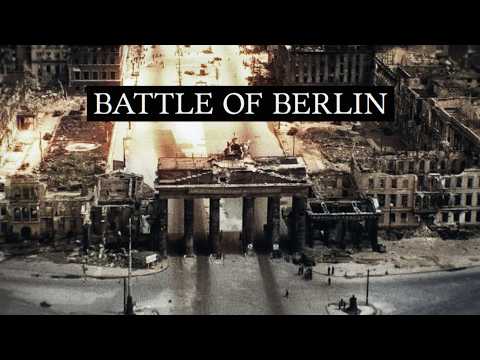
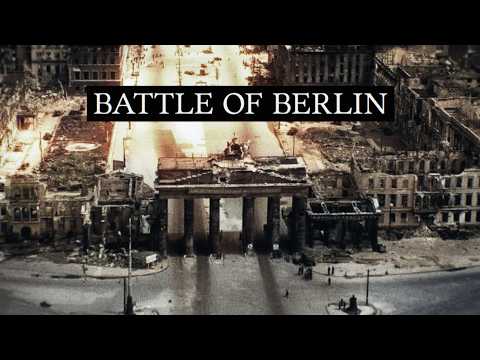
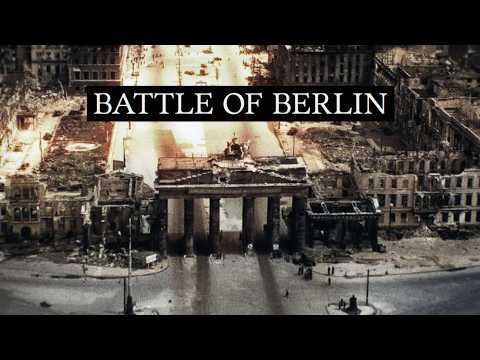
April 1945. The Red Army stands massed on the banks of the Oder River, just 60 kilometers from Berlin. After nearly six years of war, the Nazi capital and Hitler’s bunker are within reach. But the Nazi party and the Volkssturm are preparing to fight to the bitter end. This is the final struggle of World War II in Europe – the Battle for Berlin.
The Soviet plan is massive: three fronts converge on the city, with Marshal Zhukov’s 1st Belorussian Front striking at the heart of Berlin. Facing them, the German Army is a shadow of its former self – a million men, many poorly trained and ill-equipped. As the Red Army amasses a colossal force of 2.5 million men, 6,000 tanks, and 40,000 artillery pieces, both sides draw on different motivations to fight. Germans fear Soviet revenge, while Red Army troops seek retribution for German crimes. On April 16th, the battle begins with a thunderous artillery barrage.
At the Seelow Heights, the Germans have cleverly pulled back, waiting until the barrage stops before reoccupying their defenses. Soviet searchlights, meant to blind the enemy, instead silhouette their own troops. Zhukov, under immense political pressure, orders tanks to advance through the infantry, causing confusion and heavy losses. For three days, the Soviets batter their way up the heights against bitter German resistance. Finally, on April 19th, Zhukov’s units break through. Further south, Konev’s artillery plan is more effective, and the Red Army crosses the Neisse River relatively easily.
Stalin now allows Konev to turn north towards the city, sparking a debate about whether he planned for his two marshals to race each other for the honor of capturing Berlin. The Seelow Heights cost at least 33,000 Soviet lives and about 12,000 German. From April 20th, Hitler’s birthday, both main Soviet fronts race towards Berlin, their task now to encircle it. Soviet progress is slowed by thick forests, swamps, and logistical difficulties, but by April 21st, Soviet artillery begins to shell the city center. German command and control breaks down; Hitler has a near breakdown in his bunker, screaming that the war is lost.
On April 25th, the Red Army closes the ring around Berlin and meets up with American forces on the Elbe River. Both armies continue to commit war crimes on a mass scale. German officers summarily execute thousands of their own troops for alleged cowardice, while Soviet troops loot and rape. Stalin refers to rape as ‘a trifle,’ and historians estimate that between 100,000 and 130,000 women in Berlin were raped, some 10,000 of whom commit suicide. Inside the surrounded city, German defenses are disorganized, with makeshift barricades and a mix of Volkssturm, police, and foreign SS troops. The Red Army’s objective is the central Z Zone, including Hitler’s bunker and the Reichstag.
Urban warfare requires special tactics: small teams of infantry, combat engineers, flamethrowers, and self-propelled guns work together to blast and infiltrate their way forward block by block. The fighting is bloody and chaotic. German civilians caught in the crossfire experience hellish conditions, many fleeing to flak towers or shelters. In the Soviet-controlled areas, the Red Army distributes food and reconnects utilities. Zhukov’s forces eventually storm the Reichstag in a bloody three-day struggle, flying the red banner over the building in time for May 1st. In the final days, Hitler marries Eva Braun and they kill themselves. Admiral Dönitz becomes president, and Goebbels becomes Chancellor, but after failed negotiations with the Soviets, he and his wife kill themselves and their children.
Several groups of desperate Germans try to break out, but most are killed or captured. Finally, on May 2nd, General Weidling surrenders the ruined city. The Battle of Berlin is over. The Red Army suffers at least 880,000 killed, while German losses may have been as many as 100,000 military and between 20,000 and 100,000 civilian dead. With Hitler dead and the hammer and sickle flying above the German capital, surrender is a matter of time, and World War II in Europe ends on May 8th. For Soviets, it is the culmination of the Great Patriotic War; for German citizens, it’s the beginning of a tense occupation that will last 45 years.
But the story of Berlin’s fall does not end with the surrender on May 2nd. The city that greeted the Red Army was a landscape of ash and silence — and for the millions of civilians emerging from cellars and bunkers, a new and uncertain ordeal was only beginning.
For the survivors of the Halbe pocket, the nightmare had a different shape. Of the tens of thousands who tried to break out through the Soviet lines south of the city, only a fraction reached the relative safety of Wenck’s army. Most lay dead in the forests and on the narrow roads, cut down in the crush to escape. The wounded, left behind by comrades who could not carry them, were often given a hand grenade and a few final words.
Inside Berlin, the first Soviet order of business was not vengeance but administration. Military commandants took over districts, food kitchens were set up, and water and electricity were slowly restored. Yet the liberation, if it could be called that, was deeply ambiguous. For the estimated 100,000 to 130,000 women and girls who were raped in the city, the end of the war brought no relief — only a different kind of terror. Many of the victims were not even German, but forced laborers from Poland and Ukraine, and even Soviet citizens themselves.
For the Nazi leadership that survived, the reckoning was swift and uneven. Some, like Hitler’s armaments minister Albert Speer, would later claim ignorance and escape with their lives. Others, like Martin Bormann, vanished into the rubble — his fate unknown for decades. And a few, like Traudl Junge, Hitler’s young secretary, carried the memory of the bunker with them for the rest of their lives, eventually breaking decades of silence.
In the weeks that followed, the Allies moved to formalize the occupation. Berlin, like Germany itself, was divided into four sectors — Soviet, American, British, and French. The city that had been the heart of the Nazi empire now became the front line of a new struggle, one that would define the next half-century.
For the veterans of the Red Army, the victory was bittersweet. Many had marched from the ruins of Stalingrad to the ruins of Berlin, losing friends and family along the way. Sergeant Golitsyn, the tank crewman who survived the shell hit at Seelow, would later recall the moment he saw the Reichstag’s shattered dome: ‘We had come so far, and lost so much. And now it was over.’
Yet the war in Europe was not quite finished. In the days between Hitler’s death and the final surrender, fighting continued in Czechoslovakia, where the last German forces held out. And in the Pacific, the war against Japan raged on — a conflict that would only end with the atomic bombings of Hiroshima and Nagasaki in August.
The Battle of Berlin, though often overshadowed in Western accounts, remains one of the most consequential and costly engagements of the Second World War. It was the final act of a war that had begun with a criminal invasion and ended with a ruined capital, a dead dictator, and a continent in ashes.
And yet, out of those ashes, something else was already beginning to stir. In the rubble of Berlin, ordinary people — soldiers, civilians, survivors — were taking the first tentative steps toward an uncertain future. The war was over. The peace, with all its complications, was just beginning.
In the smoking ruins of the Chancellery garden, Soviet soldiers dug through the crater where Hitler’s body had been burned, uncertain of what they were even looking for. When a jawbone was eventually recovered and later matched to dental records, the confirmation traveled up the chain of command in near silence. Stalin, characteristically, chose to say little in public — and for years afterward, Soviet propaganda would insist the Führer had escaped, a calculated ambiguity designed to keep the West guessing.
The truth was messier than any myth. For the ordinary soldier who had fought from the Volga to the Spree, the death of one man mattered far less than the silence that followed the guns. Red Army interpreter Elena Rzhevskaya, who had been tasked with identifying the remains, later wrote of the strange emptiness of the moment: the enemy was dead, and yet the horror of what they had found in the city would not leave her.
For the German civilians who emerged blinking into the daylight, the first weeks of May were a blur of hunger, fear, and improvisation. Women became the backbone of the city’s survival, clearing rubble by hand in the so-called Trümmerfrauen brigades, trading whatever remained of value for bread, and shielding children from the worst of what was happening around them. The black market flourished in the Tiergarten, where cigarettes became currency and old loyalties dissolved overnight.
Freda Schulzer, who had fled into the woods near Rangsdorf rather than follow the retreating infantry, eventually made her way back toward the city. What she found was not a nation in mourning but a population in shock, unable to process the scale of the catastrophe. ‘We had been told we were the masters of Europe,’ she recalled decades later. ‘Now we were begging for soup from men who had every reason to hate us.’
Among the occupation forces, the mood was equally complicated. The Red Army’s political officers worked to impose order on their own troops, distributing food and restoring services while simultaneously wrestling with the epidemic of violence that had swept through the city. Some commanders were genuinely appalled by the rapes and looting; others dismissed it as the natural price of conquest. The contradiction would poison Soviet-German relations for generations.
Meanwhile, the Western Allies were arriving in their own sectors, and the first cracks in the wartime alliance were already visible. At Torgau on the Elbe, American and Soviet soldiers had embraced as brothers-in-arms — but within months, the same river would mark the fault line of a Cold War. Eisenhower’s decision not to push for Berlin, controversial at the time and ever since, would shape the map of Europe for the next forty-five years.
For the survivors of the camps — those liberated at Sachsenhausen and Ravensbrück, and the tens of thousands left behind on the death marches — liberation came too late for many and too strangely for the rest. CA Fuk, who had wept with the Soviet general who promised to help the survivors forget the horror of fascism, would spend years searching for family members who had simply vanished into the machinery of the Reich.
The war in Europe was over. But the reckoning — legal, moral, and personal — had only just begun.
In the decades that followed, Berlin would be rebuilt, divided, and reunited. The rubble of the Reichstag would be replaced by a new dome, and the bunker where Hitler died would become a parking lot — a deliberate erasure of the site’s dark gravity. Yet the scars of April 1945 never fully healed; they simply became part of the city’s foundation.
The Battle of Berlin remains one of history’s most colossal and costly struggles, often overshadowed in Western memory by D-Day and the Bulge. Its 880,000 Soviet dead and the untold suffering of German civilians stand as a reminder that victory and horror can share the same hour. For the men who fought from the Oder to the Spree, the war ended not with triumph alone, but with an exhaustion too deep for words.
What do you think — was the Battle of Berlin a necessary final blow, or a tragedy that could have been avoided? Share your thoughts in the comments below.
Report this article
Select a reason for reporting:






