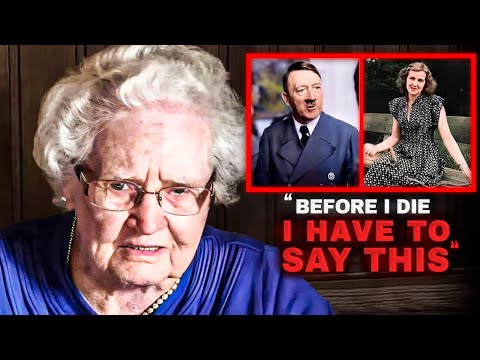
For nearly 80 years, Elizabeth Kalhammer kept a secret that could have haunted her to the grave. She was barely 22 when she answered a job ad in 1943, expecting nothing more than a modest domestic position. Instead, she found herself standing in the eerie silence of the Berghof, Adolf Hitler’s Alpine fortress, surrounded by stolen art and whispered orders. “Before I die, I must speak,” she declared as an elderly woman, and what she revealed would send shivers down the spine of the world.
Her voice, preserved in rare interviews, offers a chilling glimpse into the heart of darkness. From secret midnight meetings to the silent disappearances of staff, Kalhammer’s testimony paints a portrait of a regime built on fear and absolute control. She was warned from the very first day: “Don’t speak about what you see or you will disappear like so many others.” Yet, she couldn’t look Hitler in the eye, claiming that his presence could be felt even without entering the room. While Europe burned, she made tea and swept the halls, just feet away from the men who orchestrated invasions and exterminations.
When Elizabeth Kalhammer was hired as a domestic servant at the Berghof, she had no idea that her workplace would be the Führer’s private residence. Born in 1923 in Salzburg, Austria, she belonged to a modest family and was raised under the constant influence of the Nazi regime, though without fervent affiliation. She had completed a commercial training course and was looking for work when, in 1943, she was informed that female staff was required at an important residence in the Bavarian Alps. She was not initially told that the workplace would be Hitler’s private home. Discretion was absolute, and candidates were not allowed to ask too many questions. It was her mother who signed the consent form for her to accept the position, and only after she was admitted was she officially informed that she would be working for Adolf Hitler.
Her arrival at the Berghof was, in her words, shocking. “We didn’t really know what to expect,” she would recount decades later. “The structure dominated the mountainside, offering spectacular views of the Alps and operated as a closed universe with a strict organization.” Kalhammer joined a group of around 20 young women, all employed in administrative tasks, cleaning, or cooking. Her role was primarily that of an office assistant, typist, and logistical support for the daily management of the residence. She didn’t have constant access to Hitler, but she saw him almost daily, as he would often wander the halls, give instructions, or appear at meals.
One of her first impressions was the contrast between Hitler’s public image as a powerful leader and the almost domestic nature he displayed at the Berghof. In her words, “He was surprisingly kind in his everyday dealings. He never shouted or raised his voice. He behaved toward us with a courtesy that no one expected.” Throughout her stay, she observed Hitler’s meticulous habits. He always dressed soberly inside the residence, wearing comfortable but neat clothes. He ate light meals, usually vegetarian dishes, and often held long evening conversations with his closest collaborators. Among them were Martin Bormann, Eva Braun, and occasionally Albert Speer. Kalhammer never witnessed political decisions or war discussions, but she noticed the growing tension as the war progressed.
In 1943, there was still a certain calm at the Berghof. But in 1944, the atmosphere changed. “It became more serious, more closed off,” she recalled. One of the most striking aspects of her accounts is her description of Eva Braun. Kalhammer was one of the few employees who had direct visual contact with her, although not a close personal relationship. She described her as a reserved woman, very concerned about her appearance, who rarely interacted with the lower staff. In a 2014 interview, Kalhammer stated, “Eva Braun had no authority over anyone. She didn’t even seem very interested in exercising any power role. She was like a figurehead, but Hitler treated her with great affection.” According to Kalhammer, the female presence at the Berghof was greater than many believe. The women worked in the kitchen, laundry, and administrative offices, and many of them were very young, mostly Austrian and South German. None were party members, and all knew they were to maintain complete confidentiality. The training included a key warning: never ask questions, never express political opinions, and never initiate conversation with Hitler unless he did so first.
Although Elizabeth Kalhammer was not part of the Führer’s inner circle, she recalls having several brief encounters with him. Some were banal exchanges. Other times she directly received a work order or a directive. One of the moments that most affected her was an occasion when Hitler entered the office and personally thanked her for her work. “He walked in, stood in front of me, and said, ‘Good work. I’ve heard you’re very efficient.’ I felt completely paralyzed. It was impossible not to feel the weight of who he was.” She also recalls his presence on several nights when films were being shown. Hitler had a private cinema at the Berghof and enjoyed watching films, many of them German or captured Swedish and American productions, accompanied by Eva Braun and his aides. The technical staff and some secretaries were allowed to attend. Elizabeth attended on several occasions, but recalls the atmosphere as more solemn than festive. “It wasn’t fun. It was like attending a ritual. No one laughed. No one spoke. You could tell everyone wanted to please him.”
As the Eastern Front crumbled and Allied bombing intensified, the Berghof ceased to be a peaceful refuge. In 1944, Kalhammer noticed an increase in visits from high-ranking military officials and the atmosphere became increasingly tense. Although the employees were not informed of news from the front, rumors circulated. The postal service slowed and restrictions became stricter. In the spring of 1945, the Berghof was evacuated. Kalhammer was sent back to Salzburg just before Allied forces began bombing the area. Shortly after, the Berghof was partially destroyed by British air raids and subsequently demolished by American forces to prevent it from becoming a neo-Nazi sanctuary.
After the war, Elizabeth Kalhammer remained silent for decades about her experience at the Berghof, not because she feared reprisals, but because she didn’t feel her role had been historically significant. Furthermore, the stigma of having served in Hitler’s private residence was difficult to overcome in postwar Austria. She worked as a teacher and later as a travel agent. It was only in her old age, already retired, that she began to recount her memoirs and participated in several television interviews, mainly in Germany and Austria between 2005 and 2018. In one of them for the German channel ZDF, she explained, “For a long time I wondered whether I should say something. But then I thought, if people like me don’t tell what it was really like, others will make up stories.” Her testimony stands out for its measured tone. Kalhammer doesn’t seek to justify or accuse. She simply describes what she saw and experienced without drama or omissions. “I didn’t see crimes. I didn’t see violence. But I did see how a regime could wrap everything in an aura of order, cleanliness, and efficiency. And behind that facade, the horror of the outside world was hidden.”
Elizabeth Kalhammer lived to 96. She died in 2023, leaving behind an unusual legacy of oral memory, that of someone who worked very closely with Hitler without being an accomplice or direct victim, and who knew how to maintain the emotional distance necessary to recount her experience clearly. In her recent interviews, she reiterated that she didn’t regret telling her story. “It was only one year of my life, but it’s lived with me for all the rest.”
Yet Kalhammer’s account was only the first crack in a long-sealed vault. As historians and journalists began to circle the dwindling number of survivors, another name surfaced—a woman who had been even closer to the epicenter of power, and whose story would prove far more difficult to reconcile. Trudel Junge, born Gertraud Humps in Munich in 1920, had wanted to be a dancer. Rejected by the academy, she enrolled in a typing course and, like so many young women of her generation, enlisted in the Hitler Youth. At 22, she was offered a job at the seat of government, never imagining that the Führer himself would conduct her interview.
He asked her age and a few personal questions, then made a face of disgust when he learned she wasn’t married. “I don’t usually hire single young women. Then they get married and leave.” Without missing a beat, she responded submissively, “My Führer, I’ve already lived 22 years without a man. That’s not a problem for me.” He reassured her that everyone makes mistakes and that she would be no exception. He asked her to put a sheet of paper in the typewriter and began to dictate. Trudel was so nervous that she typed almost every word containing an error. An aide interrupted—Hitler had come for an urgent consultation. That fortuitous incident may have saved her job and doomed her for the rest of her life. The young woman had time to correct each mistake, and when Hitler re-entered the room, the sheet was pristine. She was hired that same afternoon.
Hitler immediately resolved the issue of the youngest secretary’s spinsterhood. He introduced her to an officer, Hans Junge, and urged them to marry. They both obeyed. A few months later, Hans was sent to the front and died in combat in Normandy. After the defeat at Stalingrad, Hitler stopped sharing meals with officers and ministers. He didn’t want to hear the truth. So he ate his four meals a day with each of his secretaries. They talked about movies, passed on gossip, and flattered him. Trudel emphasized that Hitler had two personalities, and that she and the rest of his female circle only ever saw his kind and charming side.
This circle included his three other secretaries, Eva Braun, the wife of his personal physician Annie Brandt, Maria von Below, and Margarete Speer. In her memoirs, Trudel recalls, “I have to admit it, I was fascinated by Hitler. He was a kind boss and even a father figure. I deliberately ignored all the warning signs and voices that arose within me, and I enjoyed being with him almost until the very end.” She maintained that her boss had a unique hypnotic power of attraction. It would be insufficient to define it as charisma, but something more—and it wasn’t just her youth that had made her fall under that influence. The generals and ministers felt the same way and couldn’t contradict him.
In her memoirs, Trudel recalls a particularly happy day: July 20th, 1944. That day, an attempt had been made on Hitler’s life. The secretaries heard the news and went to meet him with fear. His appearance was almost pathetic—hair standing on end, eyes wild, face dirty, trousers in tatters. But there was no worry on his face. He was exultant. He believed that having survived was a sign that everything would be fine, that he was indestructible. “Fate has protected me. It’s a sign that I must see my mission through to the end,” he said. A visit from Mussolini was scheduled that afternoon. Not only did he not cancel it, but euphoric, he took the Duce to the scene of the attack to show him how he had survived.
In January 1945, Trudel entered the bunker with the Führer. She wouldn’t leave until the end of the war. The atmosphere was unreal—the stale air, the illusion of a normal everyday life, the confinement, the disconnection from reality. In the last days, everything happened with the thunderous sound of bombs falling on Berlin in the background. On April 22nd, after a meeting with generals, Hitler seemed to accept reality for the first time. He gathered the women and told them they were defeated. He urged them to escape, saying that he was going to shoot himself. Eva Braun approached him and kissed him on the mouth. It was the first time that had happened in public. “I’m staying,” she said. Trudel repeated the same thing almost without thinking, without pain, without despair, without knowing why she had said it. Perhaps because she couldn’t imagine where else she could go, couldn’t imagine life without war, without Hitler. “I wish my generals had your courage,” said the Führer.
The next day, Hitler distributed cyanide pills to those who remained underground. After his marriage to Eva Braun, everything happened like a nightmare. There was a celebration, a sad toast. Magda Goebbels paced like a ghost, rejecting every offer to take her children to safety. “I’d rather they die here than survive in the indignity of a defeated Germany,” she would say. She would then poison all six of them before committing suicide herself. During those hours, men who had never dared to look up in front of Hitler commented loudly on what he said and smoked in his presence as if he were no longer there. Some even dared to joke: “When the Führer passes, we must hold our heads high as long as we have them.” We were no longer capable of normal feelings. All we thought about was death—when Hitler and Eva would die, when the six children would be murdered, and naturally when and how we would die.
Hitler called Trudel into his office. He asked her how she felt, if she needed anything. “I’m going to dictate something to you. Are you ready to take notes?” Before she could answer, he began to dictate. Solemnly and without further explanation, he gave the title of the document: My Testament. The secretary took a few seconds before she began to hit the keys. She stared at him. Then she fell into step with the Führer’s words. He was less frantic than usual. There was only defeat in his dull voice. But not even in his final moments did he regain his senses. “At that moment I believed I would be the first person on earth who would understand why all this was necessary, that I would say something that would explain it, justify it, teach us something. But my God, when he began to dictate the list of ministers he was designating to succeed his government in such a grotesque manner, I thought the whole situation was very undignified.” He repeated the same phrases again in his usual calm tone, and to finish, he once again used those terrible words to refer to the Jews. After all that despair, all the suffering, he didn’t have a single word of compassion or pain.
After Hitler’s suicide, Trudel left the bunker with other survivors. For the first time, she saw destroyed Berlin—the columns of smoke, the rubble, the stench of death. “We traveled with the blinds down on special trains across Germany,” she recalled. She walked like a zombie, past old people crying, children climbing over ruins, and corpses on every corner. She had nothing except a cyanide pill in her pocket.
Another secretary was caught by the Soviets and raped for days. Trudel escaped to the western sector but was captured by the Red Army. She never spoke of those days. Later, in British hands, she was interrogated exhaustively and became a key source for historian Hugh Trevor-Roper in confirming Hitler’s suicide. In 1947, she was denazified.
She avoided mentioning her wartime activities, working as a secretary and later at a publishing house. Twice she tried to move to Australia, but authorities rejected her due to her Nazi past. Her life became a constant struggle to hide, to avoid accusations, to understand her own actions. “I contented myself with the thought that I personally wasn’t to blame, and that I knew nothing about the full extent of it all,” she said. “But one day, I passed by Sophie Scholl’s memorial plaque and saw that she was born the same year as me and that she had been executed the same year I went with Hitler. At that moment, I felt that being young was no excuse.”
In 2002, she published her memoirs, Until the Last Moment. The nakedness of her account gave greater force to her words. She died of cancer at 81 on February 10, 2002—shortly after publication and the day after the documentary’s premiere at the Berlin Film Festival. She had announced, “Now that I’ve told my story, I can die.”
Her testimony, like Kalhammer’s, remains a chilling reminder of how ordinary people were drawn into the orbit of absolute evil. How do we reconcile the banality of daily life with the horror that surrounded it—and what does it teach us about our own capacity for silence?
Report this article
Select a reason for reporting:






