Imagine a world where every purchase you make carries no extra tax—no sales tax added at the register, no line item on your receipt. For the first 150 years of American history, that was reality. Sales tax didn’t exist at any level of government until 1930, when Mississippi broke the mold. Yet somehow, a fledgling nation grew into a continental powerhouse, funding roads, wars, schools, and courthouses without a single penny from retail transactions. How was this possible?
The answer is a wild ride through financial improvisation, political backroom deals, and a cast of characters who shaped a fiscal system as ruthless as it was creative. From Alexander Hamilton’s tariff schemes to state-run lotteries and canal-building gambles, the story of early American public finance is one of power, pragmatism, and unintended consequences. Buckle up—this is the untold story of how America paid its bills before the sales tax.
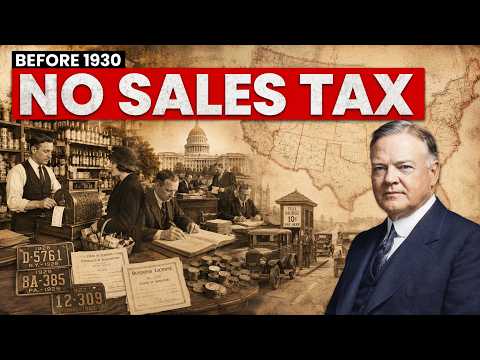
In 1789, the newly ratified Constitution left the federal government broke and desperate. The Revolutionary War had saddled the nation with a staggering $79 million debt—over $2 billion in today’s money—owed to foreign governments, domestic creditors, and soldiers who had bled for independence. Under the Articles of Confederation, the federal government couldn’t levy taxes directly; it had to beg the states for money, and they often refused. Enter Alexander Hamilton, the first Secretary of the Treasury, a brilliant and pragmatic visionary who understood that a nation without revenue was a nation without sovereignty.
Hamilton’s first move was to push Congress to pass the Tariff Act of 1789, taxing imported goods. “Tariffs were the backbone of the early federal budget,” and for good reason: they were easy to collect at ports and protected America’s infant industries from foreign competition. Throughout the 19th century, customs duties accounted for 50 to 90% of federal revenue. In 1900, tariffs generated nearly half of the $520 million federal budget. But Hamilton didn’t stop there. He proposed an excise tax on distilled spirits—a move that sparked the Whiskey Rebellion in 1794, when frontier farmers tarred and feathered tax collectors. President Washington assembled 13,000 troops to crush the revolt, sending a clear message: the federal government would tax what it pleased and use force to collect.
While the federal government relied on tariffs and excise taxes, the states played a different game—one that was even more creative and chaotic. The heavyweight champion of state and local finance was the property tax. By the 1790s, every state had some form of property tax, and by 1902, it provided 45% of state general revenue. At the local level, property taxes were even more dominant—by 1932, they accounted for a staggering 85.2% of local government revenue. But the property tax had fatal flaws: assessments were wildly inconsistent, corruption was rampant, and the tax was deeply regressive, falling hardest on small farmers while wealthy merchants hid their assets in stocks and bonds.
In the early 1800s, many states actually reduced or eliminated property taxes entirely. Why? Because they found other ways to make money—by going into business for themselves. The most dramatic example was the Erie Canal. In 1817, New York State funded the 363-mile canal not with taxes but with state-issued bonds. It was a massive gamble—costing roughly $200 million in today’s money—but it paid off spectacularly. Toll revenues covered debt service in the first year, and by 1834, the canal had erased its construction debt completely. New York City became the nation’s largest port, and grain shipments soared more than 30-fold.
Naturally, every other state wanted a piece of that action. Pennsylvania, Maryland, Ohio, and others borrowed heavily from European investors to fund their own canals and railroads. By 1838, state debt was 30 times the national debt. But most projects never generated the promised toll revenue. When the Panic of 1839 hit, eight states and the territory of Florida defaulted. “The canal disaster damaged American creditworthiness for a generation,” and many states rewrote their constitutions to limit government borrowing. The era of states as entrepreneurs was largely over.
Beyond property taxes and bond-funded infrastructure, states had a portfolio of revenue tools that most people today have forgotten. One of the oldest was the poll tax—a fixed sum levied on every eligible adult, regardless of income. By 1923, 38 states permitted or required poll taxes, typically $1 to $5 per person, earmarked for schools or roads. But poll taxes carried a dark underbelly: after the Civil War, Southern states weaponized them to disenfranchise Black voters, a practice not fully abolished until the 24th Amendment in 1964.
Then there were license fees and business taxes. Pennsylvania had a mercantile license tax as early as 1821—sometimes cited as a precursor to the sales tax—charging merchants flat fees for the right to operate. The revenue was modest but gave states a foothold in regulating commerce. And then there was the state lottery, one of the most fascinating and morally ambiguous revenue sources. Between 1790 and 1860, 24 of 33 states used lotteries to fund jails, courthouses, hospitals, schools, and even churches. Lotteries funded Harvard, Yale, and Princeton, and rebuilt Faneuil Hall after it burned in 1761. By 1831, Philadelphia alone had over 100 lottery ticket shops. But corruption eroded public trust—crooked agents absconded with proceeds, and fraudulent drawings became common. By the late 1800s, most states banned lotteries entirely.
Public land sales were another major revenue stream. The Land Ordinance of 1785 was designed to raise money by selling territories northwest of the Ohio River. Land sales were not just about revenue—they were instruments of policy, encouraging westward migration while filling the Treasury. In some periods, land sales were the second-largest source of federal revenue after tariffs.
So, by the early 20th century, the American fiscal landscape was a patchwork: federal tariffs, state property taxes, poll taxes, license fees, lotteries, and land sales. It was messy, uneven, and held together by improvisation. And it might have continued indefinitely if not for two seismic events: the 16th Amendment in 1913, which gave Congress the power to levy a federal income tax, and the Great Depression, which shattered the property tax base and forced states to find a new revenue source. That’s when the sales tax entered the picture—but that’s a story for another chapter.
When the stock market crashed in October 1929, the fiscal foundations of state and local government cracked almost immediately. Property values plummeted, and by 1933, property tax delinquency nationwide had reached a staggering 26.3%—a record that still stands. More than a quarter of all property owners simply stopped paying because they couldn’t. Income taxes, where they existed, dried up as unemployment soared. State governments were trapped: revenue was collapsing at the exact moment demand for relief, public order, and basic services was exploding.
The human cost was brutal. Farmers lost their land, families lost their homes, and voters were furious. What followed became known as the Great Depression tax revolts. Property owners organized strikes, refused to pay, and in some cities physically intimidated assessors and collectors. Under enormous pressure, states slashed property tax rates, adopted homestead exemptions, and reduced assessments. State property tax revenue as a share of total revenue dropped from 27% in 1929 to 19% in 1932—then cratered to just 7% by 1937. The ancient cornerstone of American public finance was crumbling.
Desperate for revenue and politically unable to raise property taxes further, state after state turned to a new idea: a broad-based tax on retail transactions. Mississippi led the way, converting its gross receipts tax into something resembling a modern retail sales tax in 1930, with formal legislation codified in 1932. West Virginia, which had imposed a limited sales tax on coal and oil as early as 1921, enacted a free-standing retail sales tax in 1933. Then the floodgates opened. Twenty-three states adopted general sales taxes during the 1930s alone. Kentucky introduced a 3% sales tax in 1934, and 24 more states quickly followed suit.
But here’s the part often left out of the textbooks. The sales tax wasn’t a neutral technocratic fix—it was a political choice with clear winners and losers. Economists call it a regressive tax: it takes a larger percentage of income from people who earn less. A billionaire and a minimum wage worker pay the same percentage on a gallon of milk, but for the worker, that tax represents a far bigger share of total earnings. The sales tax was adopted precisely because it was politically easier than alternatives like higher income taxes on the wealthy or more progressive property assessments. It spread the burden across the entire population, so no single powerful interest group bore the brunt. Wealthy landowners got relief. Industrialists and financial elites were largely spared. The cost shifted to consumers—ordinary people making everyday purchases.
And the timing was remarkable. After Prohibition officially ended in December 1933, 29 states restructured their alcohol taxes as sales excise taxes rather than continuing to rely on licensing fees. The end of Prohibition didn’t just bring back legal drinking—it created an entirely new revenue stream that states eagerly tapped. The sales tax wasn’t a single innovation but part of a wholesale transformation of American public finance in the space of a single decade, driven by the worst economic catastrophe the country had ever experienced.
By the time the dust settled, the American tax landscape had been completely remade. The old system—states relying overwhelmingly on property taxes, the federal government on tariffs—was gone. In its place was the modern structure we recognize today: a layered system of federal income taxes, state income taxes, state and local sales taxes, and local property taxes, each occupying its own niche in the fiscal ecosystem. Sales taxes today account for roughly 45% of all state tax revenue nationwide and about a third of state government revenues overall. Only five states—Alaska, Delaware, Montana, New Hampshire, and Oregon—still don’t have a statewide sales tax, and even within some of those, local jurisdictions have imposed their own.
The story of how America got from 1789 to 1930 without a sales tax isn’t just a history lesson. It reveals something fundamental about the relationship between governments and the people they govern. Every tax is a political decision. Every revenue system reflects the priorities, prejudices, and power dynamics of the society that created it. The founding generation chose tariffs because they were easy to collect and served northern manufacturers who wanted protection from foreign competition. States chose property taxes because land was the most visible and hardest-to-hide form of wealth in an agricultural society. And when the Depression destroyed the property tax base, states chose the sales tax because it was administratively simple, politically feasible, and didn’t threaten the interests of the people who held the most power.
What’s remarkable, stepping back to look at the full sweep of this history, is how recent all of it really is. The federal income tax is barely over a century old. The state sales tax is younger than that. For most of American history, government was funded by a patchwork of tariffs, property taxes, lotteries, license fees, poll taxes, and bond sales—a system held together by improvisation, political compromise, and occasionally brute force. And it worked, more or less, until it didn’t. Until the world changed, the economy transformed, and the old tools were no longer equal to the new demands. The sales tax wasn’t inevitable. It was the product of a specific crisis at a specific moment, adopted by desperate politicians with no better options. And now, nearly a century later, it’s so deeply embedded in the fabric of American life that most people can’t imagine a world without it.
But nothing in the world of taxation is ever truly settled. The debates Hamilton and Jefferson had about tariffs versus excise taxes, the fights over property assessments in the 1830s, the tax revolts of the Great Depression—these are not ancient history. They are the same debates we’re having right now, just wearing different clothes. Who pays, how much, and who decides? Those questions are as old as civilization itself, and they’ll be with us long after every tax code currently in effect has been rewritten, reformed, or thrown out entirely. The history of American taxation isn’t just about numbers and revenue streams. It’s about the fundamental bargain between the citizen and the state—and that bargain, as we’ve seen, is always being renegotiated.
That bargain looks different in every generation, but the underlying question never changes: who bears the cost of building a society, and who gets to decide? The sales tax was never inevitable—it was a desperate answer to a broken system, and the choices made in the 1930s still shape every receipt you touch today.
So the next time you glance at that extra line at the register, remember: it’s not just a number. It’s a century-old compromise, a political artifact, and a reminder that the rules of who pays are always up for renegotiation.
Which pre-sales-tax revenue source surprised you the most—the state lotteries, the poll taxes, or the canal gambles? Drop your answer in the comments below.
Report this article
Select a reason for reporting: