In June 1941, Adolf Hitler stood before his ally Benito Mussolini and unleashed a venomous tirade: “Switzerland has the most disgusting and miserable people and political system. The Swiss are the moral enemies of the new Germany.” Yet, despite this burning hatred, the Nazi war machine never crossed the Swiss border. Why?
By 1940, Hitler’s armies had crushed France, Poland, Norway, Denmark, Belgium, and the Netherlands. Italy, Hungary, Romania, and Spain were allies or puppet states. Switzerland—a tiny nation literally surrounded by Axis territory—remained free. Hitler had promised to respect Swiss neutrality, but on June 25, 1940, the same day France fell, Germany began planning Operation Tannenbaum, a massive invasion involving up to half a million soldiers. So why was it never launched?
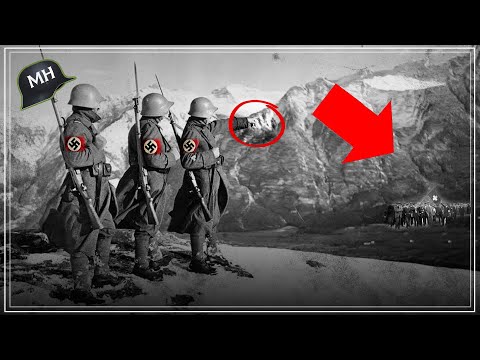
The answer lies in a mix of military might, economic convenience, and sheer pragmatism. Switzerland was no easy prey. During the 1930s, the Swiss beefed up their military budget, developing superior weapons like the K-31 rifle and the MS.406 fighter. Most Swiss men had military training, and General Henri Guisan, the armed forces commander, raised the conscription age to 60. His strategy was chillingly simple: abandon the cities and flatlands, retreat to the Alps, and turn the mountains into a fortress. There, Swiss soldiers could wage guerrilla warfare, using the terrain to neutralize German tanks and air power.
Even if the Nazis conquered the lowlands, the Alps would become a death trap. “The Swiss are a porcupine,” went a Wehrmacht song. “They will have for dessert, then we’ll go for the whole wide world.” But that porcupine had quills—and Hitler knew it. As the war dragged on, his priorities shifted to Britain and the Soviet Union. Invading Switzerland would have required diverting precious resources for a prize of questionable strategic value.
Yet some historians argue that military deterrence wasn’t the real reason. “Hitler was crazy, but not crazy enough to attack his own banker,” said Swiss sociologist Jean Ziegler. During the war, the Third Reich stashed vast amounts of gold and money in Swiss banks. Attacking Switzerland would have been economically suicidal. Moreover, Swiss companies supplied the Axis with ten times more weapons and military technology than the Allies. Neutrality, it turned out, was highly profitable—for both sides.
So the plans for Operation Tannenbaum gathered dust, finally fizzling out in 1943 after Mussolini’s fall. Switzerland survived, but its role in the war remains controversial. Would Hitler have invaded eventually if he had won? The Swiss knew the answer: “Switzerland is a porcupine that will have for dessert,” the song continued. “Then we’ll go for the whole wide world.” The porcupine was lucky—this time.
But the story of Swiss neutrality is not merely one of mountains and machine guns. It is also a story of uncomfortable compromises, of gold that changed hands in the quiet of Zurich vaults while Europe burned. To understand why Hitler never gave the order, we must look beyond the Alps and into the ledgers of Swiss banks.
As early as 1939, the Reichsbank began funneling massive reserves into Swiss accounts. Some of this gold was stolen—melted down from the teeth and wedding rings of concentration camp victims, re-stamped and deposited without a whisper of protest. Switzerland became the Third Reich’s financial laundry, a neutral vault where Nazi elites could stash their fortunes in case the war turned sour. And it did.
For Hitler, attacking Switzerland would have been like burning down his own safe house. The Swiss franc was convertible, the banks discreet, and the borders—though guarded—remained open to German capital. Why invade a country that is already doing your banking? The economic argument was so strong that even Heinrich Himmler, who had once drawn up lists of potential Nazi governors for Swiss cantons, quietly shelved his ambitions.
There was another, more human factor at play: fear. Not fear of Swiss soldiers, but fear of what an invasion would do to the myth of German invincibility. The Wehrmacht had rolled through Poland in weeks and France in days. But the Alps were different. General Guisan had turned the Gotthard, the Simplon, and the Saint Bernard passes into fortified bunkers—each tunnel rigged with explosives, each bridge wired for demolition. If the Germans came, the Swiss would blow their own infrastructure sky-high, turning every valley into a killing field.
Hitler’s generals knew this. In their war games, the invasion of Switzerland always ended the same way: initial success in the lowlands, followed by a bloody, endless guerrilla war in the mountains. The Swiss had stockpiled ammunition, food, and fuel in hidden alpine depots. Every farmer was a reservist. Every chalet could become a sniper’s nest. “The Swiss will fight like wildcats,” one German intelligence report concluded. “And we will bleed for every meter of rock.”
By 1943, the tide of war had turned. Stalingrad had shattered the myth of German invincibility, and Mussolini’s Italy was crumbling. Operation Tannenbaum was quietly abandoned, its maps folded and filed away. Switzerland survived—not because Hitler respected its neutrality, but because the cost of violating it was simply too high.
Yet the Swiss did not simply wait for the storm to pass. In the summer of 1940, as German troops massed along the border, General Guisan summoned his senior officers to the Rütli meadow—the legendary birthplace of the Swiss Confederation. Standing on the same ground where their ancestors had sworn their oath of freedom, the officers pledged to fight to the last man. The Rütli Report, as it became known, sent a clear message to Berlin: Switzerland would not surrender.
But the Swiss also knew that defiance alone would not save them. Quietly, they played both sides. While Swiss factories churned out precision instruments and ammunition for the Wehrmacht, Swiss diplomats in Bern served as intermediaries between the Axis and the Allies. Red Cross trains carrying wounded prisoners crossed Swiss territory, and intelligence agents from both camps found refuge in Geneva’s discreet hotels. Neutrality, it turned out, was not a passive state—it was a delicate balancing act, performed under the constant threat of annihilation.
One of the most controversial figures in this high-wire act was Hans Frölicher, the Swiss ambassador to Berlin. A staunch admirer of Hitler, Frölicher pushed Bern to align more closely with the Reich, arguing that resistance was futile. “We must adapt to the new order in Europe,” he wrote in a 1941 memo. But other voices prevailed—men like Minister Marcel Pilet-Golaz, who walked a fine line between appeasement and survival, and the military hardliners who refused to bend.
Meanwhile, the Swiss public watched the war with growing unease. Refugee policy became a moral battleground. Thousands of Jews fleeing Nazi persecution were turned away at the border—a dark chapter that would haunt Switzerland for decades. The official justification was cold: the country was too small to absorb a flood of refugees. But the real fear was that accepting too many would provoke Berlin. In the end, some 25,000 Jewish refugees were admitted, while an estimated 20,000 were refused entry—many of whom would later perish in the camps.
As the war entered its final phase, Swiss neutrality became even more precarious. Allied bombers occasionally strayed into Swiss airspace, and Swiss fighters—flying their nimble MS.406s—shot down several American aircraft, killing crewmen. The U.S. demanded compensation, and Bern paid millions in reparations. At the same time, Swiss banks continued to hold Nazi gold, and the Allies began to take notice. The post-war reckoning was coming.
But in the mountains, the porcupine’s quills remained sharp. Guisan’s alpine fortress—the Réduit national—was never tested. The bunkers, the hidden artillery, the demolition charges: all remained unused. Switzerland had survived the war not by winning battles, but by making invasion unthinkable. Whether that was a triumph of deterrence or a Faustian bargain with the devil, historians still argue. What is certain is that the story of Swiss neutrality is far more complicated than a simple tale of brave mountaineers defying a tyrant.
When the war ended in 1945, Switzerland stood intact—but not unscathed. The Allied victors had not forgotten the gold, the weapons deals, or the refugees turned away at the border. In Washington and London, Switzerland was no longer seen as a brave little democracy but as the Third Reich’s willing accountant. The reckoning was swift and uncomfortable.
In 1946, the Allies forced Bern to sign the Washington Agreement: Switzerland would pay 250 million francs in compensation for gold it had knowingly accepted from Nazi coffers. Swiss banks, which had once welcomed German deposits with open vaults, now scrambled to explain where the gold had come from. Some of it, investigators discovered, had been looted from the central banks of occupied Europe—Belgium, the Netherlands, Czechoslovakia. Some of it came from the victims themselves.
The moral accounting took longer. For decades, Swiss officials insisted they had done what any small nation must to survive. But in 1996, a young historian named Thomas Maissen published documents that shattered that comfortable narrative. The files showed not just passive neutrality but active collaboration: Swiss firms had built parts for German tanks, Swiss insurers had covered Nazi factories, and Swiss border guards had turned back Jews with the cold efficiency of bureaucrats following orders.
Then came the lawsuits. Holocaust survivors in New York filed a class-action suit against the Swiss banks, demanding the return of dormant accounts—money deposited by Jews who never came back to claim it. The banks fought for years, then settled for 1.25 billion dollars in 1998. It was the largest settlement of its kind, and it forced Switzerland to confront what it had preferred to forget.
Today, the Rütli meadow still hosts ceremonies of national pride. Children learn about General Guisan and the alpine fortress, about the porcupine that refused to be eaten. But they also learn about the gold, the refugees, the compromises. “Neutrality is not a virtue in itself,” a Swiss historian once said. “It is a tool. What matters is how you use it.”
The porcupine survived—but its quills were not only pointed outward. Some of them, it turned out, had been pointing inward all along, pricking the nation’s own conscience. Hitler never invaded Switzerland. But the war left its mark on the Swiss soul, a stain that no amount of alpine snow could ever fully whiten.
So here is the question, dear reader: If your country’s survival depended on doing business with a monster, would you open the vault—or would you blow the tunnels and take your chances in the mountains? Let us know in the comments below.
Report this article
Select a reason for reporting:






