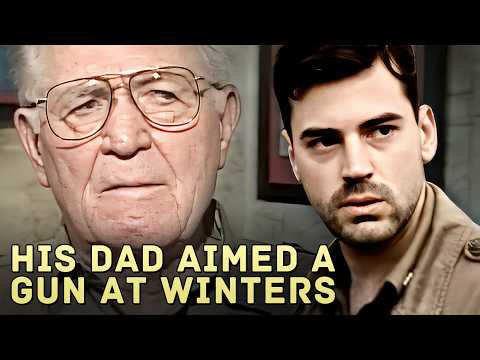
Major Dick Winters survived the harrowing battles of World War II, but his greatest test came not on the battlefield, but in the quiet aftermath. In the fall of 1945, a 27-year-old Winters returned home a hero, only to find himself staring down the barrel of a gun held by his best friend’s father. This is the story of how Winters’ civilian life unraveled, and how a drunken confrontation at a New Jersey mansion became the final straw.
Within two weeks of returning from Europe, Winters traveled to New York City to meet Lewis Nixon’s father, Stanhope Nixon, who offered him a position at the family business, Nixon Nitration Works. The company manufactured cellulose nitrate, a highly flammable plastic used primarily for motion picture film. Winters accepted and became personnel manager in January 1946, working under his best friend, Lewis Nixon. But the job came with unexpected challenges.
Lewis Nixon, his wartime confidant, showed up at the office only once or twice a week to collect his mail and paycheck. “Nix, why in the hell don’t you take a job around here?” Winters once asked him. “There’s a lot to do. They can use you. Someone from the family should be here.” But Lewis just smiled. “Dick, I can’t take a job,” he replied. “If I take a job, I’m taking work from somebody else, and that would bother my conscience.” Winters realized that Lewis was the same man in civilian life as he had been in the army—a good communicator but one whose drinking took precedence over administrative details.
Stanhope Nixon, recently divorced and remarried, spent winters in Florida and only six weeks each spring at the plant. The day-to-day operations fell to company president Charlie Schuster, who guided Winters until he too was let go. By the late 1940s, the plastics industry was shifting from cellulose nitrate to safer acetate, and Nixon Nitration Works struggled to adapt. Layoffs began, and as personnel manager, Winters had to fire employees. “It got to the point that when employees saw me coming, they got very, very nervous,” he recalled.
Winters was promoted to plant manager, but the pressure mounted. Stanhope, now a worsening alcoholic, constantly sent orders by phone and mail while keeping his distance from the plant. Then one day, Winters received a frantic call from Stanhope’s Japanese housekeeper, Lillian, with whom Stanhope was having an affair. “I must see you,” she said. “It’s important. I can’t control him.” Winters told her to call Stanhope’s attorney, but she insisted, “No, it must be you. Please. He respects you. No one else will be able to help.”
Winters drove to Stanhope’s large New Jersey home, Fington Lake, with the mail. The door was cracked open. He knocked several times, then cautiously stepped inside. “Anyone home?” he called. Stanhope appeared from a hallway, half-dressed and far from sober. In his right hand was a pistol, pointed directly at Winters’ chest. “Oh, it’s you,” Stanhope slurred. “What do you want?”
Winters’ first concern was to get the gun away before anyone got hurt. He kept his eyes on Stanhope and slowly walked forward. “You haven’t been at the plant for a few days,” Winters said calmly. “I thought I’d bring the mail out here in case there was anything you needed to see.” He gently pushed the gun aside and removed it from Stanhope’s hand. Opening the revolver, he found all six chambers empty. Glancing across the room, he noticed six holes in the screened porch door—Stanhope had tried to shoot at ducks on his pond. Stanhope laughed. “I’ll bet you thought I was going to shoot you,” he said.
Winters set the gun on the table with the mail and walked out. “This is it,” he told himself. “I’m leaving. I need a job, but I don’t need this.” He decided to resign, but with a wife and one-year-old son, he couldn’t leave without another job. Fortunately, the army recalled him to active duty for Korea, giving him an excuse to escape the drama without hurting his friendship with Lewis.
Winters served briefly at Fort Dix, New Jersey, then was given the option to resign before being shipped to Korea. He’d had enough of war. Without job options, he tried to return to Nixon Nitration Works in September 1952, but his position had been filled. Lewis Nixon gave him six months’ pay and signed over the company car to help him stay on his feet. Winters soon found work at Johnson & Johnson, and eventually moved back to Pennsylvania, where he bought a 300-acre farm and started a successful livestock feed business.
But the story doesn’t end there. It was during his time at Nixon Nitration Works that Winters met his wife, Ethel, at a restaurant near the rail station. And perhaps most importantly, those years kept him close to Lewis Nixon, the one person who truly understood what he’d been through in the war. Their bond remained unbreakable until Lewis’s death in 1995.
What the transcript leaves unsaid is how Winters carried the weight of that moment at Fington Lake long after he set the revolver down on the table. He never mentioned it to Lewis. Not once. In the years that followed, the two men would sit together in the same quiet rooms, Lewis with a glass in his hand and Winters with a cup of coffee, and Winters would study his friend’s face and wonder how much of the father lived in the son.
He didn’t wonder long. Lewis Nixon was a drunk, but he was not Stanhope. The difference, Winters came to believe, was the war. Lewis had seen what happened when men lost control of themselves, and some part of him—buried deep, beneath the bourbon and the easy smile—still held the line. He drank to forget, but he never once raised a hand or a gun against anyone but himself.
Still, the memory of that afternoon stayed with Winters like a splinter. When he finally left Nixon Nitration Works for the last time in the autumn of 1952, he did not feel triumph. He felt relief, and then, almost immediately, guilt. Lewis had given him six months’ pay and the company car without a word of complaint. That generosity was not the gesture of a careless man. It was the gesture of a friend who knew exactly what he was losing.
Winters drove the company car to his new job at Johnson & Johnson, and for a while the two men wrote letters. Lewis’s letters were short, funny, and increasingly hard to read—the handwriting loosening, the sentences trailing off. Winters kept every one of them in a shoebox in the attic of his Pennsylvania farmhouse, though he rarely opened it.
It was Ethel who finally asked him, one evening in the late 1950s, why he never talked about the Nixons. Winters was quiet for a long moment. “Because there’s nothing to say that wouldn’t sound like a betrayal,” he said. “Lewis was my best friend. His father was a drunk with a gun. Both of those things are true, and I can’t make them fit together.”
Ethel understood. She had met Stanhope once, at a company dinner, and had spent the entire evening watching him refill his glass while his son watched him do it. She never asked again.
What Winters could not have known, as he built his feed business and raised Tim and Jill and taught them to shoot straight and tell the truth, was that his departure from Nixon Nitration Works had saved more than his own life. The company folded within a few years of his leaving. Stanhope’s drinking worsened. Lewis drifted from one venture to the next, and the Nixon name, which had once meant something in New Jersey, faded quietly into the ledgers of forgotten businesses.
But Winters never spoke of it that way. When the old veterans gathered at reunions and someone asked about Nixon, Winters would smile and say only, “He was the best officer I ever served with, and the best friend I ever had. The rest doesn’t matter.”
And in a way, he meant it. The war had given him Lewis Nixon, and Lewis Nixon had given him a job, a car, six months’ pay, and a front-row seat to the slow ruin of a family that had once seemed untouchable. Winters took what was useful from that education and left the rest behind, the way a soldier leaves a foxhole when the shooting stops.
Lewis Nixon died in 1995, and Winters flew east for the funeral. He stood at the back of the church and watched the small crowd of mourners, and he thought about the shoebox in his attic and the letters he had never answered quickly enough. “He was a good man,” Winters told Lewis’s daughter at the reception, and he meant it with the same certainty he had once used to push a loaded revolver aside.
After the burial, Winters drove north on roads he had not traveled in forty years. He passed the exit for Nixon Nitration Works and did not take it. The plant was gone by then—sold, scraped, replaced by a warehouse and a parking lot—but the memory of it remained, a place where a young hero had learned that survival sometimes meant walking away from the people you loved.
Back home in Pennsylvania, Winters opened the shoebox one last time. He read three letters, then closed the lid and put it on a shelf where his grandchildren might find it someday. “Some friendships are not for keeping,” he wrote in the margin of his own memoir. “They are for surviving.”
He never spoke of Fington Lake again. But every autumn, when the ducks flew south over his farm, Winters would pause at the window and watch them go, and for just a moment he would remember the six holes in a screen door and the sound of a drunk man laughing, and he would be grateful—deeply, quietly grateful—that he had been the one who walked out.
So here is the question that lingers: when a friendship is built in war but tested in peace, how much of it can we truly keep—and how much must we forgive to keep it at all?
Report this article
Select a reason for reporting:






