The cold February morning of 1944 bit through Squadron Leader Edward Whitmore’s sheepskin jacket as he stood on the tarmac at RAF Essex, watching the fog swallow the Spitfires he had trusted with his life for years. He had survived the Battle of Britain, lost friends whose names he still carried silently, and now he faced a new machine that promised to change everything—or so the Americans claimed.
Just days earlier, Whitmore had scoffed at the idea that any American fighter could match his beloved Spitfire. “With respect, sir, we’ve tried the Mustang before,” he had told his group captain. “It couldn’t fight above 15,000 feet.” But the numbers on the briefing room wall told a different story: a Merlin-engined Mustang with four times the range, speed to match the Spitfire at altitude, and the ability to escort bombers all the way to Berlin and back.
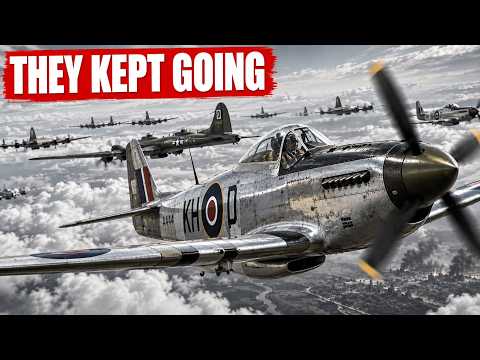
Now, as he strapped into the unfamiliar cockpit for his first conversion flight, Whitmore’s hands moved over American switches and gauges that felt foreign under his fingers. The long nose blocked his forward view, and the engine’s roar was deeper, more purposeful than the Merlin he knew. He pushed the throttle forward, and the Mustang leaped ahead with an eagerness that caught him off guard.
At 25,000 feet, where his Spitfire would have been gasping for power, the Mustang surged with newfound strength as the two-stage supercharger kicked in. Whitmore dove, twisted, and climbed, testing every maneuver he knew. The aircraft responded with a smoothness that belied its weight, and when he finally landed, his hands were trembling—not from fear, but from disbelief.
Back on the ground, he faced the American liaison officer, Major Robert Caldwell, who wore a knowing smile. “Well?” Caldwell asked. Whitmore removed his helmet and ran a hand through sweat-dampened hair. “I believe I owe you gentlemen an apology,” he said slowly. “I didn’t think any aircraft could do what I just felt at that altitude.”
The days that followed were a blur of training flights and ground school, with Whitmore’s squadron adapting to the Mustang’s quirks. Young Alan Reed, the red-haired flight officer, took to the new fighter instantly, his natural instincts translating to the heavier controls with ease. But Whitmore struggled, nearly cutting fuel to the engine during a long-range simulation—a mistake that left him shaken and humbled.
By mid-February, the squadron was declared operational, just in time for a major push against German aircraft factories. The briefing room was thick with tension as Group Captain Reeves outlined the mission: deep escort into enemy territory, protecting American bombers all the way to the target and back. “Personal victories are secondary,” Reeves emphasized. “Get those crews home.”
That night, sleep came in fragments. Whitmore lay in the darkness of his quarters, listening to the wind rattling the blackout curtains, running fuel figures through his mind until the numbers blurred together. He thought of Reed’s easy grin, of Ashby’s meticulous notebook, and of the strange, unexpected affection he had developed for an aircraft he had dismissed with such certainty only weeks before.
He rose before dawn and dressed with the slow, deliberate care that had become ritual. Silk gloves first, then leather over them, the silk scarf knotted at his throat, and over it all the heavy sheepskin flying jacket that had kept him alive through three winters of war. He checked his service revolver out of pure habit—six rounds in the cylinder—and tucked his small escape kit into an inner pocket: a map of Europe folded tight, a tiny compass, a handful of concentrated rations, and a few German banknotes that felt both absurd and vital.
In the mess hall, breakfast was eaten in near silence. Reed sat across from him, unusually quiet, pushing food around his plate rather than eating it. “Nervous?” Whitmore asked, more gently than usual. “A bit, sir,” Reed admitted. “It’s the farthest I’ll have flown into Germany by a wide margin.”
“Stay glued to my wing,” Whitmore said. “Trust the aircraft. It’ll get you there and back, provided you fly it the way Samers taught us.” Reed managed a small smile at that, some of his old brightness returning to his face, and Whitmore found himself hoping, with an intensity that surprised him, that the promise he had just made would hold true.
Outside, ground crews moved between the aircraft in the gray pre-dawn light, fueling, arming, and checking each Mustang against a long list of items that could not be allowed to fail at 25,000 feet over enemy territory. Matthews met Whitmore at his aircraft with a clipboard and a terse report. Full internal fuel, drop tanks mounted, guns armed and harmonized, oxygen bottles topped, radio set to the correct frequency. “She’s ready, sir,” Matthews said. “Bring her back safe.”
They took off just after seven the following morning, climbing above the English coast into the pale gray light of a winter dawn, sections forming into squadrons, squadrons forming into the full wing. The engines’ drone was steady as they climbed to altitude and turned east across the water. By the time they crossed the enemy coast, Whitmore had switched to oxygen, feeling the cold flow through his mask, watching the temperature gauge drop toward levels that would freeze exposed skin in seconds.
The American bomber formation appeared ahead of them exactly where the briefing had promised. A vast box of heavy bombers stretching for miles, contrails rising white against a hard blue sky. Whitmore felt something tighten in his chest at the sheer scale of it—dozens upon dozens of aircraft carrying hundreds of young men deep into enemy territory, to a distance none of them could have reached without the fighters now taking their positions around them.
The fighters settled into their stations above and alongside the bomber streams, rocking gently to match the slower bombers’ speed without overshooting the formation, their pilots’ eyes constantly sweeping the sky above, below, and to every side. For nearly an hour, nothing happened but the steady drone of engines and the occasional crackle of radio chatter between formations. Then the calls began.
“Bandits, eleven o’clock, high, large formation,” came the warning over the radio. The voice was tight with the urgency that meant business. Whitmore strained his eyes toward the indicated direction and found them—small specks at first against the scattered clouds, then resolving into individual aircraft as the distance closed. Messerschmitts, their angular lines unmistakable, climbing hard to gain position above the bombers before diving to attack.
“Nineteen Squadron, prepare to engage,” came Reeves’s voice over the frequency. “Protect the bombers first. Personal scores mean nothing today.”
The German fighters split as they came in. Part of the formation continued toward the bombers, while a dozen or more broke off to meet the escorting Mustangs head-on. Whitmore hauled his aircraft into a steep climbing turn as tracer fire flashed past close enough to make his stomach clench. G-forces pressed him into his seat, his vision graying at the edges before it cleared, and he was already searching for a target.
A Messerschmitt crossed in front of him and pulled up sharply after a failed pass. Whitmore shoved the throttle to full power and followed. The Mustang responded with the same eager surge he remembered from that first flight, and the German aircraft grew in his gunsight. This time his estimate of the range was right. He pressed the trigger and felt the airframe shudder as the four .50-caliber guns fired together, tracers converging on the enemy fighter’s wing root. Pieces tore away and the Messerschmitt tumbled into a spiraling trail of smoke. A parachute blossomed moments later against the pale sky. There was no time to watch it descend.
Another German fighter cut across Whitmore’s path, cannon shells passing close enough to rattle his nerves, and he threw the Mustang into a violent evasive maneuver, using the aircraft’s superior roll rate to shake the attacker before reversing and diving away to gain speed for another pass. Across the burning battlefield, other engagements flickered in and out of his vision between his own maneuvers. A bomber trailing smoke from one engine but still holding formation through sheer stubborn discipline. A Mustang and a Focke-Wulf locked in a tight turning fight, guns flashing. Somewhere in the chaos, a voice came over the radio with a warning that turned Whitmore’s blood to ice.
“Reed, break right! Break right!” The scream came, followed immediately by a burst of static and then flat silence. “Reed, answer.” Whitmore called, banking hard to scan the sky in the direction of the last transmission. Fear cut through the adrenaline of combat with a sudden, sickening clarity. No reply came but the steady hum of an open channel. “Does anyone see Reed?” Whitmore called again, his voice tighter than he intended. “I saw him go down, north of the bomber stream,” came the reply from another pilot, breathless from his own maneuvers. “Couldn’t tell if he got out, sir. Lost sight of him in the clouds.”
There was no time for grief, no room in the chaos of combat for anything beyond the next threat, the next maneuver, the split-second decision between life and death. Whitmore forced the fear and the sorrow into a locked corner of his mind and brought his full focus back to the fight, because that was the only thing he could do for Reed now, and the only thing that might save the bomber crews still holding formation below him.
Ahead, the first puffs of flak began to bloom around the leading bomber formation as it approached the target. Ugly gray flowers opening with terrifying precision at the same altitude the bombers flew. Whitmore had heard other pilots describe flying through flak barriers, and he had never quite believed those descriptions until he saw it for himself. A wall of exploding shells that the bombers simply had to fly through, straight and level, holding their course toward the bomb run with no possibility of evasive action.
One B-17 in the lower formation took a direct hit and seemed to come apart in a single orange flash. Whitmore forced himself to count the parachutes rather than look away. Three, perhaps four, from a crew of ten. A second wave of German fighters arrived as the bombers turned for home, Focke-Wulfs this time, recognizable by their radial engines and their short, aggressive silhouettes, diving out of the high clouds in disciplined pairs flown by experienced hands.
One pair targeted a straggling bomber with smoke already trailing from its damaged engine, lining up for a direct stern attack where the bomber’s defensive guns were weakest. Whitmore saw the situation developing and pushed his Mustang into a full-power dive without waiting for orders. The airspeed indicator climbed past 400 miles per hour as he cut the corner to intercept them. The leading Focke-Wulf grew rapidly in his gunsight. Its pilot was focused entirely on the damaged bomber ahead, oblivious to the threat closing from behind. Whitmore fired from long range, trusting the flat trajectory Samers had promised, and watched his rounds chew into the fighter’s engine cowling in a shower of sparks.
The Focke-Wulf rolled onto its back and fell away trailing thick black smoke, its pilot bailing out moments before it struck the ground below. The second fighter abandoned its attack and dove for the clouds, seeking safety rather than continuing the fight alone. The damaged bomber, still flying and still holding its place at the edge of the battered formation, continued its long crawl toward the coast.
Whitmore pulled up and away, his chest heaving inside his oxygen mask, and glanced at his fuel gauge before sweeping the sky for the next threat. He was still within the safe limits Ashby had calculated so carefully in his notebook, though those limits now seemed far tighter than they had on paper in the warm briefing room. With the enemy fighters scattering across the sky, the long return flight across Germany and the North Sea still waited for him.
The fight burned for what felt like hours but lasted only twenty minutes before the remaining German fighters withdrew east, out of fuel and ammunition. The sky cleared with startling suddenness, leaving only the drone of the bomber stream and the sharper note of the escorting Mustangs. Beneath that unnatural calm lay a dull ache: the not-knowing whether the twenty-one-year-old with the red hair and the easy grin had survived the last quarter-hour of his short life.
The bombers reached their target as the last German fighters pulled away, bomb bays opening in long, ragged lines as tons of ordnance fell toward the factory complex below. Even from 26,000 feet, Whitmore could see the flashes of explosions ripple across the target, followed moments later by a secondary blast far larger than the rest—perhaps fuel or ammunition stores igniting deep within the plant. A good strike, he thought, but the thought came without satisfaction, only the hollow exhaustion that had settled in him since Reed’s voice went silent.
The formation turned for home, the long, grueling return beginning. German fighters rose to meet them twice more along the way, brief and violent skirmishes that cost the squadron nothing further but left every pilot’s nerves frayed by the time the enemy coast finally fell away behind them. Whitmore watched his fuel gauge with growing concern as they crossed the North Sea. The needle sat lower than Ashby’s careful calculations had predicted—the price of two hard fights and an unexpected interception, burning through reserves faster than any theoretical sum.
“Blue Section, check your fuel,” he called over the radio, trying to keep his voice level though his own gauge offered no comfort. “Quarter tank, Skipper,” Ashby replied, the same worry threading his words. “Still ninety miles of water to go.”
Whitmore eased the throttle back to the leanest cruise he dared, watching the gauge with the focus of a man for whom every gallon had become the only thing in the world. He remembered nearly courting disaster during conversion training, when the engine coughed and fell into a spine-chilling silence before catching again, and he understood now, with a clarity the training alone had never given him, how little margin this aircraft’s extraordinary range left for a pilot who squandered it recklessly in combat.
The English coast appeared at last through the haze, its pale chalk cliffs catching the weak afternoon sun. Whitmore felt something loosen in his chest at the sight, though the danger had not passed. His fuel gauge now rested at a mark he had never seen an aircraft reach and keep flying. “Kingfisher, Kingfisher,” he called, using the squadron’s radio call sign as they crossed the coast at 8,000 feet. “Requesting direct approach, priority landing. Several aircraft critically low on fuel.”
“Roger, Kingfisher,” came the calm reply from the ground controller. “You’re cleared for direct approach, runway 27. Wind 270 at 10 knots. Welcome home.”
Whitmore led his section down in a shallow, careful descent, husbanding every ounce of fuel, dropping his landing gear only at the last moment to avoid any premature drag. His engine coughed once on final approach—a sound that dropped his stomach in a moment of instinctive fear—then caught again to carry him through the last few hundred yards to the runway threshold. He landed hard, rolled, and let the aircraft stop just short of the assembly area, where the engine finally died as the last drops of fuel ran dry and the propeller wound down into an eerie silence.
He sat in the cockpit for a long moment, hands trembling slightly on the controls, before a ground crew tractor arrived to tow him the rest of the way. “Cut that one fine, sir,” the young driver said mildly as he hooked up the tow bar. “A bit,” Whitmore agreed, and found he had no strength left for more than that simple honesty.
Matthews was waiting at the dispersal when the tractor pulled him in, and he looked at the empty fuel gauge with an expression devoid of surprise, a man who had seen too many exhausted pilots return in too many conditions over too many years. “Told you she’d bring you back, sir,” Matthews said, patting the engine cowling once the propeller had stopped. “Didn’t say it’d be a comfortable ride.” Whitmore managed something like a laugh—the first sound that day that had cost him no effort at all—and climbed down from the wing on legs that did not feel entirely steady.
The squadron gathered to give their reports in the same briefing room where Whitmore had stood three weeks earlier, openly doubting that any American aircraft could match what he already flew. Group Captain Reeves moved through the room collecting the accounts, his face grave as the day’s tally emerged. Two aircraft lost, one sergeant pilot from Ashby’s section confirmed killed when his Mustang was seen falling in flames. Flight Officer Reed, still missing, last seen taking his aircraft down in a controlled descent north of the bomber stream, with what one witness believed was a successful parachute.
“There is a reasonable chance he is alive,” Reeves said, his tone carefully balanced between candor and something gentler. “A prisoner of war, most likely, if the parachute report is accurate. We’ll know more in time through the Red Cross, though word may take weeks.”
Whitmore clung to that slender possibility the way a man clings to anything in wartime that might end well, without quite daring to trust it. But the operational picture that emerged from the day’s reports told its own undeniable story. Every bomber the Nineteenth and its sister squadrons had escorted to the target and back had returned to friendly soil—whatever the damage, whatever the crews they had lost along the way. Not one had been forced to make the final leg of the journey home alone and unescorted, stranded in that gap that had killed so many bomber crews on the deep missions of the past two years. For the first time in the war, a fighter based in England had carried the fight into the heart of German industry and brought the bombers home with it.
Major Caldwell arrived the following morning to collect the squadron’s combat reports for his own headquarters, and found Whitmore near the flight line watching ground crews already working to repair battle damage on aircraft that would fly again within days. “Well, Lieutenant,” Caldwell said. “Was I wrong to make my claims so boldly three weeks ago?”
Whitmore considered the question honestly before answering, with the perspective he had learned to bring to most things since Reed’s disappearance—weighing the cost against whatever gains had actually been won. “We lost good men yesterday, Major,” he said. “I won’t pretend the aircraft made that easy. But every bomber crew we escorted came home, and they could have died alone over Germany with no one beside them. I was wrong about what this aircraft could do. I don’t believe I’ve ever been happier to admit I was wrong about anything in my life.”
Caldwell nodded slowly, without the satisfied smile Whitmore might have expected three weeks earlier. “There will be more missions like yesterday’s,” he said. “Many more before this war is done. The Luftwaffe knows what this aircraft means to them now. Quite clearly—just as you do.”
In the weeks that followed, word reached the squadron through Red Cross channels that Alan Reed had indeed survived his parachute descent and was alive in a prisoner-of-war camp inside Germany, wounded but recovering. The news spread through the squadron like sunlight breaking through weeks of heavy cloud. Whitmore read the confirmation twice before allowing himself to believe it fully, then folded the letter carefully and kept it in the same pocket where he had once carried a list of names of friends who had not come home.
The wing continued to fly deep escort missions throughout the rest of February and the months beyond, shepherding American bombers on raids that reached targets no RAF fighter had ever touched. Buying time for the American Mustang groups still building their strength to eventually take over the longest and deepest of those missions entirely. Bomber losses on raids the Nineteenth escorted dropped sharply compared to the unescorted missions of the previous year—a change visible enough in the casualty figures that reached headquarters each week, whatever the cost they had paid to achieve it.
Whitmore thought often, in the quiet moments, of the Rolls-Royce test pilot he had never met. The one who had climbed into an unwanted, underperforming Mustang in the spring of 1942 and seen in it something almost everyone else had dismissed—including, at first, men within his own company. One stubborn recommendation, offered against considerable institutional doubt, had traveled from a test airfield in Cambridgeshire to a cold dispersal in Essex two years later, and from there into the sky over Germany, and had ended up mattering more to the survival of ordinary bomber crews than almost anything else decided that winter of the war.
Whitmore never entirely forgave himself the certainty with which he had once rejected an aircraft he had never flown. Though he began, in time, to see that error as an ordinary and forgivable one—the kind any experienced pilot in his position might logically make before the evidence proved otherwise in the air rather than on paper. What stayed with him longer, through the rest of that hard year of war, was something closer to wonder. Quiet and unassuming. That an aircraft built in haste, fitted with an engine never designed for it, and assembled by workers on the other side of the world who would never see the country it was sent to defend, had somehow crossed an ocean and closed a gap in the sky that had been left open at the cost of so many young lives.
He went on flying that aircraft for the rest of the war—across France, Belgium, and finally over the coast of Norway—and he never doubted it again. Not once, through all of it.
What would you have done, standing on that cold Essex tarmac in February 1944—trusted the unfamiliar machine, or clung to the fighter you knew? Share your thoughts below.
Report this article
Select a reason for reporting:






