You’ve been told the Vietnam War was an American fight. That when bullets flew in Southeast Asia, it was American blood and courage that held the line. But they lied. Hidden in the deepest jungles, where even the Viet Cong feared to tread, a partnership so lethal operated that the enemy gave them a name that still haunts North Vietnamese veterans today: “The Red God and the Ghost.”
Two nations, separated by 2,000 kilometers of ocean, bound by a warrior culture centuries old. When Australia and New Zealand combined their elite reconnaissance forces in 1968, they created a two-headed predator that could track you for weeks unseen, strike without warning, and vanish before you knew you were hunted. Imagine being a North Vietnamese soldier on a familiar supply trail, suddenly realizing the trees aren’t just watching—they’re counting your weapons, your supplies, your men. By the time you sense it, the information is gone, transmitted to aircraft that will turn your column to ash within hours.
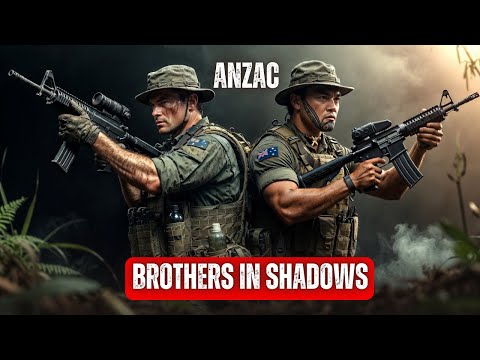
Who were these ANZAC recon teams that achieved a 98% mission success rate with minimal casualties? What was Operation Southern Cross, the joint mission so classified that even headquarters didn’t know their location? And what happened during the Long Tan aftermath when a mixed Kiwi-Aussie patrol did something so audacious it’s still debated in military circles today?
Buckle up. We’re about to expose the most successful partnership of the entire Vietnam War—a brotherhood forged not in conference rooms, but in the mud, blood, and silence of the jungle, where the only thing louder than the insects was the sound of two nations refusing to leave each other behind.
You think you know coalition warfare? You have no idea. Watch until the very last second, because what we reveal at the end about this partnership is still operational today—and it’s something the intelligence community wishes would stay buried.
To understand why the Australian-New Zealand reconnaissance partnership in Vietnam was so devastating, you have to rewind the clock 50 years to the blood-soaked beaches of Gallipoli. April 25, 1915. A combined force of Australian and New Zealand troops—the ANZAC Corps—stormed hostile shores in what was supposed to be a quick victory in World War I. Instead, it became an eight-month nightmare of trench warfare, disease, and death.
But something remarkable happened in those trenches. Something that would echo through every conflict that followed. The Australians and New Zealanders didn’t just fight side by side. They bled together, starved together, and covered each other’s retreats when the situation became impossible. They shared water when there was barely enough for one. They carried each other’s wounded under fire. They learned each other’s slang, sang each other’s songs, and when one nation’s section of the line was about to break, the other nation’s troops would appear unbidden to plug the gap. It wasn’t ordered. It wasn’t doctrine. It was brotherhood.
When the Gallipoli campaign finally ended in evacuation—a tactical defeat, but a spiritual victory—the ANZAC bond was forged in a way that no treaty could replicate. Every April 25th since then, both nations pause to remember not just the battle, but the partnership.
That partnership was tested again in World War II. In the deserts of North Africa, Australian and New Zealand forces fought together against Rommel’s Afrika Korps. In the jungles of Papua New Guinea, they held the line against Japanese invasion. In the mountains of Italy, they assaulted impossible positions together. By the time Vietnam rolled around in the 1960s, the ANZAC Alliance wasn’t just military cooperation. It was muscle memory. It was instinct. Two nations that understood each other’s tactics, trusted each other’s capabilities, and knew without needing to say it that neither would ever abandon the other on the battlefield.
But Vietnam was different from any war they’d fought before. Australia and New Zealand both sent troops for different reasons, but with the same underlying motivation: supporting allies and containing communism in Southeast Asia. Australia deployed the Special Air Service Regiment (SASR)—elite soldiers trained in long-range reconnaissance, unconventional warfare, and surviving weeks behind enemy lines with minimal support. These were men who’d learned their craft in the jungles of Malaya and Borneo, hunting communist insurgents through terrain that made Vietnam look friendly by comparison.
New Zealand sent the New Zealand Special Air Service (NZSAS)—a smaller but equally deadly force with a reputation for producing some of the toughest soldiers on the planet. The Kiwis brought something unique: Māori warriors whose ancestors had fought in the dense bush of New Zealand for centuries. Men who understood tracking, ambush, and the psychological warfare of making the enemy believe the jungle itself was alive and hunting them.
Both units operated on similar principles: patience over aggression, intelligence gathering over body counts, and survival through invisibility. Both had selection processes that broke most candidates. Both believed the best weapon wasn’t the rifle—it was the ability to be where the enemy didn’t expect you and see things they didn’t want you to see.
But they operated separately at first. Each nation ran its own operations out of its own bases, coordinating with American command structures but maintaining independence. That changed in early 1968 after the Tet Offensive revealed massive gaps in Allied intelligence about enemy movement and logistics. The Americans had firepower and technology, but they didn’t have enough eyes in the deep jungle—the places where the enemy felt safe, where supplies moved freely, and where the Ho Chi Minh Trail pulsed like a living artery feeding the war.
Someone in headquarters—the exact person is still debated—looked at the map and had a radical idea. What if we combined the Australian and New Zealand reconnaissance capabilities into joint teams? What if we created an ANZAC reconnaissance force that operated as a single unit, pooling resources, sharing intelligence, and covering twice the ground?
The proposal faced immediate resistance: logistical nightmares, chain of command conflicts, national pride, equipment incompatibility. But the Aussies and Kiwis themselves had a different reaction when they heard about it. They said, “About bloody time.”
The first joint briefing between Australian SASR and New Zealand NZSAS operators took place at Nui Dat, the Australian base in Phước Tuy Province, in March 1968. The room was packed with weathered, lean men who looked like they’d been carved from the jungle itself. Australians on one side, Kiwis on the other, eyeing each other with the competitive weariness of elite units meeting for the first time.
The briefing officer, an Australian major, laid out the concept: mixed patrols, shared operations, integrated command structure. The Australians would provide logistical support, base infrastructure, and liaison with American forces. The Kiwis would bring tracking expertise, cultural knowledge from Māori bush warfare, and a level of physical endurance that was frankly terrifying.
The room was silent as the briefing concluded. Then from the back, a voice with a thick New Zealand accent called out, “So you’re telling us we have to babysit the Aussies?” The room erupted in laughter—not hostile laughter, but the laughter of recognition, of shared humor, of warriors who respected each other enough to give each other grief. An Australian sergeant responded immediately: “Mate, you’ll be lucky if you can keep up.” More laughter. The tension evaporated.
Then a Māori NZSAS corporal named Rawiri Takare stood up. He was compact, muscular, covered in traditional Tā moko facial tattoos that told the story of his lineage and battles. He looked around the room and said something in te reo Māori. The Australians didn’t understand the words, but they understood the tone: This is serious. This is sacred. Then Takare switched to English: “My people have a saying: He waka eke noa. A warrior who stands alone is nothing compared to warriors who stand together. We fought beside you before. We’ll do it again. And when we walk into that jungle, we’re not Australian and New Zealand anymore. We’re ANZAC. And that means no one gets left behind.”
The room went silent again, but this time it was the silence of agreement, of commitment. The Australian major nodded slowly. “Then let’s get to work.”
Within two weeks, the first mixed ANZAC reconnaissance patrols were deployed into the field. What happened next would rewrite the book on coalition special operations.
The genius of the ANZAC reconnaissance partnership wasn’t that both nations did the same things well. It was that they did different things well—and when combined, those differences created something far more lethal than the sum of its parts.
The Australians brought systematic reconnaissance methodology. They were engineers of intelligence gathering: meticulous in their observations, obsessive about documentation, and expert at calling in fire support with surgical precision. They excelled at long-duration operations, carrying massive loads over impossible terrain and maintaining discipline over weeks of patrol. They were also masters of communications, able to coordinate with artillery, air support, and higher command even from the deepest jungle.
The New Zealanders brought instinctive tracking and environmental reading. The Māori warriors in particular possessed an almost supernatural ability to read the jungle—to sense disturbances in the natural order, to identify tracks that seemed invisible to others, and to predict enemy movement patterns based on terrain and behavior. They were also physically formidable, capable of carrying even heavier loads than the Australians and maintaining a pace that left even fit soldiers gasping.
When you paired an Australian patrol commander with a Kiwi tracker, you got something terrifying. The Australian would plan the route, coordinate the logistics, and manage the mission timeline. The Kiwi would read the ground, spot the signs of enemy presence, and guide the patrol through terrain that seemed impassable. The Australian would call in the air strikes when targets were identified. The Kiwi would ensure they were never in the wrong place when those air strikes landed.
One American liaison officer who worked with ANZAC teams described it this way: “The Aussies were the brains. The Kiwis were the instinct. Together, they were a goddamn nightmare for Charlie.”
But it wasn’t just about complementary skills. It was about mutual trust that went beyond professional respect. On a typical ANZAC reconnaissance patrol, the team consisted of four to six men—usually two or three Australians, two or three Kiwis—sometimes mixing nationalities in buddy pairs, sometimes keeping them separate depending on the mission. They communicated almost entirely through hand signals developed specifically for the mixed teams: a hybrid of Australian, New Zealand, and even some adapted Māori gestures that allowed complex tactical information to be conveyed without a single spoken word.
But more than that, they developed what veterans later called the telepathy. After weeks in the jungle together, the ANZAC teams could anticipate each other’s movements, read each other’s body language, and understand each other’s intentions without any signal at all. A Kiwi tracker would pause mid-step, head cocked slightly. The Australian behind him would immediately freeze, rifle coming up, eyes scanning. Neither would need to look at each other. The Kiwi sensed something. That was enough.
This level of synchronization took time to develop, but once it did, the teams operated like a single organism with multiple limbs. They ate the same rations, slept in the same mud, shared the same watch rotations, and urinated in the same bottles to avoid leaving scent trails. National identity became secondary to team identity.
One Australian veteran, Corporal James “Jimmy” Brennan, recalled: “After about the third patrol, I stopped thinking of Hemi as a Kiwi. He was just my mate who happened to have better eyes than me and could smell the enemy before I could see them. And when the shit hit the fan, I knew he’d be there. That’s all that mattered.”
The enemy noticed. Intelligence reports captured from North Vietnamese units in 1969 specifically warned about Đội trinh sát ANZAC—ANZAC reconnaissance teams. The reports described them as silent, patient, and impossible to ambush because they see everything before you see them.
One captured NVA officer during interrogation was asked about the ANZAC teams. His response, translated from Vietnamese, was chilling: “They are not men. They are forest spirits. You can set an ambush for them and they walk around it as if they knew it was there before you did. You can track them for days and never catch them. And when they want you dead, you are already dead before you hear the shot.”
This was the reputation the ANZAC teams built. Not through propaganda, not through exaggeration, but through results.
In August 1968, ANZAC command approved what would become the most ambitious joint operation of the partnership: Operation Southern Cross. The mission was simple in concept, impossible in execution. A mixed ANZAC team would insert sixty kilometers behind enemy lines, deep into War Zone D—a region so hostile that even American special forces avoided long-duration operations there. The team would establish multiple observation posts overlooking key sections of the Ho Chi Minh Trail, gather intelligence on enemy logistics for twenty-eight days, and then exfiltrate on foot, walking the entire sixty kilometers back to friendly territory.
No resupply. No extraction unless catastrophic emergency. Just six men alone in enemy territory for a month.
The team composition was carefully selected. Patrol commander Lieutenant Marcus “Mark” Holloway, Australian SASR, age twenty-nine—veteran of Borneo and two previous Vietnam tours. Calm, methodical, expert in navigation and fire support coordination. Second in command Sergeant Rawiri Takare, NZSAS, age twenty-six—Māori warrior with Tā moko tattoos, legendary tracker, could move through jungle without disturbing a single leaf. Signaller Corporal David “Davo” Mitchell, Australian SASR, age twenty-four—radio operator with the ability to repair equipment with nothing but wire and stubbornness. Medic Lance Corporal Hemi Parata, NZSAS, age twenty-three—combat medic and expert in bush survival and indigenous plant medicine. Scout Private Joel “Macca” McIntyre, Australian SASR, age twenty-two—youngest team member, but with eyes like a hawk and the patience of stone. Heavy weapons Corporal Tane “Big T” Williams, NZSAS, age twenty-seven—built like a brick house, carried the M60 machine gun like it was a toy, gentle giant until someone threatened his team.
They inserted by helicopter at dusk, twenty kilometers from their actual target zone to avoid detection. The moment their boots touched the ground, they vanished.
The first week was pure movement. Sixty kilometers of jungle, mountain ridges, river crossings, and enemy-controlled villages. They moved with the glacial pace of professional ghosts—400 meters a day, sometimes less. Every step deliberate, every pause calculated. Rawiri led most days, reading the ground like a book written in mud and broken twigs. Twice he stopped the patrol mere meters before they would have walked into enemy ambushes. Not because he saw the enemy, but because the jungle felt wrong. The birds were silent. The insects had stopped. The air itself seemed to hold its breath.
On day five, an NVA patrol twenty strong walked within ten meters of their position. Tane’s finger rested on the trigger guard. Holloway’s hand signal was clear: Do nothing. When the enemy was gone, Hemi whispered, “That was the hardest thing I’ve ever done.” Holloway whispered back: “That’s why we’re still alive.”
For two weeks they watched the Ho Chi Minh Trail, counting trucks, porters, and fuel caches. On day eighteen, Soviet-made Mi-8 helicopters began flying search patterns. They crawled into a collapsed cave barely large enough for six men and stayed there thirty-six hours while an NVA soldier ate lunch two meters from the entrance.
On day twenty-two, the air strikes came. The secondary explosions shook the earth from two kilometers away. Then came the long walk home—sixty kilometers through enemy territory on high alert. On day twenty-eight, they crossed into friendly territory. Zero casualties.
Decades later, at a reunion in Auckland, an old Australian named Jimmy Brennan raised his glass to his Kiwi brother Hemi. “We were never Australian and New Zealand in that jungle,” he said. “We were just ANZAC. And ANZAC means no one gets left behind.”
Every April 25th, both nations still pause. Lest we forget.
But here’s the question that keeps historians awake at night: if this partnership was so devastating, so effective, and so classified—what operations are they running right now that we’ll never hear about?
Report this article
Select a reason for reporting:






