Summer 1944. Somewhere in Nazi Germany, a cameraman named Gail Cop filmed members of the Hitler Youth and the Federation of German Girls bringing in the harvest. These images, commissioned for the Deutsche Wochenschau, were meant to show a nation united and unbroken. But the war was already bleeding into every frame. At the same time, other cameramen captured morning dance performances at a gymnastics college—scenes intended only for neutral countries, a desperate illusion of normalcy.
In Germany, cinema audiences would have sneered at such pictures. The precarious situation at the front and the devastating Allied bombing raids could no longer be kept secret. The gap between propaganda and reality had become a chasm.
London, May 1944. The calm before the storm. American war reporter Jack Lee took his amateur camera to Westminster Abbey, where troops attended services. In Hyde Park, Londoners relaxed on a warm Sunday, no longer fearing German bombers. They had no idea of Hitler’s wonder weapons—the V1 and V2—or of the massive invasion being planned just across the Channel.
At the end of May, a host of American war correspondents headed to southern England. They were to report on the biggest amphibious landing in history. Everything was top secret. Star journalist Ernie Pyle wrote in his notebook: “So I now know the secret the whole world has waited years to hear. And once you have heard it, you become permanently a part of it.” More than three million troops stood ready on the south coast.
On June 3, the correspondents waited in Weymouth, where part of the Allied armada lay at anchor. Pyle confessed: “We also conjectured on our chances of coming through alive. We felt our chances were not very good, and we were not happy about it.” Commanders expected losses to be high—some put the chance of establishing a bridgehead at just 50%.
British Field Marshal Alan Brooke wrote in his diary: “At the best, it will come very far short of the expectations of the bulk of the people… At its worst, it may well be the most ghastly disaster of the whole war.” The plan, Operation Overlord, involved five divisions landing in Normandy, aiming to reach the Seine within 90 days.
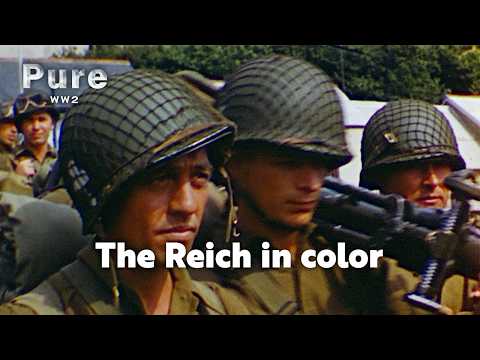
June 6, 1944. D-Day. Only professionals were allowed on the scene. Hollywood director John Ford had been given the task of recording the event on film. Field Marshal Rommel’s orders were clear: “The moment when troops make for the beach… should be used for defense with every means possible.” On Omaha Beach, machine gunners fired at anything that moved. Thousands of American soldiers were killed or wounded.
John Ford later remembered: “Once I was on the beach, I ran forward and started placing some of my men behind things so they’d have a chance to shoot their film… To my mind though, seasick kids were heroes.” On HMS Belfast, director George Stevens experienced D-Day off Juno Beach. Just before the men went ashore, the captain recited Shakespeare’s St. Crispin’s Day speech: “We few, we happy few, we band of brothers.”
When Hitler learned of the landings, he was in high spirits. “The news couldn’t be better. As long as they were in England, they were out of reach. Now, at last, we have got them where we can defeat them.” On Utah Beach, the Americans had a surprisingly easy time—the tide had swept their craft to a virtually undefended sector. Some GIs were disappointed.
In the days that followed, the Allies faced fierce resistance in the hedgerows of the Bocage. Ernie Pyle wrote to a friend: “This hedgerow stuff is a form of warfare we haven’t had to cope with before… I have continually to fight a kind of inner depression over the ghastliness of it all.” On July 7, Montgomery decorated American soldiers for their courage. General Patton, who had just arrived, inspired his troops: “Now, let’s cut the guts out of those crowds and get the hell on to Berlin.”
By late July, the port of Cherbourg had fallen. Hitler was said to be as enraged as he was at Stalingrad. The cameras kept rolling, capturing every triumph and every horror.
The cameras did not stop at Cherbourg. In the weeks that followed, Jack Lee trailed General Collins’s staff deeper into the Cotentin Peninsula, where the roads were still littered with the blackened husks of German armor. Every village they passed through seemed to hold its breath, unsure whether the liberators would stay. French farmers emerged from stone houses to offer cider and hard cheese, their faces caught somewhere between joy and terror. Lee filmed it all—the handshakes, the tears, the children climbing onto the hoods of Jeeps.
But the Bocage was another matter. George Stevens and his army film team pushed west of Saint-Lô, where the fighting had turned the hedgerows into a slaughterhouse. “You couldn’t see ten yards in any direction,” one sergeant told him. “The Germans had every gap zeroed in with machine guns.” Stevens kept his camera low, filming the exhausted faces of infantrymen who had not slept in days. Their eyes were hollow, their uniforms stiff with dried mud.
In one orchard, Stevens found a squad of Americans digging a hasty grave for a lieutenant killed by a sniper. The men worked in silence, passing a bottle of calvados between them. Stevens filmed the burial from a distance, then turned his lens away—some things, he later admitted, were too private for even a Hollywood director to capture.
Ernie Pyle, meanwhile, had moved from unit to unit, notebook always in hand. He wrote of the ordinary soldiers with a tenderness that made him beloved back home. “I’ve seen men die in every way you can imagine,” he scribbled on a scrap of paper, “and I still can’t describe it without sounding like a fool.” He mailed the note to his wife, then stuffed it into his pocket when the censors arrived.
On July 25, the Allies launched Operation Cobra, the breakout from Normandy. Bombers pounded a narrow corridor west of Saint-Lô, and Patton’s Third Army poured through the gap. Within days, the roads were jammed with American tanks racing south and east, kicking up clouds of white dust. Jack Lee rode with a forward reconnaissance unit, his amateur camera rattling against his chest as the Jeep bounced over bomb craters.
They passed through Coutances, which had been liberated so quickly that German officers had left their meals half-eaten on café tables. A French waiter, still wearing his apron, pointed to a plate of cold omelettes and said, “They left in such a hurry, they forgot to pay.” Lee filmed the empty plates, the abandoned wine glasses, the irony too rich to ignore.
By early August, the Americans had reached the outskirts of Brest, but the Germans there refused to surrender. The fighting was brutal, house to house, and Lee’s footage grew darker. He filmed a young GI sitting on a curb, crying quietly, his rifle propped against his knee. The man’s buddy had been killed by a sniper an hour earlier. Lee lowered his camera after a few seconds, but the image stayed with him.
Meanwhile, in Berlin, Gail Cop was still shooting propaganda. But even the Deutsche Wochenschau could not hide the truth forever. The weekly newsreels now showed grainy footage of Volkssturm volunteers—old men and boys—digging anti-tank ditches. The message was unmistakable: the Reich was calling on its last reserves.
Hitler’s wonder weapons had finally arrived, too late to change the outcome. V1 rockets fell on London throughout the summer, killing civilians and shaking the city’s nerves. Jack Lee, back in England on a brief assignment, filmed the wreckage of a row house in Croydon. A woman stood in the rubble, holding a singed photograph of her husband. She looked at the camera without speaking, then turned away.
The Allies were now racing across France. Paris was within reach, and with it, the symbolic end of the occupation. In his diary, Patton wrote: “We have the Germans on the run. The only question now is who gets to Berlin first.” The cameras were ready. The world was watching.
But Berlin was not yet in the frame. In the last days of August, Jack Lee was summoned to a briefing tent near Chartres, where a public relations officer spread a map across a crate and told the correspondents that Paris would be spared—if the Germans obeyed the order not to destroy it. “You’ll go in with the French,” the officer said. “Leclerc’s division. Keep your heads down and your cameras up.”
Lee rode toward the city behind a column of Sherman tanks flying the tricolor. The roads were lined with crowds that grew thicker with every mile. By the time they reached the Porte d’Orléans, people were throwing flowers onto the hulls of the tanks and reaching up to touch the soldiers’ hands. Lee filmed it all, his amateur camera trembling in his grip.
On the Champs-Élysées, the crowd was so dense that the Jeep could barely move. A young woman in a white dress climbed onto the hood and kissed the windshield. Somewhere near the Arc de Triomphe, a sniper fired, and the crowd scattered—then surged back within minutes, as if defiance were the only language left.
George Stevens arrived the following day, with his army film team, and set up on the Place de la Concorde. He filmed General de Gaulle walking down the avenue with his long stride, the crowd parting before him. Stevens later said it was the only time in the war he had to tell his cameramen to stop filming—because they were crying too hard to hold the cameras steady.
In Germany, Gail Cop was filming the other side of the same story. The Deutsche Wochenschau now showed footage of French civilians welcoming German troops—old reels, dusted off and re-edited. The deception was so clumsy that even the projectionists in Berlin exchanged glances. In the darkened cinemas, audiences sat in silence, the flickering images of victory playing to a nation that no longer believed.
At the front, the German retreat had become a rout. Through the Bocage and across the Seine, the Wehrmacht fell back toward the Reich’s borders, leaving behind burned vehicles and abandoned equipment. Jack Lee filmed a German staff car overturned in a ditch, its doors hanging open, a suitcase of officer’s uniforms spilled across the mud. A French boy poked through the wreckage with a stick.
Ernie Pyle, exhausted and thin, wrote his final dispatch from Normandy in early September. “I have been out here so long that I no longer feel like a reporter,” he wrote. “I feel like a soldier who has somehow misplaced his rifle.” He was granted a leave and flew back to the States, promising to return to the Pacific. He never did.
By mid-September, the Allies had reached the German border. The cameras were still rolling—but now, for the first time, they were filming German soil.
On September 11, 1944, an American patrol crossed into Germany near Aachen. Jack Lee was with them, his amateur camera loaded with fresh film. He filmed a signpost riddled with bullet holes, the word “Deutschland” still legible. The soldiers walked past it without ceremony, too tired to celebrate.
In Berlin, Gail Cop was ordered to film the last reserves. He captured a line of boys in oversized helmets, their faces pale beneath the brims. One boy stared directly into the lens, and Cop looked away first.
Ernie Pyle never returned to Europe. He was killed by a sniper on Ie Shima in April 1945, and Jack Lee learned of it in a Paris café. He raised his glass and said nothing. The cameras kept rolling, but the war had already changed them all.
When the newsreels finally went silent, what remained were the frames—soldiers, civilians, boys, and girls, all caught between propaganda and truth. Which image will you carry forward?
Report this article
Select a reason for reporting:






