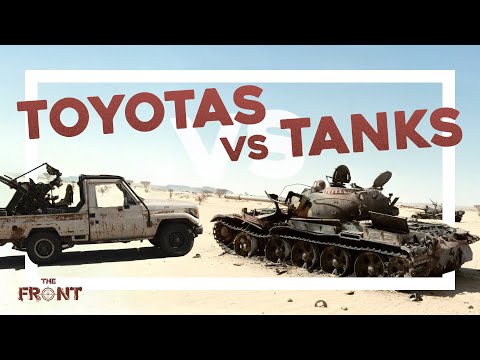
In the annals of military history, few conflicts are as bizarre as the one where pickup trucks took on tanks—and won. The Great Toyota War, the final phase of the Chadian-Libyan conflict, saw ragtag Chadian forces in Toyota Hiluxes and Land Cruisers rout Muammar Gaddafi’s heavily armored army. It was a showdown that defied all logic: a dictator’s lust for land and uranium, a ragtag army’s desperation, and the unlikely weapon that changed everything.
How did a poor African nation humiliate a military superpower? The answer lies in a story of ambition, resilience, and the unlikeliest of heroes: the Toyota pickup.
Muammar Gaddafi, Libya’s eccentric dictator, seized power in 1969 with dreams of grandeur. He eyed the Aouzou Strip, a barren chunk of northern Chad rumored to hold uranium. In 1972, he began meddling in Chad’s civil war, supplying rebels with weapons to gain a foothold. By 1975, he occupied the strip, but Chad’s new leaders wouldn’t back down.
Throughout the 1980s, the conflict simmered. Gaddafi poured troops and arms into Chad, backing northern rebels. He bought 7,000 soldiers, 60 aircraft, 300 tanks, and helicopters—a force that dwarfed Chad’s 5,000 poorly armed troops. But Libya’s army was disorganized, trained only to advise rebels, not to fight. Chad’s southern forces, though outgunned, were motivated and knew the terrain.
Then came the game-changer: France supplied Chad with 400 Toyota pickups—Hiluxes and Land Cruisers. These weren’t armored vehicles, but they were durable, easy to maintain, and could be fitted with heavy weapons. The Hilux, nicknamed the “Nokia of trucks,” was nearly indestructible. Soldiers needed no special training to drive them, and any mechanic could fix them.
In 1986, when Gaddafi’s rebel allies defected, the Libyans were left exposed. Chad’s forces, now doubled, saw their chance. On January 2, 1987, they launched a counteroffensive. At the battle of Fada, Toyotas swarmed around Libyan tanks, firing anti-tank guns with deadly precision. The Libyans were stunned—their armor was no match for the nimble trucks. In that first battle alone, Chad destroyed 100 tanks while losing just three Toyotas.
The victories kept coming. At the Ouadi Doum air base, Chadian forces overran 5,000 Libyan soldiers, capturing tanks, aircraft, and supplies. Within months, 3,000 Libyan soldiers were killed, captured, or deserted. Chad had reclaimed almost all its territory—except the Aouzou Strip.
But the fight wasn’t over. When Chad captured the town of Aouzou, they struggled to defend it without French air cover. Libya bombed them from the air, forcing a retreat after just 20 days. Yet the Chadians didn’t falter. They regrouped and planned a daring raid: a 200-kilometer drive into Libya to attack the Maaten al-Sarra air base.
The raid was a masterpiece of surprise. Undetected, they struck in one night, killing up to 1,700 Libyans, destroying 70 tanks and 30 aircraft, while losing only 65 men and a few Toyotas. The attack shocked the world—and terrified the French, who feared the conflict would escalate. Days later, France called for a ceasefire, and both sides agreed.
The war ended, but the legacy of the Toyota War was just beginning. The Aouzou Strip was eventually returned to Chad after a 1994 International Court of Justice ruling. And the Toyota Hilux became a legend, adopted by rebel groups and militaries across Africa and the Middle East.
But how did this unlikely victory shape modern warfare? And what does it say about the power of ingenuity against overwhelming odds? The story of the Toyota War is far from over.
The ceasefire of 1987 didn’t silence the guns entirely. In the months that followed, both sides licked their wounds, but the Aouzou Strip remained a festering wound. Gaddafi, humiliated by his defeat, refused to accept the loss of territory he considered Libya’s birthright.
Chad’s president, Hissène Habré, was equally determined. He knew that as long as Libya occupied the strip, his country’s sovereignty was incomplete. Diplomatic channels opened, but progress was glacial. Meanwhile, the world watched to see if the Toyota War would reignite.
Behind the scenes, the United States and France pressured both sides to negotiate. The Cold War was thawing, and Gaddafi’s influence in Africa was a growing concern. In 1989, Chad and Libya signed a framework agreement to resolve the dispute peacefully. But trust was thin, and skirmishes continued along the border.
The turning point came in 1990. A new Chadian government, led by Idriss Déby, took power. Déby, a former rebel commander, understood the cost of war. He pursued diplomacy with Libya, and in September 1990, both nations agreed to submit the Aouzou Strip question to the International Court of Justice.
The court’s ruling in 1994 was a decisive victory for Chad. The judges declared that the 1955 treaty between France and Libya, which had never been ratified, did not legally transfer the strip to Libya. The Aouzou Strip belonged to Chad.
Gaddafi, surprisingly, accepted the verdict. In a rare display of compliance, Libyan troops withdrew from the strip in 1994. The withdrawal was peaceful, and Chad regained its territory without firing a shot. It was a victory not of Toyotas, but of law and persistence.
But the story of the Toyota War didn’t end with the court’s ruling. Its echoes rippled outward for decades, reshaping how militias and armies alike thought about mobility, cost, and survival. The Hilux had proven that a cheap, reliable truck could be more valuable than a battalion of tanks in the right hands.
Military analysts began studying the conflict with renewed interest. Papers and documentaries dissected every battle, from Fada to Maaten al-Sarra. The term “technicals”—civilian trucks fitted with heavy weapons—entered the lexicon of modern warfare. What the Chadians had improvised out of necessity became a template for insurgencies across the globe.
Toyota, for its part, tried to distance itself from the association. Company executives insisted they built vehicles for peaceful purposes, not for war. But the market told a different story. In conflict zones from Somalia to Afghanistan, the Hilux became as iconic as the AK-47. Rebel commanders boasted about their fleets the way generals boasted about tanks.
Back in Chad, the victory became a national legend. Veterans of the Toyota War were celebrated as heroes. Schoolchildren learned how their country’s soldiers had outmaneuvered a superpower’s army with nothing but courage and pickup trucks. The story was told and retold, growing larger with each telling.
Yet the peace was fragile. Chad remained a poor, divided nation, and Habré’s rule grew increasingly brutal. In 1990, he was overthrown by Idriss Déby, the very man who would later secure the Aouzou victory through diplomacy. The irony wasn’t lost on observers: the war that had united Chad against Gaddafi had also armed the men who would tear it apart.
Déby, once a rebel backed by Libya, now found himself defending the same territory he had once helped Gaddafi covet. He understood the strip’s symbolic weight. When the ICJ ruled in Chad’s favor, he wasted no time in celebrating. But he also knew that the real battle—building a stable nation—was only beginning.
Gaddafi, meanwhile, never fully abandoned his ambitions. Though he withdrew from Aouzou, he continued to meddle in Chadian affairs, funding rebels and stirring dissent. His defeat in the Toyota War had wounded his pride, and he sought revenge in subtler ways.
The Libyan dictator’s obsession with Chad would haunt him for years. When his regime finally collapsed in 2011, some Chadian officials quietly celebrated. The man who had once sent tanks to conquer a desert strip had been toppled by his own people—in a revolution that, fittingly, made heavy use of pickup trucks.
Today, the Aouzou Strip is quiet. Its uranium deposits remain largely untapped, and its population is sparse. But the legacy of the Toyota War lives on—in military textbooks, in the design of insurgent tactics, and in the minds of every commander who has ever faced a better-equipped enemy.
The war also left a darker inheritance. The proliferation of armed pickups made conflicts cheaper to start and harder to end. What had once been Chad’s salvation became, in other hands, a tool of chaos.
Still, the story of the Toyota War endures as a testament to ingenuity. It reminds us that wars are not won by equipment alone, but by the people who fight them—and by the unexpected tools they choose to wield. Sometimes, a truck is more than a truck. Sometimes, it’s a revolution on four wheels.
The Toyota War had ended, but its lessons refused to fade. Military academies from West Point to Sandhurst dissected the battles, trying to bottle the lightning of Chad’s victory. Yet the real legacy wasn’t tactical—it was psychological. A poor nation had stared down a tyrant and won not with superior firepower, but with grit, improvisation, and a fleet of indestructible pickup trucks.
In the decades since, the Hilux became a symbol of resistance from the deserts of Mali to the mountains of Afghanistan. Rebel groups painted their Toyotas with slogans, named them after fallen comrades, and treated them like armored cavalry. The truck that once carried Chadian soldiers to victory now carried insurgents into battle from Syria to Somalia.
Toyota, the company, remained uneasy with its warlike reputation. Executives repeatedly stated they built vehicles for farmers, not fighters. But the market ignored them. In 2015, when ISIS paraded captured Hiluxes through the streets of Mosul, Toyota’s stock barely dipped. The truck was too useful, too durable, too ubiquitous to be tarnished by its users.
Back in Chad, the war’s heroes aged quietly. Some became generals, others faded into obscurity. The Aouzou Strip remained peaceful, its uranium still buried beneath the sand. But in the capital, N’Djamena, a small museum displayed a battered Hilux—its body riddled with bullet holes, its engine rusted but intact. A plaque read: “This truck survived Fada. It survived Maaten al-Sarra. It survived Libya.”
Historians still debate whether the Toyota War was a fluke or a revolution. Some argue it was the first true “technicals” conflict, where civilian vehicles became weapons of war. Others say it was simply a case of a disorganized enemy and a motivated defender. But the Chadians who fought there know the truth: it was about using what you had, not what you wished you had.
As for Gaddafi, he never forgot the humiliation. He spent the rest of his life trying to rebuild his image, funding wars and buying influence. But his defeat in Chad haunted him. When he was dragged from a drainage ditch in Sirte in 2011, some Chadians nodded knowingly. The man who wanted a desert strip had lost everything—and the trucks had won again.
The Toyota War is over, but its question lingers: can a simple machine outmatch a superpower’s army? The Chadians proved it once. Will anyone prove it again—or has the age of the pickup truck warrior finally passed?
Report this article
Select a reason for reporting:






