On March 7th, 1945, Adolf Hitler sat in his Berlin bunker, convinced that the Rhine River—Germany’s ancient barrier—would hold. His generals had assured him that every bridge was wired for demolition, the river swollen and unfordable, and that no foreign army had crossed it by force in 140 years. The Führer believed the Americans would bleed themselves white trying to breach this final obstacle. He was wrong.
Seven hundred miles to the west, a 22-year-old second lieutenant named Karl Timmermann stood on a bluff overlooking the Rhine at a small town called Remagen. He stared at something impossible: the Ludendorff Bridge was still standing. His commanding officer asked a simple question: “Do you think you can get your company across?” Timmermann, born in Frankfurt less than 100 miles away, gave an answer that would change history: “Well, we can try it, sir.”
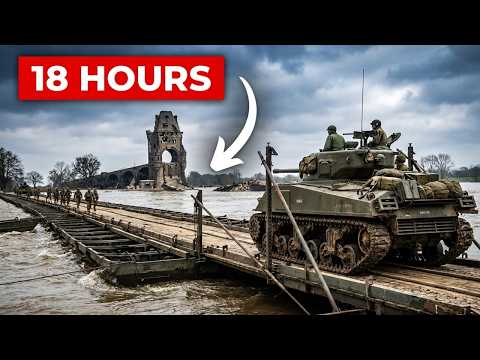
The German confidence in the Rhine ran deeper than military strategy—it was woven into the national identity. For nearly 2,000 years, the river had marked the boundary between Germanic civilization and its enemies. Roman legions had stopped at its banks. Napoleon had struggled to cross it. In March 1945, the Rhine stretched between 800 and 1,000 feet wide, its current running 5 to 7 feet per second, cold enough to kill an unprotected man in minutes. The United States Army Corps of Engineers had assessed it as totally unfordable. The Wehrmacht had prepared accordingly: every permanent bridge wired with demolition charges, 600 kg of military explosive at each crossing point, artillery registered on every approach. Field Marshal Gerd von Rundstedt assured Hitler that the Allies would need at least six weeks to establish a bridgehead—if they could establish one at all.
What the Germans failed to understand was that they were not facing a conventional army. They were facing an enemy that had spent three years perfecting the art of combat engineering across North Africa, Sicily, Italy, and France. The American army had developed equipment specifically designed to solve the problem the Germans considered unsolvable. The M2 steel treadway bridge used pneumatic floats made of rubberized fabric, each supporting 18 tons, connected to steel saddles that held 12-foot treadway sections—a road surface strong enough to carry Sherman tanks across water. A single engineer battalion could carry enough equipment to build 864 feet of floating bridge. Every specification had been calculated, tested, and refined through years of combat experience. The Germans knew none of this. They measured American potential by German standards and concluded the Rhine would hold. They were wrong about everything.
The first crack appeared on March 7th, 1945, at approximately 1530 hours. Sergeant Alexander Drabik of Company A, 27th Armored Infantry Battalion, became the first American soldier to cross the Rhine River since Napoleon’s time. He sprinted 398 meters across the damaged Ludendorff Bridge at Remagen, bullets snapping past his head, his helmet lost somewhere behind him. When he reached the far side, gasping for breath on German soil, he had done something the Wehrmacht High Command considered impossible.
The capture happened almost by accident. Combat Command B of the 9th Armored Division, led by Brigadier General William Hoge, had been advancing toward the Rhine with orders to reach the river and prevent German forces from escaping. No one expected to find a bridge still standing. But when American tanks crested the bluffs overlooking Remagen and spotted the Ludendorff Bridge intact, Hoge made the decision that would define his career. Hoge was an engineer officer, not an infantry commander. He had built the Alaska Highway through frozen wilderness and commanded engineers at Omaha Beach on D-Day. He understood bridges the way infantry officers understood rifles. Looking at the Ludendorff span, he recognized immediately what it meant. He later recalled that he felt inside him that he could never live with the knowledge that he had given up that opportunity without making a try for it.
Lieutenant Timmermann received the order to take his company across. He had been in command for less than 24 hours—his previous commander had been killed in action the day before. Now he was being asked to lead 100 men across a bridge that everyone expected to explode at any moment. When he asked Major Murray Deevers what would happen if the bridge blew up in his face, Deevers had no answer.
The Germans on the bridge were frantically trying to destroy it. Captain Willy Bratche, the bridge commander, had only 36 men to defend a span that required at least 200. Most of his experienced troops had been pulled away for other duties. The men remaining were a mixture of Volkssturm militia, walking wounded, and administrative personnel pressed into combat roles. Worse, the military explosives that should have been positioned at key structural points had been diverted to other locations along the Rhine. Bratche had only 300 kg of Donarite, a weak industrial explosive used for mining operations, instead of the 600 kg of military-grade demolition charges he had repeatedly requested. He had filed paperwork. He had made phone calls. He had been told the explosives would arrive soon. They never came.
Captain Karl Friesenhahn, the engineer officer responsible for the demolition preparations, had done what he could with inadequate resources. He had positioned the Donarite at points that should have brought the bridge down if the charges detonated properly. But Donarite was designed to fracture rock, not shatter hardened steel. Its explosive power was a fraction of what military charges would have delivered. At approximately 1540 hours, the Germans detonated their charges. The bridge shuddered. Debris flew into the air. A massive explosion echoed across the valley. American soldiers watching from the west bank saw the span rise and then, impossibly, settle back down. The Donarite had blown a crater in the roadway and damaged structural supports, but the bridge still stood.
Timmermann could not wait to see what would happen next. He led his men forward at a run. The bridge deck was covered with debris from the explosion. Planks had been torn up. Craters pocked the roadway. The span swayed slightly with each step, damaged structural members groaning under the weight of running men. Machine gun fire from the far towers raked the roadway. Rifle rounds cracked past the advancing soldiers. Men stumbled and fell—some hit, others simply losing their footing on the treacherous surface. Behind the infantry, three combat engineers followed with wire cutters and carbines. Lieutenant Hugh Mott, Staff Sergeant John Reynolds, and Sergeant Eugene Dorland moved along the span, cutting every wire they found, pulling fuses from demolition charges, throwing explosive packages into the river below. The Germans had planted backup charges throughout the structure, insurance against the primary demolition failing. Mott and his engineers raced to neutralize them before the Germans could trigger a secondary detonation. When Dorland found a cable too thick for his wire cutters, he unslung his carbine and fired three shots into it, severing the line. The engineers worked with desperate speed, knowing that at any moment another charge might detonate and send the bridge and everyone on it into the Rhine.
The crossing took fewer than 15 minutes. By 1600 hours, American infantry held both ends of the Ludendorff Bridge. Within 24 hours, 8,000 soldiers had crossed the Rhine. Supreme Allied Commander General Dwight Eisenhower received the news during dinner and immediately redirected five divisions to exploit the bridgehead. General Omar Bradley’s reaction captured the moment perfectly when he spoke to General Courtney Hodges: “Hot dog, Courtney. This will bust him wide open. Shove everything you have got across it.”
The men of the 9th Armored Division erected a sign at the bridge entrance. It read, “Cross the Rhine with dry feet, courtesy of the 9th Armored Division.” Thirteen soldiers received the Distinguished Service Cross for the capture. One hundred fifty-two received the Silver Star. The bridge that German planners had promised would never fall to enemy hands had fallen in less than an hour.
Hitler’s reaction was immediate and catastrophic. When Alfred Jodl informed him of the bridge’s capture on March 8th, the Führer flew into a rage that shocked even his inner circle. He sacked Field Marshal von Rundstedt as Commander-in-Chief West, replacing him with Field Marshal Albert Kesselring, who arrived at his new headquarters and told his staff that he was the new V3—a dark joke about Germany’s supposed wonder weapons. Hitler then appointed a general named Rudolf Huebner to lead what he called a flying special court-martial west, a mobile tribunal with its own firing squad, tasked with executing anyone deemed responsible for the disaster. Four German officers were tried, convicted, and shot by firing squad. Major Hans Scheller, 31 years old with a pregnant wife at home, died alongside Major August Kraft, Major Herbert Strobel, and Lieutenant Karl-Heinz Peters. All four were buried together at Bernbach. Field Marshal Walter Model, commanding Army Group B, stated plainly that all four men were completely innocent. Another general, Richard von Bothmer, being tried for surrendering Bonn, grabbed a pistol from the courtroom table and shot himself rather than face the same fate. The executions accomplished nothing. They could not undo what had happened at Remagen.
American engineers were already building replacement bridges to supplement the damaged Ludendorff span, working around the clock under conditions that tested the limits of human endurance. Lieutenant Colonel David Pergrin received orders to build an M2 steel treadway bridge from Remagen to Erpel on the eastern bank. He was 27 years old, a Penn State civil engineering graduate who had played football as a Nittany Lion. His 291st Engineer Combat Battalion had been building bridges across Europe since Normandy. But when Pergrin surveyed the site at Remagen, he was, in his own words, dumbstruck by the enormity of the task. The bridge would need to span 1,032 feet, making it the longest tactical bridge ever constructed under combat conditions. The Rhine’s current at this point ran strong enough to sweep pontoons downstream if they were not properly anchored. German artillery had the site zeroed in. Enemy aircraft attacked constantly. Snipers on the eastern heights picked off engineers whenever they exposed themselves.
Construction began at approximately 0830 hours on March 9th under cold, rainy, overcast skies. The temperature hovered just above freezing. A light drizzle fell continuously, making the steel treadway sections slippery and difficult to handle. The engineers worked in teams, each group responsible for a specific section of the span. They inflated pneumatic floats using truck-mounted air compressors, the machinery roaring as it pumped air into the rubberized fabric. Then they maneuvered the floats into position using cables and small boats, fighting against the Rhine’s relentless current that tried constantly to sweep the pontoons downstream. Steel saddles went atop each float. Twelve-foot treadway sections locked together to form the road surface. One-hundred-pound kedge anchors dropped upstream to hold the structure against the current. The work required extraordinary physical strength. Each treadway section weighed hundreds of pounds. The engineers manhandled the steel in freezing conditions, their hands going numb from cold water and metal. They worked waist-deep in the Rhine, holding positions against the current while others locked sections into place. The specialized trucks lined up on the west bank, feeding a continuous stream of equipment to the construction crews. The forward attachment point became known as Suicide Point. German shells exploded among the working parties with terrible regularity. Around 1300 hours on March 9th, a direct artillery hit killed one engineer and wounded five more. Shell fragments punctured pontoon floats. Shrapnel tore through equipment. The engineers kept working.
By the time the bridge was completed at approximately 1710 hours on March 10th, 35 casualties had been suffered from artillery, sniper fire, and bombing. During one particularly intense barrage, 17 engineers were killed or wounded and 19 pontoon floats were destroyed. But the 291st had done what the Germans believed impossible. They had built a floating road across the Rhine in approximately 32 hours under continuous enemy fire. A sign went up at the bridge entrance. It read, “The longest tactical bridge built first across the Rhine, constructed by the 291st Engineer Combat Battalion and the 998th Treadway Bridge Company.”
Simultaneously, other engineer units built additional spans. Lieutenant Colonel Harvey Fraser and the 51st Engineer Combat Battalion constructed a reinforced heavy pontoon bridge from Kripp to Linz, two miles upstream. This 969-foot span used 60 aluminum alloy boats from the 181st and 552nd Engineer Heavy Pontoon Battalions, along with 57 rubber floats. Construction was ordered to begin at 1600 hours on March 10th before the far shore was fully secure. Major Robert Yates had everything staged, including six smoke pots for a protective screen. Despite the smoke, six rounds of heavy artillery immediately hit the site. Engineers worked behind the protective screen while German warplanes bombed and strafed. Three men were killed and two injured. The bridge was completed at 1900 hours on March 11th, just 27 hours after construction began—the fastest floating bridge ever completed under fire up to that point.
The 276th Engineer Combat Battalion worked on repairing the Ludendorff Bridge itself and built a 140-foot double Bailey bridge at the near shore approach. Their executive officer, Major James Foley, was killed by a direct artillery hit on the night of March 10th.
The Germans threw everything they had at the bridges. The Luftwaffe sent 367 aircraft against the Remagen crossing over 10 days. Initial attacks using Stuka dive bombers were annihilated by American anti-aircraft batteries, establishing immediately that low-altitude bombing was suicidal. The Americans had learned hard lessons about air defense in the years since Pearl Harbor. They had massed guns around the bridgehead in concentrations that made the sky lethal for any aircraft flying below 10,000 feet. The Germans escalated to jet aircraft. Arado 234 jet bombers carrying 1,000 kg bombs attacked alongside Messerschmitt 262 fighter bombers. These were Germany’s most advanced combat aircraft, flying faster than any Allied fighter could intercept. But speed alone could not solve the accuracy problem. Releasing a bomb at 500 mph from several thousand feet meant the weapon would fall far from its target if the aim was off by even a fraction of a degree. And the German pilots, attacking through curtains of anti-aircraft fire while traveling faster than any aviator had ever flown in combat, could not achieve the precision necessary to hit a bridge. On March 13th alone, the Luftwaffe flew 90 sorties against the bridges, including 19 jet bomber missions. It was one of the largest concentrated air attacks of the Western Front campaign. The Americans responded by concentrating the largest assembly of anti-aircraft weapons in the history of warfare at the Remagen bridgehead. By March 13th, 672 anti-aircraft weapons defended the site, including 16 gun batteries and 33 automatic weapons batteries. Army records describe the engagements as the greatest anti-aircraft artillery battles in American history. Five Messerschmitt 262s were shot down on March 13th alone.
When conventional attacks failed, Hitler ordered unconventional measures. On March 14th, he commanded the launch of V2 rockets against the Remagen Bridge—the first time the ballistic missiles had been used against a tactical target, and the only time they were ever fired at a German target. On March 17th, a battery at Hellendoorn in the Netherlands fired 11 V2s at the bridge. The weapons, designed for area bombardment of cities, proved grotesquely inaccurate against a small target. Missiles landed as far away as Cologne, 64 kilometers to the north. The closest hit struck 270 meters from the bridge, destroying the command post of the 284th Engineer Combat Battalion and killing three American soldiers. Germany also deployed the Karl Gerät, a 124-ton super-heavy mortar that fired shells weighing over 2,000 kg. Karl Battery 628 arrived on March 20th and fired 14 rounds of 1,250 kg shells. Every single one missed every bridge, damaging nothing but random houses in the surrounding area.
Perhaps the most desperate German countermeasure involved seven SS frogmen dispatched by Otto Skorzeny on March 17th. These swimmers from the Kampfschwimmergruppe carried 28 packages of plastic explosives and Italian underwater breathing apparatus. They entered the water 17 kilometers upstream, floating downstream on oil drums toward the bridges. The Americans detected them using 13 million candlepower searchlights mounted on modified tanks from the 738th Tank Battalion—a top secret weapon system being used operationally for the first time. Two frogmen died of hypothermia in the 7°C water. Two were killed by gunfire. Three were captured. Not a single charge reached any bridge. The 164th Engineer Combat Battalion’s log and net booms upstream intercepted floating mines and explosive barges.
German artillery remained the only weapon capable of inflicting significant damage. More than 100 artillery pieces, including 5 105-mm guns, 5 150-mm guns, and 12 210-mm howitzers, hammered the bridgehead continuously. A German forward observer had infiltrated Remagen itself and was calling in accurate fire. On March 9th, artillery hit an ammunition truck on the Ludendorff Bridge, blowing a 15-foot hole in the deck that engineers had to repair under fire.
Despite everything Germany threw at them, the bridges held. Traffic flowed continuously. Tanks, trucks, artillery pieces, and infantry poured across the Rhine into the German heartland. The barrier that had protected Germany for 2,000 years had been breached.
On March 17th at approximately 1500 hours, engineers working on the Ludendorff Bridge heard a sharp cracking sound. Rivets were snapping. The massive arch of the original span buckled and collapsed, taking adjoining sections and approximately 200 engineers into the icy Rhine. Private John Morgado of the 276th Engineer Combat Battalion witnessed the collapse. “When it came down, the noise and the sight of the falling soldiers was very frightening. I was afraid that the rest of the bridge would go, and all of us would meet the same end.” “I looked down to see the men, several of whom I knew, trying to keep their heads above the water, but because they had on heavy gear and the river was swift, many did not survive.” The collapse killed 28 engineers and injured 63. The 276th suffered devastating losses, including their executive officer, two company commanders, three platoon leaders, and six platoon sergeants. Major William Carr of the 1058th Engineer Port Construction and Repair Group was among the dead. Lieutenant Colonel Clayton Rust fell into the water but survived. The structural failure resulted from cumulative damage. The March 7th German demolition charge had broken a critical bottom chord in the upstream truss, compounded by the added weight of timber decking, continuous heavy traffic from March 7th through 12th, and vibrations from repair work.
But the collapse did not matter, not strategically. By March 17th, the Americans had already completed the Treadway Bridge, the heavy pontoon bridge, and additional spans. Within three hours of the Ludendorff’s collapse, engineers began constructing a floating Bailey Bridge to replace the lost span. They completed the 1,258-foot structure on March 20th. The bridgehead continued to expand. By the time the breakout came on March 25th, 18 days after the original capture, more than 125,000 troops in six divisions with tanks, artillery, and trucks had crossed at Remagen.
While the drama at Remagen captured headlines, another crossing was taking shape 60 miles to the south that would prove equally significant. General George Patton had been watching the Remagen situation with barely concealed jealousy. His Third Army had been racing toward the Rhine, and Patton was determined to cross before Field Marshal Bernard Montgomery launched his meticulously planned Operation Plunder to the north. On the morning of March 22nd, Patton’s 12th Corps reached the Rhine near the towns of Oppenheim and Nierstein. What happened next demonstrated American combat engineering at its absolute peak.
At 2200 hours on March 22nd, the Fifth Infantry Division launched an assault crossing with approximately 200 boats. There was no preliminary artillery bombardment, no aerial bombing, no smoke screens. The operation, sometimes called the silent crossing, represented a calculated gamble that surprise would succeed where firepower might have failed. Major General LeRoy Irwin, commanding the Fifth Division, had studied the German positions carefully. He knew their defenses were thin, spread along miles of river with too few men to cover every possible crossing point. He also knew that a conventional attack with artillery preparation would alert every German unit within 50 miles. The Fifth Division had practiced assault crossings throughout their advance across France and Germany. The men knew how to paddle the boats, how to maintain silence, how to hit the far bank and move inland before the enemy could organize a response. This was not their first river. It was simply their largest. A diversionary feint by the 90th Infantry Division at Mainz drew German attention away from the actual crossing site. The 90th made noise, fired weapons, launched a few boats with great fanfare, all designed to make the Germans think the main attack was coming at Mainz. It worked. By the time German commanders realized the actual crossing was happening at Oppenheim and Nierstein, six American battalions were already on the east bank. The assault cost a total of only 20 casualties killed and wounded. It was one of the most economical river crossings of the war.
The engineering operation that followed set records that still stand. The 249th Engineer Combat Battalion, commanded by Colonel John Addison and operating under the 1135th Engineer Combat Group, led by Colonel Alfred Starbird, began constructing a floating pontoon bridge on the evening of March 22nd. The Rhine at this point stretched approximately 980 feet wide with a swift, cold current. They finished in 18 hours. Three hundred sixty-six meters of floating bridge across one of the great rivers of Europe completed overnight while German forces were still trying to understand what was happening. Two additional bridges followed rapidly. The 150th Engineer Combat Battalion constructed a Class 40 M2 Treadway Bridge at Oppenheim, completing it by 1800 hours on March 23rd. A third bridge, 1,280 feet of Class 24 span, was finished on March 24th and later upgraded to handle heavier traffic. Together, these three bridges became a massive artery into Germany. During the period of March 24th through 31st, more than 60,000 vehicles crossed the Oppenheim and Nierstein bridges. By March 27th, five full divisions with supporting troops and supplies had passed over the spans. The entire Sixth Armored Division crossed in less than 17 hours. Navy boat units ferrying troops between the bridges moved over 15,000 men and 1,200 vehicles in just three days.
Patton could not contain his excitement. On the morning of March 23rd, he phoned General Omar Bradley with news of the crossing. “Brad, do not tell anyone, but I am across. There are so few Krauts around there, they do not know it yet.” By evening, his tone had changed completely. “For God’s sake, tell the world we are across. I want the world to know that Third Army made it before Monty starts across.” On March 24th, crossing his pontoon bridge at Nierstein, Patton halted halfway across the span. He urinated into the Rhine River while an Army photographer captured the moment. Reaching the east bank, he deliberately stumbled, picked up two handfuls of German soil, and exclaimed, “Thus, William the Conqueror.” Imitating William’s famous recovery after falling upon landing in England in 1066, he wrote to his wife that night with unusual humility, “I am scared by my good luck.”
Montgomery had launched Operation Plunder the previous evening, March 23rd at 2100 hours—the set piece crossing he had been planning for months. The contrast with Patton’s improvised crossing could not have been starker. Where Patton had relied on surprise and speed, Montgomery relied on overwhelming force and meticulous preparation. Both approaches worked, but they revealed fundamentally different philosophies of warfare.
The statistics of Operation Plunder reveal the scale the Allies had achieved by this point in the war. Over one million troops and more than 30 divisions participated. Preparations required 250,000 tons of supplies, including 60,000 tons of British ammunition and 30,000 tons of engineer material. The British had stockpiled 25,000 wooden pontoons, 2,000 assault boats, 650 storm boats, and 120 river tugs. Approximately 60,000 British, Canadian, and American engineers worked on preparations. Roads had been improved and new routes constructed to handle the massive flow of men and material to the riverbank. The opening bombardment used between 3,500 and 5,500 Allied guns firing along a 25-mile front. The artillery preparation began at 1600 hours and continued through the night, pounding German positions with high explosive and smoke rounds. The noise was audible for dozens of miles. Residents of towns far from the front knew something massive was happening.
Operation Varsity, the supporting airborne operation, dropped over 20,000 paratroopers using 1,625 transport aircraft and 1,348 gliders—the largest single-day airborne operation of the entire war. The paratroopers landed east of the Rhine to seize key terrain and prevent German reinforcements from reaching the crossing sites. Unlike the scattered drops at Normandy, Varsity achieved concentrated landings that allowed the airborne forces to accomplish their objectives quickly.
Bridge building records fell repeatedly during the broader Rhine crossings. At Wesel on March 24th, the 17th Armored Engineer Battalion laid an 1,152-foot M2 Treadway Bridge using 93 pneumatic floats in just 6 hours and 15 minutes—a record for a bridge of that size. At Honnef the 254th Engineer Combat Battalion built the 1,372-foot Victor Bridge in 12 hours, working from both banks simultaneously, creating what was called the longest tactical bridge in the world. The Jackpot Bridge in the Bonn area took 16 hours and 45 minutes for 1,145 feet of span. By March 28th, the Ninth Army alone had 12 bridges spanning the Rhine, establishing a bridgehead 35 miles wide and 12 miles deep.
Winston Churchill visited the Rhine on March 25th, crossing by boat with Montgomery. He recorded in his memoir that they landed in brilliant sunshine and perfect peace on the German shore and walked about for half an hour or so unmolested. He returned on March 26th, walking across a Bailey bridge at Xanten with Montgomery, Field Marshal Alan Brooke, and General William Simpson. Churchill called the crossings the last great heave of war.
The Rhine crossings precipitated the fastest military collapse in modern European history. Once American and British forces established themselves east of the river, German resistance simply disintegrated. The Wehrmacht that had conquered France in six weeks in 1940 was now collapsing even faster. Units that had fought tenaciously in the Ardennes and along the Siegfried Line simply melted away. Soldiers surrendered in groups of dozens, then hundreds, then thousands. The German army was dying, not from lack of courage, but from lack of everything else. Fuel, ammunition, food, and above all, hope.
The timeline from Rhine crossing to German surrender compressed with stunning speed. On March 7th, the Remagen Bridge was captured. Within 24 hours, 8,000 troops were across. On March 22nd through 24th, Patton and then Montgomery crossed the Rhine at multiple points. By March 25th, the Remagen bridgehead broke out and all four American armies stood east of the Rhine by month’s end. Frankfurt fell on March 29th. Mannheim and Heidelberg followed within days. German cities that had never heard hostile gunfire since the Thirty Years’ War now saw American tanks rolling through their streets. On April 1st, the First and Ninth Armies linked up near Lippstadt, completing the encirclement of the Ruhr Pocket and trapping 370,000 German soldiers of Army Group B. This was the largest encirclement of German forces on the Western Front. On April 11th, American forces reached the Elbe River within 60 miles of Berlin. The advance had been so rapid that supply lines struggled to keep up. Tankers outran their fuel. Infantry outpaced their rations. But the momentum was irresistible. German units that tried to stand and fight were destroyed. Units that tried to retreat found American armor already behind them. The front had ceased to exist in any meaningful sense. There were only pockets of resistance, quickly surrounded and reduced.
On April 15th, Field Marshal Model dissolved Army Group B rather than surrender. He knew the Nuremberg trials were coming. He knew what awaited German commanders who had carried out Hitler’s orders. He told his staff that a field marshal did not become a prisoner and gave each man permission to escape, surrender, or fight as his conscience dictated. On April 18th, the Ruhr Pocket surrendered, yielding 317,000 prisoners, including 24 generals—the largest single German surrender in Western Europe. Model could not face capture. On April 21st, he walked into a forest near Duisburg and shot himself. His last words reportedly were, “A field marshal does not become a prisoner. Such a thing is just not possible.”
American and Soviet troops met at the Elbe on April 25th. Hitler committed suicide on April 30th. Germany surrendered unconditionally on May 8th, V-E Day—exactly two months and one day after Sergeant Drabik sprinted across the Ludendorff Bridge at Remagen.
The prisoner statistics tell the story of total collapse. In March 1945, Western Allied forces captured Germans at a rate of 10,000 per day. In the first 14 days of April, this rose to 39,000 per day. In the final 16 days of April, it peaked at 59,000 per day. Total German prisoners in March and April exceeded 1.8 million, more than double the 800,000 who surrendered to the Soviets in the same period. Before the Rhine crossings even began, 280,000 German troops had been captured and another 120,000 killed, wounded, or missing fighting west of the river, largely because Hitler had forbidden retreat behind it.
German commanders understood exactly what the Rhine crossings meant. General Carl Wagener, Model’s chief of staff, stated plainly that Remagen should have been considered a basis for termination of the war. It provided an ideal springboard for the coming offensive east of the Rhine. Hermann Göring admitted that the capture of the bridge made a long defense impossible. Kesselring himself called it the crime of Remagen, saying it broke the front along the Rhine. And German generals told their interrogators simply, “Remagen killed us.”
The men who built the bridges that broke Germany returned to ordinary lives after the war. Lieutenant Colonel Pergrin went back to Pennsylvania, where as class president he had led the committee that commissioned the Nittany Lion Shrine at Penn State before the war. He wrote a memoir about his battalion’s experiences and lived until 2012. Colonel Addison, who commanded the battalion that built the 18-hour bridge at Nierstein, returned to civilian engineering. The 249th Engineer Combat Battalion, redesignated over the decades, still exists today in the Army’s force structure. Its lineage traced directly back to those hours on the Rhine.
Karl Timmermann, the young lieutenant who led the first crossing at Remagen, came home without fanfare. He stepped off a train in West Point, Nebraska, and walked into town carrying his barracks bag. His mother, Mary, a waitress at the Goldenrod Cafe, had received a call from the Omaha World-Herald on the day of the crossing. Reporters told her that her son was the first officer to cross the Rhine since Napoleon. Her response captured a mother’s priorities perfectly. “Napoleon, I do not care about. How is my Karl?” Timmermann died of cancer on October 21st, 1951, at the age of 29.
Sergeant Alexander Drabik, a butcher from Holland, Ohio, who had become the first American soldier to cross the Rhine, returned to his hometown and lived quietly for decades. He rarely spoke of his wartime service. When asked about that day in March, he offered only brief, modest answers. “We ran down the middle of the bridge, shouting as we went. I did not stop because I knew that if I kept moving, they could not hit me.”
The Rhine Crossing Memorial at Nierstein, dedicated on March 25th, 2017, contains copper plaques listing the units and commanders who achieved the crossing. Robert Shallato attended that dedication as the last known living veteran of the Nierstein crossing—a final witness to one of the great engineering feats of the 20th century.
The story of the Rhine crossings carries lessons that extend far beyond military history. German commanders looked at the river and saw an impregnable barrier. They calculated currents and widths and temperatures. They counted bridges and demolition charges. They measured everything that could be measured and concluded that crossing the Rhine would require months of preparation and cost tens of thousands of lives. They failed to measure what mattered most. American combat engineers had spent years perfecting techniques that German planners never studied. They had developed equipment that solved problems the Germans considered unsolvable. They had trained young officers and sergeants to make decisions under fire, to improvise solutions when plans failed, to keep working when shells were falling around them. Most importantly, they had developed an institutional culture that rewarded initiative and forgave honest mistakes. When Brigadier General Hoge saw the Ludendorff Bridge still standing, he did not wait for permission from higher headquarters. He acted. When Lieutenant Timmermann was ordered to take his company across a bridge that might explode beneath his feet, he led from the front. When Sergeant Drabik reached the far bank of the Rhine, he did not stop to consolidate. He kept moving, kept pushing, and kept exploiting the opportunity.
The Germans, by contrast, had created a system that punished initiative and demanded blind obedience. The officers buried at Bernbach had not failed through cowardice or incompetence. They had failed because the Wehrmacht’s own bureaucracy had failed to deliver the explosives needed to destroy the bridge. They died because Hitler needed scapegoats more than he needed honest assessments of what had gone wrong. This was the fatal flaw in German thinking. They believed that barriers could hold back an enemy with superior resources and superior adaptability. They trusted in obstacles rather than in the ability of their own people to overcome challenges. When those obstacles failed, they had no response except rage and recrimination.
The American approach was different. Obstacles were problems to be solved. Rivers were engineering challenges. Every barrier had a weakness, and finding that weakness was simply a matter of training, equipment, and determination. The Rhine had stopped armies for 2,000 years. American combat engineers bridged it in hours.
The bridges are gone now. The Ludendorff Bridge collapsed and was never rebuilt. Its stone towers still stand on either bank at Remagen, preserved as a peace museum. The pontoon spans were dismantled after the war and shipped away. The treadway bridges were taken apart and moved to other construction sites. Their steel sections reused for peacetime projects. Today, modern highway bridges cross the Rhine at Remagen and Nierstein, carrying commuter traffic where tanks once rolled and shells once fell. Tourists cruise past the crossing sites on riverboats, admiring the castles and vineyards, rarely knowing what happened in those waters eight decades ago. But the achievement endures in military engineering doctrine, in the training manuals still used by combat engineers, in the institutional memory of units that trace their lineage back to those desperate days in March 1945.
General George Marshall called it American initiative and adaptability at its best. Eisenhower reflected that the traditional defensive barrier to the heart of Germany was pierced, and the final defeat of the enemy was suddenly in our minds just around the corner. The history books remember the generals and the grand strategy. They should also remember the sergeants and lieutenants, the men who built bridges under fire and ran across spans that might explode at any moment. They should remember David Pergrin and John Addison, Alexander Drabik and Karl Timmermann, Hugh Mott and Eugene Dorland. These were the men who turned the impossible into the inevitable. Germany’s last natural barrier fell not to some secret weapon or brilliant strategy, but to the simple, stubborn competence of young men with tools and training and the will to use them. The bridge they built in 18 hours carried 60,000 vehicles into Germany. Six weeks later, the war in Europe was over.
Today, the stone towers of the Ludendorff Bridge stand silent on either bank at Remagen, preserved as a peace museum. Tourists photograph the vineyards and riverboats, rarely knowing what happened in these waters eight decades ago. But the achievement endures—in engineering doctrine, in training manuals, in the institutional memory of units that trace their lineage to those desperate days.
The history books remember the generals and the grand strategy. They should also remember the sergeants and lieutenants, the men who built bridges under fire and ran across spans that might explode at any moment. Germany’s last natural barrier fell not to some secret weapon, but to the simple, stubborn competence of young men with tools and training and the will to use them. The bridge they built in 18 hours carried 60,000 vehicles into Germany. Six weeks later, the war in Europe was over.
What do you think was the single most decisive factor at Remagen—the German failure to destroy the bridge, or the American willingness to seize the moment?
Report this article
Select a reason for reporting:






