The American pilots wrote insulting songs about it. The British took one look and sent theirs back. Its engine was in the wrong place, its cannon where the engine should be, and you had to climb in through a car door and roll down the window by hand. On paper, the Bell P-39 Airacobra was a joke. Yet one man used it to shoot down more enemy aircraft than any pilot flying an American fighter in the entire war. He flew for Stalin. This is the contradiction: a fighter built backwards, rejected at home, then turned deadly somewhere else entirely. Why?
To understand how a fighter gets built backwards, you have to start with the thing almost nobody notices at first—not the engine, but the cannon. In the mid-1930s, an American company called American Armament Corporation, a subsidiary of Oldsmobile, had a massive weapon: a 37mm cannon. It was about 8 feet long, weighed around 200 pounds, and fired a shell roughly the size of your fist. Nothing like it flew in any fighter anywhere in the world, and a young designer at a smaller company saw it and decided he had to build an airplane around it.
That company was Bell Aircraft. It had only existed since 1935, run by a man named Larry Bell out of Buffalo, New York. In 1937, it had nothing to speak of—no famous fighter, no reputation, just a small team that needed to do something no one else had done to get noticed. The chief designer was Robert Woods. Working under him was a designer named H.M. Poyer, and Poyer was the one most captivated by that giant Oldsmobile cannon.
Larry Bell knew something about betting everything on being different. He had spent years as a senior official at Consolidated Aircraft in Buffalo, and when Consolidated packed up and moved across the country to San Diego in 1935, Bell stayed put and founded his own company from what they left behind. A company like his couldn’t survive by building a slightly better version of what others already made. It survived by building the airplane no one else would dare to.
So an aircraft arranged around a cannon, with the engine buried in the middle and the pilot sitting above a driveshaft, wasn’t a problem they could be talked out of. It was the whole point.
Here’s the problem, and it’s the entire story compressed into one sentence: you can’t put a cannon that size in a normal fighter. A normal fighter of that era had its engine up front with the propeller mounted on the front of the crankshaft. If you wanted cannon armament, you put them in the wings, or you crammed smaller ones into the cowling and used a timing mechanism to fire between the spinning propeller blades. That worked perfectly well for machine guns. It even worked with a small 20mm cannon buried inside the engine firing its shells through a hollow propeller shaft. But this cannon was too big to fit any of that. It was too long, too heavy, and it had to be mounted rigidly and exactly on the centerline or it would never shoot accurately.
There was simply no room for it in a nose already packed with an engine. And Poyer would not let the cannon go.
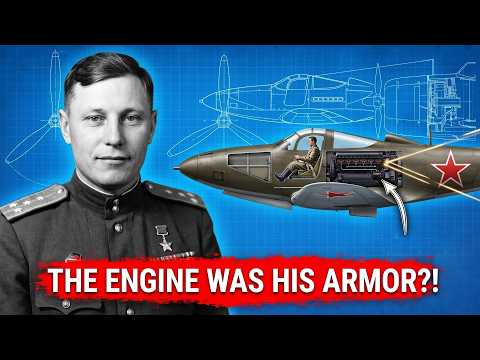
So Woods and his team did something almost no one had tried. They took the engine out of the front and put it in the middle of the aircraft, right behind the pilot’s back. Then they ran a driveshaft forward—a long steel shaft passing under the cockpit floor and between the pilot’s legs to turn a propeller that was no longer anywhere near the engine. That single decision is the answer to the whole title. The engine went behind the pilot because the cannon took over the front. One forced the other. It wasn’t an aesthetic choice or a publicity stunt. It was the only way to carry the weapon the designers refused to give up.
And once you commit to something that extreme, other strange things suddenly become possible. With the nose free of an engine, Bell could put a wheel somewhere no fighter had ever had one: directly under the nose. The P-39 got tricycle landing gear—three wheels with one up front—at a time when nearly every fighter in the world rested on its tail with a tiny wheel in back, nose pointing at the sky, the pilot unable to see directly ahead while taxiing. The Airacobra sat level. You could see where you were going. You entered through a side door like a car, and you could roll down the window by hand.
There was a hidden advantage too. With a heavy engine near the center of the aircraft instead of hanging out front, all that mass was concentrated near the middle. That made the airplane a wonderfully stable gun platform and gave it a quick, precise response that pilots later loved at low altitude. But every advantage in this machine came with a cost, and this was no exception. With the weight concentrated and the balance shifted, a slight error could send the P-39 into a violent flat spin that was genuinely hard to recover from. The same clever design that made it deadly could also kill the man flying it. Keep that thought. We’ll come back to it.
For the pilot, all of this made the Airacobra unlike anything else in the air. He sat up front under a glass bubble with a clear view over the nose, a driveshaft spinning beneath his seat, and over a thousand pounds of hot engine behind his back. The car doors that seemed so civilized on the ground had a darker side in the sky. You couldn’t simply shove the canopy back and bail out quickly. You had to claw your way out through a door in an aircraft that might be spinning and falling, and every pilot who flew it knew that.
In October 1937, the Army requested a single prototype and designated it XP-39. When it flew in the spring of 1939, it looked like the future had arrived early. Because this first machine had something the production aircraft never would: a turbo-supercharger.
Here’s what that actually means, away from the jargon. An engine breathes air, and the higher you go, the thinner the air, and the less power the engine can make. A supercharger fights that by cramming air into the engine under pressure. A turbo-supercharger does that cramming using the engine’s exhaust gases to drive it, and it’s especially good at preserving power at high altitude where the air is thinnest. The prototype had one, and the result proved it. Reports suggest that early XP-39 reached about 390 miles per hour at 20,000 feet. For 1939, that was astonishing.
But here’s the first crack in the story. That prototype was cheating a little. It was light. It carried no armament, no armor, no protection of any kind. It weighed almost a ton less than a real combat-ready fighter would. The speed was real. But the airplane that achieved it was not ready.
Still, the head of the Army Air Corps, General Henry Hap Arnold, was desperate for a fast, modern fighter, and he wanted more. He wanted over 400 miles per hour. So in June 1939, he sent the prototype to the country’s best aerodynamic minds at the NACA, the government research body that would one day become NASA, and asked them to reduce drag. That decision, made to improve the aircraft, is what quietly ruined it.
NACA put the XP-39 in a giant wind tunnel and examined it inch by inch. They found drag in many places and recommended a long list of fixes. Make this streamlined, shrink that, move the radiator intakes to the wing roots, lower the cockpit, tuck the wheels in tighter. Good, sound engineering. But one recommendation, paired with a decision the Army was already leaning toward on its own, ripped the heart out of the aircraft.
They removed the turbo-supercharger.
On paper, it made sense. The turbine and all its ducting created drag, added weight, complicated the design, and gave mechanics something extra troublesome to maintain. Removing it made the aircraft cleaner, lighter, and simpler, and the Army had convinced itself it didn’t really need high-altitude performance anyway. The prevailing logic was that the United States was protected by two oceans, that no enemy bomber fleet would come flying high over American cities. So why obsess over a fighter tuned for the top of the sky?
And so the rebuilt prototype, now called XP-39B, got a different Allison engine with a modest single-stage supercharger geared for low altitude. At low altitude, it performed well. But up high, above roughly 15,000 feet, the aircraft’s performance fell apart. Power faded away entirely where the air war over Western Europe would be decided, in the thin, cold air at 25 and 30 thousand feet.
The engineers had solved the drag problem. And in doing so, they had amputated the aircraft’s future across half the sky.
Here’s the bitter part. The Army had asked for the exact opposite. In 1937, it had issued a requirement for a high-altitude interceptor, a fast-climbing fighter that could race up and hit incoming bombers in their own element, high up. That was the aircraft the turbocharged prototype was chasing. So the same Army that asked for a fighter to win in the heights approved ripping out the only piece that let it fight there. The aircraft was born for high altitude, then deliberately nailed to the ground.
Then the facts started arriving in reports. The first production version, the P-39C, of which only 20 were built, came out without armor and without self-sealing fuel tanks. Combat over Europe in 1940 and 1941 was teaching everyone the same harsh lesson. An unprotected fighter is a flying coffin. One bullet in a standard fuel tank could turn the aircraft into a fireball in seconds. So Bell had to go back and install armor plating and fit self-sealing tanks—rubber-lined tanks that could plug bullet holes themselves—and add more guns in the wings. Every bit of that saved lives. Every bit of it also added weight.
And weight was the one thing this aircraft, stripped of its high-altitude engine, could not afford. Every pound of armor made it slower to climb and worse in a fight, especially at the altitudes where it was already gasping for air.
The British requested the Airacobra hoping for an unstoppable fighter. They briefly introduced it into service with one squadron in 1941, test-flew it, and came away bitterly disappointed with its high-altitude performance and handling quirks. They returned most of theirs or passed them along. The Americans got their answer in the Pacific, and that answer arrived in the worst possible way.
A batch of Airacobras built to the original British order, a version called the P-400, came back into American hands and was rushed to Guadalcanal in 1942 to join the mix of aircraft the Marines called the Cactus Air Force. Japanese bombers came in high, above 20,000 feet. The P-39s and P-400s struggled to climb to that altitude and simply couldn’t get there in time. By the time they arrived, laboring upward, the bombers had finished their run and left. The pilots were furious, but at low altitude those aircraft were genuinely valuable, strafing troops and barges and hitting targets in support of the men defending the island.
Even here, half a world away from Russia, the pattern was already showing itself. High up, useless. Low down, dangerous. No one in the American chain of command drew the obvious conclusion from that. But someone else would.
The aircraft also carried a reputation that frightened pilots before they even strapped in. Word spread that the P-39, with all that mass concentrated in the middle, could tumble end over end and spin helplessly through the air. The truth was more specific but still troubling. It wouldn’t tumble as the rumors claimed, but it could enter a flat spin that was hard to recover from, especially after firing off the heavy ammunition in the nose and shifting the center of gravity backward. NACA ran spin tests to map this behavior, but reputation doesn’t need accuracy to stick, and by then the P-39’s reputation was very bad indeed.
By the end of 1941, the P-39 looked exactly like what the crude barracks songs said it was: a clever idea that didn’t work. And here the story should have ended. Just a footnote. A promising failure. Except that is precisely why it was sent to the one place on Earth that would understand it.
But before we follow it east, we have to kill a myth. Because there’s a story about the P-39 that almost everyone repeats, and most of it is completely wrong. The story goes like this: the Soviets loved the P-39 because of that huge cannon, and they used it as a tank killer, smashing German Panzers from the air. It sounds perfect. Big gun, low-flying aircraft, an Eastern Front crawling with tanks. Obviously that’s what they did with it.
But they didn’t actually do that. And the evidence is hard to ignore. That 37mm cannon looked terrifying, but it was a poor tank killer for very concrete reasons. It fired slowly, and it carried only 30 rounds—a few seconds of shooting before it ran dry. Worse, the United States never shipped the Soviets armor-piercing ammunition for that cannon. What they got instead was over a million high-explosive shells, more than 1.2 million of them, the kind you use to shred an aircraft or a truck, not to punch through solid armor. And even with armor-piercing rounds, the cannon could barely penetrate the armor of a real tank. By mid-war, most German tanks were armored too thickly to care, especially from above.
So where did the myth come from? A big part of the answer lies in a translation problem. Soviet records described the P-39’s main mission with a phrase that translates literally to “covering the ground forces.” To a Western reader, “covering the ground forces” sounds like ground attack, close support, tank busting. But in Soviet usage, it meant the exact opposite. It meant flying above the battlefield and clearing the sky of German aircraft so the troops below could do their work without being bombed or strafed. That was the real mission—not killing tanks, but killing aircraft.
The P-39 was an air superiority fighter, and at low altitude, where the fighting on the Eastern Front actually happened, it was very good at that job. Now the numbers get big. Bell built nearly 9,600 Airacobras before it was done. About half of everything produced—roughly 5,000 aircraft—went to the Soviet Union. Building that many was a war in itself. The Buffalo factory, a company whose entire staff a few years earlier could have fit in two rooms, became a massive production machine turning out fighters by the thousands. Much of that work was done by a workforce the war had reshaped entirely, including women who had never been near an aircraft before emergency put them on the line. That strange fighter almost no one wanted in American service became, by simple arithmetic, one of the most-produced American fighters of the entire war.
There’s a reason America was perfectly willing to let it go. By 1942 and 1943, better American fighters were pouring off the lines—the P-47 and the P-51 Mustang—aircraft capable of flying high over Europe and winning. The P-39 suddenly became surplus in a country with better options. So the fighter nobody wanted at home became the fighter there were plenty of to give away. And that, more than anything else, is how a rejected aircraft found its way into the hands that would finally understand it.
America’s embarrassment was the Soviet Union’s windfall. Getting it there was a grim adventure in itself. Many were flown over one of the hardest air routes of the war, across Canada and Alaska, over the Bering Strait, and into Siberia, where Soviet pilots took delivery and flew them the rest of the way. American fighters delivered in the Alaskan cold, heading west toward a war the American public barely followed. And the aircraft that America and Britain had dismissed arrived in a country fighting for its survival at low altitude and in bad weather over its own land—the very conditions the P-39 had been unintentionally designed for when the Army removed its turbocharger and told it to stay where the air was thicker.
The Soviets called it the Kobra, and they flew it hard and savagely. What they loved about it tells you everything the Western air forces failed to see. At low altitude it was fast, with excellent maneuverability, and it hit with tremendous force. That concentrated weight in the middle made it a steady, accurate gun platform, and the nose-mounted guns fired straight ahead instead of converging at a set distance as wing guns did. It carried a good radio at a time when many Soviet fighters lacked decent ones or had none at all, meaning pilots could talk and coordinate in a fight. It could take damage and bring the pilot home safely. And the engine behind the pilot became an unintended shield, a solid mass of iron standing between enemy fire and the pilot’s back in a head-on pass. And when that big shell hit its target, it ended the argument completely. It didn’t fire fast, and it didn’t fire long, but it didn’t need to. One or two high-explosive rounds into a fighter or bomber didn’t just damage it—they tore it apart. A pilot who could close the distance, aim carefully, and fire one short burst could destroy an enemy in a single pass. The slow-firing cannon that was a poor weapon against tanks proved to be a superb aircraft killer in the hands of someone patient enough to use it properly.
Early results drew attention. One elite Guards fighter regiment claimed dozens of German aircraft shot down in its first two months of flying the type, against the loss of only a handful of its own. Now, a warning. Soviet victory claims in the war tend to be inflated, and you sometimes have to cut them roughly in half compared to what German records admit to losing. So treat exact numbers with caution, but even halved, the reality was undeniable. In the right hands, at the right altitude, the P-39 was lethal.
By 1943, over the Kuban region of southern Russia, it was at the heart of some of the fiercest air battles of the entire Eastern Front. And here one man turned a good aircraft into a legend. His name was Aleksandr Pokryshkin. He was a fierce fighter pilot and tactician, the kind who wrote down what worked and what got men killed, then argued with his commanders about combat doctrine so stubbornly that they arranged a court-martial to get rid of him. When his unit transitioned to the P-39, he made the aircraft part of his being. By the end of the war, Pokryshkin was credited with 59 victories, and the vast majority of them—about 48—were achieved from the cockpit of that supposedly failed American fighter. That made him the most successful P-39 pilot of any nation on Earth, and the highest-scoring Allied pilot flying an American-built fighter in combat. And it wasn’t a fluke. Another Soviet pilot, Grigory Rechkalov, scored 50 of his 56 victories in a P-39. Of the handful of Soviet pilots who exceeded 50 kills during the war, most achieved the bulk of their victories in this aircraft. Accounts say Stalin himself remarked, “Ask Roosevelt for more of them.” Think about that for a moment. The fighter the British returned and the Americans mocked produced more top-scoring aces within a single air force than any other aircraft that air force flew.
Now, the honest part, the part a good story owes you. The aircraft didn’t do it alone. By 1943 and 1944, the Luftwaffe was bleeding badly on several fronts at once. Their best and most experienced pilots were dying faster than the air force could train good replacements, while the Soviet Air Force was growing, learning, reorganizing, and finally getting proper radios and smarter tactics. Huge numbers of German air power were pulled west to defend Germany itself against the bombing campaign, thinning resistance in the east. The P-39 arrived as part of a system that was finally starting to work: better training, greater numbers, stronger coordination, and pilots like Pokryshkin who had learned the hard way exactly how to fight.
So when you see those results, don’t imagine a magic airplane. Imagine the right aircraft in the right place, flown by men who had learned their trade in blood against an enemy whose stock of veterans was slowly running out. The P-39 didn’t win by being the best fighter in the sky. It won by being exactly good enough for the mission the Eastern Front actually demanded, and by showing up by the thousands.
That’s the thing the West misunderstood about it. They judged the aircraft based on the war they expected to fight, high over Europe. The Soviets flew it in the war they actually fought, low over the steppe. Same machine, entirely different verdict.
So what happened to all of it? The P-39 got a bigger, more advanced successor, the P-63 Kingcobra, built on the same unconventional idea: engine behind the pilot, cannon up front. And once again, the United States barely used it, and most went to the Soviet Union. The concept America found no use for ended up being one it kept building for someone else to fly. Bell Aircraft, that little Buffalo outfit that bet its whole reputation on a cannon, came out of the war as anything but small. And the same appetite for building the strange thing no one else would try led it somewhere no one expected. A few years later, Bell built the X-1, the rocket plane Chuck Yeager rode past the speed of sound in 1947, the first aircraft ever to do it. The company that put an engine behind the pilot to make room for a cannon became the company that broke the sound barrier and then grew into a giant of the helicopter world.
And now go back to those first hundred words: the joke fighter, the one with its engine in the wrong place and its cannon where the engine should be. The one you climbed into through a car door and rolled down the window by hand. None of it was a mistake. The engine sat behind the pilot because a designer flatly refused to give up a cannon that had nowhere else to fit. The cannon sat up front because moving the engine was the only way to mount it there. So that low-altitude fighter its own country found no use for became the most lethal weapon in another country’s sky. Not despite those strange choices, but because of every single one of them. The Americans built it backwards, looked at it, and shrugged. Someone else looked at the same aircraft and saw exactly what it was made for.
Because the P-39 was never a mistake. It was a solution to a question America never asked. Bell built a cannon with wings, and the wings were shaped by the cannon. Every oddity—the engine behind the pilot, the car door, the tricycle gear—flowed from that one stubborn refusal to give up the gun.
And in the east, where the war was fought low and brutal and close to the ground, that refusal paid off in blood and fire. Pokryshkin and his Kobra became a legend not because the aircraft was perfect, but because it was honest about what it was.
So the next time you see a machine everyone calls a failure, ask yourself: failed by whose standards, and in whose war? Maybe it’s not the aircraft that was backwards. Maybe it was the war it was judged by.
What do you think—was the P-39 a failure, or just a fighter born in the wrong sky? Tell us in the comments.
Report this article
Select a reason for reporting:






